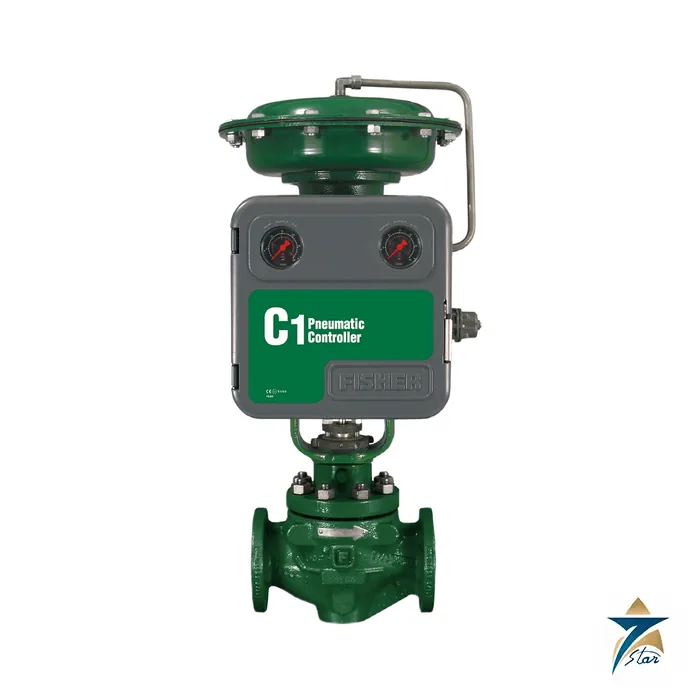
C1 pneumatic controller and transmitter: a low-consumption Fisher pressure instrument
The C1 is Fisher’s pneumatic controller and transmitter for pressure and differential pressure. As a controller it compares sensed process pressure with an operator set point and sends a pneumatic signal to a nearby control element, usually a diaphragm-actuated valve. As a transmitter it senses the process variable and sends a pneumatic signal to an indicator or recorder. The manufacturer positions it as a durable instrument for chemical processing and oil and gas production, with steady-state air or gas consumption reduced to as little as one-tenth of earlier designs.
The same case can be configured as proportional-only, proportional-plus-reset or differential gap, and with Bourdon tube or bellows sensing, so a single C1 designation on a purchase order is not enough; the configuration table in the bulletin has to be completed.
C1 technical specifications
| Parameter |
Specification |
| Manufacturer / part number |
Fisher C1 controllers and transmitters |
| Input |
Gauge, vacuum, compound or differential pressure of a liquid or gas |
| Output (P and P+I) |
0.2 to 1.0 bar (3 to 15 psig) or 0.4 to 2.0 bar (6 to 30 psig) |
| Output (differential gap) |
0 and 1.4 bar (0 and 20 psig) or 0 and 2.4 bar (0 and 35 psig) |
| Action |
Field reversible, direct or reverse, without extra parts |
| Supply medium |
Clean, dry, non-corrosive air or natural gas to ISA 7.0.01 or ISO 8573-1 |
| Steady-state consumption |
0.08 normal m3/hr (3 scfh) for 3 to 15 psig; 0.12 normal m3/hr (4.5 scfh) for 6 to 30 psig |
| Proportional band (P only) |
2% to 100% of sensing range (3 to 15 psig output) or 4% to 100% (6 to 30 psig output) |
| Proportional band (P+reset) |
3% to 100% or 6% to 100% respectively |
| Reset |
0.01 to 74 minutes per repeat |
| Differential gap |
15% to 100% of sensing element range |
| Transmitter span |
6% to 100% of sensing element range, with continuous zero adjustment |
| Repeatability |
0.5% of sensing element range |
| Dead band |
0.1% of sensing element range (not for differential gap) |
| Ambient limits |
Standard -40 to 71°C; high temperature construction -18 to 104°C (0 to 220°F) |
| Housing |
NEMA 3, IEC 529 IP54 |
| Connections |
Supply and output 1/4 NPT internal |
| Weight |
8.2 kg (18 lb) |
The bulletin lists ATEX Group II Category 2 gas and dust marking (Ex h IIC / IIIC; gas T4, T5, T6) and conformity with the Customs Union technical regulation for equipment of that category. Note that anti-reset windup and process pressure gauge options are available only in standard construction.
Sensing elements and pressure ranges for the C1
Bourdon tubes in 316 stainless steel cover 0 to 2.0 bar (0 to 30 psig) up to 0 to 700 bar (0 to 10,000 psig), with stated maximum static limits at each range and higher limits with an optional travel stop. Bellows elements cover low-pressure and vacuum duty: 0 to 150 mbar (0 to 60 in. wc), 0 to 340 mbar vacuum, 0 to 1.0 bar vacuum, compound ranges such as -1 to 1 bar, and positive ranges up to the higher psig steps, in brass or stainless construction. Differential pressure is handled by a bellows element. NACE-compliant materials are available for sour service; the bulletin refers to NACE MR0175 / ISO 15156 and NACE MR0103, with possible environmental restrictions.
How the C1 operates
Process pressure acts on the Bourdon tube or bellows, moving a flapper toward or away from a nozzle. Nozzle pressure drives a relay with a large and a small diaphragm, whose area ratio converts small nozzle pressure changes into much larger output changes. Feedback bellows set the proportional band, and a reset bellows adds integral action. Direct or reverse action is changed by moving the reversing block to the opposite side of the flapper, inverting the proportional band assembly and swapping the feedback bellows tubing, all with no additional parts. A spring-out cleaning wire clears the relay orifice without taking the controller out of service. Settings are made with dial knobs.
Where the C1 fits among Fisher pneumatic controllers
The C1 is a successor-generation option to older pressure controllers such as the 4195K for gas and oil production applications that must meet low-emission rules. Its steady-state consumption is stated to be under the 6 scfh limit used in the US EPA oil and gas rule. It can be yoke-mounted on a control valve actuator, or mounted on a panel, wall or pipestand. Output feeds a valve actuator, or a positioner bellows when finer positioning is required. For level duty the Fisher L2 and 2500 level controllers are the equivalents; where electronic signals and diagnostics are needed, a FIELDVUE positioner and a separate pressure transmitter would be used instead.
C1 selection and ordering checklist
- Duty: controller or transmitter, and mode (proportional, proportional-plus-reset, differential gap).
- Sensing element: Bourdon tube for high pressure; bellows for vacuum, low pressure or differential pressure.
- Range and maximum static pressure, with or without a travel stop.
- Output signal and supply pressure available.
- Wetted material: standard, stainless bellows or NACE-compliant for sour service.
- Standard or high temperature construction against site ambient.
- Options: anti-reset windup, gauges, mounting hardware, hazardous area marking.
Installation, setup and maintenance
Mount the case where the dials can be read, keep supply clean and dry with a filter regulator, and pipe a supply gauge and output gauge for commissioning. For direct valve mounting, use yoke mounting hardware for the actuator. Maintenance is mainly cleaning the relay orifice with the cleaning wire, replacing relay diaphragms, and checking for supply contamination. Because ambient temperature affects the output (about ±3% of span per 28°C change for proportional control), calibrate at working temperature if accuracy matters.
Typical C1 applications in Oman and the GCC
Typical Gulf uses include wellhead and flowline pressure control, separator pressure, fuel gas skid control, gas dehydration and compressor suction or discharge pressure at remote stations without power. The high temperature construction, rated to 104°C, is worth considering for sun-exposed or hot-line installations. Where natural gas is the supply medium, the output vent must be routed safely.
C1 configuration summary
| Item |
Choices |
| Controller |
Proportional only; proportional plus reset; differential gap |
| Transmitter |
Pressure or differential pressure, pneumatic output |
| Sensing |
Bourdon tube or bellows (brass or stainless) |
| Options |
Anti-reset windup, process gauge, travel stop, NACE materials |
Information to send with a C1 enquiry
- Controller or transmitter, with mode and action.
- Process fluid, pressure range and maximum pressure.
- Output range, supply pressure and supply medium.
- Sour service or special material requirement.
- Mounting style and site ambient temperature.
- Quantity and destination.
Documents and quotation for the C1
A manufacturer product bulletin for the C1 is attached on this page. Seven Star LLC is an independent supplier in Muscat.
Send the C1 configuration and range and we will confirm availability and quote.


























Reviews
There are no reviews yet.