- Automation & ControlView all 3,073 products
- Automation Accessories
- AC Drives
- PLC & I/O Cards
- Industrial Communications
- Vibration Monitoring
- Isolator & Barrier
- Controllers & Data Acquisition
- Safety Switches & Guard Locking
- Motor Soft Starters
- Encoders
- CCTV & Security
- Pneumatic Cylinders
- HMI Displays
- Servo Drives
- Industrial Computers
- Machine Vision
- Automation Software
- Robotics
Brand: Thorlabs
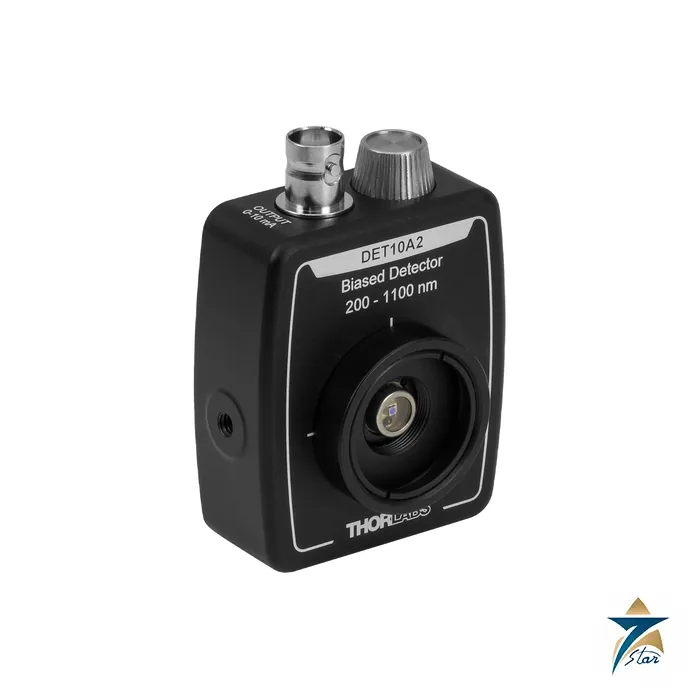
Thorlabs DET10A2 Si Biased Detector, 200-1100 nm, 1 ns Rise Time
Description
Overview
The Thorlabs DET10A2 is a battery-biased silicon photodetector designed for fast detection of light from the deep ultraviolet at 200 nm to the near infrared at 1100 nm. Inside a rugged aluminium housing it combines a high-speed silicon photodiode with a 1.0 mm diameter (0.8 mm squared) active area and an internal 12 V bias battery. With a typical rise time of 1 ns into a 50 ohm load and a junction capacitance of only 6 pF, the detector resolves nanosecond optical pulses and high-frequency modulation that would be smoothed out by slower amplified detectors. Because there is no amplifier, the output is a clean photocurrent that the user converts to voltage with a terminating resistor of choice.
Seven Star LLC supplies the Thorlabs DET10A2 to laser laboratories, university physics and engineering departments, telecom test benches and industrial photonics users across Oman and the GCC. Our Muscat team helps customers select terminators, cables and mounts, and can propose the right detector when bandwidth, active area or wavelength requirements differ.
Measurement Principle
A junction photodiode behaves like a current source in parallel with a diode and a small capacitance. Light absorbed in the depleted region generates electron-hole pairs that are swept out as photocurrent. In the Thorlabs DET10A2 the photodiode is operated in photoconductive mode with a 10 V reverse bias from the internal battery. The bias widens the depletion region, which lowers the junction capacitance and reduces carrier transit time, so the detector responds much faster than in unbiased photovoltaic mode. The trade-off is a small dark current, specified at 0.3 nA typical and 2.5 nA maximum into a 1 megohm load.
The photocurrent equals the incident optical power multiplied by the responsivity, which for this detector peaks at about 0.44 A/W at 730 nm. To read it as a voltage, the BNC output is terminated with a load resistor: the output voltage is the photocurrent times the load resistance. A 50 ohm load gives the fastest response, while larger loads give more voltage per watt but reduce bandwidth because the load and the detector capacitance form an RC low-pass filter. The user manual explains how to choose the resistor and how to estimate bandwidth for a given load.
Engineering Design of the Thorlabs DET10A2
The Thorlabs DET10A2 housing measures 70.9 by 49.8 by 22.5 mm and weighs about 0.10 kg. The photodiode sits just 2.2 mm behind the front of the housing, and an SM1 threaded front with an included SM1T1 coupler and SM1RR retaining ring accepts lens tubes, filters and fibre adapters. Mounting holes accept both 8-32 and M4 threads, so the detector fits imperial or metric posts, and the housing is compatible with Thorlabs cage system components.
On the housing are a slide power switch and a momentary battery check pushbutton. The bias battery is a standard A23 12 VDC cell of 40 mAh, easy to replace and widely available. Thorlabs warns that a low battery voltage results in slower rise times and reduced bandwidth, so checking the battery is part of good practice before critical measurements. The DC-coupled BNC output delivers 0 to 10 mA. Operating temperature is 10 to 50 degrees Celsius and storage temperature is minus 20 to 70 degrees Celsius.
Key Features
The Thorlabs DET10A2 user manual lists these characteristics.
- Silicon detector with a 1.0 mm diameter (0.8 mm squared) active area.
- Wide wavelength range of 200 to 1100 nm, including the ultraviolet.
- Rise time of 1 ns typical with a 10 V bias into a 50 ohm load.
- Junction capacitance of 6 pF typical and noise equivalent power of 5.0 times 10 to the power minus 14 W per root hertz.
- Low dark current of 0.3 nA typical and 2.5 nA maximum.
- Internal 12 V A23 bias battery with momentary battery check button.
- DC-coupled BNC output of 0 to 10 mA for flexible termination.
- SM1 threaded housing with universal 8-32 / M4 mounting holes and cage compatibility.
Industrial Applications
Fast biased detectors are standard tools wherever optical signals change quickly. In GCC university laboratories the Thorlabs DET10A2 is used to observe Q-switched and mode-locked laser pulses, to measure modulation of laser diodes, to time optical events in pump-probe and time-of-flight experiments and to monitor beams in UV photochemistry setups. Its battery bias makes it portable and free of power supply noise, which helps on crowded optical tables.
In industry, the Thorlabs DET10A2 supports laser process monitoring in marking, welding and cutting equipment, optical component testing in fibre and telecom workshops, and development of optical sensors for gas detection and environmental monitoring. Seven Star LLC supplies the detector with terminators, BNC cables and mounting hardware, and our Muscat engineers help laboratories in Oman and the GCC choose between fast biased detectors and amplified detectors for each measurement.
Choosing Between Biased and Amplified Detectors
As general engineering guidance, a biased detector such as the Thorlabs DET10A2 is the better choice when speed matters most and the optical signal is strong enough to produce a useful voltage across a low value load. An amplified detector adds a transimpedance stage that multiplies sensitivity but limits bandwidth as gain increases. Many laboratories therefore keep both types: the Thorlabs DET10A2 for nanosecond pulses and fast modulation, and an amplified model for weak or slowly varying light. Its small active area also makes it well suited to focused beams and fibre-coupled light, where a large detector would only add capacitance.
Technical Specifications
The Thorlabs DET10A2 data below is taken from the Thorlabs user manual (TTN133878-D02), measured at 25 degrees Celsius unless noted.
| Parameter | Specification |
|---|---|
| Model | Thorlabs DET10A2 |
| Detector | Silicon (Si) photodiode |
| Active area | Ø1.0 mm (0.8 mm²) |
| Wavelength range | 200 to 1100 nm |
| Peak wavelength / response | 730 nm / 0.44 A/W (typ.) |
| Rise time | 1 ns (typ.), 50 Ω load, 10 V bias |
| Junction capacitance | 6 pF (typ.) |
| NEP at peak | 5.0 × 10⁻¹⁴ W/√Hz (typ.) |
| Bias voltage | 10 V |
| Dark current | 0.3 nA typ., 2.5 nA max. (1 MΩ load) |
| Output | BNC, DC coupled, 0 to 10 mA |
| Battery | A23, 12 VDC, 40 mAh |
| Package size | 70.9 × 49.8 × 22.5 mm |
| Weight | 0.10 kg |
| Operating / storage temperature | 10 to 50 °C / –20 to 70 °C |
| Accessories | SM1T1 coupler, SM1RR retaining ring |
How to Order
To request a quotation for the Thorlabs DET10A2, contact Seven Star LLC with the quantity and any terminators, cables or mounts required. Our Muscat instrumentation division confirms availability, provides the Thorlabs user manual and supports research and industrial laboratories in Oman and the GCC. Related Thorlabs products include the Thorlabs PDA200C photodiode amplifier, the Thorlabs PM400 touchscreen power meter console and the Thorlabs PM100USB power meter interface.
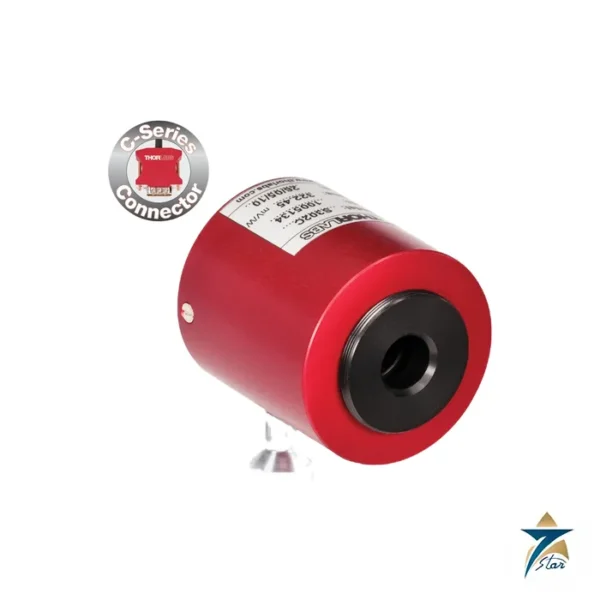
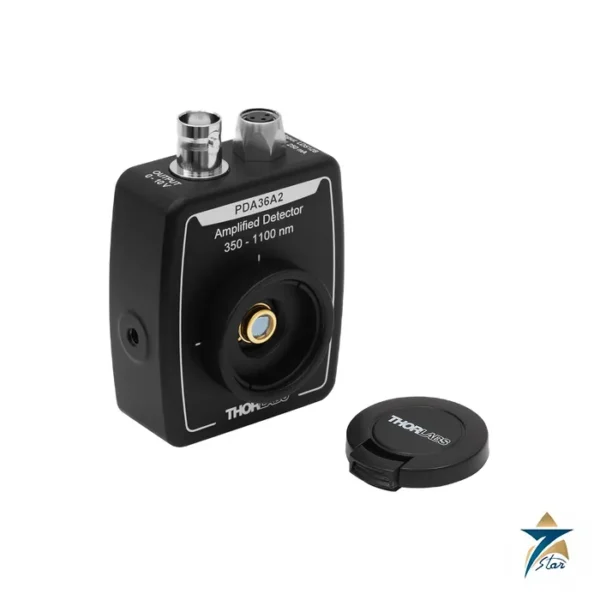
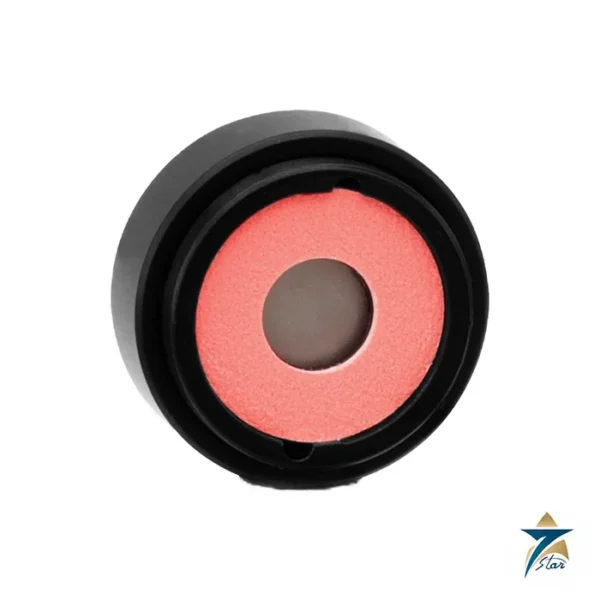
See also: Thorlabs S302C Thermal Power Sensor Head, 0.19-25 µm, 2 W; Thorlabs PDA36A2 Si Switchable Gain Amplified Detector, 350-1100 nm; Thorlabs S120C Compact Photodiode Power Sensor, Si, 400-1100 nm.
Datasheets & Documents
- Instruction Manual Thorlabs DET10A2 Si Biased Detector User Manual (TTN133878-D02) Download
Reviews (0)
How would you rate this product? Cancel reply
About brand
Thorlabs is the American maker of photonics equipment: optics and optomechanics, light sources and lasers, photodetectors, power meters, motion control, laser diode and temperature controllers. Alex Cable founded the company in 1989 in Newton, New Jersey, where it is still headquartered, and it remains privately held with manufacturing in the USA, Europe and Asia.
Seven Star LLC sources and supplies Thorlabs benchtop electronics and optical power meters for universities, research centers and industrial laboratories in Oman, quoting by the manufacturer's item number.
Thorlabs company profile
| Founded | 1989, Newton, New Jersey, USA |
|---|---|
| Founder | Alex Cable |
| Headquarters | Newton, New Jersey, USA |
| Ownership | Privately held |
| Product families | Optical power meters and sensors, photodetectors, K-Cube and T-Cube controllers, piezo and stepper motion control, laser diode and TEC controllers, optics, optomechanics and breadboards |
Thorlabs instruments listed here
The listed items fall into four groups. Thorlabs power meter consoles: the handheld PM100D, the touchscreen PM400 and the PM100USB interface, all of which read the manufacturer's photodiode, thermal and pyroelectric sensor heads. Laser diode control: the LDC205C current driver, the TED200C thermoelectric temperature controller, the combined ITC4001 laser diode and TEC controller, and the compact CLD1015 driver and TEC controller with a mount for butterfly-packaged lasers. Motion control: the BPC303 three-channel benchtop piezo controller, the MDT693B three-channel open-loop piezo controller and the KDC101 K-Cube brushed DC servo controller. Detection: the PDA200C photodiode amplifier.
Where Thorlabs equipment is used
Typical users are university physics and engineering departments, fiber-optic and telecom test benches, laser development groups, spectroscopy and sensing laboratories, and production lines that align or test optical assemblies. Buyers in the GCC usually need a specific item number that is named in a setup description or a published method.
Thorlabs products we list
Ordering Thorlabs items: what we need
Thorlabs item numbers are exact, so PM100D, PM400 and PM100USB are different products, and a console is normally ordered with a separately numbered sensor. Send the item numbers and quantities. For a power meter, add the wavelength, the power or energy range and the beam size, so the sensor can be checked. For laser diode drivers, give the diode pin configuration, the operating current and the TEC current. For motion controllers, name the actuator or stage to be driven. Mention the mains voltage and plug type you need.
Facts checked against Thorlabs' published company profile, October 2026.
Browse Thorlabs products by category: Controllers & Data Acquisition, Portable Test & Measurement, Sensors & Transmitters.
FAQ
Questions about the Thorlabs DET10A2 Si Biased Detector, 200-1100 nm, 1
Answers from our engineering team on installation, compatibility and integration.
01What is the Thorlabs DET10A2 designed for?
The Thorlabs DET10A2 is a biased silicon detector for fast optical signals from 200 to 1100 nm. With a 1 ns typical rise time into 50 ohm, it suits pulsed laser monitoring, modulation measurements and timing work where an amplified detector would be too slow.
02How is the Thorlabs DET10A2 powered?
An internal 12 V A23 battery provides the 10 V reverse bias for the photodiode, so no external supply is needed. A momentary battery check pushbutton lets the user confirm the battery is healthy, since a low battery slows the rise time and reduces bandwidth.
03What output does the Thorlabs DET10A2 provide?
The output is a DC-coupled photocurrent on a BNC connector, from 0 to 10 mA. A terminating resistor converts it to voltage; Thorlabs offers a 50 ohm terminator for best frequency response and a variable terminator for higher voltage at lower bandwidth.
04Can the Thorlabs DET10A2 measure UV light?
Yes, its wavelength range starts at 200 nm. Thorlabs notes that long-term UV exposure may degrade specifications, for example reducing UV response and increasing dark current, depending on irradiation level, intensity and usage time.
05Does Seven Star LLC supply the Thorlabs DET10A2 in Oman?
Yes. Seven Star LLC supplies the Thorlabs DET10A2, spare A23 batteries, terminators and mounting accessories to research and industrial laboratories in Oman and the GCC, with support from our Muscat office.


Reviews
There are no reviews yet.