
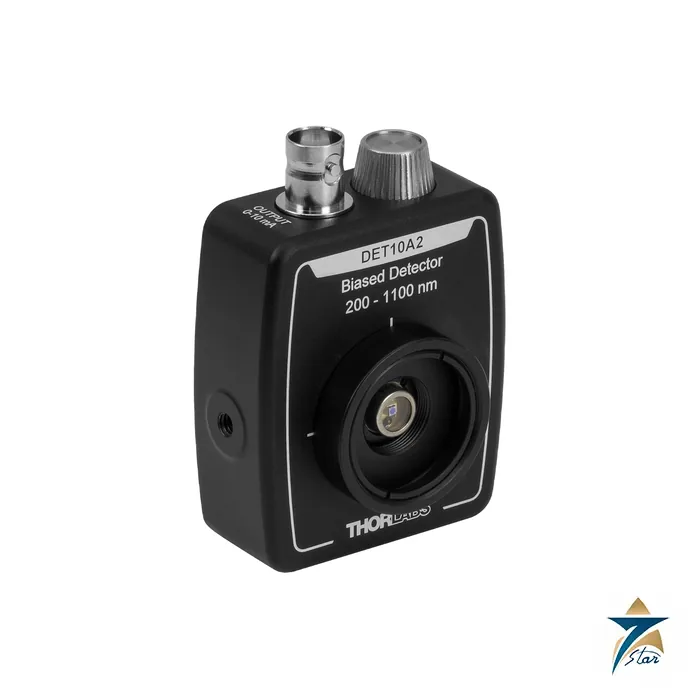
The Thorlabs DET10A2 is a battery-biased silicon photodetector designed for fast detection of light from the deep ultraviolet at 200 nm to the near infrared at 1100 nm. Inside a rugged aluminium housing it combines a high-speed silicon photodiode with a 1.0 mm diameter (0.8 mm squared) active area and an internal 12 V bias battery. With a typical rise time of 1 ns into a 50 ohm load and a junction capacitance of only 6 pF, the detector resolves nanosecond optical pulses and high-frequency modulation that would be smoothed out by slower amplified detectors. Because there is no amplifier, the output is a clean photocurrent that the user converts to voltage with a terminating resistor of choice.
Seven Star LLC supplies the Thorlabs DET10A2 to laser laboratories, university physics and engineering departments, telecom test benches and industrial photonics users across Oman and the GCC. Our Muscat team helps customers select terminators, cables and mounts, and can propose the right detector when bandwidth, active area or wavelength requirements differ.
A junction photodiode behaves like a current source in parallel with a diode and a small capacitance. Light absorbed in the depleted region generates electron-hole pairs that are swept out as photocurrent. In the Thorlabs DET10A2 the photodiode is operated in photoconductive mode with a 10 V reverse bias from the internal battery. The bias widens the depletion region, which lowers the junction capacitance and reduces carrier transit time, so the detector responds much faster than in unbiased photovoltaic mode. The trade-off is a small dark current, specified at 0.3 nA typical and 2.5 nA maximum into a 1 megohm load.
The photocurrent equals the incident optical power multiplied by the responsivity, which for this detector peaks at about 0.44 A/W at 730 nm. To read it as a voltage, the BNC output is terminated with a load resistor: the output voltage is the photocurrent times the load resistance. A 50 ohm load gives the fastest response, while larger loads give more voltage per watt but reduce bandwidth because the load and the detector capacitance form an RC low-pass filter. The user manual explains how to choose the resistor and how to estimate bandwidth for a given load.
The Thorlabs DET10A2 housing measures 70.9 by 49.8 by 22.5 mm and weighs about 0.10 kg. The photodiode sits just 2.2 mm behind the front of the housing, and an SM1 threaded front with an included SM1T1 coupler and SM1RR retaining ring accepts lens tubes, filters and fibre adapters. Mounting holes accept both 8-32 and M4 threads, so the detector fits imperial or metric posts, and the housing is compatible with Thorlabs cage system components.
On the housing are a slide power switch and a momentary battery check pushbutton. The bias battery is a standard A23 12 VDC cell of 40 mAh, easy to replace and widely available. Thorlabs warns that a low battery voltage results in slower rise times and reduced bandwidth, so checking the battery is part of good practice before critical measurements. The DC-coupled BNC output delivers 0 to 10 mA. Operating temperature is 10 to 50 degrees Celsius and storage temperature is minus 20 to 70 degrees Celsius.
The Thorlabs DET10A2 user manual lists these characteristics.
Fast biased detectors are standard tools wherever optical signals change quickly. In GCC university laboratories the Thorlabs DET10A2 is used to observe Q-switched and mode-locked laser pulses, to measure modulation of laser diodes, to time optical events in pump-probe and time-of-flight experiments and to monitor beams in UV photochemistry setups. Its battery bias makes it portable and free of power supply noise, which helps on crowded optical tables.
In industry, the Thorlabs DET10A2 supports laser process monitoring in marking, welding and cutting equipment, optical component testing in fibre and telecom workshops, and development of optical sensors for gas detection and environmental monitoring. Seven Star LLC supplies the detector with terminators, BNC cables and mounting hardware, and our Muscat engineers help laboratories in Oman and the GCC choose between fast biased detectors and amplified detectors for each measurement.
As general engineering guidance, a biased detector such as the Thorlabs DET10A2 is the better choice when speed matters most and the optical signal is strong enough to produce a useful voltage across a low value load. An amplified detector adds a transimpedance stage that multiplies sensitivity but limits bandwidth as gain increases. Many laboratories therefore keep both types: the Thorlabs DET10A2 for nanosecond pulses and fast modulation, and an amplified model for weak or slowly varying light. Its small active area also makes it well suited to focused beams and fibre-coupled light, where a large detector would only add capacitance.
The Thorlabs DET10A2 data below is taken from the Thorlabs user manual (TTN133878-D02), measured at 25 degrees Celsius unless noted.
| Parameter | Specification |
|---|---|
| Model | Thorlabs DET10A2 |
| Detector | Silicon (Si) photodiode |
| Active area | Ø1.0 mm (0.8 mm²) |
| Wavelength range | 200 to 1100 nm |
| Peak wavelength / response | 730 nm / 0.44 A/W (typ.) |
| Rise time | 1 ns (typ.), 50 Ω load, 10 V bias |
| Junction capacitance | 6 pF (typ.) |
| NEP at peak | 5.0 × 10⁻¹⁴ W/√Hz (typ.) |
| Bias voltage | 10 V |
| Dark current | 0.3 nA typ., 2.5 nA max. (1 MΩ load) |
| Output | BNC, DC coupled, 0 to 10 mA |
| Battery | A23, 12 VDC, 40 mAh |
| Package size | 70.9 × 49.8 × 22.5 mm |
| Weight | 0.10 kg |
| Operating / storage temperature | 10 to 50 °C / –20 to 70 °C |
| Accessories | SM1T1 coupler, SM1RR retaining ring |
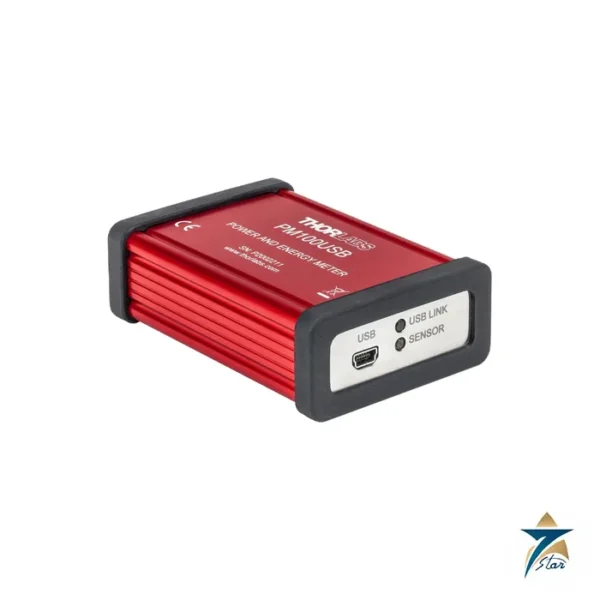
To request a quotation for the Thorlabs DET10A2, contact Seven Star LLC with the quantity and any terminators, cables or mounts required. Our Muscat instrumentation division confirms availability, provides the Thorlabs user manual and supports research and industrial laboratories in Oman and the GCC. Related Thorlabs products include the Thorlabs PDA200C photodiode amplifier, the Thorlabs PM400 touchscreen power meter console and the Thorlabs PM100USB power meter interface.
Browse Thorlabs products by category: Controllers & Data Acquisition, Portable Test & Measurement, Sensors & Transmitters.
Choose the option that best fits your needs to get the fastest response from our team.
Automatically fill the RFQ form with this product's details for a faster process.
Manually enter multiple part numbers, specific brands, or custom requirements.












Reviews
There are no reviews yet.