R9F12106: Resi9 1P 6 A C-curve miniature circuit breaker
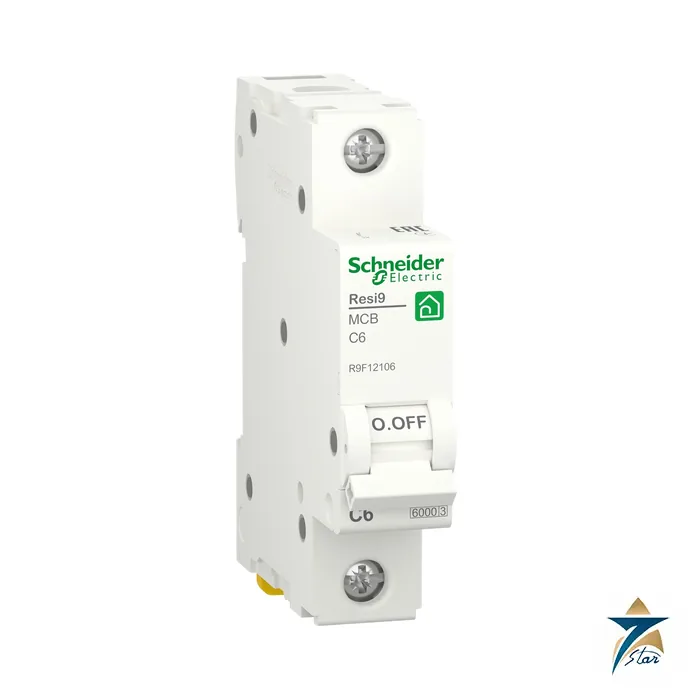
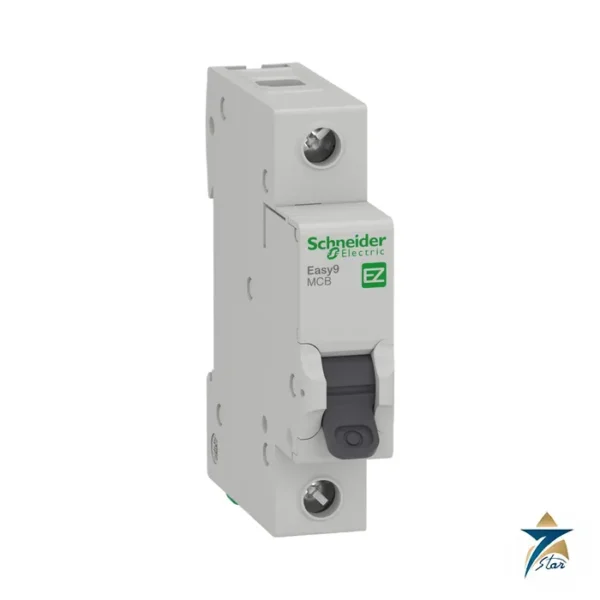
The R9F12106 is a Schneider Electric Resi9 miniature circuit breaker (single-pole, 6 A, C curve) with thermal-magnetic tripping and a 6000 A breaking capacity at 230 V AC. It clips onto a DIN rail, carries ON/OFF indication on the toggle and is finished in white (RAL 9003), the colour that distinguishes the Resi9 range from the grey Easy9 range. Seven Star LLC supplies the R9F12106 in Oman and the GCC as an independent supplier based in Muscat.
Reading the reference: across the references in this lane the digit after R9F12 follows the pole count and the last two digits follow the rated current, so R9F12106 reads as 1P and 6 A. This is our reading of the pattern and the product title, not a published ordering table, so always confirm the full reference. With one protected pole it breaks the phase conductor only and is intended for a single-phase branch where the neutral runs separately. The datasheet quotes 230 V AC as the operating voltage.
Technical specifications of the R9F12106
| Parameter |
Specification |
| Manufacturer / part number |
Schneider Electric / R9F12106 |
| Range / product name |
Resi9 / Resi9 MCB |
| Product type |
Miniature circuit-breaker |
| Device application |
Protection |
| Poles / protected poles |
1P / 1 |
| Rated current [In] |
6 A |
| Network type / frequency |
AC / 50/60 Hz |
| Trip unit |
Thermal-magnetic |
| Curve code |
C |
| Magnetic tripping limit |
5–10 × In (calculated 30–60 A) |
| Rated operational voltage [Ue] |
230 V AC |
| Breaking capacity |
6000 A Icn at 230 V AC 50/60 Hz |
| Limitation class |
3 |
| Rated insulation voltage [Ui] |
440 V AC |
| Rated impulse withstand [Uimp] |
4 kV |
| Overvoltage category |
III |
| Control / signalling |
Toggle; ON/OFF indication |
| Mounting |
Clip-on, DIN rail |
| Width |
18 mm (2 × 9 mm pitches) |
| Height / depth / embedding depth |
81 mm / 72 mm / 44 mm |
| Net weight |
120 g |
| Colour |
White (RAL 9003) |
| Terminals |
1–25 mm² – rigid; 1–16 mm² – flexible with ferrule; 1–16 mm² – flexible |
| Wire stripping length |
14 mm |
| Tightening torque |
2 N.m |
| Mechanical durability |
20000 cycles |
| Electrical durability |
10000 cycles |
| Standard |
EN/IEC 60898-1 |
| Quality label |
EAC |
| Degree of protection |
IP20 |
| Pollution degree / tropicalisation |
2 / 2 (IEC 60068-1) |
| Ambient temperature |
Operation -25 to 60 °C; storage -40 to 60 °C |
| Relative humidity |
95 % at 55 °C |
| Packing |
1 piece, 93 g; carton of 12 |
| Warranty |
18 months |
Trip behaviour of the R9F12106 at 6 A
The datasheet gives a magnetic tripping limit of 5 to 10 times In. At 6 A that corresponds to roughly 30 A to 60 A, the window in which the instantaneous element is expected to act on a short circuit. Smaller overloads are left to the thermal element, which takes longer to react the closer the current is to the rating. The C characteristic is the usual compromise for residential and light commercial wiring: it allows the short inrush of lamp drivers, small transformers and motors, yet it still reacts faster than a D curve to a real fault.
This unit is best matched to lighting circuits, doorbell and control supplies, and low-power equipment feeders. The conductor must be chosen first from the load, installation method and ambient temperature; the breaker is then picked to protect that conductor, not the other way round. The full time-current curve is part of the manufacturer’s published characteristics and is not reproduced here.
Dimensions, terminals and wiring of the R9F12106
The R9F12106 measures 18 mm wide by 81 mm high and 72 mm deep, with an embedding depth of 44 mm, and weighs 120 g net. That is 2 modules of 9 mm, so it occupies 1 standard pole width of 18 mm on the rail. Terminals are tunnel type at the top and bottom and accept 1–25 mm² – rigid; 1–16 mm² – flexible with ferrule; 1–16 mm² – flexible. Strip conductors to 14 mm and tighten to 2 N.m.
At 18 mm this is the slimmest device in the lane, the choice when many single-phase circuits have to share one small consumer unit.
Fault level, insulation and limitation class of the R9F12106
The listed breaking capacity is 6000 A Icn at 230 V AC 50/60 Hz, with a rated operational voltage of 230 V AC. The insulation voltage Ui is 440 V AC and the impulse withstand Uimp is 4 kV, with overvoltage category III. The limitation class is 3, the highest class defined in the product standard, which means the breaker restricts the let-through energy of a fault more strongly than a class 1 or 2 device.
The datasheet does not publish a separate service breaking capacity line for this reference, so the 6000 A figure is the number to compare with the prospective short-circuit current at the board. In small residential and commercial supplies this is normally comfortable, but a board close to a large transformer or a long way upstream of a smaller one can see very different values, and the calculation belongs to the installer. Confirm that the network type and voltage on site match the 230 V AC line before ordering.
Selection checklist for the R9F12106
- Conductor: size the cable for the load and the installation method, then check that 6 A protects it.
- Poles: 1P suits a phase-only single-phase branch.
- Voltage: the datasheet lists 230 V AC; make sure it fits the supply.
- Fault level: compare 6000 A Icn at 230 V AC 50/60 Hz with the prospective short-circuit current.
- Load: C curve for moderate inrush; very high inrush needs a different characteristic.
- Space: 2 modules, 18 mm of rail.
Where the R9F12106 sits among Resi9 references
The table compares nearby Resi9 C-curve references with the same 6000 A class. Pole count drives width and voltage, while the amp rating changes the magnetic trip band and sometimes the terminal size.
| Part number |
Poles |
Rated current |
Width |
Rated voltage |
Net weight |
| R9F12106 (this page) |
1P |
6 A |
18 mm |
230 V AC |
120 g |
| R9F12110 |
1P |
10 A |
18 mm |
230 V AC |
120 g |
| R9F12116 |
1P |
16 A |
18 mm |
230 V AC |
120 g |
| R9F12120 |
1P |
20 A |
18 mm |
230 V AC |
120 g |
| R9F12125 |
1P |
25 A |
18 mm |
230 V AC |
120 g |
| R9F12132 |
1P |
32 A |
18 mm |
230 V AC |
120 g |
| R9F12140 |
1P |
40 A |
18 mm |
230 V AC |
120 g |
Information to send with an RFQ for the R9F12106
- Exact reference R9F12106 and the quantity needed.
- Supply voltage, system type and earthing arrangement.
- Prospective short-circuit current at the board, if known.
- Load description and cable size for the circuit.
- Other poles or ratings needed in the same order.
- Delivery location and timeline.
Before ordering, also check that the board enclosure, busbar arrangement and neighbouring breakers leave enough spacing for heat to dissipate, since crowded boards in hot rooms run closer to their limits than the rated ambient suggests.
Keep a record of the installed ratings on the board schedule and note the supply voltage at commissioning, because later extensions and fault investigations depend on knowing exactly what protects each circuit and what the upstream device allows through.
Documents and quotation
The manufacturer datasheet for the R9F12106 is attached on this page and holds the full specification summarised above.
Send us the reference R9F12106, quantity and delivery location and Seven Star LLC will reply to your request. We supply as an independent supplier based in Muscat.




























Reviews
There are no reviews yet.