- Automation & ControlView all 3,088 products
- Automation Accessories

- AC Drives
- PLC & I/O Cards
- Industrial Communications
- Vibration Monitoring
- Isolator & Barrier
- Controllers & Data Acquisition
- Safety Switches & Guard Locking
- Motor Soft Starters
- Encoders
- CCTV & Security
- Pneumatic Cylinders
- HMI Displays
- Servo Drives
- Industrial Computers
- Machine Vision
- Automation Software
- Robotics
Brand: Meinberg
Meinberg LANTIME M3000S Modular 3U Synchronization System
Description
Overview
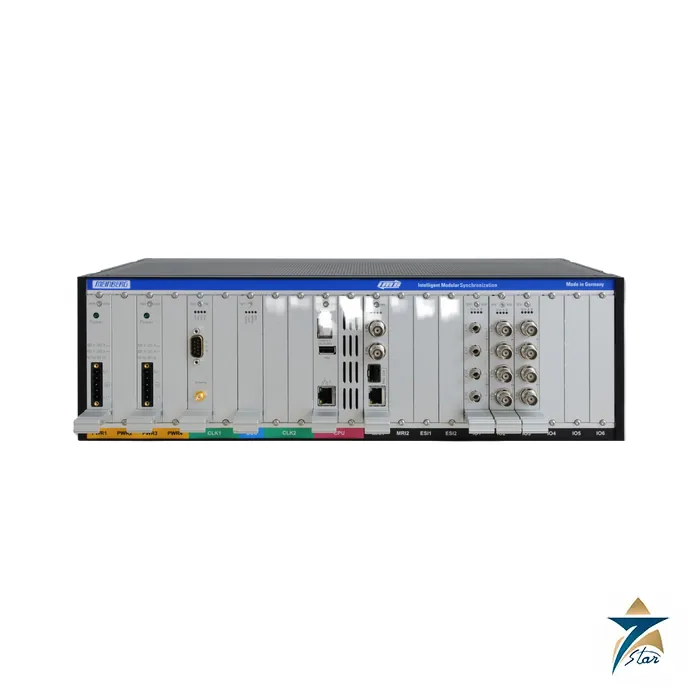
The Meinberg LANTIME M3000S is a modular time and frequency synchronization platform in a three-unit rack chassis. It belongs to the IMS family, short for Intelligent Modular Synchronization, and the S in its name marks the housing variant without a front display and keys, intended for racks that can only be reached from one side. Seven Star LLC is an independent supplier serving Oman and the GCC. This page follows Meinberg’s short datasheet for the M3000S and explains what the chassis holds and where it fits.
What is inside the Meinberg LANTIME M3000S chassis
The chassis provides four power supply slots, two clock module slots, a seamless switchover card slot, a CPU slot and ten slots for input and output modules. Fitting a second clock module together with the RSC switch module turns the system into a fully redundant solution, and up to four power supplies protect against the loss of one or more sources, with wide range AC and DC models mixed freely. Every module is hot pluggable, so a failed card can be replaced or a new capability added with zero downtime for functions that are not affected. The reduced mounting depth lets the unit go into 300 mm ETSI racks as well as 19 inch racks, and into 21 inch racks with an adapter.
Key data of Meinberg LANTIME M3000S
| Item | Value |
|---|---|
| Chassis | 3U rackmount for 19 inch racks; 21 inch with adapter; 300 mm ETSI depth |
| Slots | 4 power supply, 2 clock, 1 seamless switchover, 1 CPU, 10 input/output |
| Reference sources | GPS, GLONASS, Galileo, BeiDou, PZF, PTP/IEEE 1588, NTP, SyncE, IRIG/AFNOR timecodes, PPS, 10 MHz, 2.048 kHz, E1/T1 |
| Pulse output accuracy | better than plus or minus 50 ns with OCXO SQ, HQ or DHQ |
| Frequency synthesizer | 0.125 Hz to 10 MHz via external IMS-BPE modules |
| NTP performance | up to 25,000 requests per second, depending on CPU module |
| PTP | up to 10 PTP (IEEE 1588-2008) modules |
| Additional LAN ports | up to 24 gigabit ports, RJ45 or SFP |
| CPU module | CPU-C05F1 or CPU-C15G2 (Intel Atom, GNU/Linux 4.x) |
| Network security | NTP, SNTP and Network Time Security NTS; symmetric keys MD5, SHA-1, AES-128-CMAC; NTP v4 Autokey |
| Power supplies | AD10 90 to 265 V AC / 90 to 250 V DC; DC20 20 to 60 V DC; DC10 10 to 36 V DC |
| Power consumption | 50 W, maximum 100 W |
Using the Meinberg LANTIME M3000S in Oman and the GCC
Meinberg names financial data centres, electrical substations, telecommunication networks, digital broadcasting infrastructure and air traffic control as typical environments. In the Gulf these map directly onto utilities with IEC 61850 substations, national and private telecom operators, broadcasters, port control systems and data centres. The platform can distribute time over the network by NTP and PTP, supply PPS or 10 MHz to measurement equipment, and generate IRIG time code for protection relays and recorders, so one chassis can serve several departments.
How LANTIME M3000S differs from the M2000S and M3000
The M3000S is the large S variant: a 3U chassis with four power supply slots and ten input and output slots. The M2000S in 2U has three power supply slots and six input and output slots, and allows up to six PTP modules instead of ten. The standard M3000 has the same slot structure as the M3000S but includes the front display with function keys and a deeper chassis, so it needs access from the front of the rack. Choose the S model where on-site configuration at the front panel is not needed, because the web interface and the console utility handle configuration remotely.
Network and management features
The management CPU supports NTP and SNTP versions 2 to 4, HTTP and HTTPS, SSH with SFTP and SCP, Telnet, SNMP v1 to v3, FTP, DHCP and DHCPv6. Up to 99 logical network interfaces are available, each with IPv4 and IPv6 addresses and an optional VLAN identifier. Enterprise features include dual stack operation, IEEE 802.1Q VLAN, LACP bonding and DSCP and 802.1p priority marking. The system supports parallel redundancy under IEC 62439-3 and synchronises IEC 61850-compliant devices. Since LTOS version 7.08 all IMS LANTIME servers offer NTS in unicast client and server mode.
Redundancy strategy for critical sites
Redundancy is a layered topic. At the power level, two supplies fed from independent AC or DC sources keep the chassis alive when one feed fails. At the reference level, two clock modules with different receivers, for example GPS with GLONASS, avoid a single point of failure when a satellite system is degraded or jammed, and the seamless switchover module changes over without a time step. At the network level, PRP lets traffic travel over two separate LANs. And at the application level, clients should be configured with more than one time server so that a fault in one source does not leave them without time. Document which layers your site needs, because each one adds modules, cabling and cost, and compare the plan against the criticality of the services that depend on time.
Planning and commissioning
Specify the reference first: a GNSS receiver module with an antenna on the roof, plus a second reference such as PTP or IRIG for redundancy, is a common design. Then choose the oscillator to suit the holdover needs, the output modules for the devices to be synchronised, and the power supplies to match the site’s AC and DC feeds. Commission by mounting the chassis, connecting the antenna through surge protection, setting the network parameters on the web interface, and checking the status of every reference and output. Record the module list so that spares can be selected later.
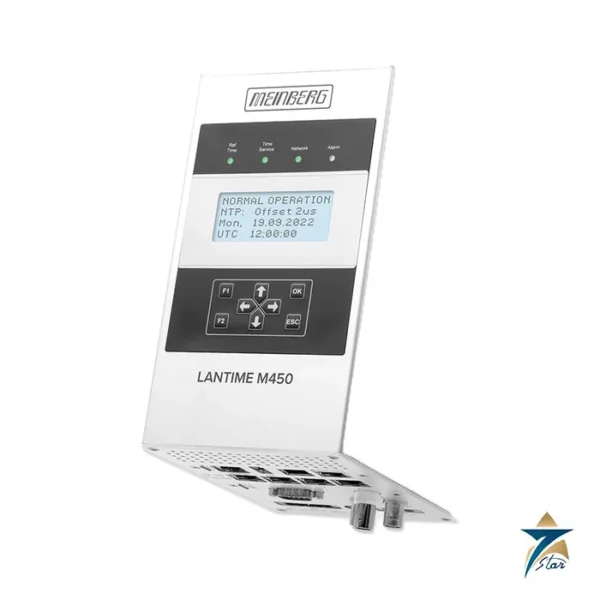
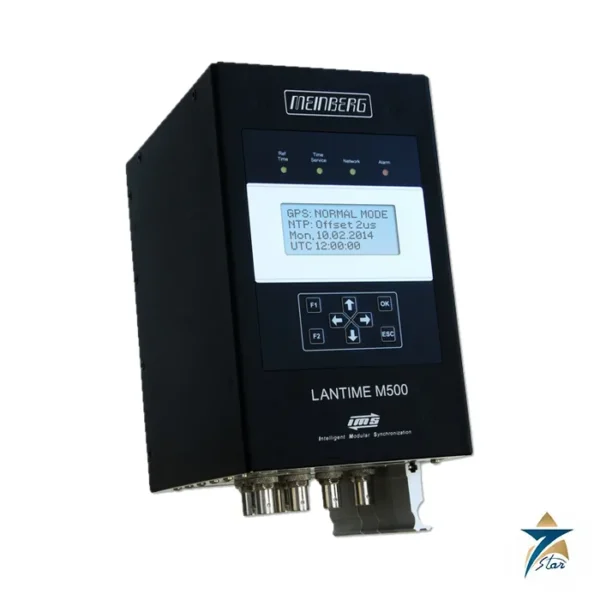
Related items you may also need: Meinberg LANTIME M500 Modular DIN-Rail Time Server | Meinberg LANTIME M150 DIN-Rail NTP Time Server | Meinberg LANTIME M250 Compact NTP Time Server | All Meinberg products.
Before you order the Meinberg LANTIME M3000S
- To avoid a wrong delivery, compare the code on the nameplate of the installed unit with the Meinberg LANTIME M3000S code on this page.
- The quotation for the Meinberg LANTIME M3000S states the confirmed code and the lead time to site.
- The attached manufacturer datasheet covers the Meinberg LANTIME M3000S ratings, dimensions and installation details.
- Delivery of the Meinberg LANTIME M3000S is arranged to project sites in Oman and across the GCC, alongside the rest of our industrial communications range.
- A spare Meinberg LANTIME M3000S on the shelf is a simple way to protect critical service from long lead times.
Documents and quotation
Meinberg’s datasheet for the Meinberg LANTIME M3000S is attached to this page. Because the system is configured from modules, please send your RFQ with the model, the reference receiver, oscillator, power supply types, input and output modules and quantities, together with your delivery location in Oman or the GCC.
Datasheets & Documents
- Datasheet Meinberg LANTIME M3000S Modular 3U Synchronization System Datasheet Download
Reviews (0)
How would you rate this product? Cancel reply
About brand
Meinberg is a German maker of time and frequency synchronisation products, founded in 1979 by the brothers Werner and Günter Meinberg in Bad Pyrmont. It began with DCF77 longwave radio clock receivers and now makes GPS and GNSS-referenced NTP and PTP time servers. Meinberg is family-owned and designs and manufactures its products in Bad Pyrmont.
Seven Star LLC sources and supplies Meinberg LANTIME time servers for utilities and networks in Oman, including the M1000 and M320 listed here.
Meinberg company profile
| Founded | 1979, Bad Pyrmont, Germany |
|---|---|
| Founders | Werner and Günter Meinberg |
| Ownership | Family-owned |
| Manufacturing | Bad Pyrmont, Germany |
| Product families | LANTIME M150, M250, M320, M500 and M1000 NTP/PTP time servers, IMS modular systems, GNSS and DCF77 receivers, PTP grandmaster clocks |
Meinberg LANTIME models listed here
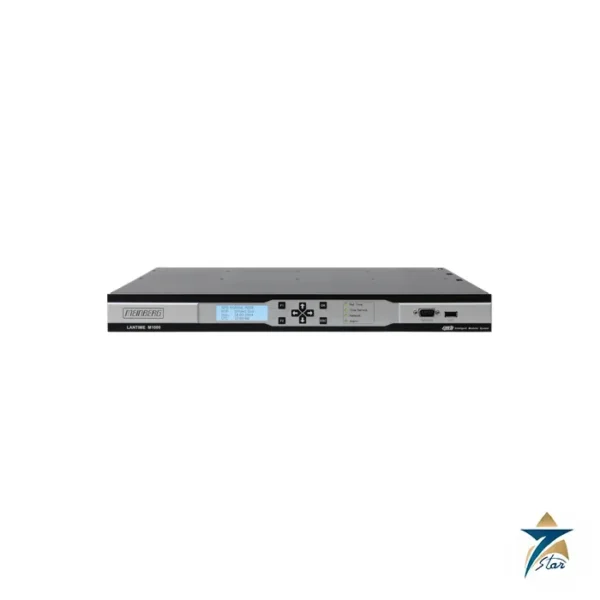
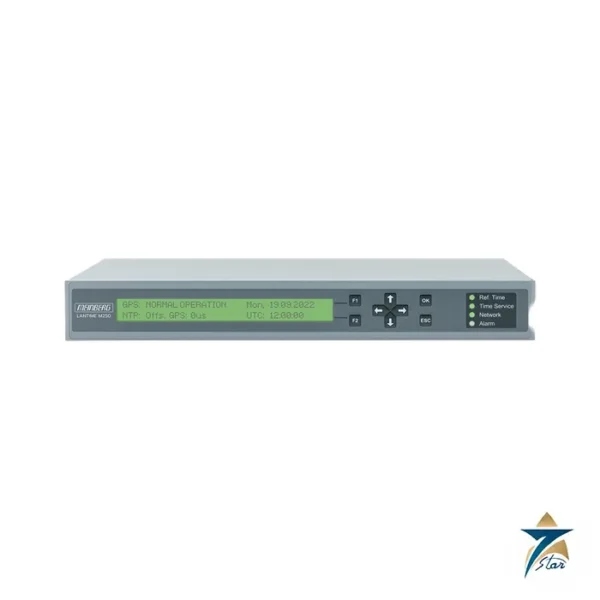
The LANTIME M320 is a 1U rackmount NTP time server. It works as a stratum 1 source with its own reference receiver, and Meinberg offers it with GPS, combined GNSS, DCF77 (PZF), MSF and IRIG time code references. The LANTIME M1000 is a 1U platform on the modular IMS system, with slots for up to two reference clocks, two power supplies and hot-pluggable I/O modules, plus PTP (IEEE 1588) and IEC 61850 time synchronization.
Meinberg products we list
Ordering a Meinberg time server: what we need
A Meinberg order code describes the build. In M320/GPS/AD10, GPS is the receiver and AD10 is the wide-range AC/DC power supply. Send the full code or serial number, the reference source, oscillator option, supply voltage, the outputs you need (PPS, 10 MHz, IRIG, extra LAN ports) and the antenna cable length. GCC utility projects often require redundant supplies.
Facts checked against Meinberg's own company history (meinbergglobal.com), October 2026.
Browse Meinberg products by category: Industrial Communications.
FAQ
Questions about the Meinberg LANTIME M3000S Modular 3U Synchronization
Answers from our engineering team on installation, compatibility and integration.
01How many modules can the Meinberg LANTIME M3000S hold?
The chassis has four power supply slots, two clock module slots, one seamless switchover slot, one CPU slot and ten slots for input and output modules.
02What is the difference between the LANTIME M3000S and the M3000?
The S variant has no front display with function keys and a reduced depth that fits 300 mm ETSI racks, so it can be installed in racks accessible from one side only.
03Can the M3000S be made redundant?
Yes. Adding a second clock module and the RSC switch module gives a fully redundant solution, and up to four power supplies can be fitted.
04How many NTP requests can the LANTIME M3000S serve?
Up to 25,000 NTP requests per second, depending on the installed CPU module.
05Does the LANTIME M3000S support Network Time Security?
Yes. As of LTOS version 7.08, the IMS LANTIME time servers support NTS in unicast client and server mode.


Reviews
There are no reviews yet.