- Automation & ControlView all 3,063 products
- Automation Accessories
- AC Drives
- PLC & I/O Cards
- Industrial Communications
- Vibration Monitoring
- Isolator & Barrier
- Controllers & Data Acquisition
- Safety Switches & Guard Locking
- Motor Soft Starters
- Encoders
- CCTV & Security
- Pneumatic Cylinders
- HMI Displays
- Servo Drives
- Industrial Computers
- Machine Vision
- Automation Software
- Robotics
Brand: Meinberg
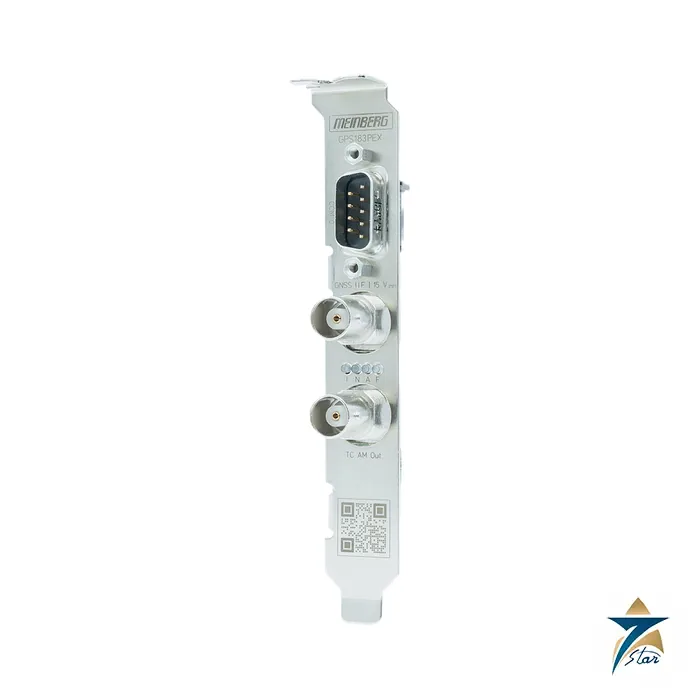
Meinberg GPS183PEX GPS Clock, PCI Express Low-Profile Card
Description
Overview
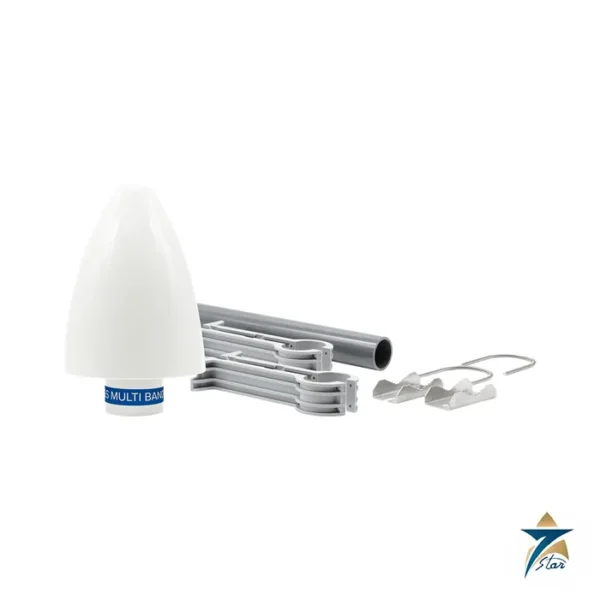
Servers, data loggers and test benches often need time better than a network can give, and the Meinberg GPS183PEX puts a complete GPS clock on a low-profile PCI Express card to provide it. It is a 12-channel GPS C/A-code receiver with its own oscillator, output drivers and an FPGA-based processor, built for time and frequency synchronisation rather than navigation. Seven Star LLC is an independent supplier serving Oman and the GCC. The card ships with the GPSANTv2 antenna, so a host PC can lock to satellite time without any other time source.
What the Meinberg GPS183PEX offers the host computer
The PCIe x1 interface carries management data and time data to the host, and memory mapped I/O time reads allow very fast access to the clock. The card has two time trigger inputs with 100 ns resolution on a falling TTL edge, programmable pulses such as pulse per minute, pulse per hour, pulse per second and DCF77 simulation, an RS-232 serial interface, and IRIG-B and AFNOR time code outputs. The time scale is configurable between UTC, local time, GPS time and TAI, and drivers are provided for all popular operating systems.
Technical data of Meinberg GPS183PEX
| Parameter | Datasheet value |
|---|---|
| Receiver | 12-channel GPS C/A code |
| Bus interface | Single-lane PCI Express, r1.0a compatible |
| Board | Low profile, 68.90 mm x 150 mm |
| Antenna | GPSANTv2 included; 300 m on RG58, 700 m on RG213, 1100 m on Ultraflex H2010 |
| Synchronisation time | Maximum 1 minute normally; up to 25 minutes, average 12, on first start |
| Pulse outputs | Three programmable TTL: PPS 200 ms, pulse per minute 200 ms, DCF77 pulses 100/200 ms |
| Serial interface | RS-232, 300 to 19200 baud |
| AM time code | 3 Vpp mark and 1 Vpp space into 50 ohm, 1 kHz carrier |
| DCLS time code | TTL into 50 ohm, active high or low |
| Time code formats | IRIG B002 to B127, IEEE 1344, C37.118, AFNOR NFS-87500 |
| Trigger inputs | Two, 100 ns resolution |
| Connectors | BNC antenna, BNC AM time code, 9-pin D-Sub male |
| Backup battery | Lithium, minimum 10 years |
| Operating temperature | 0 to 50 degrees C |
| Warranty | Three years |
How the Meinberg GPS183PEX differs from other Meinberg clock products
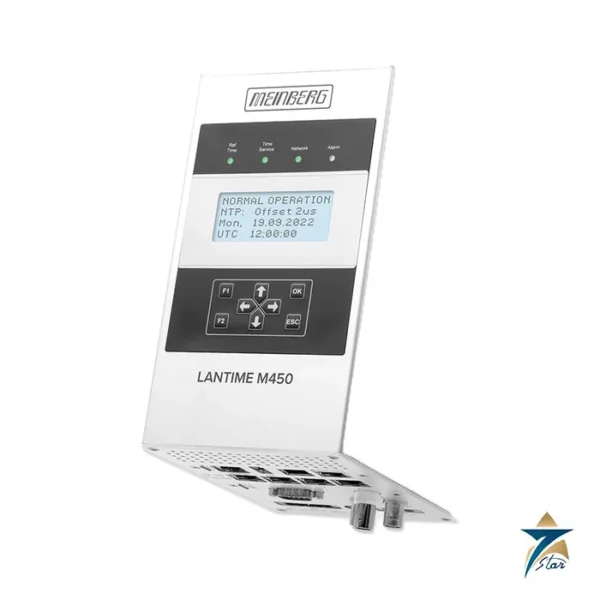
A LANTIME server delivers time over the network to many clients, whereas the GPS183PEX synchronises the PC in which it is installed and offers local outputs for connected equipment. Compared with an IRIG receiver card, it has its own satellite receiver and does not need an external time code source. The standard oscillator is a TCXO, and an upgrade to OCXO SQ or OCXO HQ is offered for longer holdover. A low-profile bracket in the box allows installation in 1U servers, with the D-Sub signals then routed to a box header on the board.
Where this card is useful in Oman and the GCC
Control system servers, historian servers, protection test sets, telecom billing systems and data acquisition PCs in remote sites often lack a reliable network time source. Installing a GPS card removes that dependence. The IRIG-B output lets the same card feed nearby relays or recorders, while the pulse outputs can drive equipment that expects one pulse per second.
Selection and compatibility notes
Check that the host has a free PCIe x1 slot of suitable height and that the operating system is covered by the driver software. Decide on oscillator quality according to how long the host must hold time if the antenna fails. Choose the cable type according to the distance from the antenna to the server room, using the distances above as limits.
Installation and commissioning
Fit the card into a free slot, using the standard bracket or the low-profile one, then connect the antenna cable to the BNC input and install the driver. Place the antenna with a clear view of the sky. The four LEDs show the state: Fail for synchronisation, Ant for the antenna connection, Nav for GNSS position and Init for firmware and host communication. Wait for the first synchronisation, then configure the time scale and outputs.
Maintenance
The status LEDs and driver software show the receiver health, so monitor them from the host. Check the antenna cable and connectors from time to time and replace the lithium battery only through the maker.
Why a hardware clock beats software synchronisation
Software clients that fetch network time are limited by network delay and jitter, and by the operating system scheduling that happens before the time is applied. A hardware card reads satellite time directly, and the host can read it through memory mapped I/O in a very short time. For event logging, sequence of events records and test timestamps, that difference is the difference between a trustworthy record and a guess. The time trigger inputs also allow external events to be stamped with 100 ns resolution.
Time scales, triggers and time strings
The card can output time in UTC, local time, GPS time or TAI, and the status byte tells the host whether the clock is free running, whether daylight saving is active or announced, and whether the time is valid. The serial interface offers many string formats, among them the Meinberg standard string, several NMEA sentences, Sysplex, SPA, RACAL and IRIG-J, which makes it easy to connect old equipment that expects a specific telegram. The trigger inputs record the exact time of an external pulse so that field events, such as a breaker operation or a test pulse, can be read back through the API or the serial port with 100 ns resolution.
Record the chosen time scale in the commissioning notes so that later users do not confuse local and UTC records.
Ordering notes for Meinberg GPS183PEX
State the oscillator option and the cable length for the antenna, since the antenna and 20 m style cable arrangement depends on the site. Mention the operating system of the host so the correct driver can be confirmed.
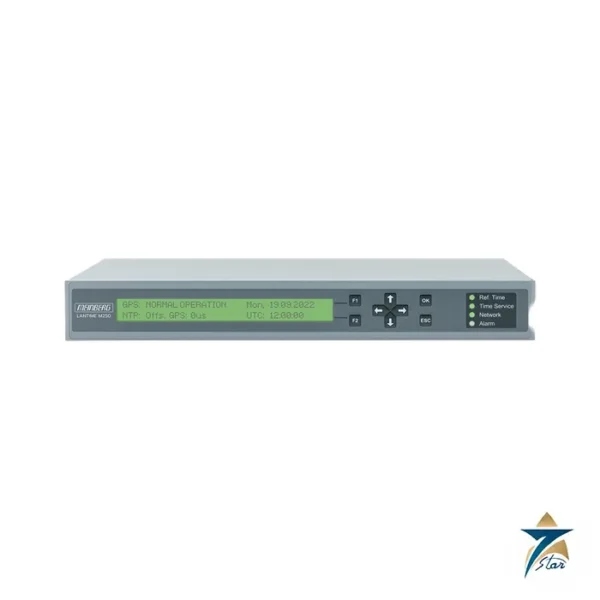
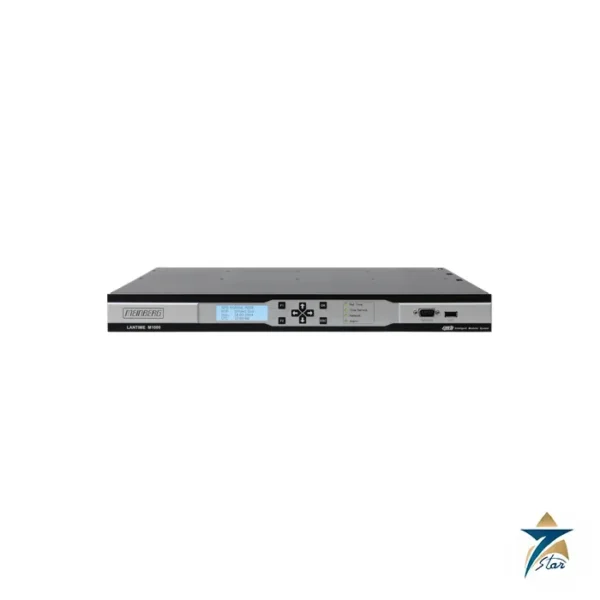
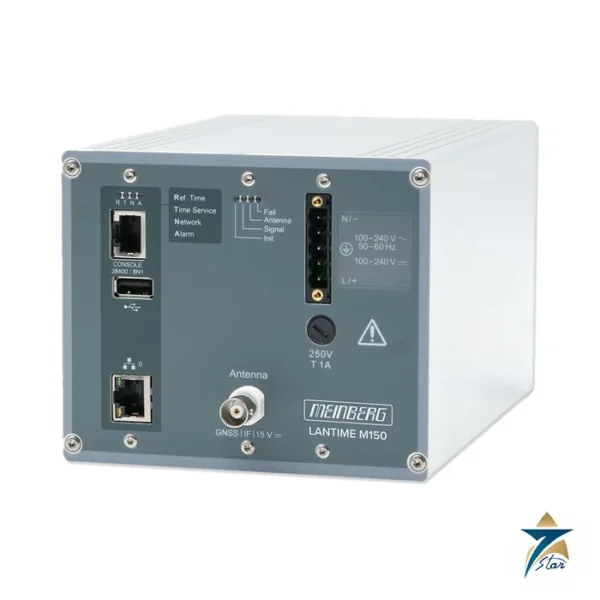
Related items you may also need: Meinberg LANTIME M250 Compact NTP Time Server | Meinberg LANTIME M150 DIN-Rail NTP Time Server | Meinberg LANTIME M1000 Modular NTP/PTP Time Server (IMS 1U) | All Meinberg products.
Documents and quotation
The manufacturer datasheet for the Meinberg GPS183PEX is attached to this page. Send your RFQ with the part number, quantity and delivery location in Oman or the GCC.
Datasheets & Documents
- Datasheet Meinberg GPS183PEX GPS Clock, PCI Express Low-Profile Card Datasheet Download
Reviews (0)
How would you rate this product? Cancel reply
About brand
Meinberg is a German maker of time and frequency synchronisation products, founded in 1979 by the brothers Werner and Günter Meinberg in Bad Pyrmont. It began with DCF77 longwave radio clock receivers and now makes GPS and GNSS-referenced NTP and PTP time servers. Meinberg is family-owned and designs and manufactures its products in Bad Pyrmont.
Seven Star LLC sources and supplies Meinberg LANTIME time servers for utilities and networks in Oman, including the M1000 and M320 listed here.
Meinberg company profile
| Founded | 1979, Bad Pyrmont, Germany |
|---|---|
| Founders | Werner and Günter Meinberg |
| Ownership | Family-owned |
| Manufacturing | Bad Pyrmont, Germany |
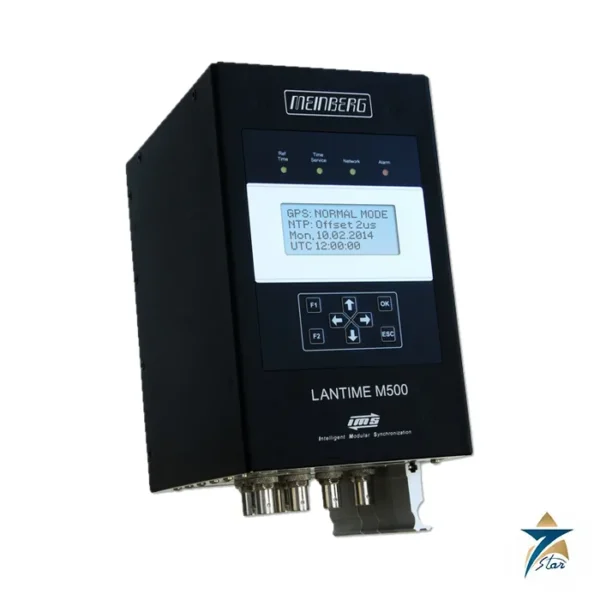
| Product families | LANTIME M150, M250, M320, M500 and M1000 NTP/PTP time servers, IMS modular systems, GNSS and DCF77 receivers, PTP grandmaster clocks |
Meinberg LANTIME models listed here
The LANTIME M320 is a 1U rackmount NTP time server. It works as a stratum 1 source with its own reference receiver, and Meinberg offers it with GPS, combined GNSS, DCF77 (PZF), MSF and IRIG time code references. The LANTIME M1000 is a 1U platform on the modular IMS system, with slots for up to two reference clocks, two power supplies and hot-pluggable I/O modules, plus PTP (IEEE 1588) and IEC 61850 time synchronization.
Meinberg products we list
Ordering a Meinberg time server: what we need
A Meinberg order code describes the build. In M320/GPS/AD10, GPS is the receiver and AD10 is the wide-range AC/DC power supply. Send the full code or serial number, the reference source, oscillator option, supply voltage, the outputs you need (PPS, 10 MHz, IRIG, extra LAN ports) and the antenna cable length. GCC utility projects often require redundant supplies.
Facts checked against Meinberg's own company history (meinbergglobal.com), October 2026.
Browse Meinberg products by category: Industrial Communications.
FAQ
Questions about the Meinberg GPS183PEX GPS Clock, PCI Express
Answers from our engineering team on installation, compatibility and integration.
01What kind of receiver is on the Meinberg GPS183PEX?
It carries a 12-channel GPS C/A-code receiver on a low-profile PCI Express x1 card, supplied with the GPSANTv2 antenna.
02What outputs does the Meinberg GPS183PEX provide?
It provides three programmable TTL pulse outputs, an RS-232 serial time string, and IRIG-B and AFNOR time codes in AM and DCLS form.
03How long does the Meinberg GPS183PEX take to synchronise?
Normally up to 1 minute, and up to 25 minutes (12 on average) on first start or when no satellite data is stored.
04How far can the antenna be from the Meinberg GPS183PEX?
Up to 300 m on RG58, 700 m on RG213 or 1100 m on Ultraflex H2010 cable, thanks to the downconverter.
05Can the Meinberg GPS183PEX fit a 1U server?
Yes. A low-profile slot bracket is included, and the D-Sub signals are then output through a box header on the board.


Reviews
There are no reviews yet.