- Automation & ControlView all 3,043 products
- Automation Accessories
- AC Drives
- PLC & I/O Cards
- Industrial Communications
- Vibration Monitoring
- Isolator & Barrier
- Controllers & Data Acquisition
- Safety Switches & Guard Locking
- Motor Soft Starters
- Encoders
- CCTV & Security
- Pneumatic Cylinders
- HMI Displays
- Servo Drives
- Industrial Computers
- Machine Vision
- Automation Software
- Robotics
Brand: Meinberg
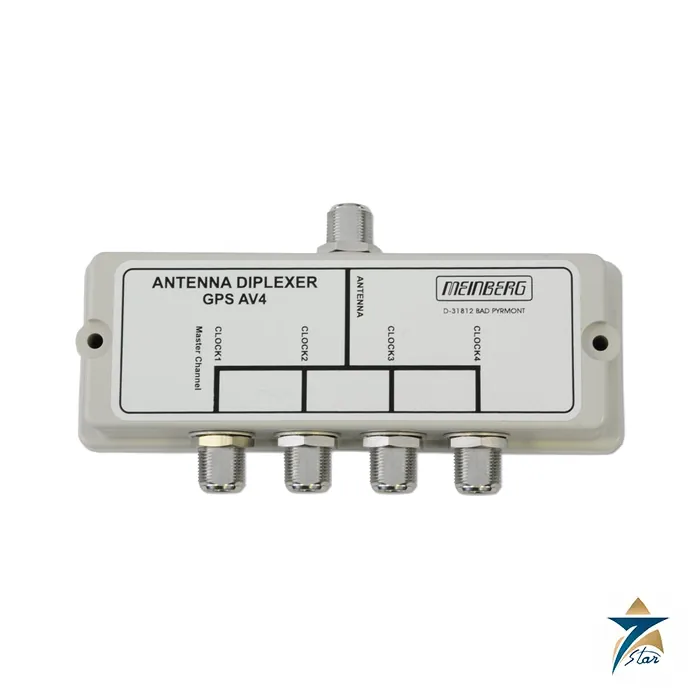
Meinberg GPSAV4 Four-Port GPS Antenna Distributor
Description
Overview
One roof antenna, several clocks: that is the job of the Meinberg GPSAV4. It is a four-port GPS antenna splitter that takes the signal from a Meinberg GPS antenna with converter and passes it to as many as four Meinberg GPS receivers, so a control building does not need a separate antenna and cable run for every time server. An internal amplifier keeps the signal loss low. Seven Star LLC is an independent supplier serving Oman and the GCC. The datasheet warns that direct connection of plain GNSS L1 components is not possible, because the unit works with the intermediate frequency signal of the Meinberg antenna and converter.
How the Meinberg GPSAV4 is powered and connected
The splitter unit has no power supply of its own. It draws about 20 mA at 12 to 18 V DC from the GPS receiver connected to output connector 1, which means that output must always be enabled, while the other three can be left unused. Five standard Type N connectors serve as the antenna input and the four outputs. Units can be cascaded in a tree of up to three levels, which allows a single antenna to feed a large number of receivers across racks and rooms.
Characteristics of Meinberg GPSAV4
| Parameter | Datasheet value |
|---|---|
| Outputs | Four, for up to four Meinberg GPS receivers |
| Connectors | Five Type N connectors (one input, four outputs) |
| Additional path delay | 50 ns |
| Gain | 0 to plus 3 dB |
| Operating voltage | 12 to 18 V DC from the receiver at output 1 |
| Current draw | About 20 mA |
| Mixing frequency | 10 MHz |
| Intermediate frequency | 35.4 MHz |
| Cascading | Up to three levels |
| Dimensions | 182 mm wide, 65 mm deep, 37 mm high |
| Housing | Plastic |
| Operating temperature | 0 to 50 degrees C; storage minus 20 to plus 70 degrees C |
| Humidity | Maximum 85 percent non-condensing at 40 degrees C |
| Warranty | Three years |
How the Meinberg GPSAV4 differs from other antenna accessories
An antenna such as the GPSANTv2 receives and converts the satellite signal. The GPSAV4 does not receive anything; it only splits the converted 35.4 MHz signal four ways with an amplifier that offsets the splitting loss, giving a net gain between 0 and 3 dB. Unlike an inline surge arrester it adds a delay of 50 ns, and unlike a passive splitter it needs power from receiver 1. It is housed in plastic for indoor mounting, with a narrower temperature range of 0 to 50 degrees C than the outdoor antennas.
Use in Oman and GCC installations
Redundant time servers are common in control rooms of power plants, refineries, desalination plants and data centres. Two or three clocks share a roof antenna through the splitter, which saves cable and roof penetrations and keeps the clocks in step with the same antenna signal. The extra 50 ns of delay is the same for all outputs, so receivers of one system remain consistent.
Selection and design notes
Check that all connected receivers are Meinberg GPS type clocks that accept the antenna with converter. Reserve output 1 for a receiver that will always be powered, as it supplies the splitter. When cascading, count levels and remember each level adds delay and uses gain budget. Count cable lengths between antenna and the last receiver against the limits given for the antenna, and include the splitter in your loss estimate.

Installation and commissioning
Mount the unit indoors on a wall or inside a rack shelf, connect the antenna cable to the input and the receiver cables to the outputs, and power up the receiver on output 1. Confirm on each receiver that satellites are tracked and the signal level is adequate. If a receiver connected to output 2, 3 or 4 shows no signal, check the output is enabled and the cable is intact.
Maintenance
Check connectors for tightness and corrosion at plant shutdowns, and keep a record of which receiver is connected to which port. If receiver 1 is taken out of service for repair, remember the splitter loses its power, and the other receivers lose their signal too.
Planning a shared antenna system
Sharing one antenna among several clocks is attractive, yet it creates a single point of failure at the roof. Reduce that risk by choosing a robust antenna, protecting the cable with a surge arrester at the entry, and keeping a spare antenna and splitter on site. Draw a signal tree that shows the antenna, each splitter, every cable length and every receiver, and mark the receiver that powers each splitter. This drawing guides fault finding later, when a technician must quickly decide whether a lost signal comes from the antenna, a cable or a splitter. Keep a note of the delay of each element too, since 50 ns per stage can matter in strict timing applications.
Why receiver one is special
Because the splitter gets its power from output 1, replacement or servicing of that receiver affects every clock downstream. In critical plants, place the most reliable and permanently powered clock on this port, label the cable clearly and write the dependency into the maintenance procedure. During planned work on this receiver, switch the antenna feed temporarily or accept the interruption of reference to the others. This simple precaution avoids surprise time losses during maintenance windows.
Typical wiring example
Picture a control building with two time servers and a spare. The antenna and converter sit on the roof, one cable enters the building through a surge arrester, and the GPSAV4 sits in the equipment room. Output 1 feeds the main time server, output 2 the standby server and output 3 a test clock, and output 4 stays unused with its connector capped. If the building later needs a third server, it takes the fourth port without any new roof work.
Ordering notes for Meinberg GPSAV4
State the number of receivers to be fed and whether cascading is planned, so that cables and spare splitters can be quoted together.
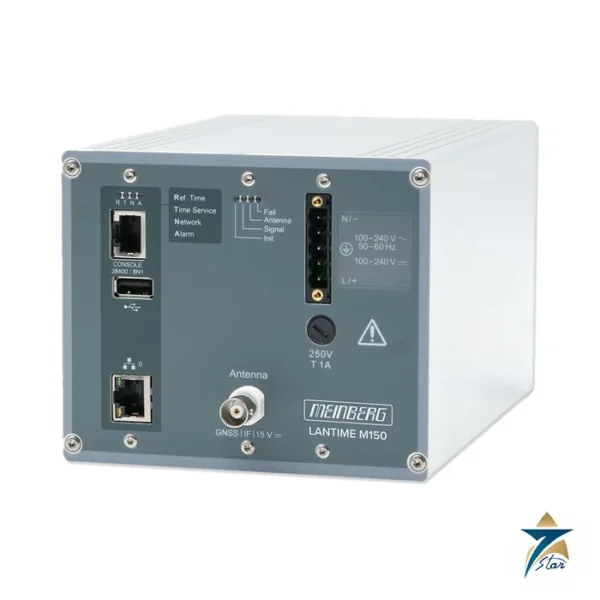
Related items you may also need: Meinberg LANTIME M320/GPS/AD10 NTP Time Server | Meinberg LANTIME M250 Compact NTP Time Server | Meinberg LANTIME M150 DIN-Rail NTP Time Server | All Meinberg products.
Documents and quotation
The manufacturer datasheet for the Meinberg GPSAV4 is attached to this page. Send your RFQ with the part number, quantity and delivery location in Oman or the GCC.
Other Models in the Meinberg Antennas Range
Seven Star LLC supplies models from the Meinberg Antennas range in Oman and the GCC. Compare the related models below and request a quote for the one that matches your application.
| Model | Category | |
|---|---|---|
| Meinberg GNMANTv2 Dual-Band Multi-GNSS Antenna, IP65 | Industrial Communications | View details |
| Meinberg GPSANTv2 GPS and Galileo Antenna with Converter | Industrial Communications | View details |
| Meinberg GPSAV4 Four-Port GPS Antenna Distributor | Industrial Communications | You are viewing this model |
Datasheets & Documents
- Datasheet Meinberg GPSAV4 Four-Port GPS Antenna Distributor Datasheet Download
Reviews (0)
How would you rate this product? Cancel reply
About brand
Meinberg is a German maker of time and frequency synchronisation products, founded in 1979 by the brothers Werner and Günter Meinberg in Bad Pyrmont. It began with DCF77 longwave radio clock receivers and now makes GPS and GNSS-referenced NTP and PTP time servers. Meinberg is family-owned and designs and manufactures its products in Bad Pyrmont.
Seven Star LLC sources and supplies Meinberg LANTIME time servers for utilities and networks in Oman, including the M1000 and M320 listed here.
Meinberg company profile
| Founded | 1979, Bad Pyrmont, Germany |
|---|---|
| Founders | Werner and Günter Meinberg |
| Ownership | Family-owned |
| Manufacturing | Bad Pyrmont, Germany |
| Product families | LANTIME M150, M250, M320, M500 and M1000 NTP/PTP time servers, IMS modular systems, GNSS and DCF77 receivers, PTP grandmaster clocks |
Meinberg LANTIME models listed here
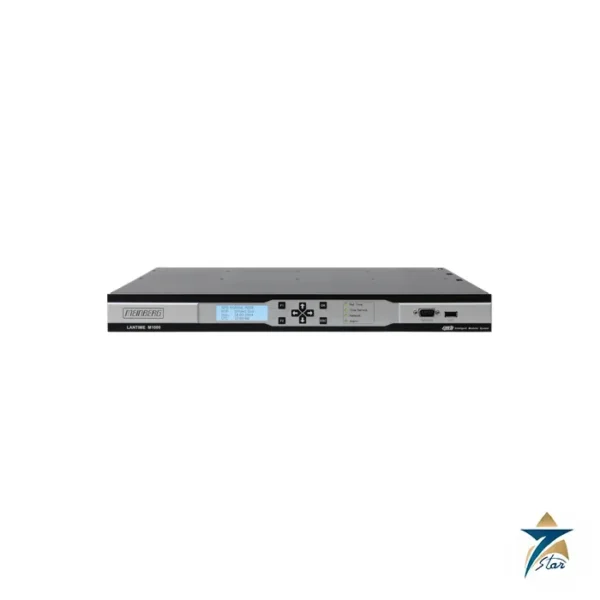
The LANTIME M320 is a 1U rackmount NTP time server. It works as a stratum 1 source with its own reference receiver, and Meinberg offers it with GPS, combined GNSS, DCF77 (PZF), MSF and IRIG time code references. The LANTIME M1000 is a 1U platform on the modular IMS system, with slots for up to two reference clocks, two power supplies and hot-pluggable I/O modules, plus PTP (IEEE 1588) and IEC 61850 time synchronization.
Meinberg products we list
Ordering a Meinberg time server: what we need
A Meinberg order code describes the build. In M320/GPS/AD10, GPS is the receiver and AD10 is the wide-range AC/DC power supply. Send the full code or serial number, the reference source, oscillator option, supply voltage, the outputs you need (PPS, 10 MHz, IRIG, extra LAN ports) and the antenna cable length. GCC utility projects often require redundant supplies.
Facts checked against Meinberg's own company history (meinbergglobal.com), October 2026.
Browse Meinberg products by category: Industrial Communications.
FAQ
Questions about the Meinberg GPSAV4 Four-Port GPS Antenna Distributor
Answers from our engineering team on installation, compatibility and integration.
01How many receivers can the Meinberg GPSAV4 feed?
It distributes the signal of one Meinberg GPS antenna with converter to up to four Meinberg GPS receivers, with cascading to three levels.
02How is the Meinberg GPSAV4 powered?
It takes about 20 mA at 12 to 18 V DC from the GPS receiver connected to output connector 1, so that output must always be enabled.
03What delay and gain does the Meinberg GPSAV4 add?
The datasheet lists an additional path delay of 50 ns and a gain from 0 to plus 3 dB.
04Can the Meinberg GPSAV4 be used with a plain GNSS L1 antenna?
No. The datasheet states that direct use or connection of GNSS L1 components is not possible.
05What are the size and temperature range of the Meinberg GPSAV4?
It measures 182 x 65 x 37 mm in a plastic housing and operates from 0 to 50 degrees C at up to 85 percent humidity.


Reviews
There are no reviews yet.