Brand:

Meinberg LANTIME M150 DIN-Rail NTP Time Server

Description

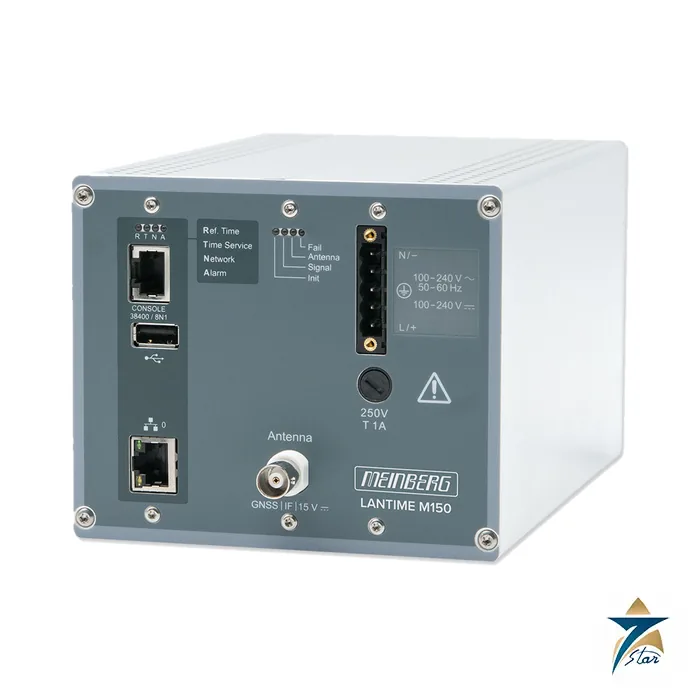
The Meinberg LANTIME M150 is a compact NTP time server in a DIN-rail aluminium chassis, built to give a control cabinet, substation or telecom room its own traceable time source. It synchronises to satellite or long-wave radio signals and serves accurate time to NTP and SNTP clients over Gigabit Ethernet, with the same LANTIME operating system, web interface and REST API found across Meinberg’s larger servers.

Technical specifications

Parameter Specification
Model LANTIME M150, constructed to order with a chosen receiver
Reference receivers GPS; GNS (combined GPS, GLONASS, Galileo, BeiDou); GNS-UC (GPS and Galileo with up-converter); PZF (DCF77 correlation receiver)
Network interface 1 x 10/100/1000BASE-T RJ45; up to 25,000 NTP requests per second
Time protocols NTP v2, v3, v4 (RFC 1119, 1305, 5905); SNTP v3, v4; NTS (Network Time Security) in unicast client/server mode; TIME protocol (RFC 868); SNTP synchronisation of IEC 61850 devices
NTP authentication Symmetric keys with MD5, SHA-1 or AES-128-CMAC; NTP v4 Autokey
Management Web interface, command line, REST API with HTTPS and TLS certificate management; SSH, Telnet, FTP, SFTP, SCP, syslog, SNMP, SMTP; IPv4 and IPv6, DHCP, DHCPv6
Local interfaces Four bicolour status LEDs (reference time, time service, network, alarm); front USB port; 8P8C console connector
Power supply Standard: 100 to 240 V AC (50/60 Hz) or 100 to 240 V DC, maximum range 90 to 264 V AC or 100 to 250 V DC. Option: 48 V DC, maximum range 20 to 60 V DC
Power consumption 20 W
Housing DIN-rail mountable aluminium profile chassis, 125.5 x 105 x 189 mm (W x H x D)
Operating / storage temperature 0 to 50 degC / -20 to 70 degC
Humidity Maximum 95 percent non-condensing at 40 degC
Delivery Meinberg outdoor antenna with mounting kit and pre-assembled cable (GPS, GNS and GNS-UC models); CAB-CONSOLE-RJ45 cable for first set-up
Manufacturer support and warranty Three-year warranty, firmware updates for the life of the product, free lifetime technical support from Meinberg

Picking the reference receiver

The receiver is the main choice when ordering. The GNS receiver listens to all four satellite systems and is the usual pick where the antenna has a clear sky view. The GPS and GNS-UC versions are supplied with Meinberg’s IF antenna, and the GNS-UC version also receives Galileo through an up-converter. The PZF option is a DCF77 long-wave receiver and is only useful within range of that transmitter, so it is rarely relevant for sites in the Gulf. Tell us the antenna position and cable length so the right receiver and cable set can be specified.

Fitting it into a cabinet or substation

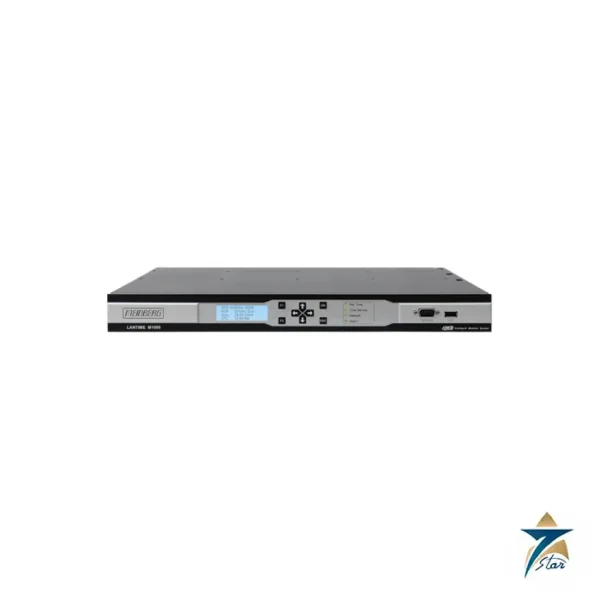
The slim DIN-rail housing mounts beside controllers and switches, and the 100 to 240 V AC or DC supply accepts either mains or a station DC bus, with a 48 V DC option for telecom power. Place the GNSS antenna where it sees open sky, away from metal obstructions, and install surge protection on the antenna line. Time then reaches SCADA servers, historians, protection relay gateways and network equipment through NTP or SNTP. For installations that also need PTP or IRIG outputs and redundant modules, step up to the modular Meinberg LANTIME M1000 modular time server; other network gear is listed under industrial communications.
Documents and quotation

The linked document is the Meinberg LANTIME M150 data sheet. Meinberg states that no online manual is available for this model, so ask for the manual through us if your project needs it. Before ordering, confirm the reference receiver, antenna and cable length, supply voltage and whether NTS or other security features are required. Seven Star LLC, an independent supplier in Muscat, will prepare a quotation from this information.

Datasheets & Documents
  • PDF Datasheet Meinberg LANTIME M150 Data Sheet Download
Reviews (0)

Reviews

There are no reviews yet.

How would you rate this product?

It takes about 10 seconds — just tap a star. Your email is never published.

About brand

Substations, telecom nodes and data centers need every device to agree on the time, and Meinberg time servers are a common way to do it. Meinberg Funkuhren, founded in 1979 in Bad Pyrmont, Germany, builds NTP and PTP time servers, GNSS receivers and signal distribution equipment. Seven Star LLC sources and supplies Meinberg LANTIME time servers for utilities and networks in Oman, including the M1000 and M320 listed here.

Meinberg LANTIME models listed here

The LANTIME M320 is a 1U rackmount NTP time server. It works as a stratum 1 source with its own reference receiver, and Meinberg offers it with GPS, combined GNSS, DCF77 (PZF), MSF and IRIG time code references. The LANTIME M1000 is a 1U platform on the modular IMS system, with slots for up to two reference clocks, two power supplies and hot-pluggable I/O modules, plus PTP (IEEE 1588) and IEC 61850 time synchronization.
Ordering a Meinberg time server: what we need

A Meinberg order code describes the build. In M320/GPS/AD10, GPS is the receiver and AD10 is the wide-range AC/DC power supply. Send the full code or serial number, the reference source, oscillator option, supply voltage, the outputs you need (PPS, 10 MHz, IRIG, extra LAN ports) and the antenna cable length. GCC utility projects often require redundant supplies.

Frequently Asked Questions

What reference signals can the LANTIME M150 use?
GPS, a combined GPS/GLONASS/Galileo/BeiDou (GNS) receiver, GPS and Galileo with up-converter (GNS-UC), or a DCF77 long-wave receiver (PZF).
How many NTP requests can it serve?
Up to 25,000 NTP requests per second on its gigabit network port.
How is the LANTIME M150 mounted?
On a DIN rail, in an aluminium profile chassis measuring 125.5 x 105 x 189 mm.
What power supply options exist?
100 to 240 V AC or DC as standard, or a 48 V DC option with a 20 to 60 V DC range.
Does it support secure time?
Yes. It supports NTS in unicast client/server mode, symmetric key authentication and HTTPS management.