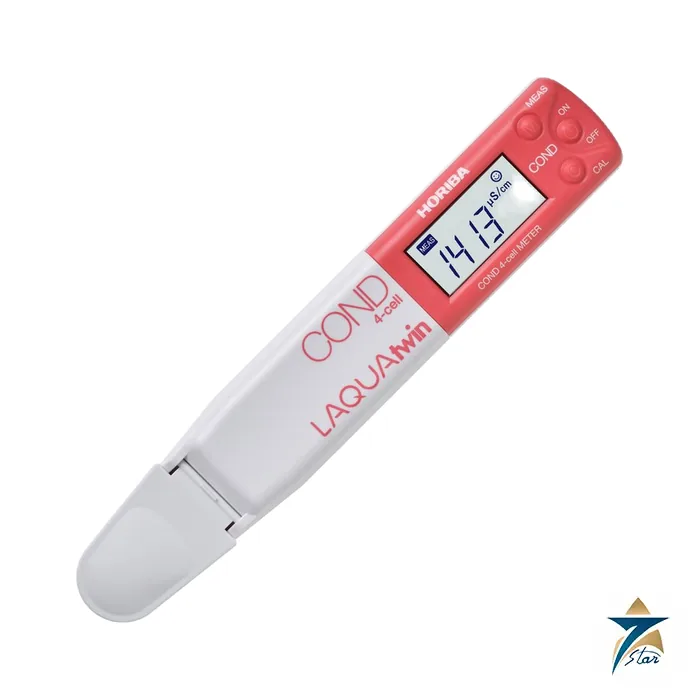
LAQUAtwin-4EC-33 is the most capable member of the 4EC pocket conductivity series: a four-electrode cell that measures from 0 to 199.9 mS/cm on 0.12 mL of sample, offers up to four calibration points and, on this model only, a choice of TDS conversion methods.
Wide-range conductivity in a cell the size of a thumbnail
The 4EC sensor is a four-electrode measuring cell that you fill with the sample up to the rim. According to the manual, conductivity is shown from 0 to 199 µS/cm, 200 to 1999 µS/cm, 2.00 to 19.99 mS/cm and 20.0 to 199.9 mS/cm, so one meter covers distilled water checks and strong brines. Accuracy is stated as ±2 % of full scale up to 19.99 mS/cm and ±5 % of full scale from 20.0 to 199.9 mS/cm.
The 4EC-33 adds what the 4EC-11 and 4EC-22 lack in its TDS handling. In setup mode you can pick a custom KCl factor (adjustable from 0.4 to 1.0, default 0.5), the Myron L 442 curve, the European EN 27888 curve or a NaCl salinity curve. That matters when a plant specification quotes TDS against a named method.
Capabilities printed in the manual
- Four-electrode measurement; 0.12 mL minimum sample.
- Up to four calibration points: 84 µS/cm, 1413 µS/cm, 12.88 mS/cm and 111.8 mS/cm (the 4EC-11 stops at three).
- Fixed temperature compensation of 2 %/°C, temperature display 0 °C to 50.0 °C, adjustable by up to ±2 °C against a reference.
- Units selectable between S/cm and S/m; conductivity, TDS and temperature on the display.
- Auto stable or auto hold, backlit LCD, automatic power off.
Technical specification
Measurement data
| Parameter |
Specification |
| Model |
LAQUAtwin-4EC-33 (series: 4EC-11, 4EC-22, 4EC-33) |
| Target / principle |
Electrical conductivity, 4-electrode method |
| Minimum sample volume |
0.12 mL |
| Conductivity ranges / resolution |
0 to 199 µS/cm: 1 µS/cm; 200 to 1999 µS/cm: 1 µS/cm; 2.00 to 19.99 mS/cm: 0.01 mS/cm; 20.0 to 199.9 mS/cm: 0.1 mS/cm |
| TDS ranges / resolution |
0.0 to 99.9 ppm: 0.1; 100 to 999 ppm: 1; 1000 to 9990 ppm: 10 |
| Calibration |
Up to 4 points on the 4EC-33 |
| Accuracy |
±2 % FS (0 to 19.99 mS/cm); ±5 % FS (20.0 to 199.9 mS/cm); TDS ±2 % FS per range; measured at 25 °C after calibration |
| TDS methods (4EC-33 only) |
Custom KCl factor 0.4 to 1.0; 442; EN 27888; NaCl |
Operating and physical data
| Parameter |
Specification |
| Environment |
5 °C to 40 °C; 85 % relative humidity or less, no condensation |
| Power |
2 x CR2032 (not included, not installed) |
| Battery life |
Approx. 400 h continuous, backlight off |
| Dimensions / mass |
164 x 29 x 20 mm excluding projections; approx. 45 g meter only |
| Waterproofing |
IP67 (1 m, 30 min); not for underwater use |
| Printed conformity |
EMC EN IEC 61326-1 Class B; RoHS EN IEC 63000; the manual states the product is not intended for industrial environments |
Parts and consumables
| Parameter |
Specification |
| Sensor S073-4EC |
Part No. 3201079162 |
| Standard 514-22, 1413 µS/cm |
Part No. 3999960110 |
| Standard 514-23, 12.88 mS/cm |
Part No. 3999960111 |
| Conditioning solution 514-4EC-CON |
Part No. 3201081522 |
| Warranty per manual |
2 years for the meter, 6 months for the sensor |
Which 4EC model and which standards
Choose the 4EC-33 when TDS must follow a defined curve, or when the sample can exceed 20 mS/cm and a 111.8 mS/cm standard is needed for the top range. The supplied 1413 µS/cm and 12.88 mS/cm standards suit fresh and brackish water; for stronger solutions the fourth point needs a 111.8 mS/cm standard, which is not in the package list, so ask us to quote it.
Batteries are not supplied with this series, so add two CR2032 cells to your order. If the sample is one of the substances the manual excludes (see below), a different instrument is the right choice.
Conditioning, calibration and what not to measure
Before the first use, put a few drops of conditioning solution on the measuring part of the sensor and wait 20 minutes, then rinse with pure water and calibrate. To calibrate, fill the cell to the top with standard without air bubbles, close the protection cover, wait about one minute for the reading to settle and press CAL. Measurement follows the same filling and waiting routine.
The manual lists samples that can damage the sensor: organic solvents, oils, adhesives, cement, alcohols, surfactants, concentrated acid (pH 0 to 2) and concentrated alkali (pH 12 to 14). Rinse with pure water straight after use and store the meter and sensor together in the case at 5 °C to 40 °C, away from direct sunlight.
Conductivity checks around water and process plant
Conductivity and TDS readings are the quick screen for desalinated and well water, cooling-tower blow-down, hydroponic nutrient solutions and rinse-water quality. Because the manual says the product is not intended for industrial electromagnetic environments, use it as a field or laboratory check instrument away from large drives and welders rather than as a permanently installed monitor.
Selection and installation notes
Laboratory and field water analysis instruments are selected from the parameter, the range and the accuracy needed. Calibrate with fresh buffers or standards that bracket the expected readings, rinse the sensor between samples, keep the sensor wet and clean as the maker advises, record the temperature with every reading and replace sensors at the interval the manual states. Keep the calibration record with the results.
Information needed for a quotation
Send the full model code, the quantity, the delivery location in Oman or the GCC, the intended use and any accessories needed, so that the complete package can be quoted together.
Documents and supply information
The manufacturer data sheet is attached to this page and should be read together with the project specification and the site risk assessment before a purchase is confirmed. Ratings, standards and dimensions are quoted as printed on that sheet. Lead time, stock position and certificates available with the shipment are confirmed in the quotation, and we supply to Oman and the wider GCC region for industrial, utility and building services projects.
Related items
The conductivity standards, conditioning solution and replacement S073-4EC sensor are listed above. HORIBA also makes benchtop conductivity meters such as the DS-72 for laboratory work.
Frequently asked questions
How many calibration points does the 4EC-33 allow?
Up to four: 84 µS/cm, 1413 µS/cm, 12.88 mS/cm and 111.8 mS/cm.
What TDS methods can be selected?
On the 4EC-33 only: a custom KCl factor from 0.4 to 1.0, the 442 curve, EN 27888 or a NaCl curve.
Are batteries included?
No. The manual says batteries are not included or installed; two CR2032 cells are needed.
What is the warranty period in the manual?
Two years for the meter and six months for the sensor.
Is Seven Star LLC a Horiba distributor?
No. Seven Star LLC is not a Horiba distributor; it is an independent Muscat-based supplier that quotes Horiba products on request.
Documents and quotation
Need LAQUAtwin-4EC-33? The Horiba instruction manual is attached to this listing. Seven Star LLC (independent supplier, Muscat) can quote the item and arrange supply on request; list quantity and site location in your enquiry. Verify the code, dimensions and approvals in the document before ordering. Other products are in the category page.













Reviews
There are no reviews yet.