Brand:

Autonics PRCM18-5DN M18 Connector Inductive Proximity Sensor

Description

Overview

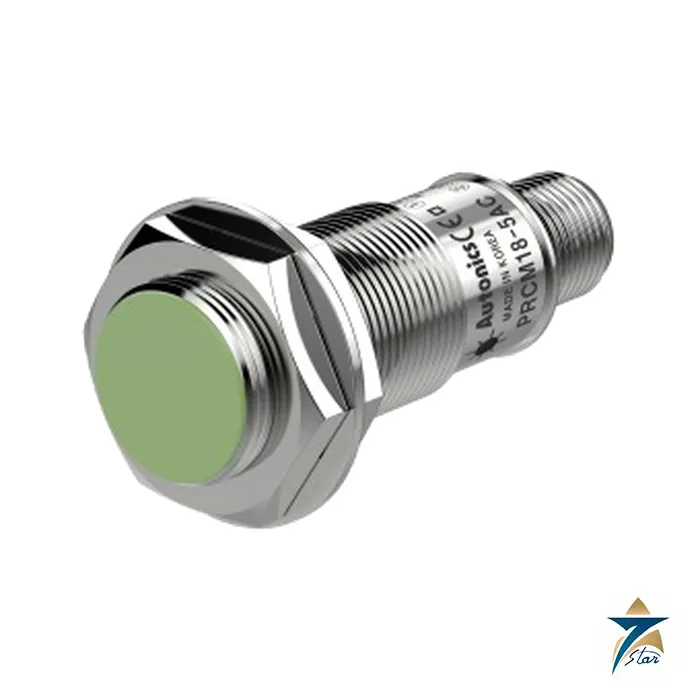
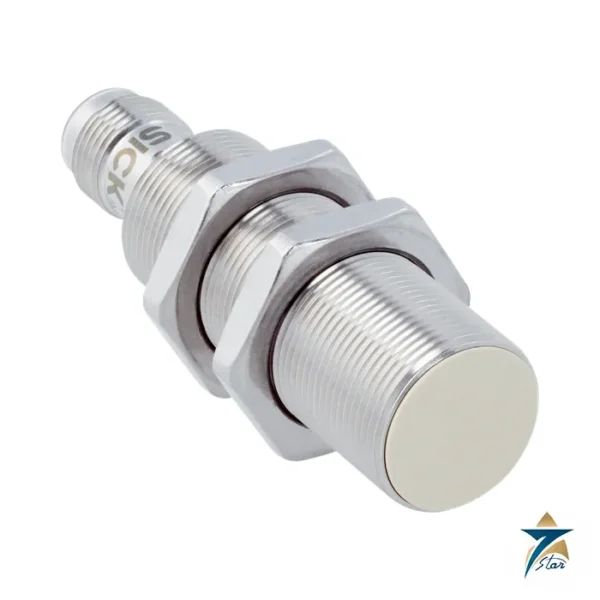
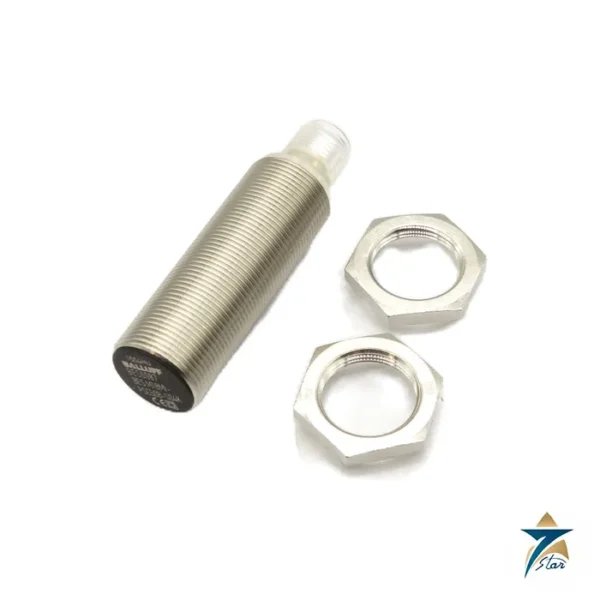
When a machine is serviced often, a sensor that unplugs saves time. The Autonics PRCM18-5DN is the M12 connector version of the 18 mm flush PR series sensor: the barrel ends directly in a four-pin M12 plug, with no cable at all, so a damaged unit can be swapped in seconds and a cable from the harness stays in place. It senses steel at a rated 5 mm, runs on 12 to 24 V DC and provides an NPN normally open output. Seven Star LLC is an independent supplier serving Oman and the GCC.

Decoding Autonics PRCM18-5DN

PR is the cylindrical DC three-wire family, and CM is the connection mark that means a connector type, as opposed to W for a short cable ending in a connector, or nothing for a straight cable. The number 18 is the sensing face diameter, 5 the sensing distance in millimetres, D the 12 to 24 V DC supply and N the NPN normally open output. No S or L follows PR, so the body is of normal length, and no A means the standard coating.

Specification of the Autonics PRCM18-5DN

Item Value
Thread and hole M18 x 1, hole 18.5 mm
Installation Flush
Sensing distance 5 mm; setting distance 0 to 3.5 mm
Standard target Iron, 18 x 18 x 1 mm
Response frequency 500 Hz
Hysteresis 10 percent or less of sensing distance
Supply 12 to 24 V DC, 10 to 30 V DC operating, ripple 10 percent or less
Consumption 10 mA or less
Output NPN normally open, up to 200 mA, residual 1.5 V or less
Connector M12, pin 1 brown plus, pin 3 blue 0 V, pin 4 black output
Protection IP67; minus 25 to plus 70 degrees C
Case and nuts Nickel plated brass, PBT face
Weight about 49 g, about 61 g packaged
Torque 14.7 N m front and rear

How the Autonics PRCM18-5DN differs from other PR18 variants

The same 18 mm family contains a straight cable model, the flush PR18-5DN, and non-flush versions that reach 8 mm. Moving from a cable to the plug body of the Autonics PRCM18-5DN cuts the weight from about 110 g to about 49 g, because there are no 2 m of PVC cable to carry. Relative to the cable connector type PRW18-8DN, which has a 300 mm pigtail, the plug sits directly on the barrel and therefore increases the length that must be allowed behind the mounting plate for the mating cable. The flush head lets the sensor sit level with the mounting surface, in contrast to the 8 mm non-flush heads that must keep 14 mm free ahead of the face.

Electrical behaviour and protection of the Autonics PRCM18-5DN

The three-wire circuit takes its supply from the brown and blue conductors and switches the load through the black one, so the sensor stays powered whether or not a target is present. Current consumption is 10 mA or less, which lets a large number of sensors share a small 24 V rail, and the output transistor can switch up to 200 mA with a residual voltage of 1.5 V or less. Three protection circuits are built in: surge suppression, short circuit current limiting on the output, and reverse polarity protection. The insulation resistance is 50 megohm or more at 500 V DC and the dielectric strength is 1,500 V AC for one minute between live parts and the case. Vibration of 1 mm double amplitude at 10 to 55 Hz for two hours per axis and shocks of 500 m/s2 are tolerated, which suits machines with reciprocating motion. Plan the harness with the permitted supply ripple of 10 percent or less in mind; a poorly smoothed supply can cause false switching at the edge of the sensing range.

With a connector sensor, always check that the cable screen or earth arrangement of the mating cable follows the plant practice, because the sensor body is metal and is normally bonded to the machine frame through the mounting bracket.

Use cases

Connector sensors are popular on packaging machines, conveyor rollers, indexing tables, robot cells and skids that are shipped in modules. In an Omani plant they are found on pump skids built abroad and assembled on site, because the cable runs can be tested and left in place while sensors are exchanged. The 5 mm flush reach is enough for a steel flange passing, a gear tooth or a bracket leaf, and the M12 plug resists vibration when it is tightened to the specified 0.39 to 0.49 N m, with the thread kept covered and a PTFE tape sealed on vibrating machinery.

Mounting the Autonics PRCM18-5DN

Use the washer and two nuts, and tighten to 14.7 N m. Maintain at least 30 mm between flush sensors facing one another and 36 mm side by side; the free space of m 15 mm and n 27 mm applies around the sensing head when the surrounding material is metal. Mate the plug with a four-pin M12 cable of the C-series type sold separately; for an NPN load connect between plus and the output pin. Do not leave the plug thread exposed after tightening.

Choosing among codes

If your controller needs sinking behaviour, pick the PNP equivalent. For normally closed behaviour, N2 or P2 codes are available. Verify the actual combinations on the manufacturer site, because the manual notes that not every code in the table exists. Use 70 percent of the nominal distance, 3.5 mm, for the working gap.

Service and diagnostics

The red indicator lights when the target is in range. If the sensor stays off, check the supply polarity at pins 1 and 3, then the cable’s continuity; if it stays on, look for metal chips or a wrong gap. A damaged barrel or bent pin means replacement, since there are no parts to repair. Keep spares for critical stop positions and note that a connector allows exchange without rewiring.

During plant shutdowns inspect the plug for water ingress and lubricate nothing on the sensing face. Store spare plug sensors in dry bags to protect the contacts from corrosion between uses, and label each connector cable at both ends so that technicians match the correct sensor to the correct input.

Related items you may also need: Autonics E40S6-2500-6-L-5 Rotary Encoder Incremental | Omron E2E-X2E1 M12 Proximity Sensor | SICK WTB4-3P2161 Flat W4 Background Suppression Photoelectric Sensor | All Autonics products.

Documents and quotation

The Autonics product manual covering the Autonics PRCM18-5DN is attached to this page. Send your RFQ with Autonics PRCM18-5DN, the required quantity and the delivery location in Oman or the GCC, and mention if you need the matching M12 cable.

Other Models in the PR Range

Seven Star LLC supplies models from the PR range in Oman and the GCC. Compare the related models below and request a quote for the one that matches your application.

ModelCategory
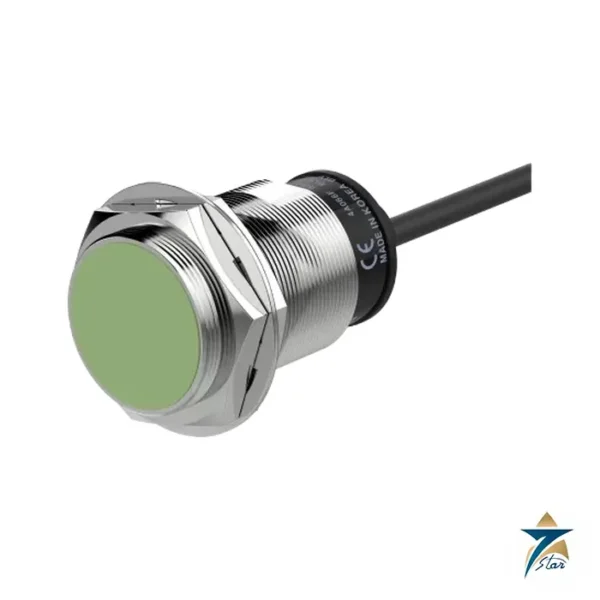
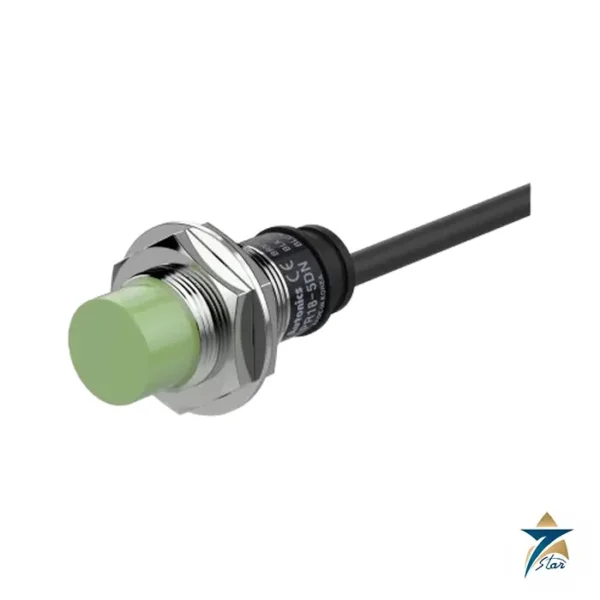
Autonics PR18-8DN M18 Inductive Proximity Sensor 8 mmInductive Proximity SensorsView details
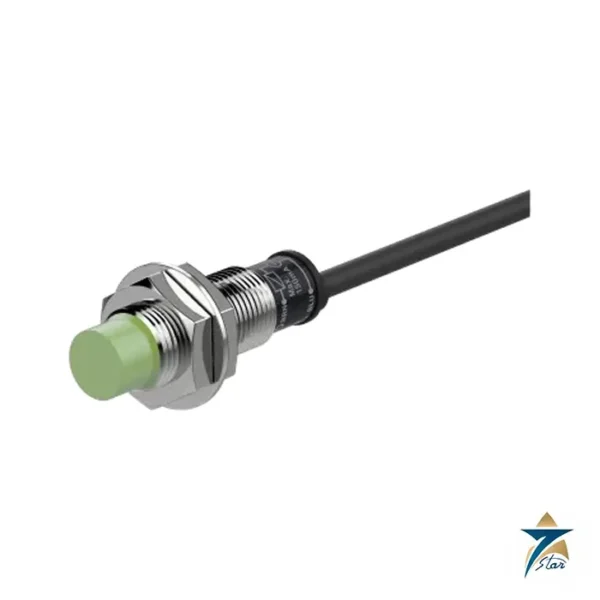
Autonics PR12-4DN M12 Inductive Proximity Sensor 4 mm NPN NOInductive Proximity SensorsView details
Autonics PR30-10DN M30 Flush Inductive Proximity Sensor NPNInductive Proximity SensorsView details
Autonics PRCM18-5DN M18 Connector Inductive Proximity SensorInductive Proximity SensorsYou are viewing this model
Autonics PRW18-8DN M18 Cable Connector Inductive SensorInductive Proximity SensorsView details
Datasheets & Documents
  • PDF Datasheet Autonics PRCM18-5DN M18 Connector Inductive Proximity Sensor Datasheet Download
Reviews (0)

Reviews

There are no reviews yet.

How would you rate this product?

It takes about 10 seconds — just tap a star. Your email is never published.

About brand

Autonics is a South Korean maker of sensors and controllers, founded in 1977 as a small engineering business making controllers for looms. It took the Autonics name in 1988 and opened a new corporate headquarters in Busan in 2014. Autonics makes proximity and photoelectric sensors, rotary encoders, temperature controllers, counters, timers and stepper motor systems, with factories in Busan and Yangsan.

Seven Star LLC lists the Autonics E40S6-2500-6-L-5 incremental rotary encoder and supplies Autonics sensors and control devices in Oman and the GCC.

Autonics company profile

Founded 1977, South Korea
Current name Autonics, since 1988
Headquarters Busan, South Korea
Factories Busan and Yangsan
Product families E40 and E50 rotary encoders, PR proximity sensors, BJ photoelectric sensors, TK temperature controllers

Milestones

  • 1977: The company is founded.
  • 1988: Renamed Autonics Corporation.
  • 2014: Opens its Busan headquarters.

Reading the Autonics E40S encoder code

E40S is the 40 mm diameter shaft-type incremental encoder, and the 6 that follows is the 6 mm shaft. 2500 is the resolution in pulses per revolution. The next 6 means six output signals: A, B and Z with their inverted signals. L is a line driver output and the final 5 is a 5 V DC supply. The same 40 mm body is made in hollow shaft form as the E40H and E40HB series.

Where Autonics encoders are used

Servo and spindle feedback, conveyor length measurement, packaging and printing machines.

Ordering Autonics encoders: what we need

Send the complete model string from the label. If it is worn off, give the body and shaft diameter, pulses per revolution, output type, supply voltage and cable or connector style.

Facts checked against Autonics corporate profiles, October 2026.

FAQ

Questions about the Autonics PRCM18-5DN M18 Connector Inductive

Answers from our engineering team on installation, compatibility and integration.

01What connection does the Autonics PRCM18-5DN use?
It is a connector type with an M12 plug directly on the barrel, wired pin 1 brown plus, pin 3 blue 0 V and pin 4 black output.
02What sensing distance does the Autonics PRCM18-5DN have?
The rated sensing distance is 5 mm for a flush M18 head, with a setting distance of 0 to 3.5 mm on the standard iron target.
03Does the Autonics PRCM18-5DN need a separate cable?
Yes, the connector body has no cable of its own, so you need an M12 connector cable which is sold separately by the manufacturer.
04What output type is the Autonics PRCM18-5DN?
It provides an NPN normally open output up to 200 mA on 12 to 24 V DC, with surge, short circuit and reverse polarity protection.
05How heavy is the Autonics PRCM18-5DN?
The manual lists about 49 g for the unit and about 61 g with packaging, much lighter than the cable versions of the same diameter.