Brand:

Autonics PRW18-8DN M18 Cable Connector Inductive Sensor

Description

Overview

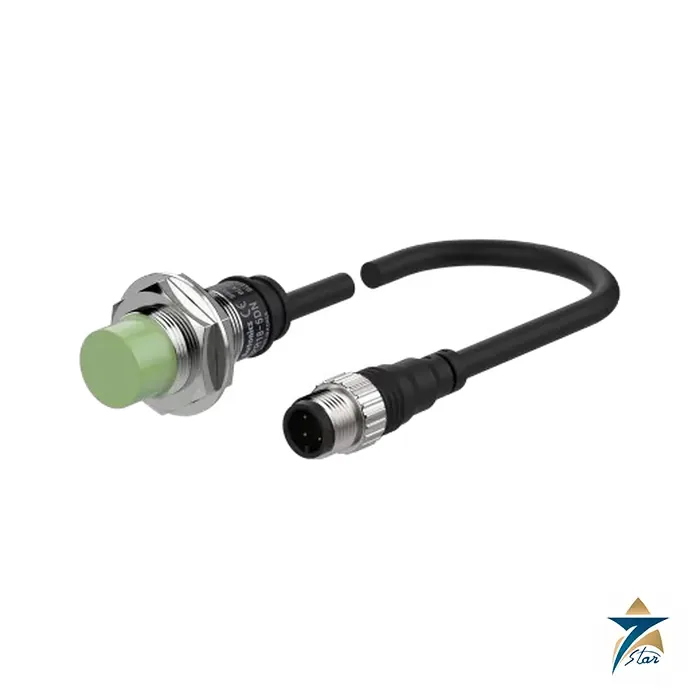
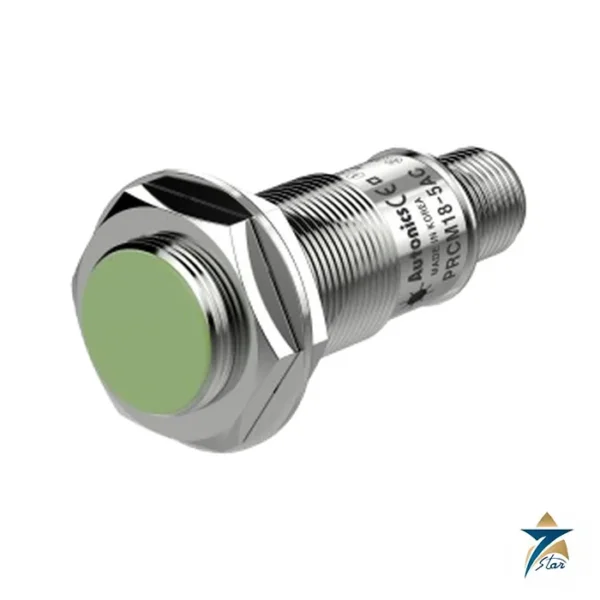
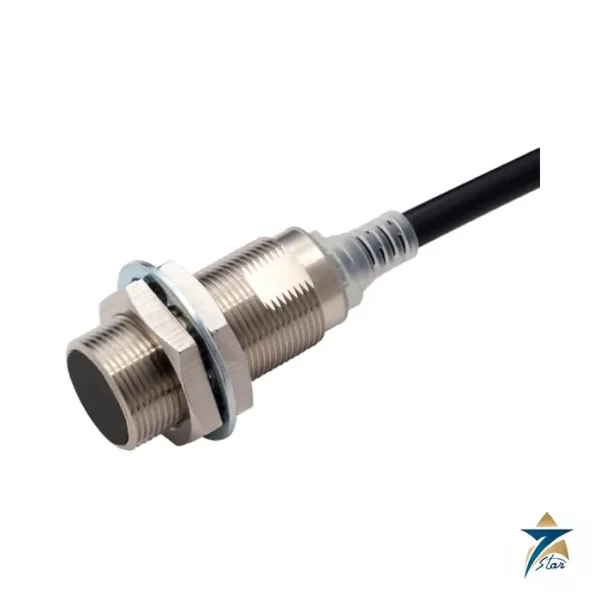
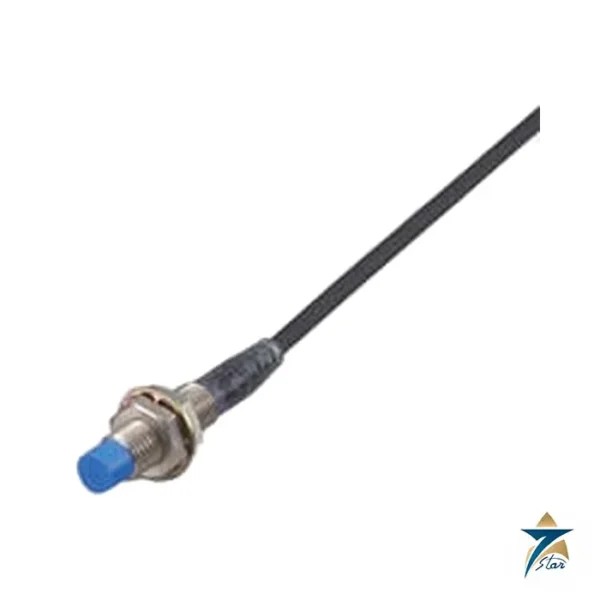
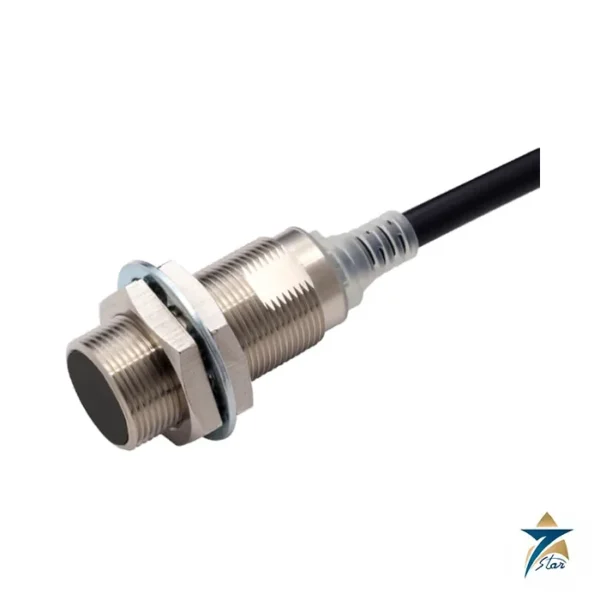
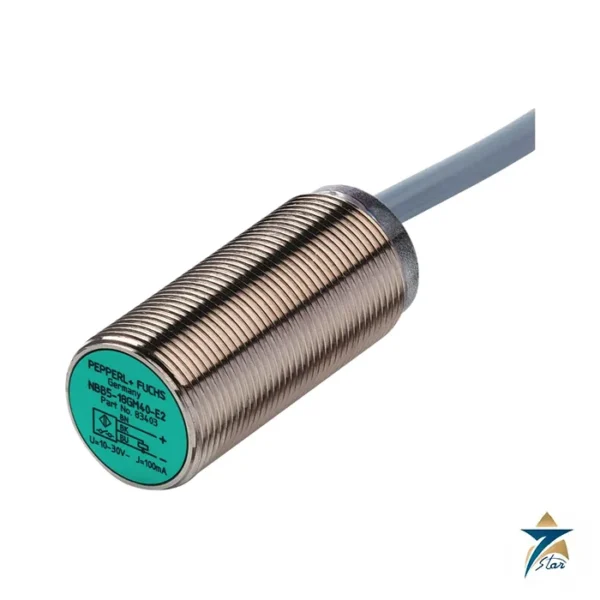
Some installations need the quick-change convenience of a plug but cannot afford a sensor body that is longer than the thread. The Autonics PRW18-8DN answers with a short 300 mm pigtail ending in an M12 connector, attached to an 18 mm non-flush barrel with 8 mm of sensing distance. It is wired for NPN normally open switching on 12 to 24 V DC. Seven Star LLC is an independent supplier serving Oman and the GCC.

Meaning of the letters in Autonics PRW18-8DN

The PR prefix again marks the cylindrical DC three-wire family. The W that follows is the connection marker for a cable connector type, a fixed short cable ending in an M12 plug. The number 18 is the sensing face diameter, and 8 is the sensing distance in millimetres, which in this series is the non-flush rating for 18 mm bodies. D is the 12 to 24 V DC supply and N the NPN normally open output.

Parameters of the Autonics PRW18-8DN

Item Value
Thread M18 x 1
Installation Non-flush
Sensing distance 8 mm; setting 0 to 5.6 mm
Standard target Iron, 25 x 25 x 1 mm
Response frequency 350 Hz
Hysteresis 10 percent or less
Supply 12 to 24 V DC, 10 to 30 V DC operating
Output NPN normally open, 200 mA or less
Cable 5 mm diameter, 3-wire, 300 mm, with M12 connector
Protection IP67, minus 25 to plus 70 degrees C
Weight about 58 g, about 70 g packaged

How the Autonics PRW18-8DN differs from other PR18 variants

Compared with the straight cable PR18-8DN, which has the same 8 mm reach and 350 Hz response but a 2 m cable and a weight of about 110 g, the Autonics PRW18-8DN drops to about 58 g because the cable is only 300 mm long. The pigtail makes it simple to run a fixed harness to a junction point and to replace the sensor without cutting wire. Compared with the flush PR18-5DN the reach rises from 5 mm to 8 mm, the target grows from 18 to 25 mm square, and the response drops from 500 to 350 Hz. Non-flush bodies need clear zones of 14 mm in front of the face and a 54 mm free diameter.

Electrical data worth knowing for the Autonics PRW18-8DN

The brown wire carries the 12 to 24 V DC supply, the blue wire is 0 V, and the black wire is the switched output. Current consumption is 10 mA or less and the output can handle 200 mA, with a residual voltage of 1.5 V or less across the output transistor, so a small relay or a PLC input is easy to drive. The sensor is protected against surge, output short circuit and reverse connection, and has an insulation resistance of 50 megohm or more at 500 V DC. Between the live parts and the case the dielectric strength is 1,500 V AC for one minute. The permitted vibration is 1 mm double amplitude from 10 to 55 Hz for two hours in each axis, and the shock rating is 500 m/s2, three times in each axis.

The ambient limits are minus 25 to plus 70 degrees C in operation and minus 30 to plus 80 degrees C in storage, with 35 to 95 percent relative humidity and no freezing or condensation. In the Gulf summer, cabinets and machine frames can exceed these limits, so mount the sensor where air can circulate and shade it from direct sun. The housing is IP67 rated and tolerates temporary immersion, but the pigtail connector should be fully tightened and kept out of standing water. The PVC cable jacket is the standard black type; an oil resistant grey cable version is selected with a V at the end of the code and is a different order code.

For machine builders, the sensing distance changes by no more than plus or minus 10 percent between minus 25 and plus 70 degrees C relative to the value at 20 degrees C, so a setting of 5.6 mm remains inside the working zone through the seasons. Remember that 5.6 mm is already the recommended 70 percent of the 8 mm rated distance.

Applications

The extended reach suits shafts, flanges and gates where the target cannot be brought close. Typical examples include cylinder end checks, pallet stops, and press guard monitoring. In Oman, similar M18 sensors are widely used on conveyors in food, cement and logistics plants, and on water treatment valve actuators. Pigtail types appear in moving or vibrating positions where a rigid connector at the barrel would strain, since the flexible 300 mm lead takes up the movement.

Fitting and wiring

Thread the barrel into the bracket with two nuts and a washer, taking care not to exceed 14.7 N m. Keep neighbouring sensors at least 48 mm apart face to face and 54 mm side by side. The mating cable is a standard M12 type from the C series sold separately; for NPN the load lies between the positive supply and the black output. Fasten the connector thread to 0.39 to 0.49 N m. Do not pull the 5 mm cable with a force over 50 N.

Selecting the right gap

Work at 70 percent of the rated distance, 5.6 mm, and check the real target. Metals other than iron shorten the distance, and a target smaller than 25 x 25 mm will do so too. Remember that the metal that surrounds a non-flush head also disturbs the field, so a clear collar is required.

Routine inspection

Look at the face for swarf or oil, check the connector for loose locking and corroded pins, and test the red indicator by passing a steel tool in front. A defective unit is replaced as a whole. Keep a spare on hand for lines where a stop is costly, and lock the supply before disconnecting plugs.

Plan the harness so that the pigtail is never stretched across a moving part and that the mated connector rests in a clip. A tidy installation avoids sudden failures that come from pulled leads, which are the usual cause of intermittent signals on conveyor equipment, especially where operators step near the cabling during cleaning rounds.

Related items you may also need: Autonics E40S6-2500-6-L-5 Rotary Encoder Incremental | SICK IME12-04BPPZC0S Inductive Sensor | SICK IME18-20NNSZC0K M18 Inductive Sensor, 20 mm Triple Range | All Autonics products.

Documents and quotation

The manual for the Autonics PR series that covers the Autonics PRW18-8DN is attached with its ordering table, diagrams and spacing data. Please send an RFQ with the part number Autonics PRW18-8DN, quantity and destination in Oman or the GCC.

Other Models in the PR Range

Seven Star LLC supplies models from the PR range in Oman and the GCC. Compare the related models below and request a quote for the one that matches your application.

ModelCategory
Autonics PR18-8DN M18 Inductive Proximity Sensor 8 mmInductive Proximity SensorsView details
Autonics PR12-4DN M12 Inductive Proximity Sensor 4 mm NPN NOInductive Proximity SensorsView details
Autonics PR30-10DN M30 Flush Inductive Proximity Sensor NPNInductive Proximity SensorsView details
Autonics PRCM18-5DN M18 Connector Inductive Proximity SensorInductive Proximity SensorsView details
Autonics PRW18-8DN M18 Cable Connector Inductive SensorInductive Proximity SensorsYou are viewing this model
Datasheets & Documents
  • PDF Datasheet Autonics PRW18-8DN M18 Cable Connector Inductive Sensor Datasheet Download
Reviews (0)

Reviews

There are no reviews yet.

How would you rate this product?

It takes about 10 seconds — just tap a star. Your email is never published.

About brand

Autonics is a South Korean maker of sensors and controllers, founded in 1977 as a small engineering business making controllers for looms. It took the Autonics name in 1988 and opened a new corporate headquarters in Busan in 2014. Autonics makes proximity and photoelectric sensors, rotary encoders, temperature controllers, counters, timers and stepper motor systems, with factories in Busan and Yangsan.

Seven Star LLC lists the Autonics E40S6-2500-6-L-5 incremental rotary encoder and supplies Autonics sensors and control devices in Oman and the GCC.

Autonics company profile

Founded 1977, South Korea
Current name Autonics, since 1988
Headquarters Busan, South Korea
Factories Busan and Yangsan
Product families E40 and E50 rotary encoders, PR proximity sensors, BJ photoelectric sensors, TK temperature controllers

Milestones

  • 1977: The company is founded.
  • 1988: Renamed Autonics Corporation.
  • 2014: Opens its Busan headquarters.

Reading the Autonics E40S encoder code

E40S is the 40 mm diameter shaft-type incremental encoder, and the 6 that follows is the 6 mm shaft. 2500 is the resolution in pulses per revolution. The next 6 means six output signals: A, B and Z with their inverted signals. L is a line driver output and the final 5 is a 5 V DC supply. The same 40 mm body is made in hollow shaft form as the E40H and E40HB series.

Where Autonics encoders are used

Servo and spindle feedback, conveyor length measurement, packaging and printing machines.

Ordering Autonics encoders: what we need

Send the complete model string from the label. If it is worn off, give the body and shaft diameter, pulses per revolution, output type, supply voltage and cable or connector style.

Facts checked against Autonics corporate profiles, October 2026.

FAQ

Questions about the Autonics PRW18-8DN M18 Cable Connector Inductive

Answers from our engineering team on installation, compatibility and integration.

01What does the W mean in Autonics PRW18-8DN?
The W marks a cable connector type: a short 300 mm cable ending in an M12 connector, in place of a long fixed cable or a plug on the barrel.
02What is the sensing distance of the Autonics PRW18-8DN?
It is 8 mm for the non-flush 18 mm head, with a recommended setting distance of 0 to 5.6 mm on a 25 x 25 x 1 mm iron target.
03How fast does the Autonics PRW18-8DN respond?
The average response frequency is 350 Hz, a little lower than the 500 Hz of the flush 5 mm PR18 sensors.
04Is the Autonics PRW18-8DN NPN or PNP?
It is NPN with a normally open output up to 200 mA, powered from 12 to 24 V DC, and the PNP sensors use a P in the last position of the code.
05How much does the Autonics PRW18-8DN weigh?
The manual lists about 58 g for the unit and about 70 g in the package, which is lighter than the 2 m cable version.