- Automation & ControlView all 3,111 products
- Automation Accessories
- AC Drives
- PLC & I/O Cards
- Industrial Communications
- Vibration Monitoring
- Isolator & Barrier
- Controllers & Data Acquisition
- Safety Switches & Guard Locking
- Encoders
- Motor Soft Starters
- CCTV & Security
- Pneumatic Cylinders
- HMI Displays
- Servo Drives
- Industrial Computers
- Machine Vision
- Automation Software
- Robotics
Brand: Autonics
Autonics MD5-ND14 5-Phase Stepper Motor Driver, 20-35 V DC
Description
Overview
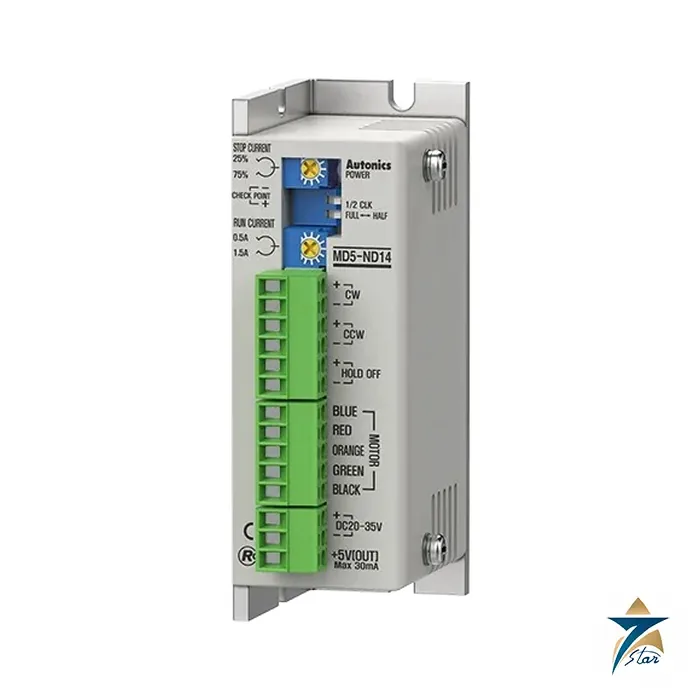
Not every stepper axis needs sixteen resolution settings, and for plain, economical positioning the Autonics MD5-ND14 offers a leaner answer. It drives Autonics five-phase stepper motors from a 20 to 35 V DC supply using a bipolar constant-current pentagon method, with a RUN current set between 0.5 and 1.5 A per phase and two selectable resolutions, full step at 0.72 degrees and half step at 0.36 degrees. The result is the usual five-phase benefit, a small step angle with good low-speed smoothness, in a compact driver. Seven Star LLC is an independent supplier serving Oman and the GCC.
Meaning of the Autonics MD5-ND14 switches and signals
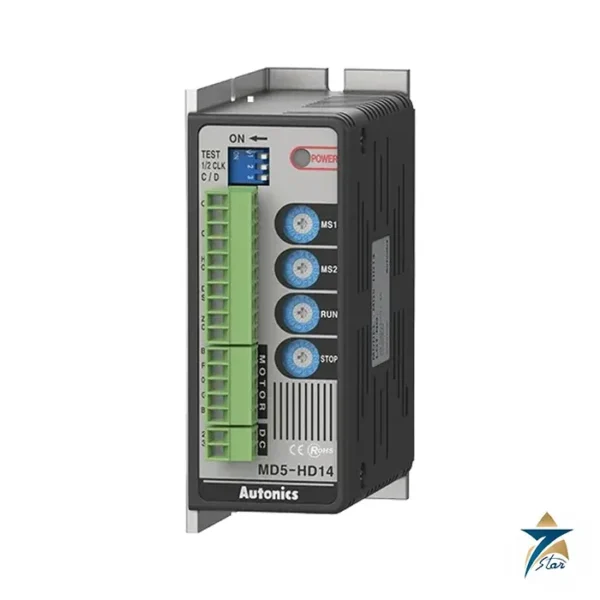
Everything is set on the front panel. A rotary switch selects RUN current across sixteen positions, another selects stop current from 25 to 75 percent of RUN current, and a DIP switch chooses between one-pulse and two-pulse command modes and enables or disables the automatic current-down function. In one-pulse mode the CW input carries the pulses and the CCW input carries the direction level, high for forward and low for reverse. In two-pulse mode, CW pulses move the motor forward and CCW pulses move it backward, but the manual warns never to give both signals at the same time, as the driver may then fail to operate properly.
Data table for Autonics MD5-ND14
| Parameter | Instruction manual value |
|---|---|
| Supply | 20 to 35 V DC (90 to 110 percent permissible) |
| Maximum current consumption | 3 A at 25 degrees C and 55 percent RH |
| RUN current | 0.5 to 1.5 A per phase |
| Stop current | 25 to 75 percent of RUN current |
| Drive method | Bipolar constant current pentagon |
| Basic step angle | 0.72 degrees per step |
| Resolution | 1 division (0.72 degrees) or 2 division (0.36 degrees) |
| Pulse width | 10 microseconds or more on CW and CCW; 1 ms for hold off |
| Maximum pulse frequency | 50 kHz |
| Pulse levels | High 4 to 8 V DC, low 0 to 0.5 V DC, 7.5 to 14 mA |
| Input resistance | 390 ohm on CW, CCW and hold off |
| Insulation | 100 megohm or more at 500 V DC |
| Dielectric strength | 1000 V AC for 1 minute |
| Noise immunity | plus or minus 500 V square wave, 1 microsecond |
| Ambient temperature | 0 to 40 degrees C; humidity 35 to 85 percent RH |
How Autonics MD5-ND14 differs from other MD5 drivers
The comparison with the micro-step MD5-HD14 shows the trade-off. The HD14 offers sixteen resolutions down to 0.00288 degrees, a 500 kHz pulse input, a zero-point output, and RUN current of 0.4 to 1.4 A. The Autonics MD5-ND14 has only two resolutions, a 50 kHz limit and a slightly higher current range of 0.5 to 1.5 A, so it can drive somewhat larger motors. If your controller is a basic PLC with a pulse output of a few tens of kilohertz, the 50 kHz limit is usually not an obstacle, and the lower cost and simpler setting are an advantage.
Applications across Oman and the GCC
Basic indexing tables, conveyors with exact stop positions, small dispensing pumps, valve positioners on test stands and film or label feeding mechanisms all use five-phase steppers of this kind. In regional workshops, the Autonics MD5-ND14 is a common replacement when an older driver fails, since the front panel switches make it easy to copy the previous settings. It suits clean indoor cabinets in water treatment panels, packaging machines and laboratory equipment.
Wiring and mounting
Provide a supply of AWG18 cable or thicker with an over-current device, and install the driver in a cabinet with air movement. Keep signal wires in twisted pair under 2 m long and at least 10 cm from power cables. If the signal voltage is higher than the rated input, add an external resistor. When extending the motor cable use a thicker one than the lead cable of the motor. Never change switch positions while the motor is turning, and wait one second before re-applying power after switching off. The motor lead colours given in the manual apply to Autonics motors only.
Operating notes and fault finding
If the supply exceeds 30 V DC, high-speed torque improves but the driver warms more, so allow ventilation. Check bolts, bearings noise and cable condition regularly. If the motor will not excite, check the pulse wiring and levels, and if the direction is opposite, invert the direction signal. For vertical loads, fit a mechanical brake because the driver does not hold the load when the supply is lost, and do not rely on it as a protection device for the motor.
Why a five-phase motor with the Autonics MD5-ND14
A five-phase stepper has ten poles per phase pair arrangement that gives a basic step of 0.72 degrees, half the 1.8 degrees of a common two-phase motor, so it reaches finer positioning without electronic subdivision. Torque ripple is also lower, which means less resonance in the middle speed range and less vibration transmitted to the machine frame. With the Autonics MD5-ND14, the half-step setting reduces the step to 0.36 degrees, which is often enough for conveyors, indexers and feeders. When a gear motor is used, the manual notes that the step angle is divided by the reduction ratio, so a 1 to 10 gearbox turns 0.72 degrees into 0.072 degrees at the output shaft. This is why the simple driver remains popular for repeatable, moderate-speed positioning where a servo system would be an expense without benefit.
Specifying the Autonics MD5-ND14
Quote the full code Autonics MD5-ND14, and send details of the motor model and its rated current so the RUN current switch position can be suggested. Cables and the matching motor can be included in the same enquiry.
Related items you may also need: Autonics E40S6-2500-6-L-5 Rotary Encoder Incremental | SICK WTB8-P2231 Miniature Background Suppression Sensor | SICK VTE18-4P4240 M18 Diffuse Photoelectric Sensor, 400 mm | All Autonics products.
Documents and quotation
The instruction manual that applies to the Autonics MD5-ND14 is attached to this page with its dimensions, switch tables and timing charts. Please send your RFQ with Autonics MD5-ND14, the quantity and your delivery location in Oman or the GCC.
Other Models in the Md5 Range
Seven Star LLC supplies models from the Md5 range in Oman and the GCC. Compare the related models below and request a quote for the one that matches your application.
| Model | Category | |
|---|---|---|
| Autonics MD5-HD14 Micro Step 5-Phase Stepper Motor Driver | Photoelectric Sensors | View details |
| Autonics MD5-ND14 5-Phase Stepper Motor Driver, 20-35 V DC | Photoelectric Sensors | You are viewing this model |
Datasheets & Documents
- Datasheet Autonics MD5-ND14 5-Phase Stepper Motor Driver, 20-35 V DC Datasheet Download
Reviews (0)
How would you rate this product? Cancel reply
About brand
Autonics is a South Korean maker of sensors and controllers, founded in 1977 as a small engineering business making controllers for looms. It took the Autonics name in 1988 and opened a new corporate headquarters in Busan in 2014. Autonics makes proximity and photoelectric sensors, rotary encoders, temperature controllers, counters, timers and stepper motor systems, with factories in Busan and Yangsan.
Seven Star LLC lists the Autonics E40S6-2500-6-L-5 incremental rotary encoder and supplies Autonics sensors and control devices in Oman and the GCC.
Autonics company profile
| Founded | 1977, South Korea |
|---|---|
| Current name | Autonics, since 1988 |
| Headquarters | Busan, South Korea |
| Factories | Busan and Yangsan |
| Product families | E40 and E50 rotary encoders, PR proximity sensors, BJ photoelectric sensors, TK temperature controllers |
Milestones
- 1977: The company is founded.
- 1988: Renamed Autonics Corporation.
- 2014: Opens its Busan headquarters.
Reading the Autonics E40S encoder code
E40S is the 40 mm diameter shaft-type incremental encoder, and the 6 that follows is the 6 mm shaft. 2500 is the resolution in pulses per revolution. The next 6 means six output signals: A, B and Z with their inverted signals. L is a line driver output and the final 5 is a 5 V DC supply. The same 40 mm body is made in hollow shaft form as the E40H and E40HB series.
Where Autonics encoders are used
Servo and spindle feedback, conveyor length measurement, packaging and printing machines.
Ordering Autonics encoders: what we need
Send the complete model string from the label. If it is worn off, give the body and shaft diameter, pulses per revolution, output type, supply voltage and cable or connector style.
Facts checked against Autonics corporate profiles, October 2026.
Browse Autonics products by category: Encoders.
FAQ
Questions about the Autonics MD5-ND14 5-Phase Stepper Motor Driver,
Answers from our engineering team on installation, compatibility and integration.
01What is the RUN current range of the Autonics MD5-ND14?
The RUN current can be set from 0.5 to 1.5 A per phase and the stop current from 25 to 75 percent of the RUN current.
02Which resolutions does the MD5-ND14 support?
It supports 1 division at 0.72 degrees per step and 2 division at 0.36 degrees per step for five-phase stepper motors.
03What pulse frequency can the MD5-ND14 accept?
The CW and CCW inputs accept up to 50 kHz with a pulse width of at least 10 microseconds and a duty rate of 50 percent.
04What supply does the MD5-ND14 need?
A 20 to 35 V DC supply is required, and the maximum current consumption is 3 A at 25 degrees C.
05Can the MD5-ND14 be used with one-pulse and two-pulse controllers?
Yes. A DIP switch selects either one-pulse input, with a direction level, or two-pulse input, with separate CW and CCW pulse lines.


Reviews
There are no reviews yet.