Brand:

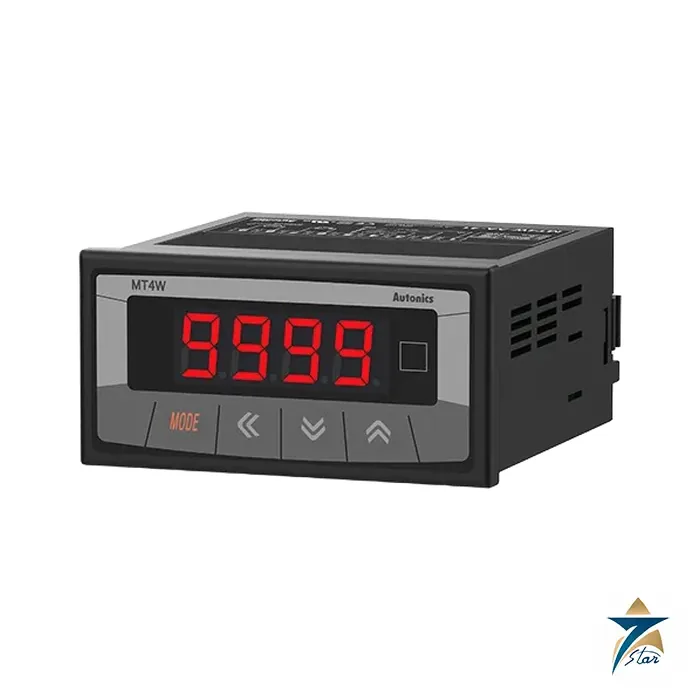
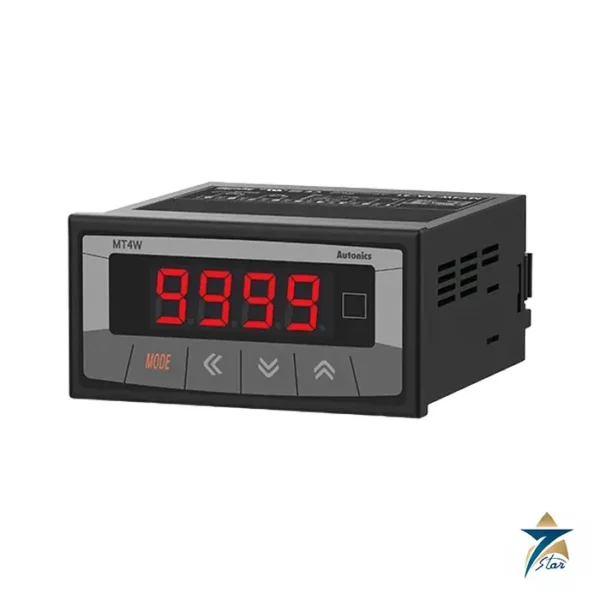
Autonics MT4W-AV-4N 4-Digit AC Voltage Panel Meter

Description

Overview

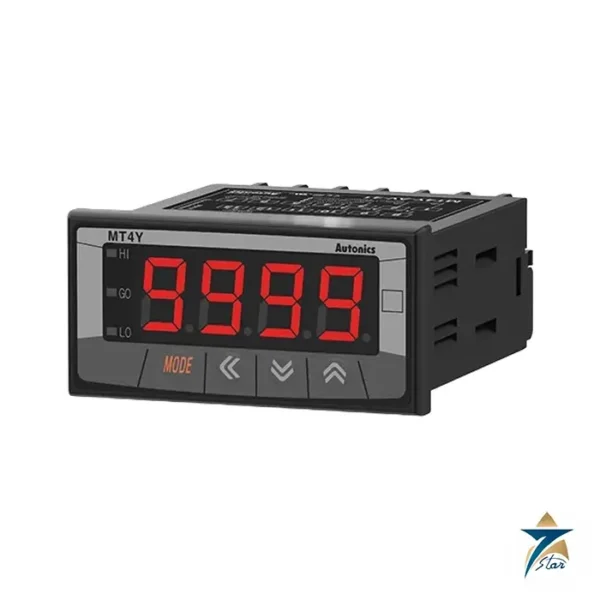
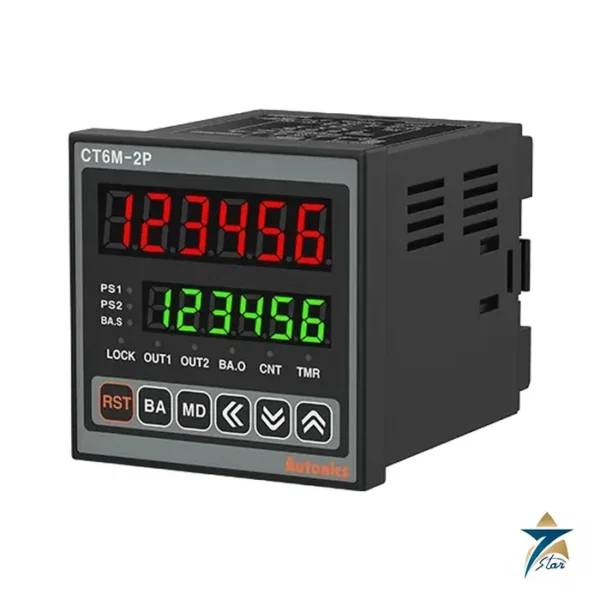
Reading mains voltage on a switchboard, a generator panel or a test bench is a job for the Autonics MT4W-AV-4N, the AC voltage version of the MT4W panel meter. It displays AC voltage in four digits on a 96 x 48 mm red LED display, accepts ranges up to 500 V AC directly, can show true RMS or average RMS values, and can alternatively display frequency. Its supply is 100 to 240 V AC and it has no outputs, which keeps it a simple indicator. Seven Star LLC is an independent supplier serving Oman and the GCC.

Meaning of the code Autonics MT4W-AV-4N

MT4W marks the four-digit multi panel meter in the 96 x 48 mm size. AV is the AC voltage input; compare DV for DC voltage, DA for DC current and AA for AC current. The digit 4 is the supply of 100 to 240 V AC, and the N indicates that no preset output or sub output is fitted. The manual adds that, if the frequency display is selected, no output would be provided even on models that have one.

Technical data of Autonics MT4W-AV-4N

Item Data
Input AC voltage: 2 V or 1 V, 20 V or 10 V, 110 V or 50 V, 500 V or 250 V terminals
Allowable input 10 to 110 percent of full scale of each range
Measurement method True RMS or average RMS, selectable
Frequency display 1 to 9999 Hz at decimal point 0
Display Red 7-segment LED, 14.2 mm, minus 1999 to 9999
Accuracy 0.1 percent F.S. plus or minus 2 digit at 23 degrees C plus or minus 5 (frequency display); 0.5 percent plus or minus 3 digit from minus 10 to plus 50 degrees C
Sampling cycle 16.6 ms for AC types
Supply 100 to 240 V AC 50/60 Hz, 5 VA
Insulation 100 megohm or more at 500 V DC; 3,000 V AC dielectric
Ambient minus 10 to plus 50 degrees C
Protection IP56 front
Weight about 211 g, about 326 g packaged

How the Autonics MT4W-AV-4N differs from other MT4W variants

The AV model covers AC voltage where its sibling the MT4W-DV-4N covers DC voltage, and the allowable input is narrower, only 10 to 110 percent of the range, because an AC meter cannot read a signal near zero reliably. The sampling cycle also differs, 16.6 ms for AC as against 50 ms for DC, so that the AC waveform is captured within a cycle at 50 or 60 Hz. The AV input has the extra choice of true RMS or average RMS and a frequency display, which DC models do not offer. The AA codes would measure AC current in the same way, using shunt or transformer inputs.

True RMS or average RMS

A true RMS meter computes the effective value of the waveform, so it stays correct with distorted signals such as those from inverters, thyristor controllers and switched loads. An average-responding meter calibrated in RMS is exact only for a pure sine wave. The manual offers both through a parameter, T.RMS and A.RMS. In a clean 230 V AC distribution panel the two read almost the same; behind a variable speed drive or a dimmer, true RMS is the safe choice. The manual also includes an example with a voltage transformer, where a 110 V AC input is shown as 440 V AC by a preset scale value, convenient for readings at the primary side of a transformer.

Frequency display

With the display type set to frequency, the same terminals read mains or generator frequency, from 1 to 9999 Hz at no decimal point, down to 0.100 to 9.999 Hz with three decimals. This is helpful on generator sets, where voltage and frequency must be watched together. Note that no output is provided in this mode, and that the meter then acts as a plain indicator.

Reading generator and mains panels with the Autonics MT4W-AV-4N

On a generator panel the voltage seldom sits at a fixed value: it dips when large motors start and rises when load is shed. The 16.6 ms sampling cycle of the AC types means that the display follows these swings smoothly, and the display shows values from minus 1999 to 9999, so a 415 V reading is shown directly if the 500 V terminal is used. For voltages above the 500 V terminal, or for a measurement on the high-voltage side of a transformer, the scale parameters let the meter show the primary value computed from the secondary signal, as in the manual’s example in which a 110 V input is displayed as 440 V.

The minimum measurable input is 10 percent of the range, so a 500 V terminal will not display a 20 V signal accurately; select the 50 V or 110 V terminal for such readings. The manual also warns that accuracy degrades if the maximum input is under 30 percent of the terminal range, which is another reason to choose the smallest range that covers the signal. In a three-phase panel, one meter and a selector switch can read all phase voltages in turn, but separate meters give a continuous overview and avoid operator error.

Applications in Oman and the GCC

Panel voltmeters appear on distribution boards, generator control panels, welding and heating equipment, and test benches. In remote sites that depend on diesel generators, a clear voltage and frequency display is part of daily checks. With IP56 front protection, the meter can be fitted into doors of indoor panels exposed to dust.

Installation

Cut the opening, insert the meter, and fix it with the bracket. Wire the supply to the source terminals and the measured voltage between the common terminal and the terminal for the chosen range. For voltages above the range, use a voltage transformer and scale the display. Observe isolation clearance when measuring a voltage above the supply, and protect the circuit with a fuse. Keep measuring wires away from noisy cables.

Maintenance

Wipe the front with a dry cloth, and check terminal tightness periodically. Verify accuracy against a calibrated source at your quality system interval. The meter has no relay to wear, so service life depends mainly on the ambient temperature, which must stay below 50 degrees C.

Related items you may also need: Autonics E40S6-2500-6-L-5 Rotary Encoder Incremental | SICK VL18L-4P324 M18 Laser Retro-Reflective Sensor, 30 m | SICK GLL170-P334 GLL170 Fiber-Optic Amplifier, PNP | All Autonics products.

Documents and quotation

The MT4W series product manual covering the Autonics MT4W-AV-4N is attached with ordering information, ranges, wiring and dimensions. Send an RFQ with the part number Autonics MT4W-AV-4N, quantity and delivery location in Oman or the GCC.

Datasheets & Documents
  • PDF Datasheet Autonics MT4W-AV-4N 4-Digit AC Voltage Panel Meter Datasheet Download
Reviews (0)

Reviews

There are no reviews yet.

How would you rate this product?

It takes about 10 seconds — just tap a star. Your email is never published.

About brand

Autonics is a South Korean maker of sensors and controllers, founded in 1977 as a small engineering business making controllers for looms. It took the Autonics name in 1988 and opened a new corporate headquarters in Busan in 2014. Autonics makes proximity and photoelectric sensors, rotary encoders, temperature controllers, counters, timers and stepper motor systems, with factories in Busan and Yangsan.

Seven Star LLC lists the Autonics E40S6-2500-6-L-5 incremental rotary encoder and supplies Autonics sensors and control devices in Oman and the GCC.

Autonics company profile

Founded 1977, South Korea
Current name Autonics, since 1988
Headquarters Busan, South Korea
Factories Busan and Yangsan
Product families E40 and E50 rotary encoders, PR proximity sensors, BJ photoelectric sensors, TK temperature controllers

Milestones

  • 1977: The company is founded.
  • 1988: Renamed Autonics Corporation.
  • 2014: Opens its Busan headquarters.

Reading the Autonics E40S encoder code

E40S is the 40 mm diameter shaft-type incremental encoder, and the 6 that follows is the 6 mm shaft. 2500 is the resolution in pulses per revolution. The next 6 means six output signals: A, B and Z with their inverted signals. L is a line driver output and the final 5 is a 5 V DC supply. The same 40 mm body is made in hollow shaft form as the E40H and E40HB series.

Where Autonics encoders are used

Servo and spindle feedback, conveyor length measurement, packaging and printing machines.

Ordering Autonics encoders: what we need

Send the complete model string from the label. If it is worn off, give the body and shaft diameter, pulses per revolution, output type, supply voltage and cable or connector style.

Facts checked against Autonics corporate profiles, October 2026.

FAQ

Questions about the Autonics MT4W-AV-4N 4-Digit AC Voltage Panel Meter

Answers from our engineering team on installation, compatibility and integration.

01What does the Autonics MT4W-AV-4N measure?
AC voltage on ranges of 1 V, 2 V, 10 V, 20 V, 50 V, 110 V, 250 V and 500 V, shown on a 4-digit red LED display from minus 1999 to 9999.
02Does the Autonics MT4W-AV-4N read true RMS?
Yes, a parameter selects true RMS or average RMS, and the true RMS setting is the better choice for distorted waveforms.
03Can the Autonics MT4W-AV-4N display frequency?
Yes, the frequency display covers 1 to 9999 Hz at decimal point 0, and no output is provided while it is selected.
04What supply does the Autonics MT4W-AV-4N use?
The digit 4 indicates 100 to 240 V AC at 50/60 Hz, with a consumption of 5 VA.
05Does the Autonics MT4W-AV-4N have outputs?
No, the N means indicator only, with no preset output and no sub output.