Brand:

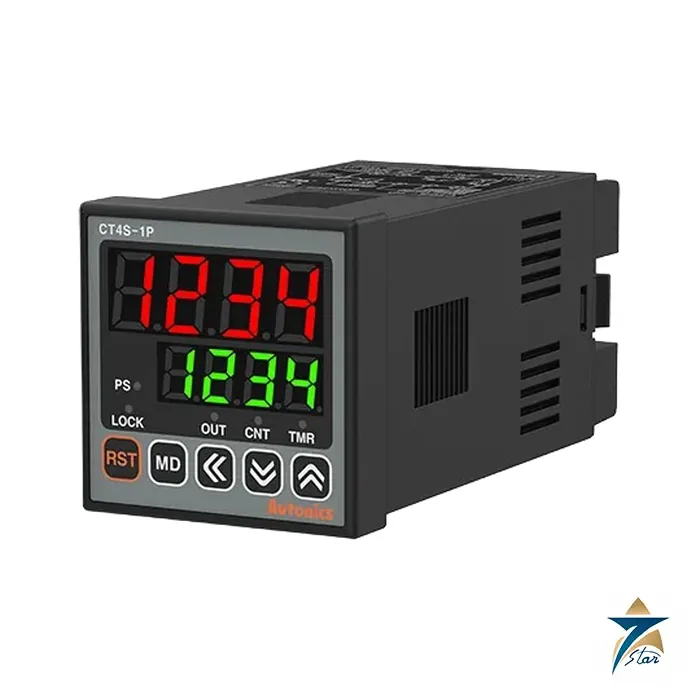
Autonics CT4S-1P4 48×48 4-Digit Counter/Timer 1-Stage

Description

Overview

Where a machine only needs to count to one number and then act, the simplest tool is the Autonics CT4S-1P4: a 48 x 48 mm four-digit programmable counter/timer with a single preset, one SPDT relay output, one NPN open collector output and a 100 to 240 V AC supply. Despite its small case, it offers the same input logic and scaling features as its larger relatives, plus a bright red count display with large 6.5 x 10 mm characters. Seven Star LLC is an independent supplier serving Oman and the GCC.

Breaking down Autonics CT4S-1P4

CT is the counter/timer family and 4 is the number of display digits. S is the 48 x 48 mm size. In the group after the dash, 1P is the one-stage preset output, and the last digit 4 stands for the 100 to 240 V AC supply. No T follows, so there is no RS485 port.

Specifications of Autonics CT4S-1P4

Item Data
Display 4-digit LED, count value red 6.5 x 10 mm, setting value green 4.5 x 8 mm
Counting range minus 999 to 9,999 (varies with decimal point)
Modes Counter: up, down, up/down; timer: up, down
Counting speed 1 cps, 30 cps, 1 kcps, 5 kcps, 10 kcps
Preset One stage
Relay output SPDT (1c) x 1, 250 V AC 5 A, 30 V DC 5 A resistive
Open collector NPN x 1, 30 V DC, 100 mA
Input logic PNP voltage input or NPN no-voltage input
Supply 100 to 240 V AC 50/60 Hz, 12 VA or less
Sensor supply 12 V DC plus or minus 10 percent, 100 mA
One-shot output 0.01 to 99.99 s
Vibration and shock 0.75 mm 10 to 55 Hz 1 hour; 300 m/s2
Ambient minus 10 to plus 55 degrees C
Protection IP65 front
Weight about 159 g, about 212 g packaged

How the Autonics CT4S-1P4 differs from other CT variants

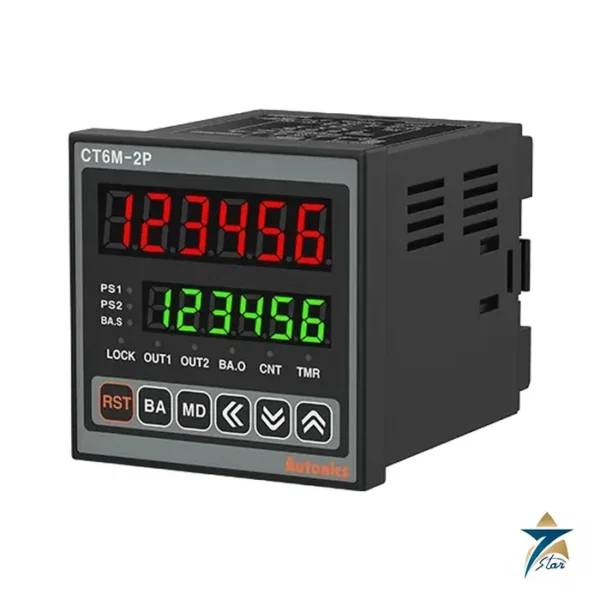
The step to a CT6S model adds two digits and widens the count range from minus 999 to 9,999 to minus 99,999 to 999,999, but it shrinks the characters from 6.5 x 10 mm to 4.5 x 10 mm. A 2P code replaces the single SPDT relay with two SPST relays and adds a second preset. The Autonics CT4S-1P4 keeps the simplest arrangement: one relay with change-over contacts and one open collector output. It also has no batch counter, which is reserved for the 72 x 72 mm CT6M-1P and 2P codes, and it is lighter than the CTM at about 252 g.

Counting setup

The parameter C-T selects counter or timer operation, and IN selects the input mode. In UP, UP-1 and UP-2 the display counts upward, in DN modes downward, and UD-A, UD-B and UD-C serve up/down counting with command, individual or phase-difference signals; the manual lists UD-C as the default. The preset is entered by pressing the left arrow key, adjusting the digits and returning to run mode with the MD key. A preset of zero is refused or produces the ERR0 message, and in the timer mode the output follows the operation mode chosen by the output parameter.

Where it works

Single preset counters appear on bag fillers, stamping presses, label dispensers, shears, conveyors that count parcels and test benches. In Oman and the GCC, the compact housing is often fitted to retrofit panels in packaging, water bottling and workshop machinery. Using the timer function, the same unit can monitor the run time of a pump, the dwell of a heater or the open time of a valve. The IP65 front resists splashes in production areas.

Scaling and display choices on the Autonics CT4S-1P4

A four-digit display limits the count to 9,999 in the positive direction, which is more than enough for most batch and cycle counts but not for total production counts, so decide whether the display must show a running total or a reset-able batch. The decimal point and prescale parameters let the counter multiply pulses by a constant: with a prescale of 0.069 and one decimal place, for example, the manual shows how a conveyor encoder can be read in 0.1 mm units. Prescaling avoids a separate converter and keeps the preset in physical units, so an operator enters the length or quantity he knows and not the pulse count. The setting value display in green shows the preset in run mode, while the red display shows the live count, and the indicator lamps show the state of the output, the key lock and the preset being edited.

If the counter is used with an encoder, choose a phase-difference input mode such as UD-C so that direction is decoded from the two channels; with a single sensor choose one of the UP or DN modes. Selecting the wrong input mode is the commonest reason for a count that runs backwards or doubles.

Signal levels and wiring

Switch the input logic before connecting sensors. To change between NPN and PNP, power down, detach the case with the clip as the manual illustrates, move the internal switch, power up and press reset. A voltage input uses 5 to 30 V DC for high and 0 to 2 V DC for low, with an impedance of 5.4 kilohm; a no-voltage input needs a short-circuit impedance below 1 kilohm. Use the built-in 12 V DC, 100 mA supply for proximity or photoelectric sensors, and keep input wiring apart from power cables to avoid noise counts.

Speed settings

At 30 cps the minimum signal width is 16.7 ms and at 1 kcps it is 0.5 ms; at 5 kcps and 10 kcps the widths shrink to 0.1 and 0.05 ms. Contact inputs such as limit switches should only be used at 1 or 30 cps, so that bounce is filtered out. Choose the lowest speed that your process needs, as this gives the best noise immunity.

Care

The unit retains settings for about ten years without a battery. Check relay wear against 100,000 electrical operations, and do not use the relay for loads above 5 A. Use a key lock to protect the settings, and clean the front with a dry cloth. Replace the case only with the power off.

Related items you may also need: Autonics E40S6-2500-6-L-5 Rotary Encoder Incremental | SICK WTB26P-3B111120ZZZ W26 Background Suppression Sensor | SICK WL4SLG-3P5254H W4 Retro-Reflective Sensor | All Autonics products.

Documents and quotation

The CT series product manual covering the Autonics CT4S-1P4 is attached to this page with ordering codes, parameters, connection diagrams and dimensions. Send an RFQ with the part number Autonics CT4S-1P4, quantity and delivery location in Oman or the GCC.

Other Models in the CT Range

Seven Star LLC supplies models from the CT range in Oman and the GCC. Compare the related models below and request a quote for the one that matches your application.

ModelCategory
Autonics CT6S-1P4 6-Digit Counter Timer 48×48 mmControllers & Data AcquisitionView details
Autonics CT6M-2P4 72×72 Six-Digit Counter/Timer 2-StagePhotoelectric SensorsView details
Autonics CT4S-1P4 48×48 4-Digit Counter/Timer 1-StagePhotoelectric SensorsYou are viewing this model
Datasheets & Documents
  • PDF Datasheet Autonics CT4S-1P4 48x48 4-Digit Counter/Timer 1-Stage Datasheet Download
Reviews (0)

Reviews

There are no reviews yet.

How would you rate this product?

It takes about 10 seconds — just tap a star. Your email is never published.

About brand

Autonics is a South Korean maker of sensors and controllers, founded in 1977 as a small engineering business making controllers for looms. It took the Autonics name in 1988 and opened a new corporate headquarters in Busan in 2014. Autonics makes proximity and photoelectric sensors, rotary encoders, temperature controllers, counters, timers and stepper motor systems, with factories in Busan and Yangsan.

Seven Star LLC lists the Autonics E40S6-2500-6-L-5 incremental rotary encoder and supplies Autonics sensors and control devices in Oman and the GCC.

Autonics company profile

Founded 1977, South Korea
Current name Autonics, since 1988
Headquarters Busan, South Korea
Factories Busan and Yangsan
Product families E40 and E50 rotary encoders, PR proximity sensors, BJ photoelectric sensors, TK temperature controllers

Milestones

  • 1977: The company is founded.
  • 1988: Renamed Autonics Corporation.
  • 2014: Opens its Busan headquarters.

Reading the Autonics E40S encoder code

E40S is the 40 mm diameter shaft-type incremental encoder, and the 6 that follows is the 6 mm shaft. 2500 is the resolution in pulses per revolution. The next 6 means six output signals: A, B and Z with their inverted signals. L is a line driver output and the final 5 is a 5 V DC supply. The same 40 mm body is made in hollow shaft form as the E40H and E40HB series.

Where Autonics encoders are used

Servo and spindle feedback, conveyor length measurement, packaging and printing machines.

Ordering Autonics encoders: what we need

Send the complete model string from the label. If it is worn off, give the body and shaft diameter, pulses per revolution, output type, supply voltage and cable or connector style.

Facts checked against Autonics corporate profiles, October 2026.

FAQ

Questions about the Autonics CT4S-1P4 48×48 4-Digit Counter/Timer

Answers from our engineering team on installation, compatibility and integration.

01What does 1P mean in Autonics CT4S-1P4?
1P means a one-stage preset output, so the counter provides a single set point that operates the SPDT relay and the NPN open collector output.
02How many digits does the Autonics CT4S-1P4 display?
It has four digits, with a counting range of minus 999 to 9,999 and red characters 6.5 x 10 mm for the count value.
03What outputs does the Autonics CT4S-1P4 have?
One SPDT relay rated 250 V AC 5 A or 30 V DC 5 A resistive, and one NPN open collector output of 30 V DC and 100 mA.
04What supply does the Autonics CT4S-1P4 need?
The digit 4 means 100 to 240 V AC at 50/60 Hz, with a power consumption of 12 VA or less.
05Can the Autonics CT4S-1P4 work as a timer?
Yes, a parameter switches it between counter and timer duty, with count-up and count-down timing modes and a one-shot output time of 0.01 to 99.99 seconds.