Brand:

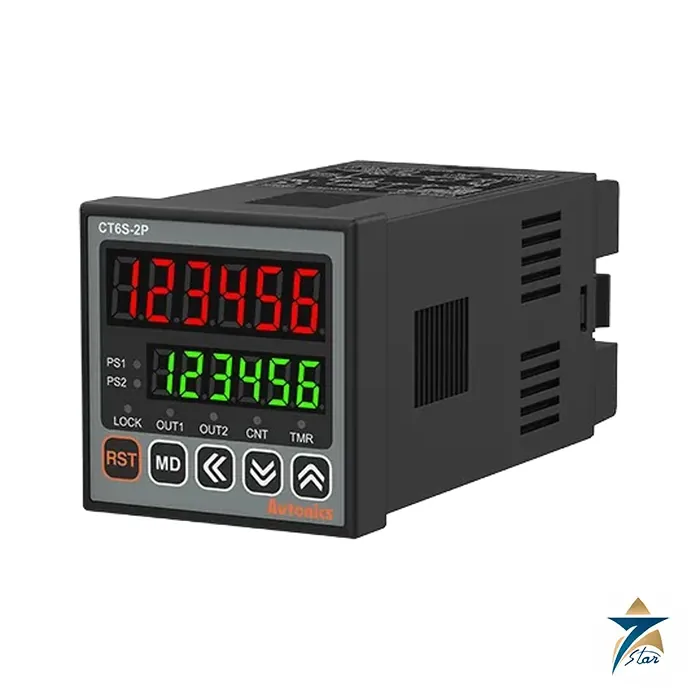
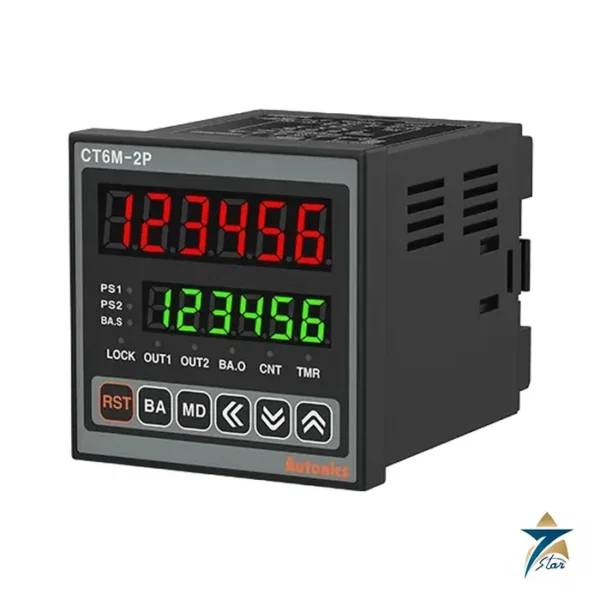
Autonics CT6S-2P2 48×48 6-Digit Counter/Timer 24 V

Description

Overview

Control panels fed from a 24 V supply need counters that run from 24 V. The Autonics CT6S-2P2 does exactly that: a 48 x 48 mm six-digit programmable counter/timer with two preset stages, powered from 24 V AC or 24 to 48 V DC, so it can share the control supply of the PLC and sensors in a low-voltage panel. It gives two SPST relays and an NPN open collector output. Seven Star LLC is an independent supplier serving Oman and the GCC.

Reading Autonics CT6S-2P2

CT is the series, 6 is the number of digits and S the 48 x 48 mm size. 2P is the two-stage preset output. The last digit, 2, is the supply code for 24 V AC plus or minus 10 percent at 50/60 Hz or 24 to 48 V DC plus or minus 10 percent; the code 4 would instead be 100 to 240 V AC. No T at the end means no RS485 communication.

Autonics CT6S-2P2 specification table

Item Data
Display 6-digit LED, count value red 4.5 x 10 mm, setting value green 3.5 x 7 mm
Counting range minus 99,999 to 999,999
Preset Two stages
Relay outputs SPST (1a) x 2, 250 V AC 5 A, 30 V DC 5 A resistive
Open collector NPN x 1, 30 V DC, 100 mA
Supply 24 V AC 50/60 Hz, 10 VA or less; 24 to 48 V DC, 8 W or less
Counting speeds 1 cps, 30 cps, 1 kcps, 5 kcps, 10 kcps
Dielectric strength 2,000 V AC for 1 minute
Noise immunity 500 V square wave, 1 microsecond
Relay life 1 million mechanical, 100,000 electrical
Memory About 10 years
Ambient minus 10 to plus 55 degrees C
Protection IP65 front
Weight about 159 g, about 212 g packaged

How the Autonics CT6S-2P2 differs from other CT variants

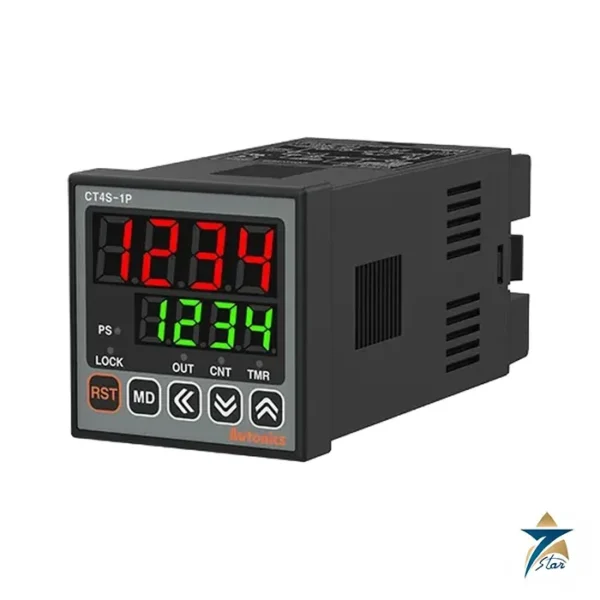
The AC version CT6S-2P4 accepts mains from 100 to 240 V AC, withstands 3,000 V AC dielectric strength and a noise level of 2 kV, and draws up to 12 VA. The low-voltage Autonics CT6S-2P2 reduces the dielectric strength to 2,000 V AC and the noise immunity to 500 V, but it draws only 10 VA on AC or 8 W on DC and fits directly onto 24 V DC panels. Relative to the CT4S-1P4, it adds two digits, a second preset and a second relay, with the relay contacts SPST instead of a single change-over contact.

Working with a 24 V supply

On a DC supply, the unit is polarity-sensitive, so check the terminal markings before applying power, and keep the voltage within 90 to 110 percent of the rating, that is between 21.6 and 26.4 V AC or the DC equivalent. With a 24 V panel it is practical to wire the sensors from the same source, but the counter also provides a 12 V DC, 100 mA output for sensors, which is convenient when the panel supply is unstable. Isolation between the supply and the case is lower than on the mains model, so do not mix the two types in a panel where a mains-rated barrier is required.

Two-stage presets in use

The first preset typically triggers a slowdown or an alarm, and the second one ends the cycle. If the two presets are accidentally entered the wrong way round, the first output is ignored and only the second one operates, as the manual explains. With the unit in timer mode, the output operation mode determines whether the outputs are ON delay, one-shot or other types; when the first preset is zero, OUT1 stays off. Each preset is set by using the left arrow and MD keys, and the unit returns to run mode after 60 seconds without key presses.

Keeping the 24 V counter reliable

Low-voltage counters have lower noise immunity than the mains versions, so wiring discipline matters. Keep the 24 V supply cables away from contactor and inverter wiring, put a surge suppressor across every inductive load that shares the supply, and use twisted or shielded pairs for pulse inputs. If a count appears without an input pulse, measure the supply for dips when relays operate. The minimum signal widths listed in the manual, 16.7 ms at 30 cps and 0.5 ms at 1 kcps, are good reference points when checking a sensor signal with an oscilloscope or when choosing between a contact and a transistor sensor.

When the counter is also used as a timer, the accuracy specification applies: the error from power-on start is 0.01 percent plus or minus 0.05 seconds and from signal start it is 0.01 percent plus or minus 0.03 seconds, small enough for most process timing but not a replacement for a precision timer in laboratory work.

Applications in Oman and the GCC

This voltage option suits skid-mounted equipment, mobile plant, solar-powered pumping stations, and OEM machinery that arrives with a 24 V control system. It counts pulses from proximity switches and encoders, measures running time and counts batches on filling, packing and conveying systems. The IP65 front is suited to operator panels that are wiped down, and the ambient limit of 55 degrees C gives some margin inside shaded cabinets.

Installation

Fit the unit through a 48 mm DIN opening with the two brackets provided, connect the supply, inputs and outputs according to the terminal diagram, and set the input logic switch inside the case with the power off. Reset by key or by an external signal of 20 ms or more. Keep the signal wires away from motor cables and use shielded cable for high-speed inputs of 1 kcps or more.

Maintenance

Inspect terminals, check that the key lock is set, and track the relay switching count against 100,000 operations at 5 A resistive load. A unit that shows ERR0 has a zero preset and must be reprogrammed. Order a spare with the same supply digit; a 2 and a 4 code look identical on the front.

Related items you may also need: Autonics E40S6-2500-6-L-5 Rotary Encoder Incremental | SICK WL250-2P2431 Retro-Reflective Photoelectric Sensor, 13 m | SICK WTT12L-B2566 WTT12 PowerProx Diffuse Photoelectric Sensor | All Autonics products.

Documents and quotation

The CT series product manual covering the Autonics CT6S-2P2 is attached with ordering information, parameters, wiring and dimensions. Send an RFQ with the part number Autonics CT6S-2P2, quantity and delivery location in Oman or the GCC.

Other Models in the CT Range

Seven Star LLC supplies models from the CT range in Oman and the GCC. Compare the related models below and request a quote for the one that matches your application.

ModelCategory
Autonics CT6S-1P4 6-Digit Counter Timer 48×48 mmControllers & Data AcquisitionView details
Autonics CT6M-2P4 72×72 Six-Digit Counter/Timer 2-StagePhotoelectric SensorsView details
Autonics CT4S-1P4 48×48 4-Digit Counter/Timer 1-StagePhotoelectric SensorsView details
Autonics CT6S-2P2 48×48 6-Digit Counter/Timer 24 VPhotoelectric SensorsYou are viewing this model
Datasheets & Documents
  • PDF Datasheet Autonics CT6S-2P2 48x48 6-Digit Counter/Timer 24 V Datasheet Download
Reviews (0)

Reviews

There are no reviews yet.

How would you rate this product?

It takes about 10 seconds — just tap a star. Your email is never published.

About brand

Autonics is a South Korean maker of sensors and controllers, founded in 1977 as a small engineering business making controllers for looms. It took the Autonics name in 1988 and opened a new corporate headquarters in Busan in 2014. Autonics makes proximity and photoelectric sensors, rotary encoders, temperature controllers, counters, timers and stepper motor systems, with factories in Busan and Yangsan.

Seven Star LLC lists the Autonics E40S6-2500-6-L-5 incremental rotary encoder and supplies Autonics sensors and control devices in Oman and the GCC.

Autonics company profile

Founded 1977, South Korea
Current name Autonics, since 1988
Headquarters Busan, South Korea
Factories Busan and Yangsan
Product families E40 and E50 rotary encoders, PR proximity sensors, BJ photoelectric sensors, TK temperature controllers

Milestones

  • 1977: The company is founded.
  • 1988: Renamed Autonics Corporation.
  • 2014: Opens its Busan headquarters.

Reading the Autonics E40S encoder code

E40S is the 40 mm diameter shaft-type incremental encoder, and the 6 that follows is the 6 mm shaft. 2500 is the resolution in pulses per revolution. The next 6 means six output signals: A, B and Z with their inverted signals. L is a line driver output and the final 5 is a 5 V DC supply. The same 40 mm body is made in hollow shaft form as the E40H and E40HB series.

Where Autonics encoders are used

Servo and spindle feedback, conveyor length measurement, packaging and printing machines.

Ordering Autonics encoders: what we need

Send the complete model string from the label. If it is worn off, give the body and shaft diameter, pulses per revolution, output type, supply voltage and cable or connector style.

Facts checked against Autonics corporate profiles, October 2026.

FAQ

Questions about the Autonics CT6S-2P2 48×48 6-Digit Counter/Timer 24 V

Answers from our engineering team on installation, compatibility and integration.

01What supply does the Autonics CT6S-2P2 use?
The digit 2 means 24 V AC at 50/60 Hz or 24 to 48 V DC, each plus or minus 10 percent, drawing 10 VA on AC or 8 W on DC.
02How many relays does the Autonics CT6S-2P2 have?
It has two SPST relays rated 250 V AC 5 A, one for each preset stage, plus one NPN open collector output.
03How many digits does the Autonics CT6S-2P2 show?
Six digits, giving a counting range of minus 99,999 to 999,999, in a 48 x 48 mm front.
04How does the Autonics CT6S-2P2 differ from the CT6S-2P4?
The 2 code runs on 24 V while the 4 code takes 100 to 240 V AC; dielectric strength is 2,000 V AC against 3,000 V AC.
05Can the Autonics CT6S-2P2 power sensors?
Yes, it supplies 12 V DC at up to 100 mA for proximity or photoelectric sensors.