- Automation & ControlView all 2,085 products
- AC Drives
- Automation Accessories
- PLC & I/O Cards
- Industrial Communications
- Vibration Monitoring
- Controllers & Data Acquisition
- Isolator & Barrier
- CCTV & Security
- Safety Switches & Guard Locking
- Encoders
- HMI Displays
- Motor Soft Starters
- Pneumatic Cylinders
- Industrial Computers
- Servo Drives
- Machine Vision
- Automation Software
- Robotics
Brand: Schneider Electric
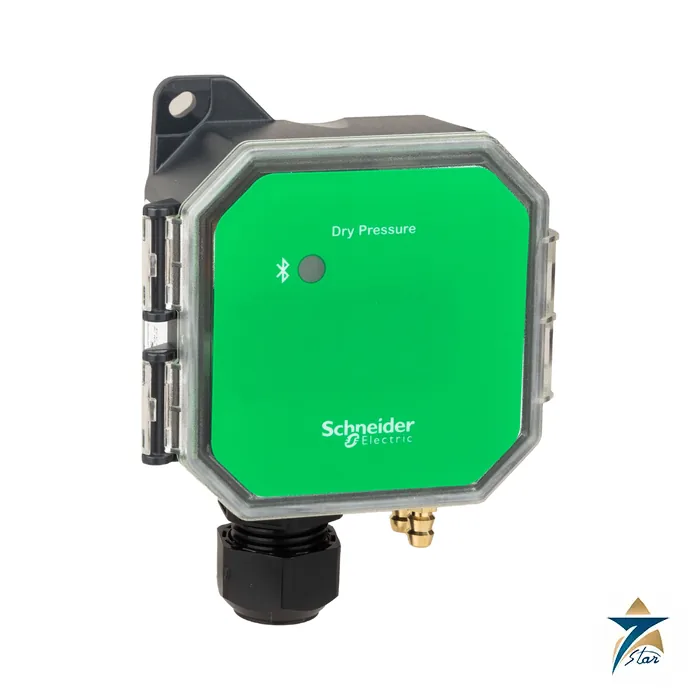
Schneider Electric EPP301 EP Differential Pressure Transmitter
Description
EPP301: EP series differential pressure transducer for air, 250 Pa top range
The EPP301 is a Schneider Electric EP series differential air-pressure transmitter. The datasheet lists four selectable ranges up to 250 Pa, an accuracy of ±1 % of full scale, voltage and current outputs and an IP65 housing with a 6 mm brass fitting. It covers the lowest ranges of the group, from 25 Pa up to 250 Pa full scale.
Seven Star LLC supplies the EPP301 as an independent supplier in Oman and the GCC for HVAC and building-automation work. The product title in the datasheet mentions a different set of ranges (100, 300, 500 and 1000 Pa) than the specification table lists, so confirm the exact range set when you order.
Selection checklist for the EPP301
- Range: pick the working differential in the lower middle of the 250 Pa family range.
- Output: 0–5 V DC, 0–10 V DC or 4–20 mA to match the controller.
- Mounting: panel as listed.
- Display: no display size listed; choose an LCD-suffixed reference if one is wanted.
- Tubing: 6 mm fittings and suitable tube material.
- Calibration: the datasheet lists no calibration certificate.
Typical uses in Oman and the GCC
The datasheet lists duct pressure, filter, fan and VAV control and air velocity monitoring as applications. In the Gulf, filter monitoring is the one most often met, because sand and dust load pre-filters quickly during shamal and the alarm has to be reliable. Fan proving and VAV box control follow, in hospitals, towers and schools.
Keep the tubing out of direct sun, as heat softens plastic and changes its length, and shield the sensor from vibration where it is mounted on a fan casing.
How the EPP301 measures differential pressure
A differential pressure transmitter compares the pressure at two ports and reports the difference as an electrical signal. In an air system the two ports usually sit before and after a filter or coil, across a fan, or on the total and static taps of a velocity probe. The EPP301 outputs the result as 0–5 V DC, 0–10 V DC or 4–20 mA, so it can feed almost any controller input.
The datasheet describes the controlled fluid as air or gas and gives a burst pressure of 5 psid (34.5 kPa), which is a protection limit, not an operating range. Keep the process well below it, and avoid sudden pressure surges on the tubing when a fan starts or a damper slams.
Installation and commissioning
Mount the transmitter, connect the tubing to the correct ports and check polarity. Set the output type and range as described in the installation sheet, apply a known pressure with a handheld calibrator if available, and compare the signal. Because no calibration certificate is supplied, a field check is the only evidence of calibration.
Keep spares of this unit on site where filter alarms or fan proving depend on it. Check the tubing every year for kinks, loose joints and dust, because blocked tubing is the most common cause of a frozen reading.
Technical specifications of the EPP301
| Parameter | Specification |
|---|---|
| Manufacturer / part number | Schneider Electric / EPP301 |
| Product range | EP |
| Product type | Pressure transmitter sensor |
| Type of measurement | Differential pressure |
| Measuring ranges | 0–25 Pa (0–0.1 in. W.C.); 0–50 Pa (0–0.25 in. W.C.); 0–100 Pa (0–0.5 in. W.C.); 0–250 Pa (0–1 in. W.C.) |
| Accuracy | ± 1 % FS |
| Pressure measurement drift | Less than 2 % |
| Controlled fluid | Air; gas |
| Burst pressure | 5 psid (34.5 kPa) |
| Fitting | 6 mm (0.24 in) male, brass |
| Output type | Analog 0–5 V DC; 0–10 V DC; 4–20 mA |
| Rated supply voltage | 12–30 V DC; 24 V AC |
| Local signalling | Red/green/blue LED |
| Mounting | Panel |
| Dimensions (W x H x D) | 88 × 112 × 42 mm |
| Net weight | 0.125 kg |
| IP degree of protection | IP65 |
| Ambient temperature, operation | -20–60 °C |
| Standards | EN 61000-6-3; EN 61000-6-1; EN 61326-1 |
| Product certifications | CE |
| Calibration certificate | None |
Choosing the range on the EPP301
The four ranges on the datasheet are 0…25 Pa, 0…50 Pa, 0…100 Pa, 0…250 Pa. A range should be picked so that the normal working differential sits between about a third and two thirds of the full scale, which leaves room to see a clogged filter or a fan trip without clipping the signal.
For clean-room, laboratory and low-velocity duct work, the lower ranges give the finest resolution. Accuracy is listed as ±1 % FS and drift as less than 2 %, so a 2 % drift on a 25 Pa range is a noticeable fraction of the signal; read the datasheet figure against your control tolerance.
Outputs, supply and wiring of the EPP301
Supply is 12–30 V DC or 24 V AC. The output type is selectable between 0–5 V DC, 0–10 V DC and 4–20 mA, and an RGB LED gives local status indication. No display size is listed for this version; the LCD-suffixed references in the same family list a 17 × 28 mm display, which is the choice when a local reading is wanted.
Wire with shielded cable on any run near variable-speed drives, and keep the current-loop option for long cable runs. The datasheet lists the connection as 22 AWG; confirm the lead construction when you order if you need a terminal-block version.
Information to send with an RFQ for the EPP301
- Exact reference EPP301 and quantity.
- Required range and tolerance.
- Output type and supply voltage of the controller.
- Mounting style and whether a display is wanted.
- Delivery location and project schedule.
Documents and quotation
The manufacturer datasheet for the EPP301 is attached on this page and carries the specification summarised above. Check the revision date printed on it against your project documents before you rely on a figure.
Send us the reference EPP301, the quantity and the delivery location, and Seven Star LLC will reply to your request. We are an independent supplier based in Muscat and we confirm availability and lead time per enquiry.
Datasheets & Documents
- Datasheet Schneider Electric EPP301 Datasheet Download
Reviews (0)
How would you rate this product? Cancel reply
About brand
Schneider Electric is the French group for energy management and industrial automation: low and medium voltage switchgear and circuit breakers, motor control, drives, PLCs, power monitoring, UPS systems and building management. Its history goes back to 1836, when the brothers Adolphe and Eugène Schneider took over the iron and steel works at Le Creusot in Burgundy. Over the 20th century the company left steel and heavy engineering and became an electrical group through acquisitions such as Merlin Gerin, Télémécanique, Square D and Modicon. Its head office is in Rueil-Malmaison near Paris, and its shares are listed on Euronext Paris.
Schneider Electric company profile
| Origins | 1836, Le Creusot, France: Adolphe and Eugène Schneider take over the Le Creusot foundry |
|---|---|
| Headquarters | Rueil-Malmaison (Paris region), France |
| Ownership | Public company listed on Euronext Paris |
| Key acquisitions | Télémécanique (1988), Square D (1991), Merlin Gerin (1992), Modicon (1997), APC (2007), Invensys (2014); majority owner of AVEVA software |
| Brand names still in use | Acti9, ComPacT and MasterPacT breakers, TeSys motor control, Altivar drives, Altistart soft starters, Modicon PLCs, Harmony control components, PowerLogic and Easergy protection and metering, APC UPS, EcoStruxure software platform |
| Product families | Low voltage distribution, medium voltage switchgear and protection relays, motor control and drives, PLCs and HMIs, power meters, UPS and cooling, enclosures, building automation and energy software |
Milestones
- 1836: The Schneider brothers acquire the Le Creusot works; the business grows in steel, locomotives and heavy engineering.
- 1975: First investment in Merlin Gerin, a French maker of electrical distribution equipment.
- 1988–1992: Télémécanique, Square D (USA) and Merlin Gerin join the group, making it an electrical specialist.
- 1997: Modicon, the company behind the first programmable logic controller, joins the group.
- 1999: The group takes the name Schneider Electric.
- 2007 and 2014: APC (UPS and data centre power) and Invensys (process automation) are acquired.
Choosing Schneider Electric breakers and motor control
Circuit breakers are chosen by current and breaking capacity. Acti9 miniature circuit breakers (iC60, C120) protect final circuits up to 125 A. ComPacT NSX molded case breakers cover about 16 to 630 A, and the letter after the frame size sets the breaking capacity: B, F, N, H, S, L from lowest to highest. MasterPacT air circuit breakers are used as main incomers on large switchboards. For motors, a TeSys contactor with an LRD overload relay or a GV2 motor circuit breaker suits direct starting, an Altistart soft starter reduces starting current, and an Altivar drive controls speed. The breaking capacity must always be at least the prospective short-circuit current at the point of installation.
Where Schneider Electric products are used
In Oman and the GCC, Schneider Electric equipment is found in main and sub-main switchboards of commercial and residential buildings, motor control centres in water, oil and gas and industrial plants, substations protected by Sepam and Easergy relays, data centres powered by Galaxy and APC UPS systems, and buildings controlled by EcoStruxure Building Operation.
APC by Schneider Electric: UPS and critical power
Since 2007, APC has been part of Schneider Electric and is now its product brand for uninterruptible power supplies, replacement batteries, battery packs, network management cards and rack power distribution. Our APC catalogue covers Smart-UPS line-interactive and on-line models, Easy UPS On-Line, the modular Symmetra LX, RM and PX ranges, Silcon three-phase systems and their spare part kits, and the RBC cartridges that keep them running. Schneider Electric breakers, drives and PLCs can be quoted together with APC UPS systems in one request.
Schneider Electric products we list
| Family | Examples |
|---|---|
| Circuit breakers | Acti9 iC60N, C120N, NSX100F, NSX250N, NSX630, EasyPact EZC, MasterPacT MTZ1, MasterPacT NW |
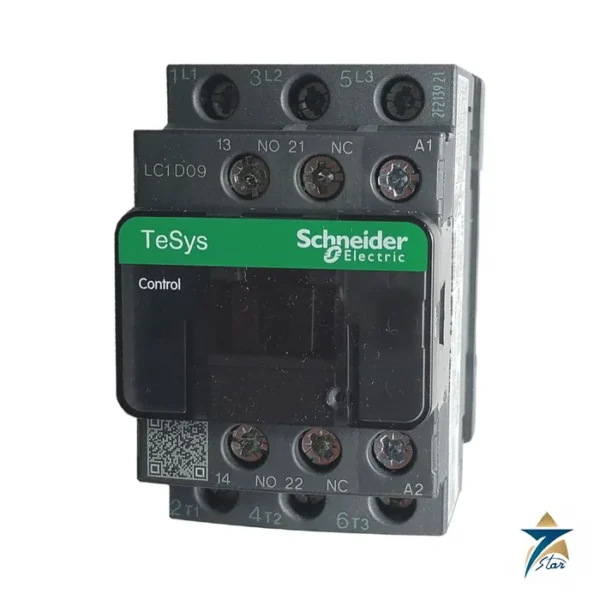
| Motor control | TeSys Deca LC1D, TeSys F, LRD overload relay, GV2ME08, Altistart 22, Altistart 480 |
| Drives | Altivar 12, Altivar 320, ATV340, Altivar Process 630, ATV930, Lexium 32 servo |
| PLCs, HMIs and relays | Modicon M221, M241, M580 BMEP582040, Zelio Logic, Magelis HMISTU655 |
| Protection, metering and power | Sepam series 20, Easergy P3U30, MiCOM P139, PM5560, iEM3255, Galaxy VS UPS |
Ordering Schneider Electric products: what we need
Send the commercial reference from the label (for example LC1D18M7 or ATV320U22N4C). For breakers, confirm the rated current, number of poles, breaking capacity and trip unit. For contactors, give the coil voltage. For drives, give the motor power and supply voltage. APC products are listed on their own brand page.
Facts checked against Schneider Electric's published company history, October 2026.
Browse Schneider Electric products by category: Circuit Breaker, Electrical & Power Modules, AC Drives, PLC & I/O Cards, Metering Systems, UPS and Batteries.
FAQ
Questions about the Schneider Electric EPP301 EP Differential Pressure
Answers from our engineering team on installation, compatibility and integration.
01What ranges does the EPP301 cover?
The datasheet lists 0...25 Pa; 0...50 Pa; 0...100 Pa; 0...250 Pa. The title text mentions different ranges, so confirm before ordering.
02What outputs does the EPP301 provide?
The datasheet lists 0-5 V DC, 0-10 V DC and 4-20 mA analogue outputs, on a 12-30 V DC or 24 V AC supply.
03What accuracy does the EPP301 have?
Accuracy is listed as +/- 1 % of full scale, with pressure drift of less than 2 %. No calibration certificate is supplied.
04Does the EPP301 have a display?
No display size is listed for this reference; the LCD-suffixed references list a 17 x 28 mm display.
05What housing rating does the EPP301 have?
IP65, with a 6 mm brass male fitting, panel mounting, and operation from -20 to 60 degrees C.


Reviews
There are no reviews yet.