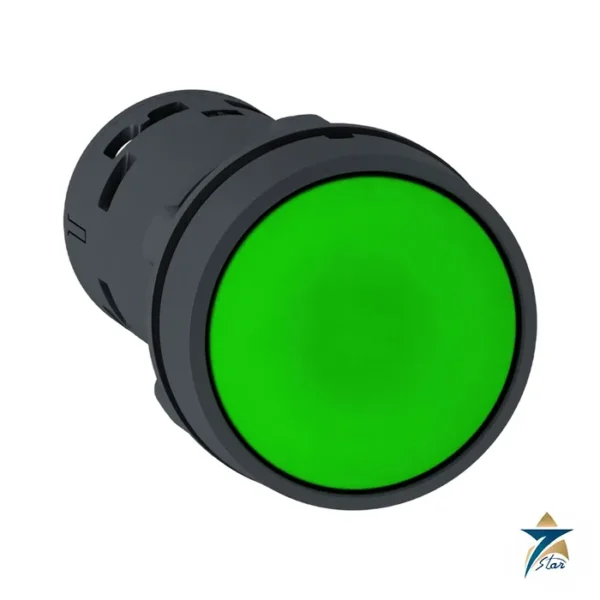
XB7NA31: XB7 green push button for 22 mm panels
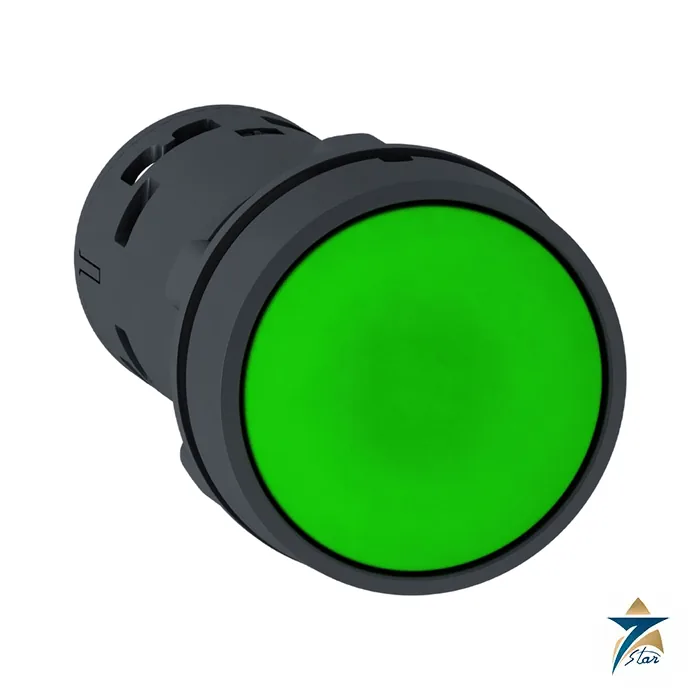
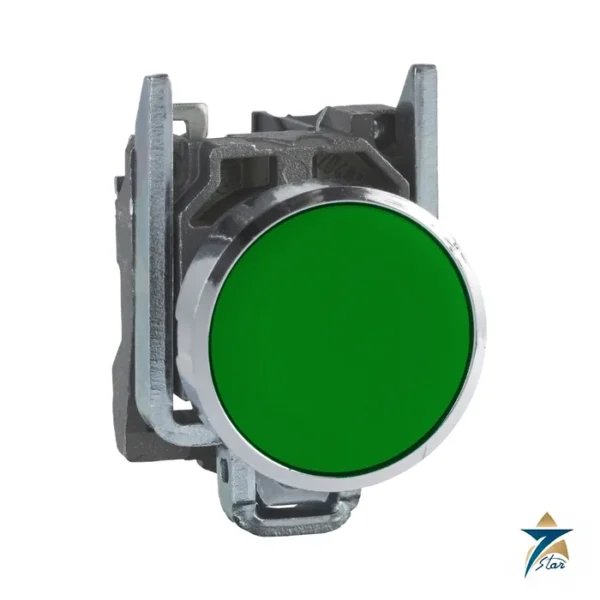
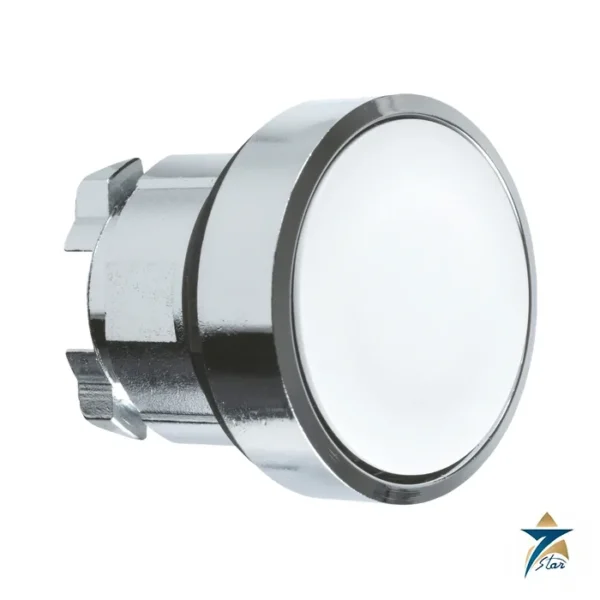
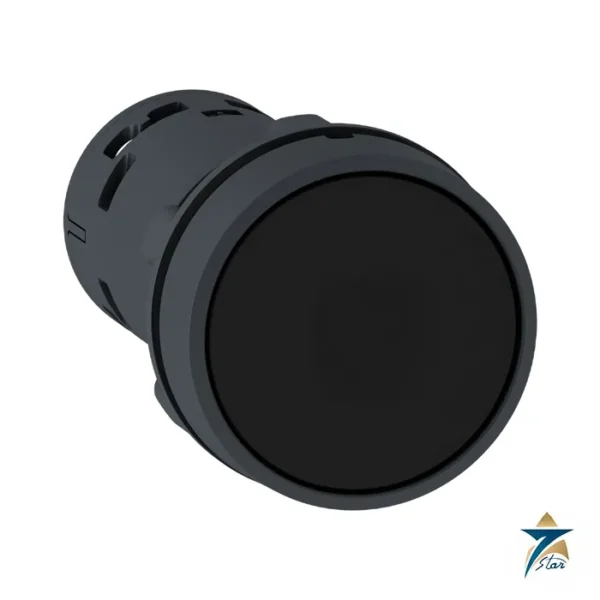
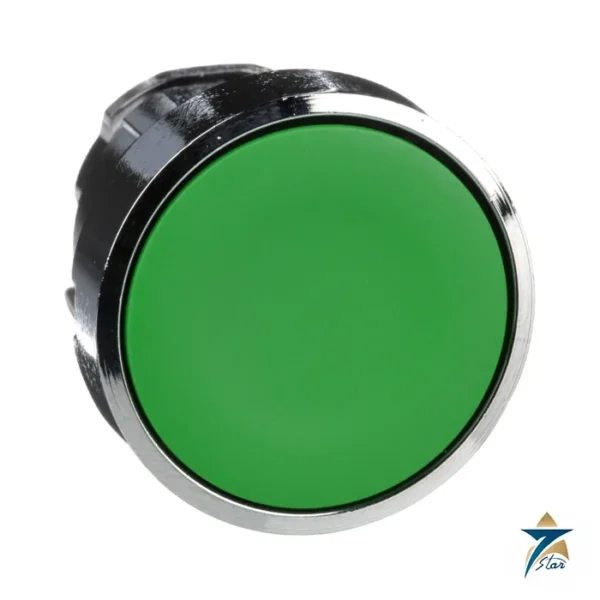
The XB7NA31 is a Schneider Electric Harmony XB7 push button: a green flush push button with one normally open contact. Pressing it closes the circuit and releasing it lets the spring open it again, so it is the plain momentary start or run-command device of the group. Seven Star LLC supplies the XB7NA31 in Oman and the GCC as an independent supplier based in Muscat, usually to panel builders, maintenance stores and contractors who need a compact plastic operator that mounts in a standard 22 mm hole.
The datasheet carries no ordering-code table, so the following reading of the reference is our interpretation from the catalogue title only: XB7 is the plastic monolithic range, the next letters describe the operator family, and the title confirms the colour, the operator action and the contact composition (1 NO). The XB7 construction is monolithic, meaning the operator and the contact element are one unit and are not separated into a head and a block.
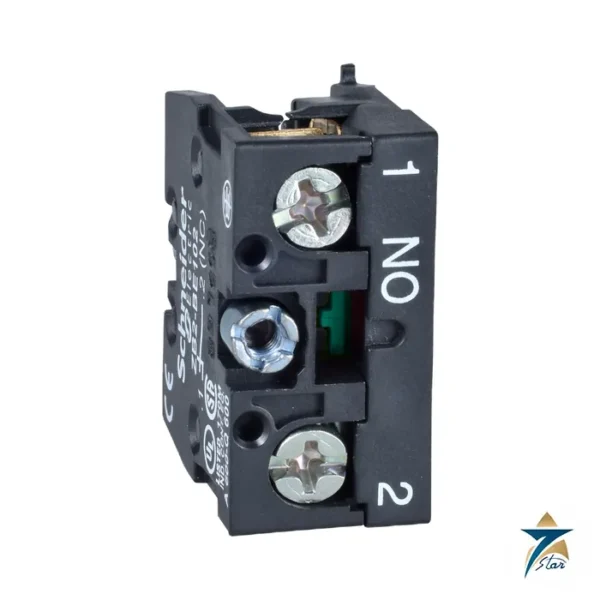
Contact arrangement of the XB7NA31
With a single NO contact on terminals 13-14 the button can only make a circuit when pressed. That is the right shape for a start input to a contactor coil circuit or a PLC digital input, where the controller needs one clean closing signal. The datasheet lists positive opening for the NO element only, which has little practical meaning for a start function but is stated for completeness.
Contact operation is slow-break and the mechanical life is stated as 1,000,000 cycles. Electrical durability is quoted at 1 000 000 cycles for the listed duty points, for example 0.3 A at 24 V DC-13, so a small signal load such as a relay coil or a PLC input is well inside the rating. Short-circuit protection of the contacts is given as a 4 A gG fuse, which should be present in the circuit feeding this device.
Technical specifications of the XB7NA31
| Parameter |
Specification |
| Manufacturer / part number |
Schneider Electric / XB7NA31 |
| Range |
Harmony XB7 |
| Product type |
Push-button |
| Device presentation |
Monolithic product |
| Mounting diameter |
22 mm (fixing hole 22.5 mm) |
| Head shape |
Round |
| Operator type |
Spring return |
| Operator profile |
Green flush, unmarked |
| Contacts |
1 NO |
| Terminal marking (ISO) |
(13-14)NO |
| Positive opening |
With (only NO) |
| Contact operation |
Slow-break |
| Terminals |
Screw clamp; up to 2 × 1.5 mm² with cable end, or 1 × 0.34 to 2 × 2.5 mm² without cable end |
| Terminal tightening torque |
0.8–1.2 N.m |
| Fixing |
Fixing nut, 2–2.4 N.m; panel 1–6 mm metal or 2–6 mm plastic |
| Dimensions (W × H × D) |
29 × 29 × 51.5 mm |
| Net weight |
0.021 kg |
| Mechanical durability |
1 000 000 cycles |
| Rated insulation voltage [Ui] |
250 V, pollution degree 3 |
| Rated impulse withstand [Uimp] |
4 kV |
| Rated operational current [Ie] |
0.1 A at 250 V DC-13; 0.22 A at 125 V DC-13; 0.3 A at 240 V and 0.6 A at 120 V AC-14 |
| Short-circuit protection |
4 A cartridge fuse, type gG |
| Degree of protection |
IP65 front face, IP20 rear face (IEC 60529) |
| UL enclosure type |
3/12 |
| Operating / storage temperature |
-25 to 70 °C / -40 to 70 °C |
| Vibration / shock |
5 gn, 2–500 Hz / 50 gn 11 ms and 30 gn 18 ms |
| Standards |
IEC 60947-1, IEC 60947-5-1, UL 508, CSA C22.2 No 14, JIS C8201 |
| Certifications |
GOST, CCC |
| Warranty |
18 months |
Installation, wiring and maintenance of the XB7NA31
Drill the panel to 22.5 mm, drop the XB7NA31 in from the front and tighten the fixing nut from behind to the 2–2.4 N.m range. Wire the screw clamp terminals at 0.8–1.2 N.m; with cable ends the terminal accepts up to two 1.5 mm² conductors, and without cable ends it accepts conductors from 0.34 to 2.5 mm². A Pozidriv, Phillips or JIS cross driver of size 1 or a flat 4 or 5.5 mm blade fits the screw head.
After wiring, press or turn the operator through every position with a multimeter on the terminals, and confirm that the contact state matches the circuit drawing. Label the front of the panel so that the function is visible to the operator. Keep spare units of this unit for critical control stations, and replace the device if the operator feels sticky or a contact reads unstable.
Typical uses of the XB7NA31 in Oman and the GCC
This device is used as a start, run or reset-acknowledge input on a small control panel, a motor starter door, or a pump control box where a single signal wire is enough. Typical sites are pump stations, water and desalination utilities, workshops, packaging and material-handling lines, and small plant panels in oil and gas support facilities. In Gulf conditions the monolithic plastic body works best in air-conditioned control rooms or well-sealed outdoor panels, since fine dust and high summer cabinet temperatures can shorten the life of any operator.
Check the panel gasket and cable entries when the XB7NA31 is placed in an outdoor enclosure, and avoid direct sun on the front face. For wash-down or marine duty, a higher-rated metal head from a different range would be the safer choice.
Comparison of the XB7NA31 with sibling XB7 references
| Reference |
Type |
Colour |
Contacts |
Action |
| XB7NA31 |
Push button |
Green |
1 NO |
Spring return |
| XB7NA33 |
Push button |
Green |
2 NO |
Spring return |
| XB7NA35 |
Push button |
Green |
1 NO + 1 NC |
Spring return |
| XB7NA42 |
Push button |
Red |
1 NC |
Spring return |
| XB7NA65 |
Push button |
Blue |
1 NO + 1 NC |
Spring return |
| XB7ND21 |
Selector switch |
Black |
1 NO |
2 positions, 90 degrees |
| XB7ND25 |
Selector switch |
Black |
1 NO + 1 NC |
2 positions, 90 degrees |
| XB7ND33 |
Selector switch |
Black |
2 NO |
3 positions, +/-45 degrees |
| XB7NS8445 |
Emergency stop |
Red |
1 NO + 1 NC |
Latching, turn to release |
The nine references above share the same 22 mm body and terminal style. They differ in operator type and contact composition, which is what decides the circuit the device can build: a single NO makes one circuit, a NO plus NC both makes and breaks, and a NC alone only breaks.
XB7NA31 operator, body and panel fixing
The operator is a flush round cap that returns by spring after each press. The body is 51.5 mm deep and 29 mm across the head, and the unit weighs 0.021 kg. It mounts in a 22.5 mm hole using a fixing nut tightened to 2–2.4 N.m, with panel thickness of 1–6 mm for metal or 2–6 mm for plastic.
The front face is rated IP65 and the rear face IP20, and the UL enclosure type is 3/12. Rear-side terminals are therefore for use inside a closed enclosure. The datasheet lists an operating range of -25 to 70 °C, so check the real panel heat load before specifying this plastic series for sun-exposed locations.
Selection checklist for the XB7NA31
- Colour and meaning: confirm that the colour matches your panel convention.
- Contacts: match NO, NC or both to the circuit logic and to the number of controller inputs.
- Action: spring-return momentary operator.
- Mounting: 22 mm hole, panel thickness within the listed range.
- Load: low-current control signals only, within the 0.1–1.5 A ratings listed.
- Environment: IP65 front face; panel temperature within -25 to 70 °C.
Information to send with an RFQ for the XB7NA31
- Exact reference XB7NA31 and quantity.
- Panel hole size and thickness.
- Required colour, contact set and operator action.
- Control voltage and expected current.
- Delivery location and project schedule.
Documents and quotation
The manufacturer datasheet for the XB7NA31 is attached on this page and carries the data summarised above. Compare its revision against your project requirement before ordering.
Send us the reference XB7NA31, the quantity and your delivery location, and Seven Star LLC, an independent supplier in Muscat, will reply to your request.
Other Models in the Se Xb7 Range
Seven Star LLC supplies models from the Se Xb7 range in Oman and the GCC. Compare the related models below and request a quote for the one that matches your application.


















Reviews
There are no reviews yet.