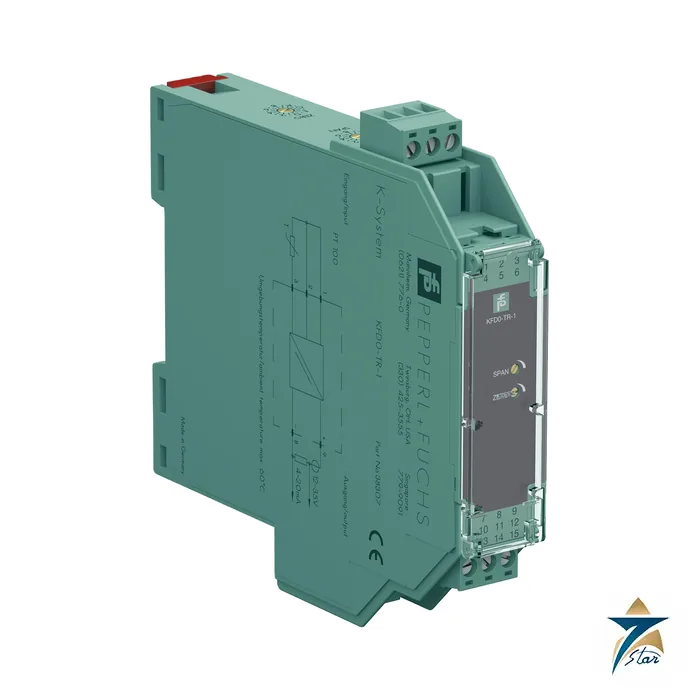
KFD0-TR-1 loop-powered RTD converter for non-hazardous areas
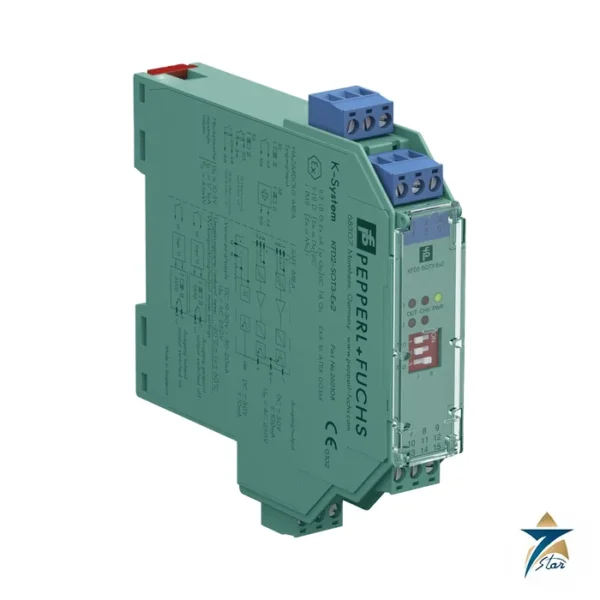
The KFD0-TR-1 is a one-channel loop-powered signal conditioner from the Pepperl+Fuchs K-System that converts a Pt100 resistance thermometer into a 4 to 20 mA signal and gives galvanic isolation between sensor and loop. It is built for non-intrinsically safe applications, so it belongs in the safe area and not between a hazardous-area sensor and the control room.
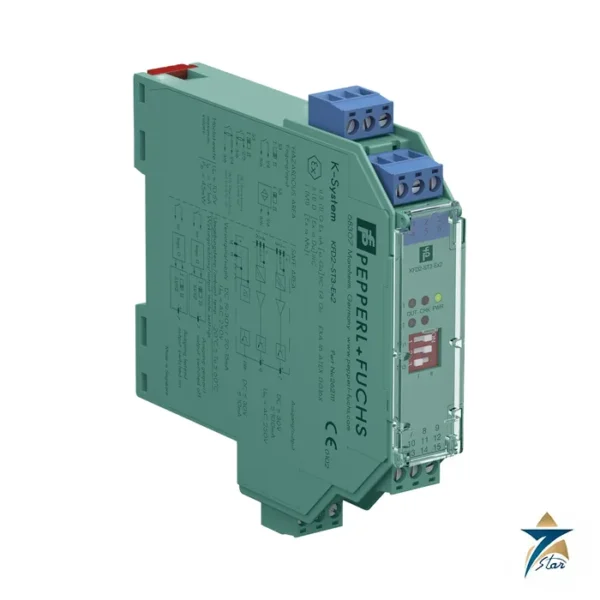
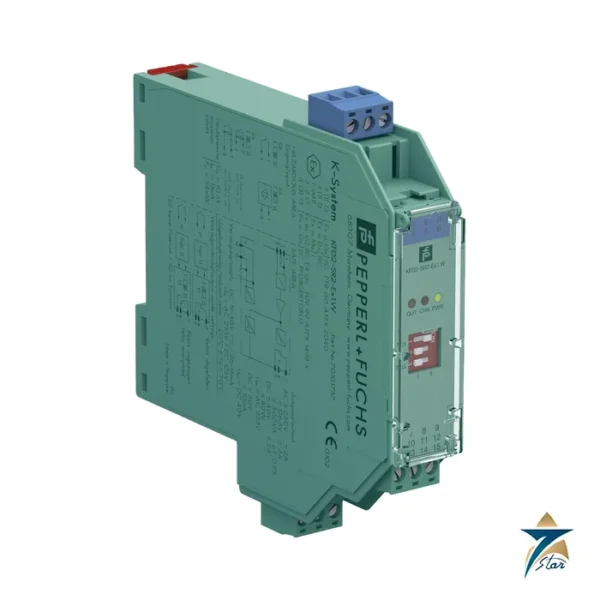
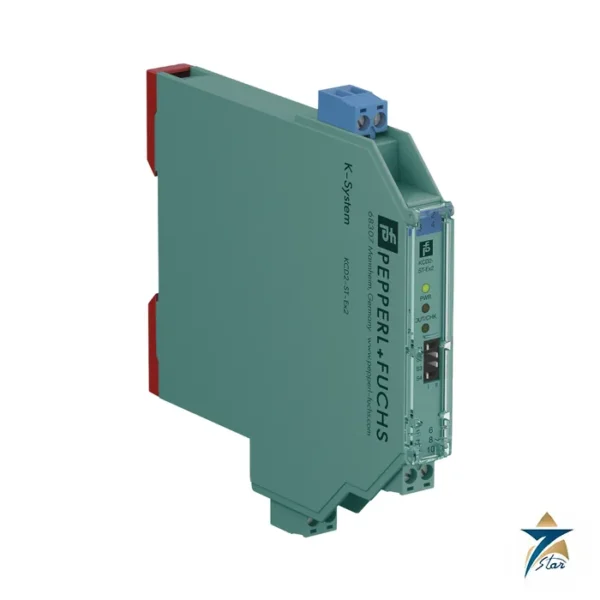
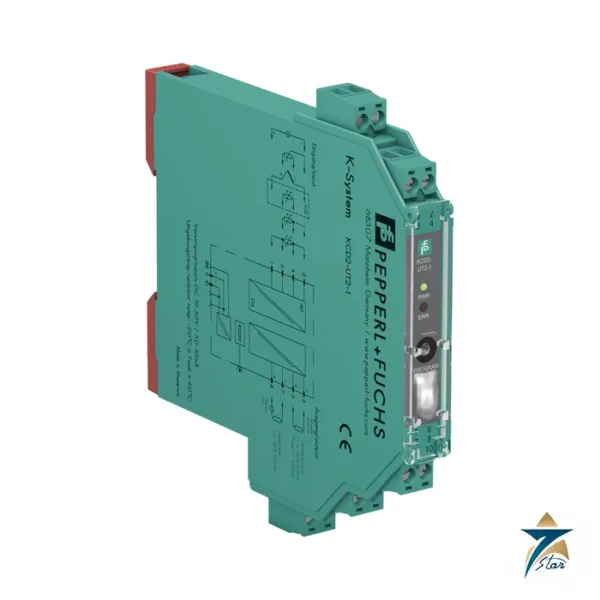
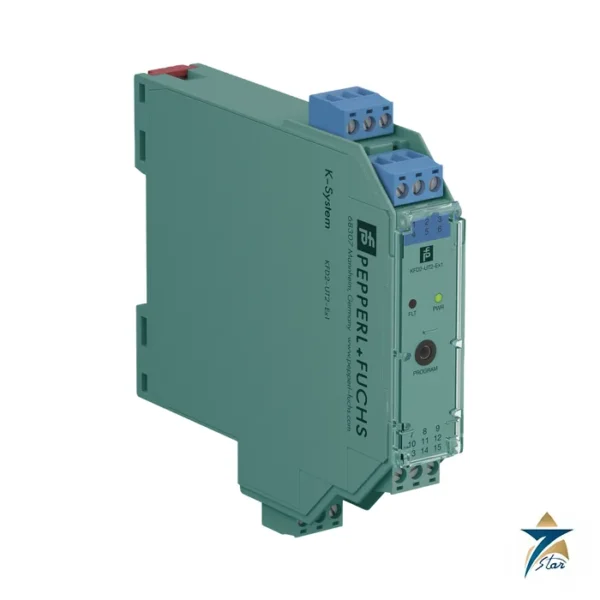
Reading the part number: KFD0 is the family of 20 mm isolators powered from the current loop itself instead of a separate 24 V DC supply, TR is the RTD converter function and 1 means one channel. The 24 V DC powered intrinsically safe temperature converters are the KFD2-UT2-Ex1 and KFD2-UT2-Ex2.
Seven Star LLC supplies this module in Oman and the GCC as an independent supplier in Muscat.
Technical specifications of the KFD0-TR-1
| Parameter |
Specification |
| Manufacturer / part number |
Pepperl+Fuchs KFD0-TR-1 |
| Input |
Pt100, 2- or 3-wire connection at terminals 1, 2-, 3+; lead resistance max. 100 Ω per line; measuring current approx. 1 mA |
| Supply |
12 to 35 V DC, loop powered; power dissipation 0.4 W |
| Output |
4 to 20 mA at terminals 9+/8-, limited to ≤ 35 mA; permitted load (U – 12 V) / 0.02 A |
| Fault signal |
Sensor burnout gives upscale ≥ 22 mA, limited to ≤ 35 mA |
| Measurement range |
Without linearization: span 25 to 800 °C, zero point -200 to 400 °C; with linearization: span 25 to 375 °C, zero point -30 to 375 °C; span and zero adjustable |
| Accuracy |
0.1 % of full-scale value after calibration; ambient influence 0.015 %/K or ± 10 mΩ/K; supply influence 6.5 ppm/V; rise time 250 ms |
| Isolation |
Input to output: safe isolation acc. to DIN VDE 0106, rated insulation voltage 253 V rms |
| Settings |
DIP switches and rotary switch for coarse range and zero, potentiometers for fine span and zero |
| Ambient temperature |
-20 to 60 °C; up to 70 °C with the mounting conditions in the manual |
| Housing |
Type B2, 20 x 119 x 115 mm, IP20, approx. 150 g, screw terminals, 35 mm DIN rail |
How the KFD0-TR-1 is powered and calibrated
The module takes its energy from the 4 to 20 mA loop, so there is no supply terminal. At least 12 V must remain at the module, which means the loop supply has to cover 12 V plus the voltage drop across the receiving device and cable at 20 mA. A typical receiving load of 250 Ω needs 5 V, so a 24 V loop leaves a comfortable reserve.
The resistance of the Pt100 is converted into a current, optionally with an analog linearization that makes the 4 to 20 mA signal linear to temperature between 25 and 375 °C. Calibration is by field adjustment: DIP and rotary switches select the coarse zero and span, and two potentiometers fine-tune them against a resistance decade box.
System fit and related parts
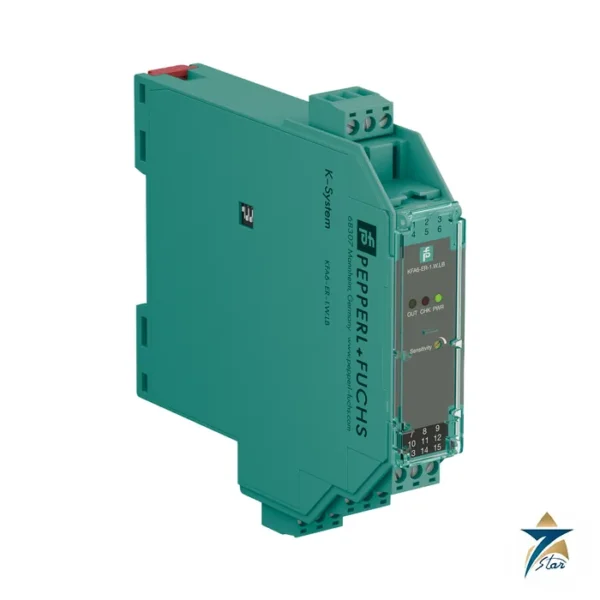
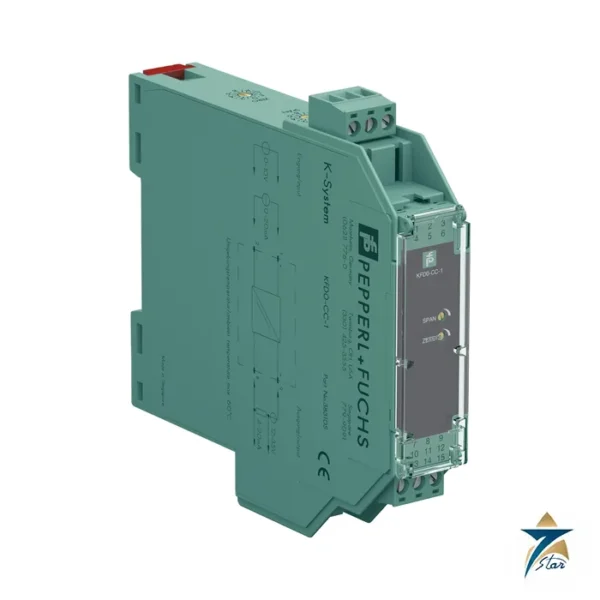
Use the KFD0-TR-1 where a plain Pt100 in a safe area must be isolated from a PLC analog input, for example to break a ground loop or to share a signal between two systems. If the Pt100 sits in Zone 0, 1 or 2, use the KFD2-UT2-Ex1 or KCD2-UT2-Ex1 instead, because this module has no Ex ia input. For current or voltage signals the sister model is the KFD0-CC-1.
Selection and ordering checklist for the KFD0-TR-1
- Sensor: Pt100 only, 2- or 3-wire, with lead resistance below 100 Ω per line.
- Required measuring range, and whether linearization is needed (25 to 375 °C).
- Loop supply voltage high enough for 12 V plus load at 20 mA.
- Fault direction: this module fails upscale at 22 mA or more.
- Safe-area location only.
- Rail space: 20 mm per module.
Installation, commissioning and maintenance of the KFD0-TR-1
Mount the module on the rail, wire the Pt100 to terminals 1, 2- and 3+, and the loop to terminals 9+ and 8-. Replace the sensor with a resistance decade at the expected zero and span temperatures, set the switches, and trim zero and span with the potentiometers.
Check the loop voltage at the module terminals under full output. Keep the adjustment values with the loop sheet, and re-check with a calibrator during turnaround.
Choosing between loop-powered and 24 V powered conditioners
Loop-powered isolators such as the KFD0-TR-1 are attractive for retrofits, because no extra supply wiring or Power Rail is needed. The trade-off is the 12 V minimum at the module, which reduces the voltage left for the rest of the loop. Where the loop supply is only 24 V and the receiver has a long cable, calculate the voltage budget before ordering.
A powered converter with a Power Rail has no such limit, and also offers PACTware configuration and fault reporting. Loop-powered modules suit simple temperature points where DIP switch setup is enough.
Typical applications in Oman and the GCC
In Oman and the GCC the KFD0-TR-1 fits skid-mounted package units, HVAC chilled-water loops, pump bearing temperature points and utility rooms in power and desalination plants, where the Pt100 is in a safe area and only galvanic isolation is required.
Family comparison
| Part |
Key difference |
| KFD0-TR-1 (this part) |
Pt100 to 4-20 mA, loop powered, non-Ex |
| KFD0-CC-1 |
Current/voltage to 4-20 mA, loop powered, non-Ex |
| KFD2-UT2-Ex1 |
Universal sensor input, Ex ia, 24 V DC, PACTware |
| KCD2-UT2-Ex1 |
Same function, 12.5 mm housing |
Information to send with an RFQ
- Part number KFD0-TR-1 and quantity
- Temperature range and sensor wiring
- Loop supply voltage and receiver load
- Linearization needed or not
- Delivery location
Documents and quotation
The manufacturer datasheet for KFD0-TR-1 is attached on this page, so you can check wiring, approvals and dimensions before ordering. Send the exact part number, quantity and delivery location in Oman or the GCC and Seven Star LLC will reply with a quotation.
Seven Star LLC is an independent supplier in Muscat and is not the manufacturer; confirm availability, lead time and any project approval requirements in your RFQ.



















Reviews
There are no reviews yet.