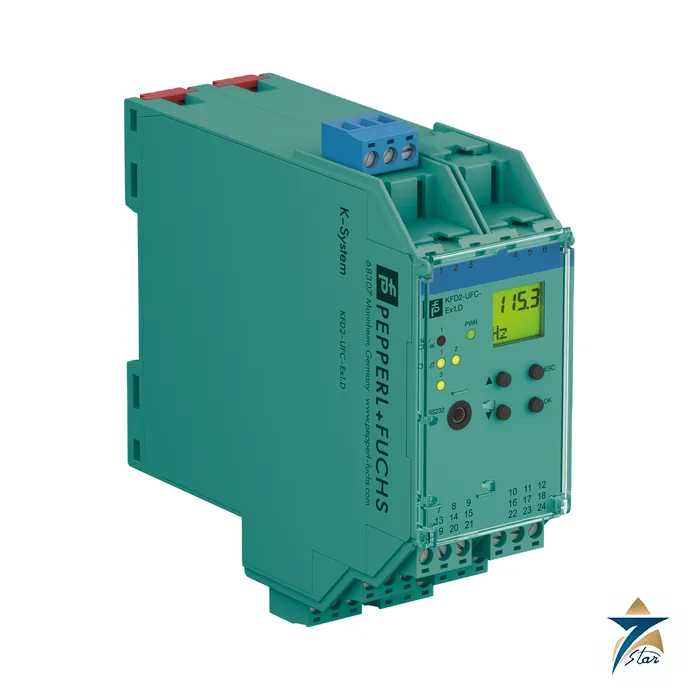
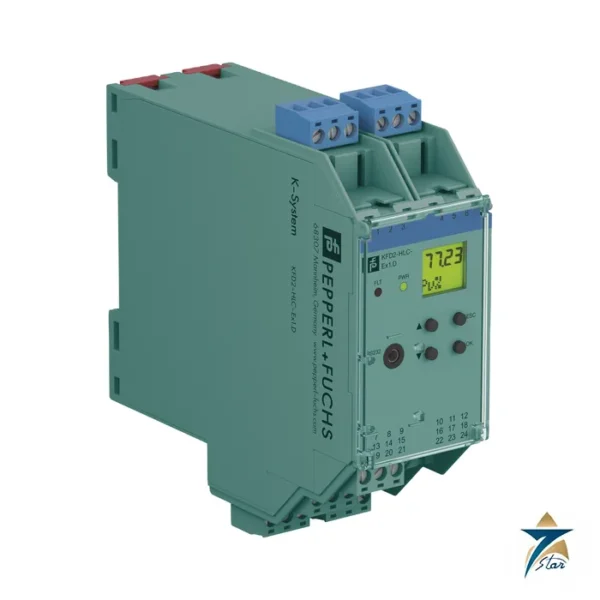
KFD2-UFC-Ex1.D frequency converter with trip values
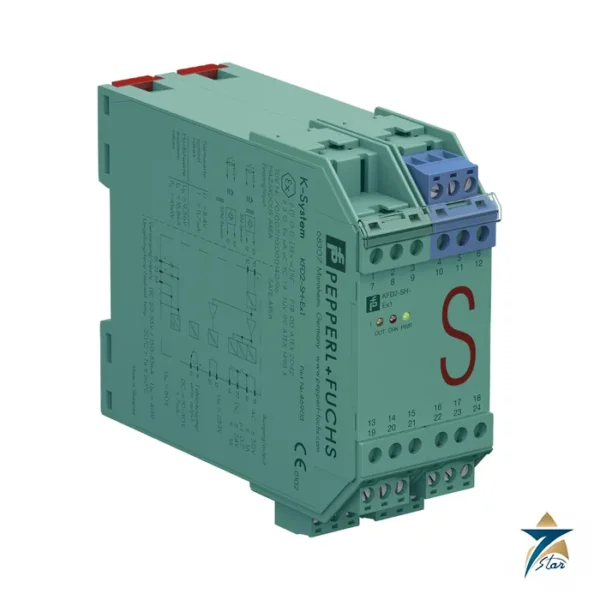
The KFD2-UFC-Ex1.D converts the pulse frequency of a NAMUR sensor or mechanical contact in a hazardous area into a freely scalable 0 or 4 to 20 mA signal, and also acts as a switch amplifier and trip alarm. It has two relay outputs and one transistor output beside the analog output, so one module can display speed, retransmit it and raise alarms.
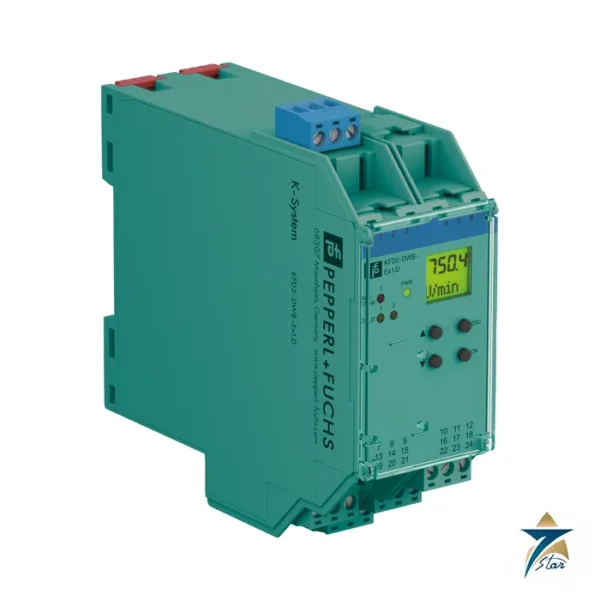
The name decodes as KFD2 (24 V DC isolated barrier range), UFC (universal frequency converter), Ex1 (one measuring channel), .D (display and keypad). Compared with the KFD2-DWB-Ex1.D, which is a speed monitor with two relays, this version adds an analog output and the transistor output.
Seven Star LLC supplies this module in Oman and the GCC as an independent supplier in Muscat.
Technical specifications of the KFD2-UFC-Ex1.D
| Parameter |
Specification |
| Manufacturer / part number |
Pepperl+Fuchs KFD2-UFC-Ex1.D |
| Input I |
NAMUR sensor or contact, terminals 1+, 3-; 0.001 to 5000 Hz; pulse > 50 µs |
| Line fault detection |
Breakage I ≤ 0.15 mA; short-circuit I > 6.5 mA |
| Input II |
Start-up override 1 to 1000 s, terminals 13+/14- |
| Measurement |
Resolution 0.1 % of value, ≥ 0.001 Hz; accuracy 0.1 %; measuring time < 100 ms |
| Output I, II |
Relays, 253 V AC / 2 A, 40 V DC / 2 A; delay approx. 20 ms; life 5 x 10⁷ cycles |
| Output III |
Passive transistor, 40 V DC, 1-signal (L+) – 2.5 V at 50 mA, short-circuit proof |
| Output IV |
0 or 4 to 20 mA, load max. 650 Ω, open loop max. 24 V; accuracy < 20 µA |
| Fault signal |
Downscale ≤ 3.6 mA, upscale ≥ 21.5 mA (NAMUR NE 43) |
| Supply |
20 to 30 V DC, terminals 23+/24- or Power Rail; ≤ 2.2 W |
| Functional safety |
SIL 2 acc. to IEC/EN 61508 / IEC/EN 61511 |
| Hazardous area data |
TUV 99 ATEX 1471, [Ex ia Ga] IIC; Input I Uo 10.1 V, Io 13.5 mA, Po 34 mW |
| Ambient temperature |
-20 to 60 °C |
| Housing |
Type C2, 40 x 119 x 115 mm, IP20, 300 g |
How the KFD2-UFC-Ex1.D turns pulses into signals
The unit counts input pulses in a measuring window shorter than 100 ms and calculates frequency with 0.1 % accuracy. The analog output scales a chosen frequency range to 0 or 4 to 20 mA, so a flow turbine, a speed pickup or a pulse flowmeter becomes an analog loop. The switch outputs can act as min or max alarms with adjustable trip values, a series-connected output, a pulse divider or an error signal.
The start-up override input forces the outputs to a programmed default state for up to 1000 seconds while a machine is starting, to prevent nuisance trips from low initial speed. Faults appear on LEDs per NAMUR NE 44 and on a collective error line of the Power Rail.
System fit and related parts
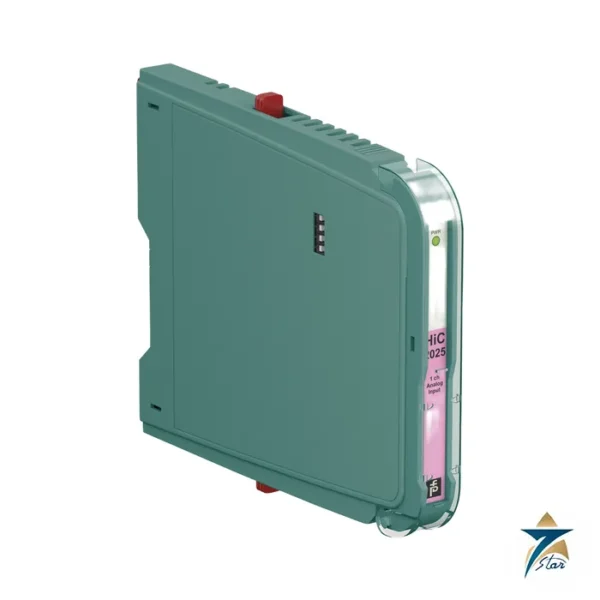
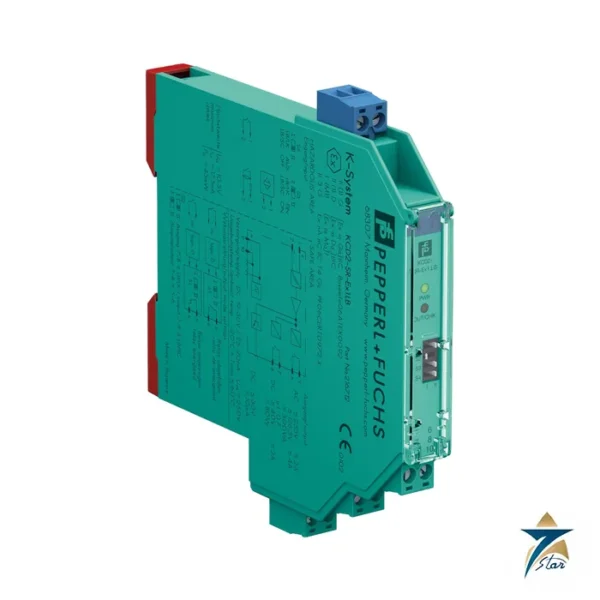
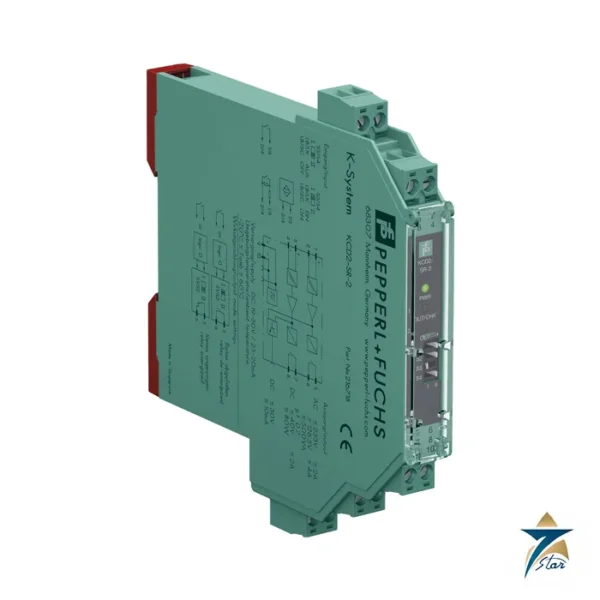
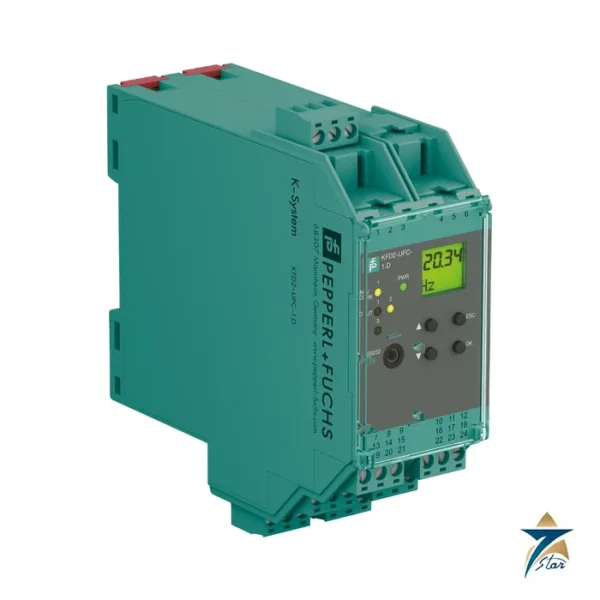
Typical sensors are NAMUR proximity switches on shafts, pulse-output turbine meters in hazardous areas and mechanical counters. If only switching is needed, the KFD2-DWB-Ex1.D is the dedicated speed monitor, and for slow digital signals a simple KFD2-SR2-Ex1.W is enough. The manufacturer also lists a KFD2-UFC-1.D; check its own datasheet before treating it as interchangeable.
Selection and ordering checklist
- Frequency range and the scaling to 4 to 20 mA.
- Alarm modes required for relays and transistor.
- Start-up override duration.
- Ex ia data of the sensor.
- Analog loop load below 650 Ω.
- Supply 20 to 30 V DC.
Installation, commissioning and maintenance of the KFD2-UFC-Ex1.D
Install on a DIN rail, wire the sensor to terminals 1+ and 3-, and program with keypad or PACTware. Inject a known frequency with a generator and check the analog output and each trip. Store the parameter list with the loop documentation.
Scaling and alarm configuration of the KFD2-UFC-Ex1.D
Start by writing down the frequency at which the process value is zero and the frequency at full scale. For a turbine meter this comes from the meter K-factor; for a shaft sensor it is pulses per revolution multiplied by speed divided by 60. The KFD2-UFC-Ex1.D then maps this range to 4 to 20 mA, and the NAMUR fault levels allow the control system to tell a failed sensor from a low reading.
The three switch outputs can be configured as minimum alarm, maximum alarm, serially switched output or pulse divider. Relays should be set so the safe state is de-energized. Use the start-up override for machines that pass through low speeds when starting, and test both the analog output and every trip with a frequency generator before handover.
Typical applications in Oman and the GCC
Use cases include pump and fan speed readouts, turbine flow pulse conversion and conveyor monitoring at oil, gas, power and desalination sites in Oman and the GCC, where the sensor sits in a classified area and the PLC accepts only analog signals.
Family comparison
| Part |
Key difference |
| KFD2-UFC-Ex1.D (this part) |
Frequency converter: 4-20 mA, 2 relays, 1 transistor |
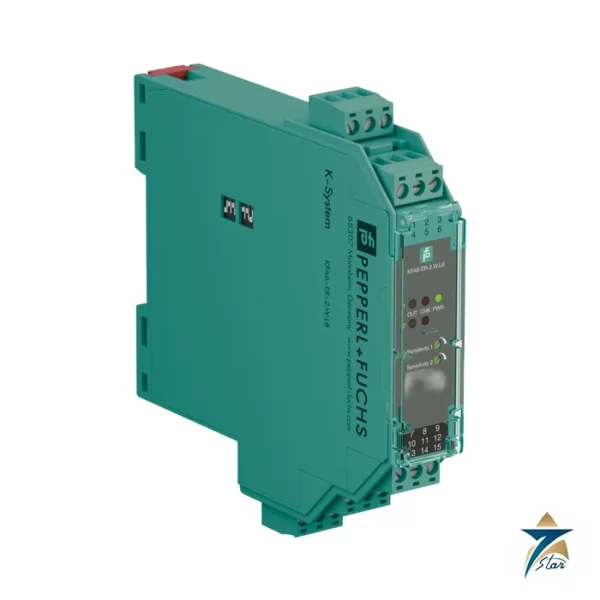
| KFD2-DWB-Ex1.D |
Speed monitor: 2 relays, no analog output |
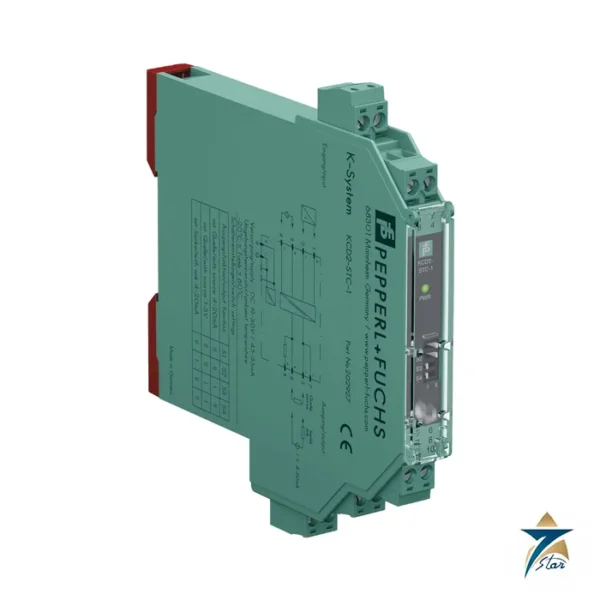
| KFD2-SR2-Ex1.W |
Switch amplifier, 1 relay |
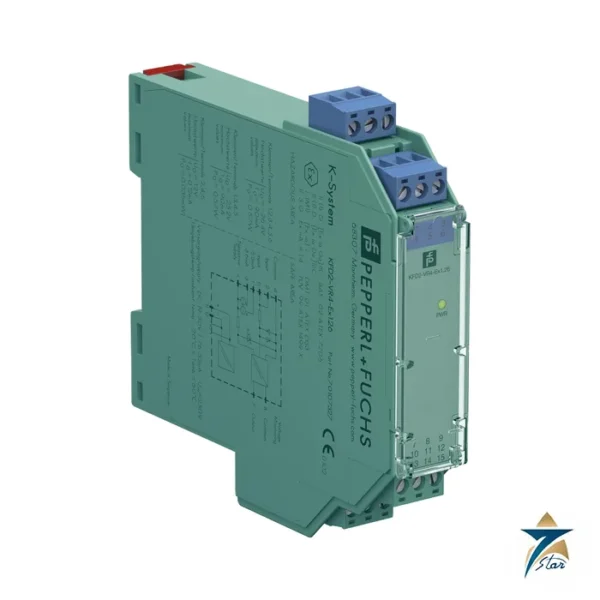
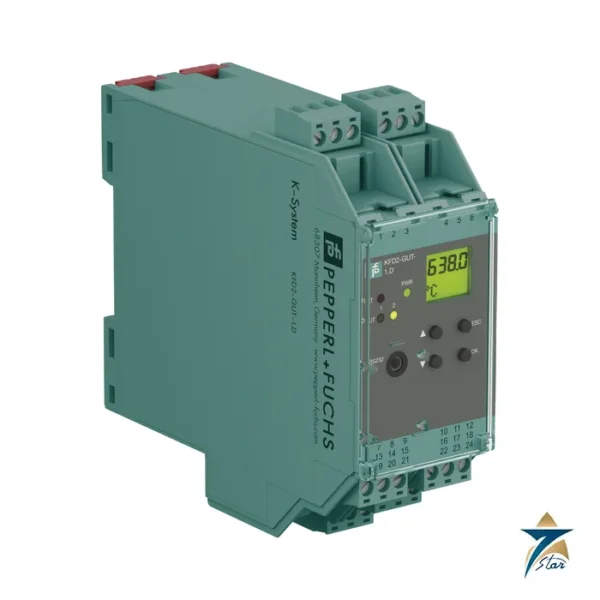
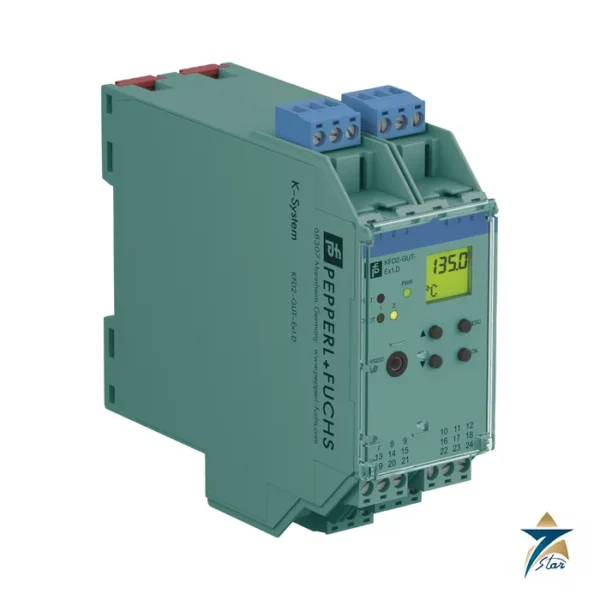
| KFD2-GUT-Ex1.D |
Temperature converter with trip values |
Information to send with an RFQ
- Part number KFD2-UFC-Ex1.D and quantity
- Sensor type and frequency range
- Analog output scaling
- Alarm requirements
- Supply method
- Delivery location
Site conditions in Oman for the KFD2-UFC-Ex1.D
Control cabinets in Gulf plants often run hot, because many sit in outdoor kiosks or in rooms where air conditioning is not always reliable. Before you finalise the KFD2-UFC-Ex1.D, check the permitted ambient range and any derating stated by the manufacturer against the real temperature inside your panel, and leave the recommended spacing around the device so that heat can escape. Long cable runs between the field and the marshalling cabinet are common on large sites, so confirm the signal types, wiring limits and earthing arrangement early in the design.
It also helps to standardise on a small number of part numbers across a project. Keeping a few spare KFD2-UFC-Ex1.D units on site in Oman shortens recovery time after a fault, and documenting configuration settings makes replacement faster for the maintenance team.
Documents and quotation
The manufacturer datasheet for KFD2-UFC-Ex1.D is attached on this page, so you can check wiring, approvals and dimensions before ordering. Send the exact part number, quantity and delivery location in Oman or the GCC and Seven Star LLC will reply with a quotation.
Seven Star LLC is an independent supplier in Muscat and is not the manufacturer; confirm availability, lead time and any project approval requirements in your RFQ.



















Reviews
There are no reviews yet.