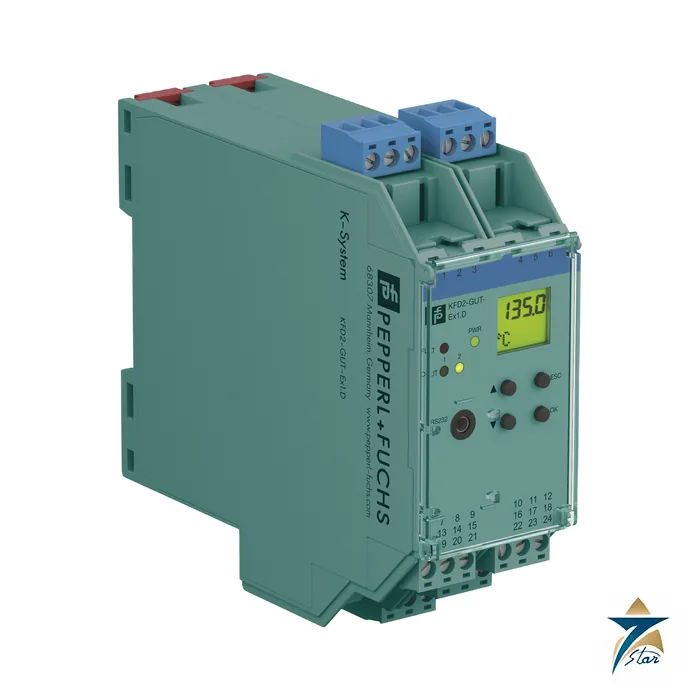
KFD2-GUT-Ex1.D programmable temperature converter with trip values
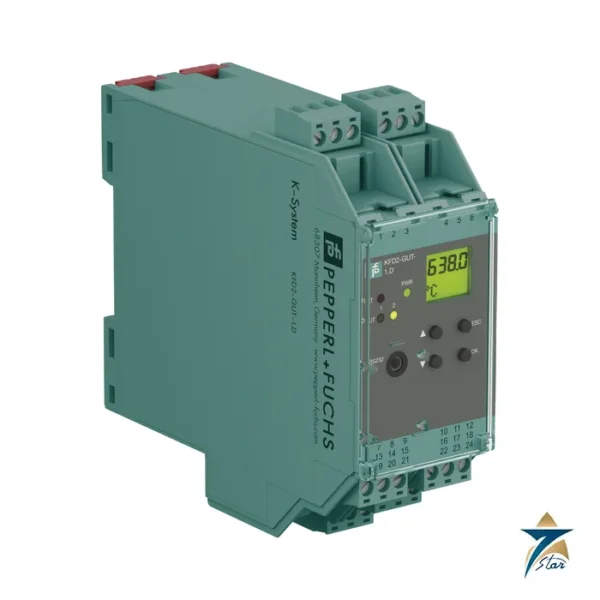
The KFD2-GUT-Ex1.D is a 40 mm wide, one-channel isolated barrier that reads a thermocouple, resistance thermometer, potentiometer or voltage source in a hazardous area and converts it to a 0/4 to 20 mA output. It also has two relay outputs that act as adjustable trip points, so it can serve as a transmitter and an alarm unit in one module.
Part number reading: KFD2 is the 24 V DC isolated barrier family, GUT the universal temperature converter with trip values, Ex1 one channel and .D the version with a display and keypad. Configuration is possible on the keypad or with PACTware software.
Seven Star LLC supplies this module in Oman and the GCC as an independent supplier in Muscat.
Technical specifications of the KFD2-GUT-Ex1.D
| Parameter |
Specification |
| Manufacturer / part number |
Pepperl+Fuchs KFD2-GUT-Ex1.D |
| RTD inputs |
Pt100, Pt500, Pt1000, Ni100, Ni1000; 2-, 3-, 4-wire; lead resistance max. 50 Ω |
| Thermocouples |
Types B, E, J, K, L, N, R, S, T; external and internal cold junction compensation (accessory K-CJC-**) |
| Other inputs |
Potentiometer 0.8 to 20 kΩ; voltage 0 to 10 V, 2 to 10 V, 0 to 1 V, -100 to 100 mV |
| Analog output |
0 or 4 to 20 mA, load max. 650 Ω, open loop voltage max. 24 V |
| Fault signal |
Downscale ≤ 3.6 mA or upscale ≥ 21 mA (NAMUR NE 43) |
| Relay outputs |
2 relays, 250 V AC / 2 A (cos φ ≥ 0.7), 40 V DC / 2 A; life 5 x 10⁷ cycles |
| Accuracy |
RTD max. 0.2 % of span; voltage 0.1 %; TC max. 10 µV; CJC deviation ± 0.8 K |
| Sampling rate |
approx. 700 ms |
| Supply |
20 to 30 V DC, terminals 23+/24- or Power Rail; ≤ 2.2 W |
| Functional safety |
SIL 2 acc. to IEC/EN 61508 / IEC/EN 61511 |
| Hazardous area data |
TUV 03 ATEX 2140, [Ex ia Ga] IIC |
| Ambient temperature |
-20 to 60 °C |
| Housing |
Type C2, 40 x 119 x 115 mm, IP20, 300 g |
How the KFD2-GUT-Ex1.D converts and monitors temperature
The input stage of the KFD2-GUT-Ex1.D measures resistance or millivolts, linearizes according to the selected sensor type and scales to the programmed range. Sensor breakage is detected for thermocouples and RTDs, and short-circuit for RTDs. When a fault occurs, the output goes downscale or upscale according to NAMUR NE 43 and the collective error message is set on a Power Rail.
The two relays each have an adjustable trip value and are independent of the analog output, which allows a high and a high-high alarm from one measurement. For a thermocouple loop, the removable terminal block K-CJC-** supplies internal cold junction compensation and avoids a separate sensor.
System fit and related parts
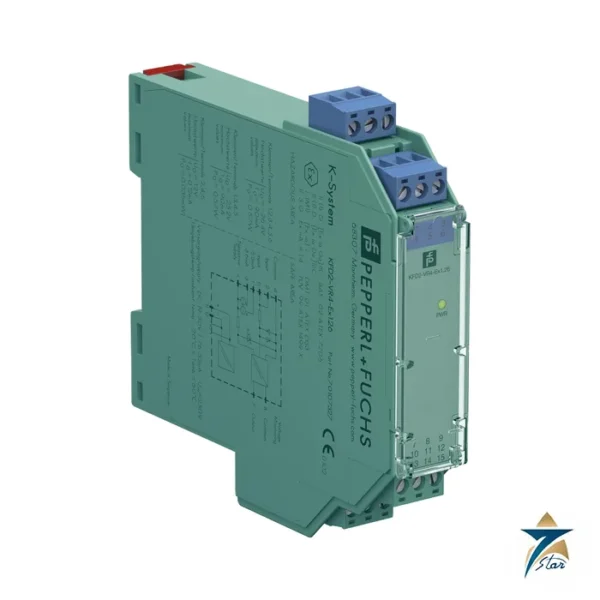
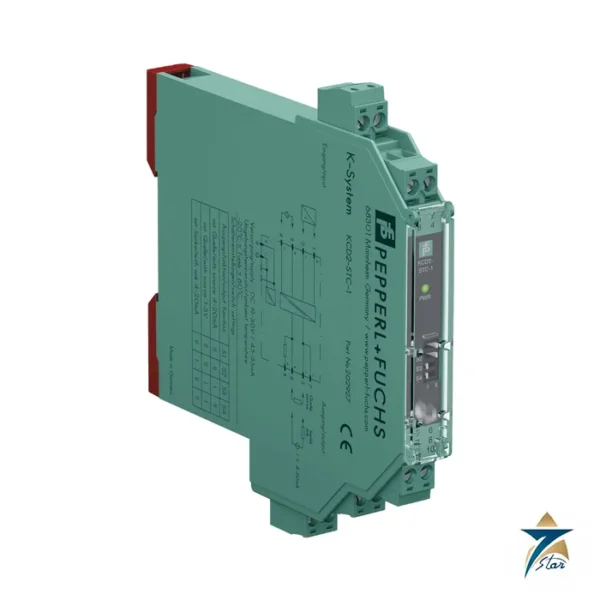
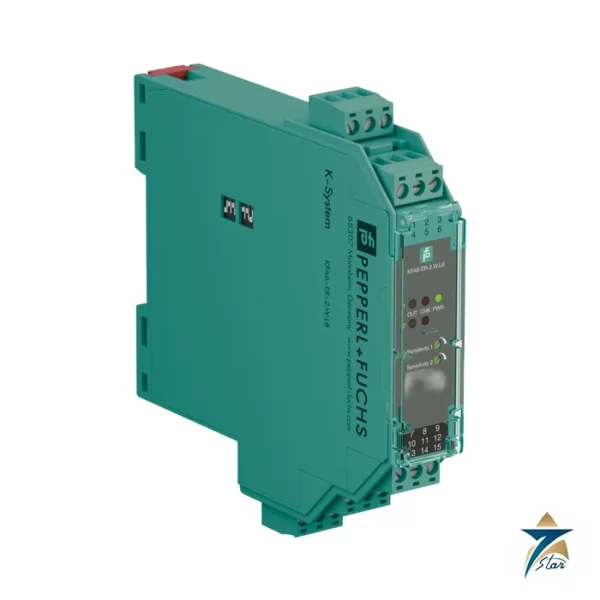
Use the KFD2-GUT-Ex1.D when a thermocouple or RTD in Zone 0, 1 or 2 must feed an analog input and local alarm contacts together, such as bearing or winding temperature monitoring. If no trip contacts are needed, a universal temperature converter such as the KFD2-UT2-Ex2 is the narrower option. Related products in the K-System are the KFD2-VR4-Ex1.26 for vibration and KFD2-DWB-Ex1.D for speed.
Selection and ordering checklist
- Sensor type and wiring (2-, 3-, 4-wire RTD or thermocouple type).
- Measuring range and output range (0 or 4 to 20 mA).
- Trip points and relay action; downscale or upscale fault direction.
- Whether the K-CJC-** terminal block is needed.
- Configuration by keypad or PACTware.
- Supply 20 to 30 V DC and heat dissipation up to 2 W.
Installation, commissioning and maintenance of the KFD2-GUT-Ex1.D
Mount on DIN rail, connect the sensor to terminals 1, 2, 3, 4 and 6 as shown on the wiring diagram, and program the module before connecting the control loop. A calibrator or decade box is the practical way to verify the output and trips at several points.
Store the PACTware configuration file with the loop documents so that a replacement module can be loaded in minutes.
Configuration and calibration notes for the KFD2-GUT-Ex1.D
Before commissioning the KFD2-GUT-Ex1.D, decide the measuring range with the process owner and write it, with the sensor type and wiring, in the loop sheet. PACTware needs the programming socket on the front, so a laptop adapter should be part of the maintenance toolkit. After programming, check the analog output at three points and the two trip values, falling and rising.
For thermocouples, decide between internal compensation with the K-CJC-** terminal block and external compensation. The datasheet gives a cold junction deviation of ± 0.8 K for the internal method, so critical loops may prefer an external reference. Long thermocouple runs should use the correct extension cable and be screened, because the input measures microvolts.
Typical applications in Oman and the GCC
The KFD2-GUT-Ex1.D is used on process heaters, reactors and turbine skids where thermocouples and RTDs sit in classified areas, as well as on motor winding and bearing sensors in power and desalination plants. High ambient temperature in cabinets should be checked against the 60 °C limit.
Family comparison
| Part |
Key difference |
| KFD2-GUT-Ex1.D (this part) |
Temperature converter, 2 relays, display, 40 mm |
| KFD2-UT2-Ex2 |
2-channel universal temperature converter |
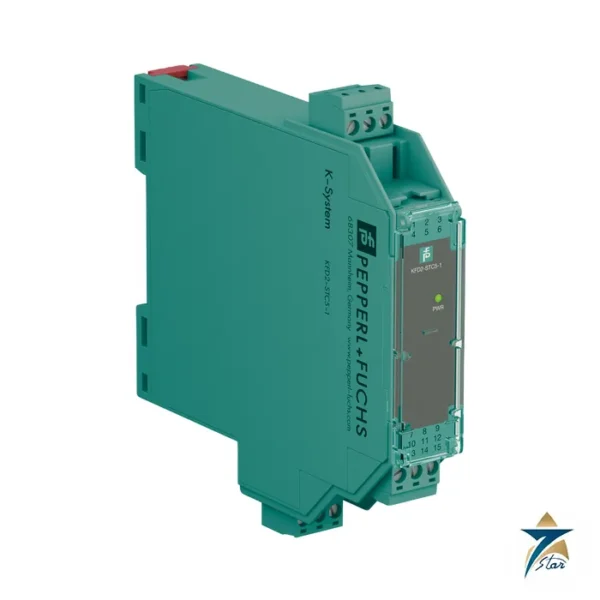
| KFD2-STC5-1 |
SMART transmitter power supply |
| KFD2-DWB-Ex1.D |
Rotation speed monitor, 40 mm |
Information to send with an RFQ
- Part number KFD2-GUT-Ex1.D and quantity
- Sensor type and range
- Trip requirements
- Zone and gas group
- Supply method
- Delivery location
Site conditions in Oman for the KFD2-GUT-Ex1.D
Control cabinets in Gulf plants often run hot, because many sit in outdoor kiosks or in rooms where air conditioning is not always reliable. Before you finalise the KFD2-GUT-Ex1.D, check the permitted ambient range and any derating stated by the manufacturer against the real temperature inside your panel, and leave the recommended spacing around the device so that heat can escape. Long cable runs between the field and the marshalling cabinet are common on large sites, so confirm the signal types, wiring limits and earthing arrangement early in the design.
It also helps to standardise on a small number of part numbers across a project. Keeping a few spare KFD2-GUT-Ex1.D units on site in Oman shortens recovery time after a fault, and documenting configuration settings makes replacement faster for the maintenance team.
Documents and quotation
The manufacturer datasheet for KFD2-GUT-Ex1.D is attached on this page, so you can check wiring, approvals and dimensions before ordering. Send the exact part number, quantity and delivery location in Oman or the GCC and Seven Star LLC will reply with a quotation.
Seven Star LLC is an independent supplier in Muscat and is not the manufacturer; confirm availability, lead time and any project approval requirements in your RFQ.




















Reviews
There are no reviews yet.