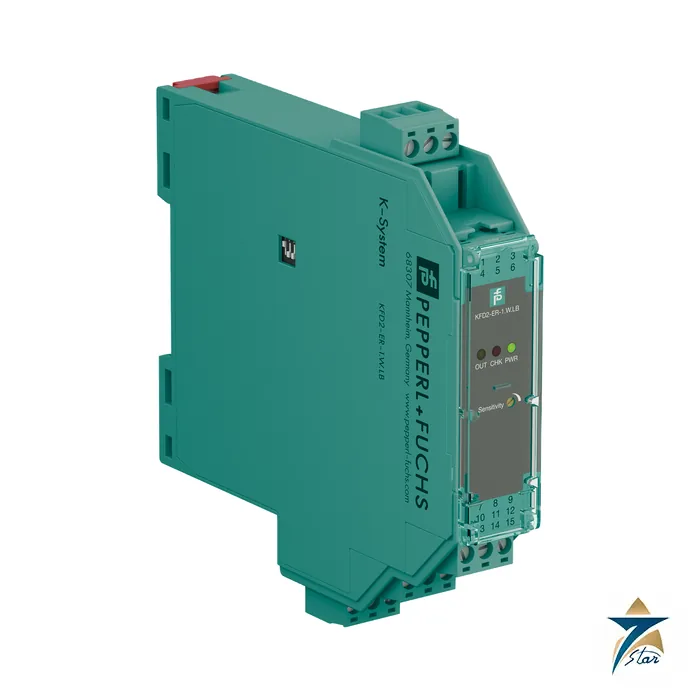
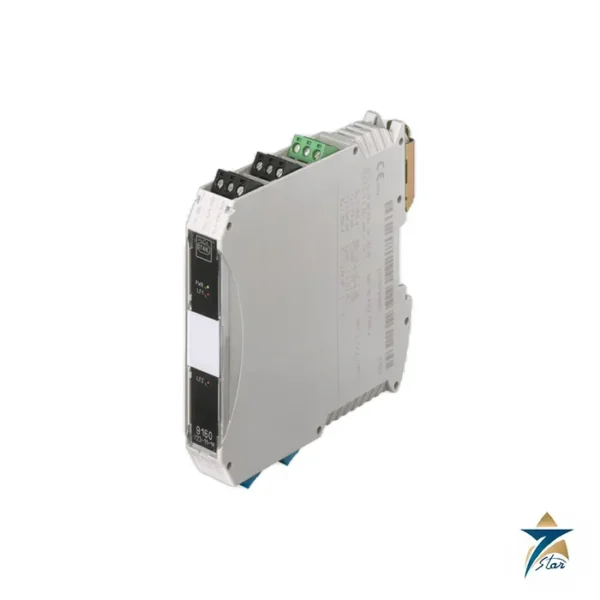
KFD2-ER-1.W.LB conductive switch amplifier for level electrodes
The KFD2-ER-1.W.LB is a relay output switch amplifier for conductive level sensing. It applies a small alternating voltage to electrodes inserted in a liquid, detects the moment the liquid bridges the electrodes, and then energizes a changeover relay. Using an AC measuring voltage prevents electrolytic deposits on the electrodes, and an adjustable sensitivity from 1 to 150 kΩ lets the module work with different conductivities.
Seven Star LLC supplies the KFD2-ER-1.W.LB in Oman and the GCC as an independent supplier in Muscat. The sections below describe the function, the wiring logic for minimum and maximum control and the practical checks for water and condensate applications.
Decoding KFD2-ER-1.W.LB
The KFD2-ER-1.W.LB is a type designation of the Pepperl+Fuchs K-System, named in the datasheet as a conductive switch amplifier, a 1-channel signal conditioner with 24 V DC supply through the Power Rail. The datasheet features include lead breakage detection, which is a red LED function that can be deactivated by DIP switches, and a fault relay contact output in addition to the level relay.
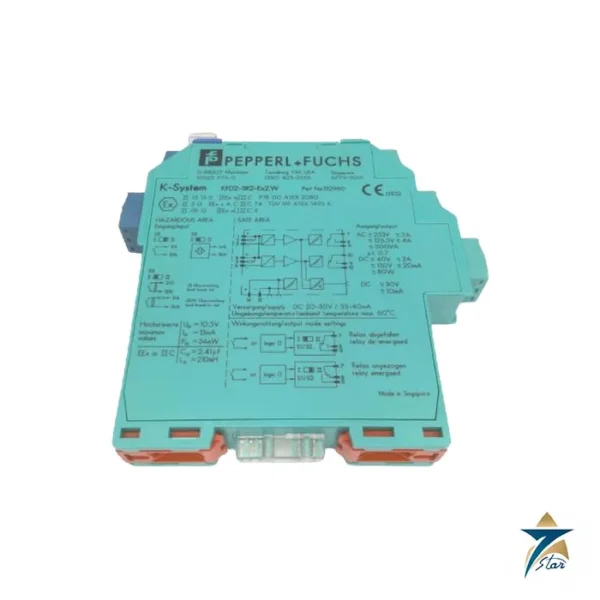
The level output is a form C changeover relay contact, and a separate fault relay contact output is listed among the features. Check the terminal diagram in the datasheet before wiring both.
Technical specifications of the KFD2-ER-1.W.LB
| Parameter |
Specification |
| Manufacturer / part number |
Pepperl+Fuchs / KFD2-ER-1.W.LB |
| Function |
Conductive switch amplifier for level electrodes, 1 channel |
| Input |
Terminals 1 (mass), 2 (minimum), 3 (maximum) |
| Sensitivity |
1 … 150 kΩ, adjustable by potentiometer |
| Control modes |
On/off (terminals 1 and 3) or minimum/maximum (terminals 1, 2, 3) |
| Time delay |
0.5 s, 2 s, 5 s, 10 s selectable |
| Lead breakage detection |
Enclosed 430 kΩ resistor between maximum and reference electrode; switchable |
| Relay output |
253 V AC / 2 A / cos φ > 0.7; 40 V DC / 2 A resistive; max. 192 W, 2000 VA |
| Supply |
20 … 30 V DC, 30 … 40 mA, via Power Rail or terminals 14+, 15- |
| Indicators |
LEDs: power, relay output, lead breakage |
| Ambient temperature |
-20 … 60 °C; extended to 70 °C with mounting conditions in the manual |
| Housing |
Type B2, 20 x 119 x 115 mm, approx. 150 g, 35 mm DIN rail, IP20, screw terminals up to 2.5 mm2 |
How conductive level switching works in the KFD2-ER-1.W.LB
When the liquid rises to the electrodes, the resistance between the reference (mass) electrode and the measuring electrode falls below the preset sensitivity. The module evaluates this resistance, applies the selected delay of 0.5, 2, 5 or 10 seconds to avoid chatter from waves and splashes, and then switches the relay. The module is described as voltage and temperature stabilized, which gives a defined switching point.
In on/off mode, two electrodes (mass and maximum) control a pump or an alarm. In minimum/maximum mode, three electrodes allow a hysteresis loop: the relay energizes when the liquid reaches the maximum electrode and releases when it falls below the minimum electrode, so a pump can be controlled between two levels without additional logic.
The lead breakage function watches the cable. A 430 kΩ resistor is wired between the maximum and the reference electrode, and the module checks the current that flows through it. If a lead breaks, the relay goes to its current-free state, which is the safe state for most alarm and pump-control schemes, and a red LED shows the fault.
Applications and related components
Conductive level detection works only in liquids that are conductive enough, such as water, brine, condensate and many aqueous process liquids, and not for oils or distilled water. For other media, pick a different sensing principle. The module is not an intrinsically safe isolator: it is intended for non-hazardous sensor circuits.
It sits on the Power Rail with the other 20 mm K-System modules and can be supplied by the KFD2-EB2.
Selection and ordering checklist for the KFD2-ER-1.W.LB
- Confirm that the liquid is conductive and estimate its resistance across the electrode gap
- Choose on/off or minimum/maximum control and the number of electrodes
- Select the time delay
- Decide whether lead breakage detection is needed and install the 430 kΩ resistor
- Check relay rating against pump contactor or alarm load
- Check ambient range
Setting up and maintaining the KFD2-ER-1.W.LB
Adjust the sensitivity potentiometer with the electrodes in the real medium: adjust until the relay switches reliably at the intended level. Set DIP switches for the delay and the fault function, and test the lead breakage function by disconnecting an electrode wire.
Electrodes foul with scale and biological growth over time, so inspect and clean them at regular intervals and re-check sensitivity. The module itself is maintenance free.
Typical applications in Oman and the GCC
Typical uses are sump and tank minimum and maximum control, boiler feedwater and condensate vessels, cooling water basins and drain tanks in power, desalination and water treatment plants. In Gulf installations with brackish or high-salinity water the conductivity is high, so low sensitivity settings (high resistance threshold) are normally used, and the electrode material must be chosen to resist corrosion.
Related modules for level and switching signals
From the datasheets.
| Part number |
Function |
Width |
| KFD2-ER-1.W.LB |
Conductive level switch amplifier |
20 mm |
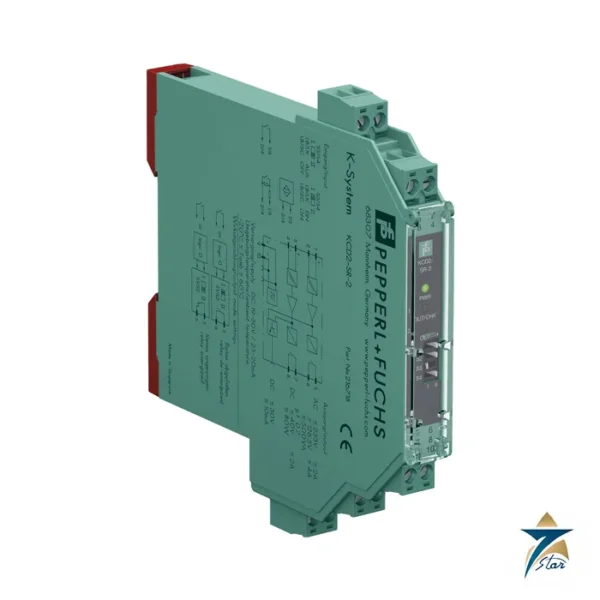
| KCD2-SR-2 |
NAMUR switch amplifier, relay |
12.5 mm |
| KFD2-RSH-1.2E.L3 |
Relay module, load switching |
20 mm |
Information to send with an RFQ for the KFD2-ER-1.W.LB
Send the following.
- Liquid and approximate conductivity
- Control mode and number of electrodes
- Relay load
- Quantity and delivery date
Documents and quotation
The manufacturer datasheet for the KFD2-ER-1.W.LB is attached on this page, so the electrical data, terminal assignment and ambient limits quoted above can be checked against the original document before an order is placed.
Seven Star LLC supplies Pepperl+Fuchs products in Oman and the GCC as an independent supplier in Muscat. Send the quantity, the signal types and the project delivery date, and we will confirm availability and lead time in a written quotation.






















Reviews
There are no reviews yet.