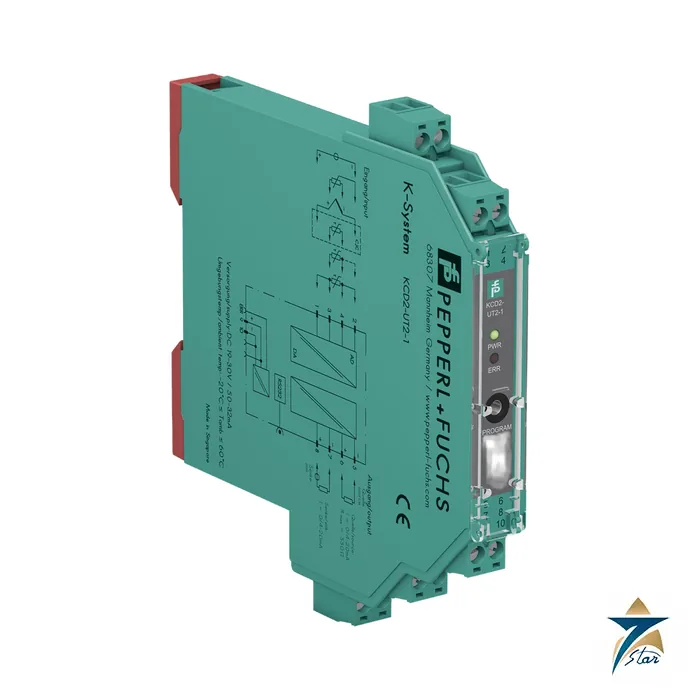
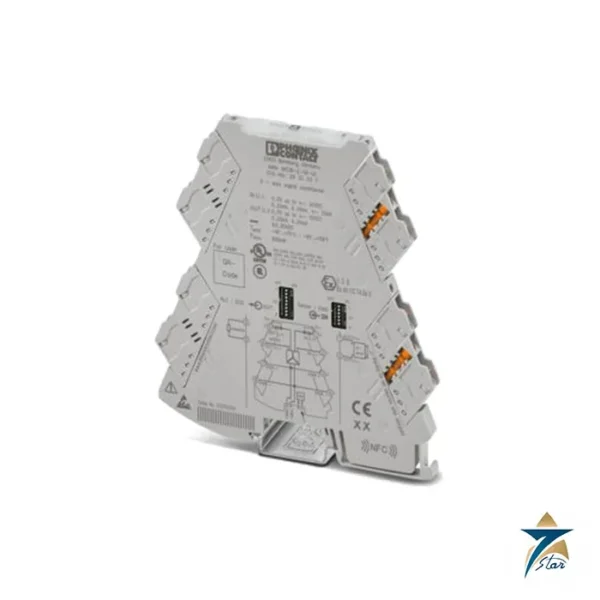
KCD2-UT2-1 universal temperature converter in a 12.5 mm housing
The KCD2-UT2-1 converts the signal of a resistance thermometer, a thermocouple, a potentiometer or a millivolt source into an isolated 0/4 to 20 mA output. It is only 12.5 mm wide and is configured with the PACTware software, with no keypad or display on the module. A wide choice of RTD and thermocouple standards, including GOST and Russian types, makes it one of the most flexible single-channel temperature converters in the K-System range.
Seven Star LLC supplies the KCD2-UT2-1 in Oman and the GCC as an independent supplier in Muscat. The sections below show the input options, the output behaviour and the checkpoints for specification.
KCD2-UT2-1 designation
The KCD2-UT2-1 belongs to the narrow 12.5 mm K-System housing family. The datasheet names it a universal temperature converter, a 1-channel signal conditioner with 24 V DC supply through the Power Rail. The removable terminal block KC-CJC-** is an accessory for thermocouples that use internal cold junction compensation. The datasheet lists the module with SIL 2 per IEC/EN 61508 and IEC/EN 61511.
Because the module has no display, the configuration is carried out through the programming socket with a PC. Note this when planning commissioning tools.
Technical specifications of the KCD2-UT2-1
| Parameter |
Specification |
| Manufacturer / part number |
Pepperl+Fuchs / KCD2-UT2-1 |
| Function |
Universal temperature converter, 1 channel, safe area |
| RTD |
Pt10, Pt50, Pt100, Pt500, Pt1000 (EN 60751), GOST Pt types, Cu10/50/100, Ni100; 2-, 3- or 4-wire |
| Thermocouples |
B, E, J, K, N, R, S, T (IEC 584-1), L (DIN 43710), TXK, TXKH, TXA |
| Potentiometer |
0 … 20 kΩ (2-wire), 0.8 … 20 kΩ (3-wire) |
| Voltage input |
-100 … 100 mV, input resistance ≥ 1 MΩ |
| Lead resistance |
max. 50 Ω per line |
| Output |
0/4 … 20 mA, sink or source; fault downscale 0 or 2 mA, upscale 21.5 mA (NE43) |
| Source load |
0 … 550 Ω, open circuit ≤ 18 V |
| Accuracy (Pt100) |
± (0.06 % of measured value in K + 0.1 % of span + 0.1 K), 4-wire after calibration |
| Supply |
19 … 30 V DC; power consumption max. 0.98 W |
| Functional safety |
SIL 2 (IEC/EN 61508 / 61511) |
| Ambient temperature |
-20 … 70 °C |
| Housing |
Type A2, 12.5 x 119 x 114 mm, approx. 100 g, 35 mm DIN rail, IP20 |
How the KCD2-UT2-1 measures and outputs temperature
For RTDs the module passes about 200 µA through the sensor and evaluates the resistance in 2-, 3- or 4-wire mode. For thermocouples it measures the millivolt signal and adds a cold-junction value, either from the KC-CJC terminal block fitted to the field terminals or from an external reference. Sensor breakage and, for RTDs, short-circuit are monitored.
The output is a 0 or 4 to 20 mA current in either source mode (load up to 550 Ω) or sink mode (5 to 30 V across the terminals). In a fault the output goes to a user-configured value: downscale to 0 or 2 mA or upscale to 21.5 mA, as defined by NAMUR NE43. When the module is on a Power Rail, a collective error message is also available.
Accuracy depends on the sensor. For a Pt100 in 4-wire connection the datasheet gives a deviation of 0.06 % of the measured value in kelvin plus 0.1 % of span plus 0.1 K after calibration; thermocouple deviations include about 1.3 K from the cold junction.
Placing the KCD2-UT2-1 among temperature converters
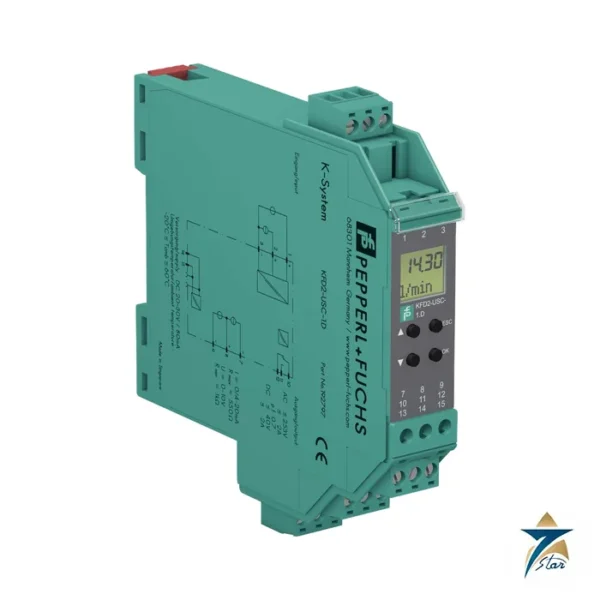
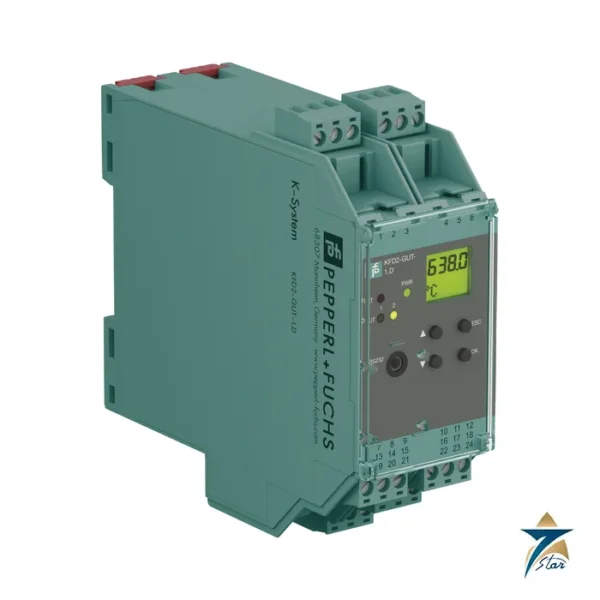
The KCD2-UT2-1 is the compact, relay-free choice; the 40 mm KFD2-GUT-1.D adds a display and two trip relays; and the KFD2-UT2-Ex2 serves intrinsically safe sensors. Use the KCD2-UT2-1 when the sensor is in a safe area and the control system performs the alarming.
Typical accessories are the KC-CJC terminal block, the KFD2-EB2 power feed module and the UPR-03 rail.
Selection and ordering checklist for the KCD2-UT2-1
- Sensor type and wire count
- Thermocouple compensation method (internal or external)
- Temperature span and output range
- Fault signalling level (0 mA, 2 mA or 21.5 mA)
- Whether a PC with PACTware is available for configuration
- SIL requirement and ambient limit
Configuring and servicing the KCD2-UT2-1
Connect the PC to the programming socket, select the sensor type, span and fault handling in PACTware, and download the parameters. Check the output with a temperature simulator or a decade resistance box, and check a sensor break for the chosen fault level.
Store the parameter file with the loop documentation. Replacing a module then takes minutes: mount the new unit, download the stored file and re-test.
Typical applications in Oman and the GCC
Slim temperature converters are used for motor winding and bearing temperatures, process line and furnace temperatures, turbine and generator auxiliaries and HVAC plants. In Gulf installations the 70 °C upper ambient limit helps in warm cabinets, while the 12.5 mm width saves space in crowded marshalling rooms.
Temperature converter options from the same maker
Comparison using manufacturer datasheets.
| Part number |
Display / keypad |
Relays |
Width |
| KCD2-UT2-1 |
No (PACTware) |
None |
12.5 mm |
| KFD2-GUT-1.D |
Yes |
2 |
40 mm |
Information to send with an RFQ for the KCD2-UT2-1
Please send the following.
- Sensor type, wiring and temperature range
- Fault signalling requirement
- Whether the KC-CJC terminal block is needed
- Quantity and delivery date
Site conditions in Oman for the KCD2-UT2-1
Control cabinets in Gulf plants often run hot, because many sit in outdoor kiosks or in rooms where air conditioning is not always reliable. Before you finalise the KCD2-UT2-1, check the permitted ambient range and any derating stated by the manufacturer against the real temperature inside your panel, and leave the recommended spacing around the device so that heat can escape. Long cable runs between the field and the marshalling cabinet are common on large sites, so confirm the signal types, wiring limits and earthing arrangement early in the design.
It also helps to standardise on a small number of part numbers across a project. Keeping a few spare KCD2-UT2-1 units on site in Oman shortens recovery time after a fault, and documenting configuration settings makes replacement faster for the maintenance team.
Documents and quotation
The manufacturer datasheet for the KCD2-UT2-1 is attached on this page, so the electrical data, terminal assignment and ambient limits quoted above can be checked against the original document before an order is placed.
Seven Star LLC supplies Pepperl+Fuchs products in Oman and the GCC as an independent supplier in Muscat. Send the quantity, the signal types and the project delivery date, and we will confirm availability and lead time in a written quotation.
Other Models in the Pf Kcd2 Range
Seven Star LLC supplies models from the Pf Kcd2 range in Oman and the GCC. Compare the related models below and request a quote for the one that matches your application.



























Reviews
There are no reviews yet.