WIKA TR60 indoor and outdoor resistance thermometer for ambient air
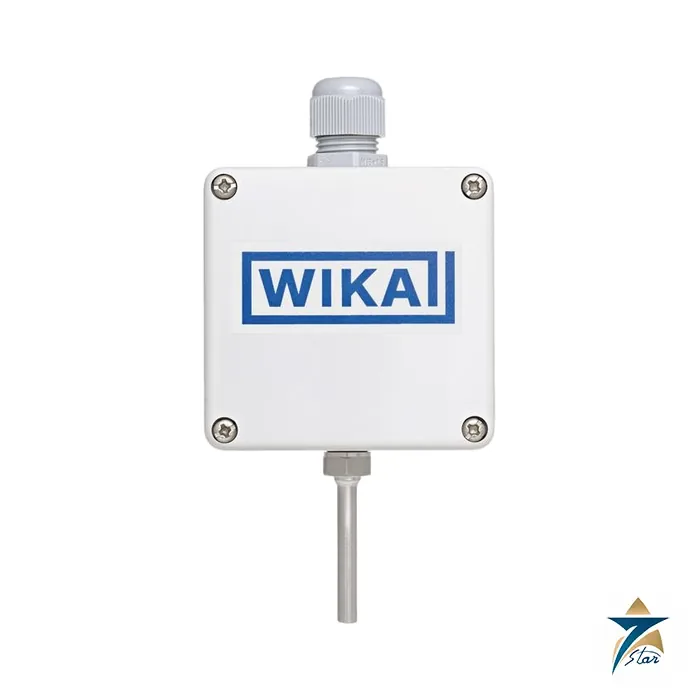
The WIKA TR60 is a wall-mounted resistance thermometer for measuring air temperature, not process media. A short Pt100 probe projects from an impact-resistant plastic or aluminium case, and the same series comes in two forms: an outdoor type with a closed probe tube for damp, humid or outside locations, and an indoor type whose tube is perforated so the sensor touches the air directly. WIKA states a sensor range of -40 … +80 °C [-40 … +176 °F]. Seven Star LLC supplies the TR60 in Oman and the GCC as an independent supplier in Muscat.
Choosing between the indoor and outdoor design
| Feature |
Outdoor TR60 |
Indoor TR60 |
| Probe tube |
Rigid, closed |
Rigid, perforated around the sensor |
| Intended for |
Damp, humid rooms and outdoor use |
Dry rooms |
| Ingress protection |
IP65 per IEC/EN 60529 |
IP20 per IEC/EN 60529 |
| Response |
Normal, sealed tube |
Faster, sensor in direct contact with air |
| Explosion-protected version |
Yes (intrinsically safe) |
Not offered |
The perforated tube of the indoor design improves response time considerably because air reaches the element without a wall in between. The sealed outdoor tube trades that speed for protection against moisture. If the choice is unclear, use the outdoor version in cold stores, grain stores and humid plant rooms, and the indoor version in clean, dry, air-conditioned rooms.
TR60 technical specifications
| Parameter |
Specification |
| Manufacturer / part number |
WIKA / TR60 (data sheet TE 60.60) |
| Type |
Indoor / outdoor resistance thermometer for ambient temperature |
| Sensor |
Pt100, 1 x or 2 x, in 2-, 3- or 4-wire; Pt1000 as thin-film option; measuring current 0.1 … 1.0 mA |
| Sensor range of use |
Limited by design to -40 … +80 °C |
| Probe |
6 mm diameter, 60 mm sensor length, stainless steel 1.4571 |
| Case material |
ABS plastic or aluminium, for wall mounting |
| Cable outlet |
M16 x 1.5 |
| Ambient and storage temperature |
-40 … +80 °C |
| Ingress protection |
IP65 (outdoor), IP20 (indoor) |
| Weight |
Approx. 0.4 kg |
| Options |
Built-in transmitters T15, T32 or T53; 3.1 inspection certificate for measurement and material |
Transmitters and output signals
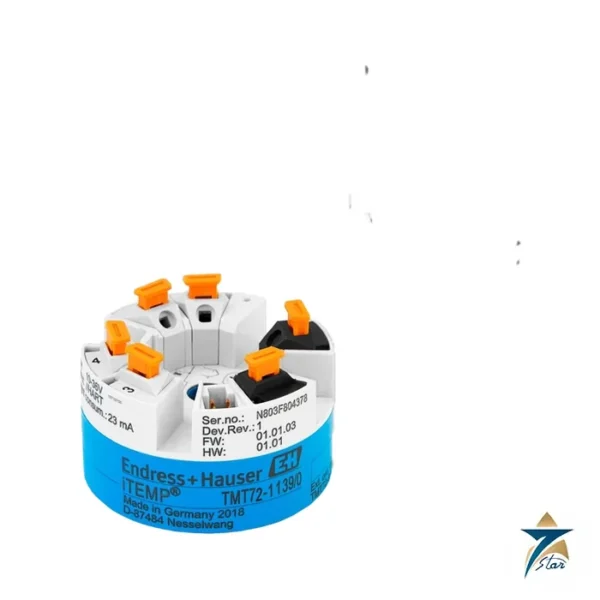
Because the case is large enough for a head transmitter, three WIKA models can replace the terminal block: the T15 (4 … 20 mA, measuring current below 0.2 mA), the T32 (4 … 20 mA and HART, below 0.3 mA) and the T53 (FOUNDATION Fieldbus and PROFIBUS PA, below 0.2 mA, with explosion protection as standard). The explosion-protected option applies only to the outdoor thermometer, and built-in transmitters carry their own approval. The system operator is responsible for choosing suitable thermowells where relevant.
Sensor accuracy and wiring
The thermometers use the same IEC 60751 tolerance system as other WIKA RTDs: Class B (±(0.30 + 0.0050 |t|)), A and AA, with A and AA not allowed in 2-wire. In an ambient-temperature application a 3-wire connection is a sensible default; 2-wire is acceptable for short cables only when the error is within the specification you need. The practical range is set by the case, so a wider sensor range does not extend the usable range beyond -40 … +80 °C.
Hazardous-area options for the outdoor TR60
The outdoor version can be ordered intrinsically safe, for zone 1 gas (II 2G Ex ia IIC T1 … T6 Gb) and zone 21 dust (II 2D Ex ia IIIC T125 … T65 °C Db) under ATEX with IECEx equivalents, plus options such as EAC, INMETRO, NEPSI, KCs, PESO and others listed in the datasheet. Permissible power and ambient temperature for each category are stated in the certificate or operating instructions.
Installation notes
- Mount on a wall away from direct sun, heaters, doors and supply air jets
- Keep the probe pointing downward for outdoor mounting and form a drip loop in the cable
- Use the M16 x 1.5 gland suitable for the cable diameter and seal it, because the case rating depends on it
- Do not use the indoor perforated version where condensation or dust are present
- Where a transmitter is fitted, set the span to the real room range to keep resolution high
Applications in Oman and the GCC
WIKA lists air-conditioned rooms, cold-storage rooms, storehouses, grain stores and malting floors. In the Gulf region the same product suits control rooms, switchgear and battery rooms, laboratories, cold rooms for food and pharmaceuticals, warehouses with climate control and outdoor ambient-air references at plants. Direct sun can add several degrees at an outdoor wall, so a shield or a north-facing position gives more reliable air readings.
TR60 selection checklist
- Indoor (perforated, IP20) or outdoor (closed, IP65)
- Case material: ABS or aluminium
- Pt100 or Pt1000, single or dual, and wiring method
- Transmitter: none, T15, T32 or T53, with output signal
- Hazardous-area marking (outdoor only)
- Certificates such as 3.1 for measurement and material
Practical points when specifying the TR60
Ambient sensors look simple, but the right choice depends on where the case will be mounted. A perforated indoor probe responds quickly to air movement, which is what you want in a conditioned room, but it must not be exposed to dust, spray or condensation, because the element is in direct contact with the air. The outdoor version with its closed 6 mm tube and IP65 case is the safer default for plant rooms, loading areas and any place where humidity is high, at the price of a slower response.
Decide at the same time whether the signal will be sent as a raw Pt100, with all the usual wiring considerations, or converted to 4 … 20 mA by a built-in transmitter. In a large building or plant, a 4 … 20 mA signal travels farther with less noise than a resistance signal. The use of a Pt100 sensor with a 3-wire connection is usually the sensible compromise when no transmitter is fitted, and class A may be requested where the room temperature is critical, but remember that class A and AA are not permitted with 2-wire connections.
Information to send with an RFQ
Provide the location type, temperature range, output signal, supply, cable details and quantity, along with any zone classification.
Documents and quotation
The WIKA data sheet TE 60.60 for the TR60 is attached on this page. Send us the configuration and quantity for a quotation from Muscat as an independent supplier.
























Reviews
There are no reviews yet.