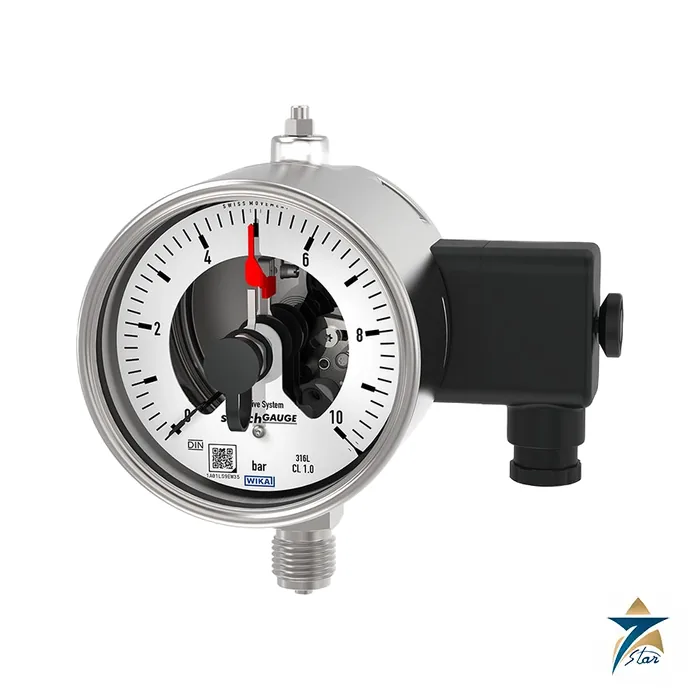
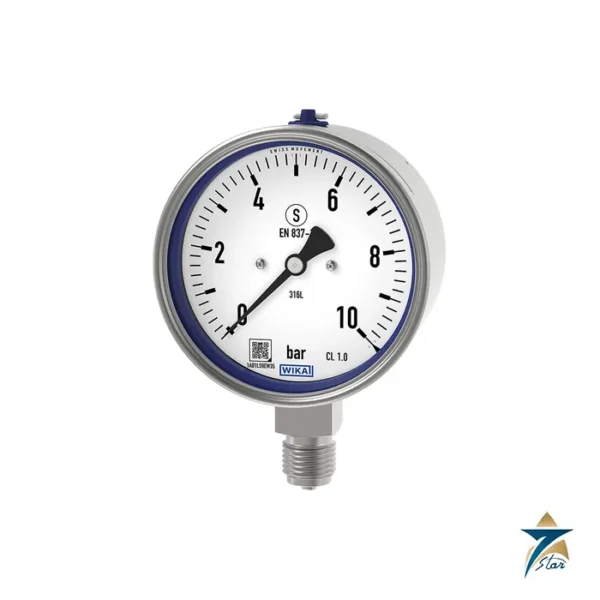
WIKA PGS23.100 switchGAUGE: stainless steel pressure gauge with switch contacts
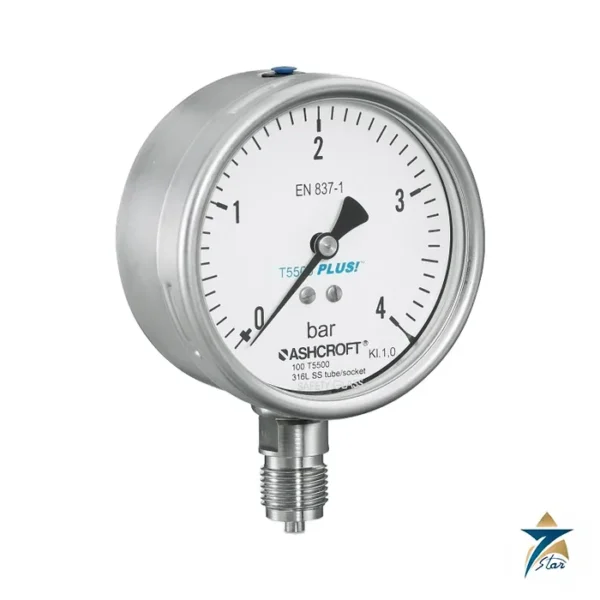
The WIKA PGS23.100 is a Bourdon tube pressure gauge that also switches electrical circuits at settable pressure values. The data sheet covers four models in one family: PGS23.100 and PGS23.160 with stainless steel 316L wetted parts, and PGS26.100 and PGS26.160 with Monel 400. The numbers 100 and 160 are the nominal sizes in millimetres. WIKA names the concept switchGAUGE and describes it for process industries where pressure must be shown locally and circuits switched at the same time, for control, monitoring of plants and switching alarms or pumps. Seven Star LLC supplies the PGS23.100 in Oman and the GCC as an independent supplier in Muscat, and the sections below explain the contact options so an RFQ can specify them precisely.
How the PGS23.100 switch contacts work
The pointer (actual value pointer) moves freely over the whole scale. Separate set pointers, adjusted with a removable key through the window, carry the contacts. When the actual pointer passes a set point, the contact operates. Contacts can be set over the full scale range, and several contacts can be set to a single set point. The contacts sit mostly below the dial. Four contact technologies are offered, and choosing the right one is the main decision on this model:
- Model 821 magnetic snap-action contact: up to three contacts, no control unit or supply needed, direct switching up to AC/DC 250 V and 1 A; switch hysteresis typically 2 … 5 %; contact material silver-nickel, gold-plated. Functions are 821.1 normally open, 821.2 normally closed and 821.3 change-over.
- Model 831 inductive contact: non-contact sensor with long life, suited to hazardous areas with a control unit (model 904.xx), with a safety version 831-SN; up to three contacts.
- Model 830 E electronic contact: for direct triggering of a PLC, non-contact and fail-safe at high switching frequency.
- Model 851 reed switch: no supply needed, direct switching up to 250 V and 1 A, also suitable to trigger a PLC.
Technical specifications of the PGS23.100
| Parameter |
Specification |
| Manufacturer / part number |
WIKA / PGS23.100 (family PGS23.100, PGS23.160, PGS26.100, PGS26.160) |
| Standards |
EN 837-1, ASME B40.100, DIN 16085 for contact devices |
| Nominal sizes |
100 mm [4 in] and 160 mm [6 in] |
| Accuracy class |
EN 837-1 class 1.0 or 2.5; ASME grade 1A or B |
| Measuring element |
Bourdon tube, C-type or helical; PGS23 316L, PGS26 Monel 400 |
| Case |
Stainless steel 1.4301 or 1.4571; safety level S1 (blow-out) or S3 (solid baffle wall, blow-out back) |
| Window |
Laminated safety glass or polycarbonate |
| Case filling |
None or silicone oil M50 (with compensating valve) |
| Contact types |
821 magnetic, 831 inductive, 830 E electronic, 851 reed switch |
| Number of contacts |
Maximum 3 (magnetic and inductive) |
| Medium temperature |
Unfilled -20 … +200 °C; silicone oil filled -20 … +100 °C |
| Ambient temperature |
-20 … +60 °C |
| Pressure limitation |
Steady full scale; fluctuating 0.9 x; short time 1.3 x full scale |
| Ingress protection |
IP65 or IP66 |
| Electrical connection |
Cable socket PA 6 with M20 x 1.5 gland, 6 screw terminals plus PE |
Selecting contact type and load for the PGS23.100
For the magnetic snap-action contact the data sheet recommends a setting range of 25 to 75 % of span (0 to 100 % on request) and a minimum distance of 20 % of span between two contacts. Switching current is 0.02 … 0.3 A on a resistive load, switching voltage AC/DC 24 … 250 V, and switching power at most 30 W or 50 VA unfilled and 20 W or 20 VA for filled instruments. A cable break monitor with a parallel resistor of 47 kOhm or 100 kOhm is possible. Where more power must be switched, a contact protection relay (WIKA model 905) can be added. For inductive contacts the allowable load depends on the control unit, so specify the barrier or relay at the same time.
For hazardous areas, the data sheet lists optional ATEX and IECEx approvals with Ex ia IIC T6/T5/T4 Gb and Ex ia IIIB T135 °C Db, together with permissible ambient ranges of -20 … +60 °C for T6 and -20 … +70 °C for T5 to T1. A pre-volume deflagration flame arrester (model 910.21) can be added for zone 0, and a NACE MR0175 or MR0103 version is offered for sour service.
Where the PGS23.100 fits and related WIKA gauges
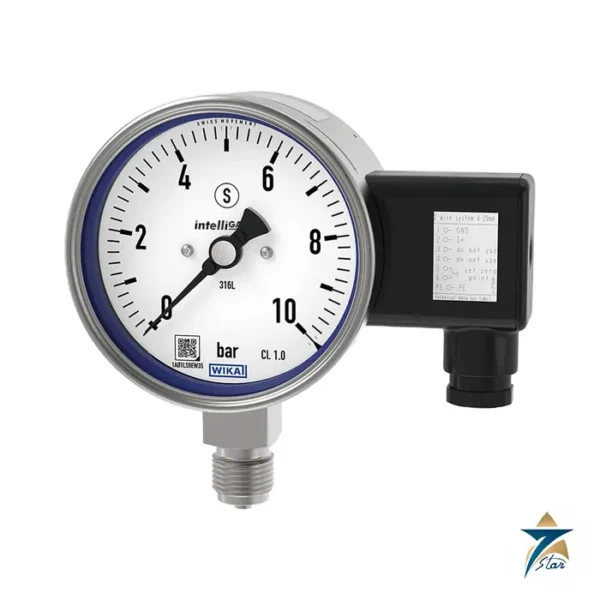
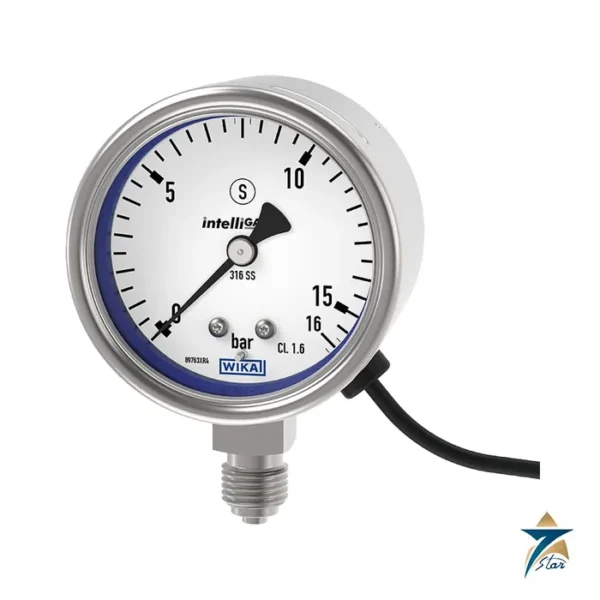
The same switchGAUGE concept is also offered by WIKA in NS 63 under the model PGS23 (separate data sheet) and, for NS 100 and 160, as the PGS21 on its own data sheet. If a continuous 4 … 20 mA signal is more useful than on/off alarms, the matching products are the PGT23.100 and PGT23.063 intelliGAUGE models. Plain mechanical versions are the 232.30 and 233.30 safety gauges. Isolation by the 910.11 valve, snubbing by the 910.12 and protection by the 910.13 overpressure protector are normal companions; the 910.13 is useful because a PGS23.100 on a start-up transient can otherwise suffer repeated overpressure.
Selection and ordering checklist for the PGS23.100
- Nominal size 100 or 160 mm, accuracy class and measuring range.
- PGS23 (316L) or PGS26 (Monel 400) wetted parts.
- Contact type (821, 831, 830 E, 851), number of contacts and whether each is normally open, normally closed or change-over.
- Contact setting: adjustable with key, fixed (give switch points), sealable or sealed lock.
- Case: S1 or S3, window, filling and ingress protection.
- Hazardous-area approval and associated control unit.
- Process connection, restrictor and any NACE or oxygen requirement.
Installation and maintenance of the PGS23.100
Mount the gauge so the case is not subjected to strong vibration, which can chatter the contacts; a filled case or a snubber helps. Set the switch points from the pointer scale with the adjustment key, then confirm them with a pressure source, because contact actuation depends on the pointer passing the set pointer. Terminals are marked on the instrument label. Check cable gland and window seals at each shutdown, and have switch points re-verified at the intervals your site requires, since contact hysteresis changes with the load.
Typical applications in Oman and the GCC
In Oman and across the Gulf the PGS23.100 is used on pump discharge lines, compressor interstage points, lube oil headers, boiler feed water and chemical dosing lines where a low or high pressure alarm or a pump start/stop is needed without a separate switch. Chemical, petrochemical, power, mining and on- and offshore plants are the fields named by WIKA. The stainless steel S1 or S3 case copes with coastal humidity and dust, and the solid baffle version suits sites that insist on operator protection.
Contact models compared
| Aspect |
821 magnetic |
831 inductive |
830 E electronic |
851 reed |
| Supply needed |
No |
Control unit |
Yes |
No |
| Direct load |
250 V, 1 A |
Via control unit |
PLC input |
250 V, 1 A |
| Hazardous areas |
Not stated |
Yes with 904.xx |
Not stated |
Not stated |
| Max. contacts |
3 |
3 |
See data sheet |
See data sheet |
Information to send with an RFQ
- Model PGS23.100 or PGS23.160 / PGS26.x with measuring range
- Contact type, count, function and switch points
- Supply, load and hazardous-area requirements
- Case safety level, filling and ingress protection
- Process connection and material requirements
- Quantity, delivery site and certificates
Documents and quotation
The WIKA data sheet for the PGS23.100 family is attached on this page. It holds the contact data, the range tables and the dimensions.
Send the range, contact type and switch points and Seven Star LLC will confirm availability and a quotation.
























Reviews
There are no reviews yet.