WIKA 213.40 heavy-duty liquid-filled brass pressure gauge for vibration and pulsation
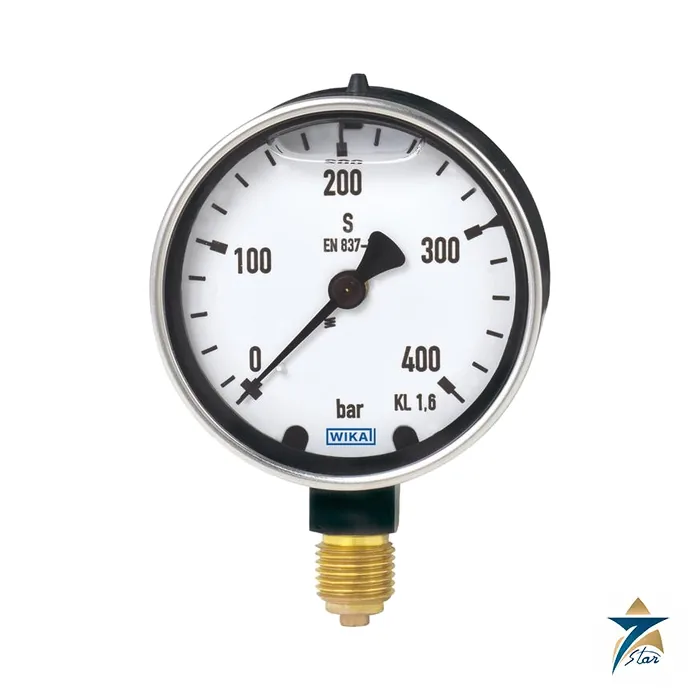
The WIKA 213.40 is a liquid-filled Bourdon tube pressure gauge with a forged brass case and copper alloy wetted parts, built for measuring points that suffer vibration, shock or fast load cycles. It is made in nominal sizes 63 mm (2 1/2 in), 80 mm (3 in) and 100 mm (4 in) and covers scale ranges from 0 … 0.6 bar to 0 … 1,000 bar. The manufacturer lists mining, hydraulics and shipbuilding as its typical fields. Seven Star LLC supplies the 213.40 in Oman and the GCC as an independent supplier in Muscat, and the sections below show how the options of the data sheet map to an RFQ.
Why the case filling matters on the 213.40
A dry gauge on a hydraulic line or a reciprocating pump shows a trembling pointer, and the movement wears quickly. In the 213.40 the case is filled with glycerine or silicone oil, which damps both the Bourdon tube and the movement. For low scale ranges the glycerine is a glycerine-water mixture. The filling also lubricates the movement, so the pointer is steady enough to read. The data sheet gives different temperature limits for the two fills: -20 to +60 °C for medium and ambient with glycerine, and -40 to +60 °C for unfilled instruments or silicone oil. This is the single most important selection point for cold stores and outdoor sites with large day-night swings.
Technical specifications of the 213.40
| Parameter |
Specification |
| Manufacturer / part number |
WIKA / 213.40 |
| Design standard |
EN 837-1 and ASME B40.100 |
| Nominal sizes |
63 mm [2 1/2 in], 80 mm [3 in], 100 mm [4 in] |
| Scale ranges |
0 … 0.6 to 0 … 1,000 bar [0 … 10 to 0 … 15,000 psi], vacuum and compound ranges also listed |
| Case |
Forged brass, black painted or natural; chrome-plated, silver or brass-coloured for NS 63 and 80 |
| Wetted parts |
Copper alloy; Bourdon tube optionally stainless steel 1.4571 or 1.4404 for NS 80 and 100 |
| Case filling |
Glycerine or silicone oil |
| Accuracy class EN 837-1 |
Class 1.6 (NS 63, 80) and Class 1.0 (NS 100) |
| Window |
Acrylic glass (PMMA) or laminated safety glass |
| Safety device |
Blow-out device on the case circumference at 12 o’clock; blow-out plug on top |
| Ingress protection |
IP65 |
| Pressure limit NS 100 |
Steady full scale, fluctuating 0.9 x, short time 1.3 x full scale |
| Pressure limit NS 63/80 |
Steady 3/4 x, fluctuating 2/3 x, short time full scale |
| Approvals |
EU declaration of conformity (PED), CRN; DNV optional for NS 63 and 100 |
Construction details and options of the 213.40
The 213.40 uses a C-type or helical Bourdon tube. The data sheet states a helium-tested leakage rate below 5·10-3 mbar l/s as the tested value and below 1·10-5 mbar l/s for the helium-tested version. For ranges up to 16 bar (250 psi) the case has an equalising valve so that the filled case can be vented and resealed, which prevents a bulging window when the instrument warms up or travels by air.
Mechanical choices are wide. Rings come as a crimp ring or a slip-on bezel in steel or brass. Mounting options include a surface mounting flange, panel mounting flanges in steel or brass, and a triangular profile ring with bracket. Connection location is lower mount or, depending on size, centre back or lower back mount. Process threads are G 1/8 B, G 1/4 B, G 1/2 B and M10 x 1 per EN 837-1, R 1/8, R 1/4 and R 1/2 per ISO 7, and 1/8, 1/4 and 1/2 NPT. A restrictor of 0.3 or 0.5 mm in brass can be fitted to protect the tube against pulsation.
Where the 213.40 fits and which WIKA gauges are related
For stainless steel wetted parts and a stainless case the manufacturer refers to the 213.53, which is also liquid-filled. The 213.40 is the brass alternative for non-aggressive media that will not attack copper alloy, such as hydraulic oil, compressed air, water and many lubricants. Media that attack copper alloy parts, ammonia being the usual example, call for a stainless steel instrument instead. The 213.40 pairs naturally with the 910.10 stopcock or 910.11 shut-off valve for isolation, the 910.12 snubber for extra pulsation damping, and the 910.17 sealing rings.
Selection and ordering checklist for the 213.40
- Nominal size and accuracy class (class 1.0 only for NS 100).
- Scale range and unit, keeping steady load within the pressure limitation of the chosen size.
- Case filling: glycerine or silicone oil, driven by the lowest ambient temperature.
- Window: acrylic or laminated safety glass.
- Case finish, ring and mounting accessories.
- Connection thread, size and location, and whether a restrictor is needed.
- Whether DNV approval is required (only NS 63 and NS 100).
- Certificates: 2.2 test report or 3.1 inspection certificate per EN 10204.
Installation, commissioning and maintenance of the 213.40
Mount the gauge so the blow-out device at 12 o’clock points away from any operator. Seal the male thread with a suitable flat ring and tighten on the square, not the case. On a filled gauge with a vent, open the equalising valve once the instrument is at ambient temperature and reclose it, otherwise internal pressure can distort the reading. The data sheet recommends a calibration interval of one year, depending on conditions of use. If the pointer sits above zero when the line is depressurised, or the filling has clouded or leaked, replace or recalibrate the gauge instead of correcting the pointer.
Typical applications in Oman and the GCC
In Oman and across the Gulf the 213.40 is a practical choice on diesel generator oil circuits, hydraulic power units, crane and winch systems, marine and offshore support vessels, mobile plant and mining equipment, all of which combine vibration with dust and heat. In process plants it is used on compressed air and water headers near rotating equipment. The brass case resists the damp, salt-laden air of coastal sites, but strongly corrosive media call for a stainless steel gauge.
213.40 versions compared by nominal size
| Aspect |
NS 63 |
NS 80 |
NS 100 |
| Accuracy EN 837-1 |
Class 1.6 |
Class 1.6 |
Class 1.0 |
| Connection location |
Lower or centre back |
Lower or lower back |
Lower or lower back |
| Bourdon tube material |
Copper alloy |
Copper alloy or stainless |
Copper alloy or stainless |
| Pressure limit steady |
3/4 x full scale |
3/4 x full scale |
Full scale |
| DNV option |
Yes |
No |
Yes |
Information to send with an RFQ
- Model 213.40, nominal size and scale range
- Case filling and expected minimum and maximum ambient temperature
- Connection thread, size and location
- Window, case finish, ring and mounting
- Restrictor, DNV or certificate requirements
- Quantity, delivery site and required documents
Documents and quotation
The WIKA data sheet for the 213.40 is attached on this page. It includes the scale range tables, dimensions per nominal size and all option lists.
Send the size, range, filling and connection and Seven Star LLC will confirm availability and a quotation.
























Reviews
There are no reviews yet.