Bresle-method soluble salt testing in one handheld gage
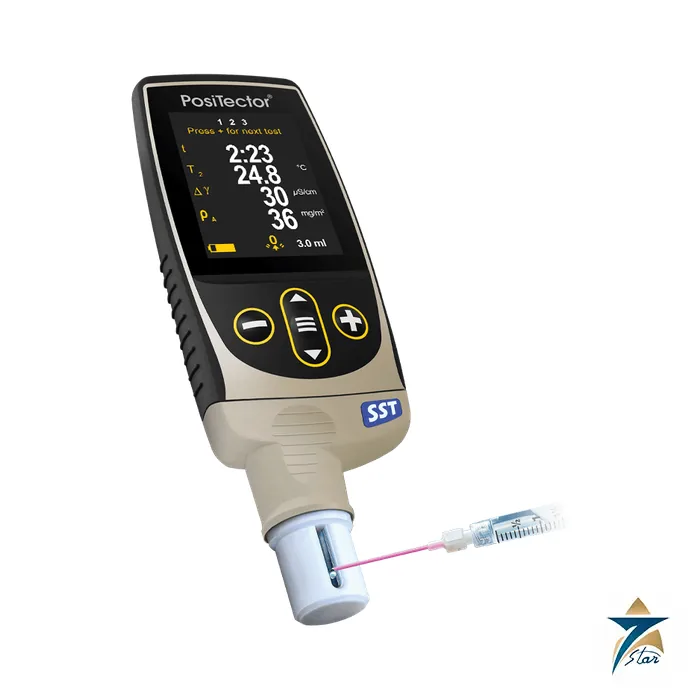
The DeFelsko PosiTector SST is a soluble salt tester built around a conductivity probe designed for the Bresle method of ISO 8502-6 and 8502-9. After a patch is attached to the blasted surface and filled with deionised water, the extracted sample is injected into the 1 ml test cell and the gage displays test duration, sample temperature, conductivity in microsiemens per cm and the surface density of salts in mg per square metre or micrograms per square cm. An on-screen interface guides the operator through the three steps of reference, sample and record, and the gage stores a background (blank) measurement for repeated tests. Salt contamination is a common cause of early coating failure on steel, so the test is normally made after blasting and before coating.
Technical specifications
| Parameter |
Specification |
| Range |
0-1500 microsiemens/cm; 0-6000 mg/m2; 0.0-600.0 micrograms/cm2 |
| Resolution |
1 microsiemens/cm, 1 mg/m2, 0.1 microgram/cm2 (Hi Res mode: 0.1 microsiemens/cm from 0-200) |
| Accuracy |
+/-2 microsiemens/cm (0-200); +/-10 (above 200-600); +/-20 (above 600-1500) |
| Temperature range |
0-50 deg C (32-122 deg F) |
| Normalisation temperature |
25 deg C (77 deg F) |
| Test cell volume |
1 ml |
| Gage body |
127 x 66 x 25.4 mm (5 x 2.6 x 1 in.), 137 g (4.9 oz) without batteries; 2.8 in. colour touchscreen; IP65-rated |
| Standards listed |
ISO 8502-6 and 8502-9, ISO 11127-6, ASTM D4940, US Navy NSI 009-32 and PPI 63101-000, AS 3894.6, IMO MSC.215(82) and MSC.244(83), SSPC Guide 15 |
Ordering codes and kits
The datasheet ordering guide lists the probe alone as PRBSST and complete gages as SST1 (Standard body) and SST3 (Advanced body). Kit versions add the sampling patches: SSTKITP1 and SSTKITP3 include five PosiPatch reusable patches, syringes with plastic tips, cups, a standard magnetic ring, 250 ml of deionised water and a hard-shell case; SSTKITD1 and SSTKITD3 include 25 DeFelsko adhesive patches with needles; SSTKITL1 and SSTKITL3 include 25 latex adhesive patches. Adding F to a kit code, for example SSTKITPF1, substitutes the flexible magnetic ring for smaller diameters. A PosiPatch starter kit and a probe-only kit are also listed. Every probe or gage includes a certified conductivity standard, foam swabs and a long-form Certificate of Calibration traceable to NIST, with a two-year warranty on body and probe.
Patches, abrasives and consumables
The PosiPatch is a reusable patch held by a magnetic ring, so there is no adhesive residue and no needle; the datasheet notes it works on pipes and curved steel with the flexible ring. The probe also accepts every Bresle patch type. An Abrasives Test Kit (SSTABRKIT) supports measurement of soluble salts in blast cleaning abrasives according to ASTM D4940 and ISO 11127-6. Consumables listed include syringes, plastic dispensing tips, needles, sterile cups, deionised water, foam swabs, a 60 ml certified conductivity standard and replacement patches. See all portable test and measurement instruments.
Selection checks for a coating inspection team
Start with the specification the project will be inspected against. Coating specifications usually name the extraction method, the acceptance limit and the unit in which results must be reported, and the PosiTector SST can display either conductivity or surface density, so agree the reporting unit with the client or third-party inspector before work begins. Next, decide whether the team already owns a compatible PosiTector gage body, in which case the probe alone may be enough, or needs a complete gage. Think about the surfaces to be tested: flat plate, large tanks, pipe spools or small-diameter pipe all influence the choice between reusable PosiPatch sampling and adhesive patches, and between the standard and flexible ring. Finally, estimate how many tests a typical shift will run so consumables can be ordered in sensible quantities.
Setting up and verifying the instrument
Before the first job, read the DeFelsko instructions and practise the reference, sample and record sequence on a test panel so every inspector follows the same routine. Check the probe against the certified conductivity standard supplied, and repeat that check at the interval your quality procedure sets. Rinse and dry the test cell between readings with deionised water and clean swabs, because carry-over from a previous sample is an easy way to get a misleading result. Keep the calibration certificate with the gage so it can be shown during audits.
Good practice on site
Test after surface preparation and as close as practical to the time of coating, since contamination can return if the surface is left exposed. Choose test locations that represent the whole surface, including welds, edges and areas that were heavily corroded before blasting, and log every location with its result. Handle syringes, cups and patches with clean gloves, store the deionised water sealed, and discard consumables that may have been contaminated. Where abrasives are also checked, keep their sampling records with the surface results so the full picture is available if a coating defect appears later.
Using the gage in Oman and GCC conditions
Coastal fabrication yards, offshore modules and desalination plants in the region often combine heat, humidity and salt-laden air, which is exactly why soluble salt testing is written into many coating specifications. Keep the gage and consumables out of direct sun and stored in their case between tests, and note that the instrument’s stated temperature range is 0-50 °C, so very hot surfaces or midday conditions may require testing earlier in the day or in shade. Wipe dust from the gage and test cell area before each sequence, and keep the deionised water container closed so airborne dust and salt do not enter it.
Documents and quotation
The attached DeFelsko datasheet carries the ordering guide and consumable codes. Please confirm before ordering whether you need the probe only, a Standard or Advanced gage body, the patch type, the standard ring or flexible ring and the consumable quantity, and send the details with your enquiry so the code can be checked against the manufacturer documentation.










Reviews
There are no reviews yet.