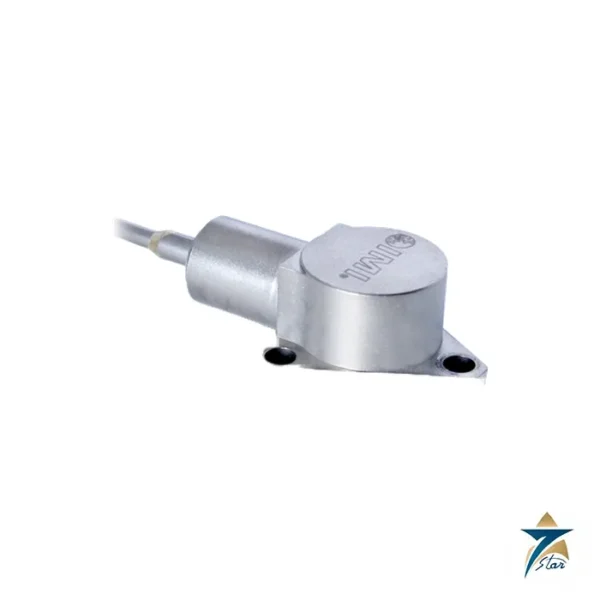
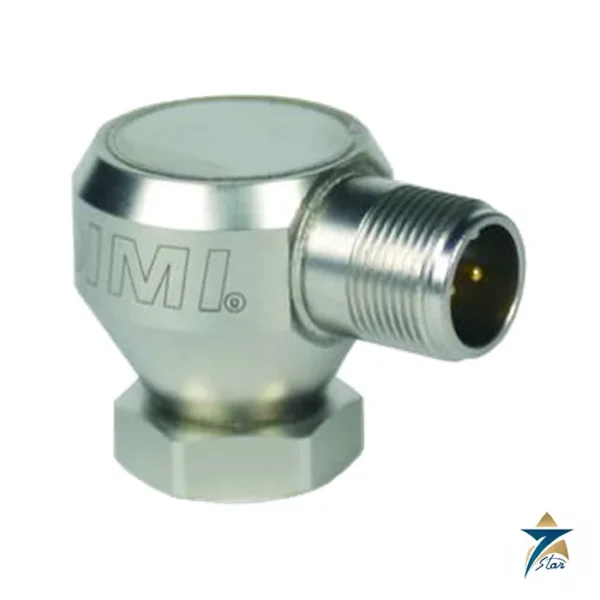
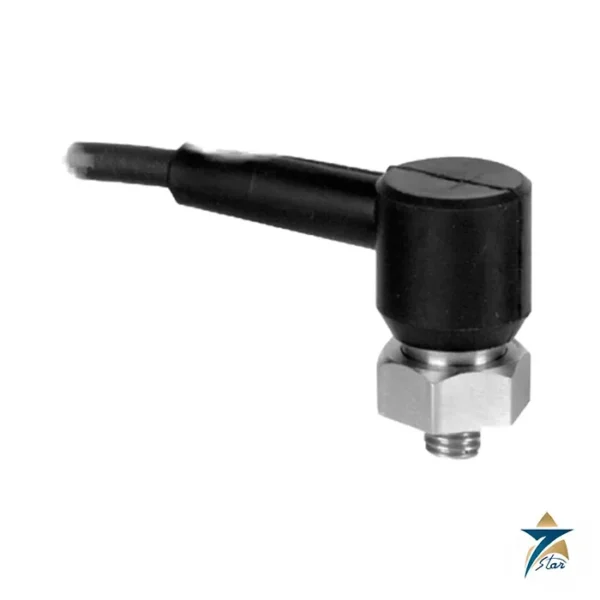
PCB Piezotronics 352C33 General Purpose ICP Accelerometer

Description

Overview

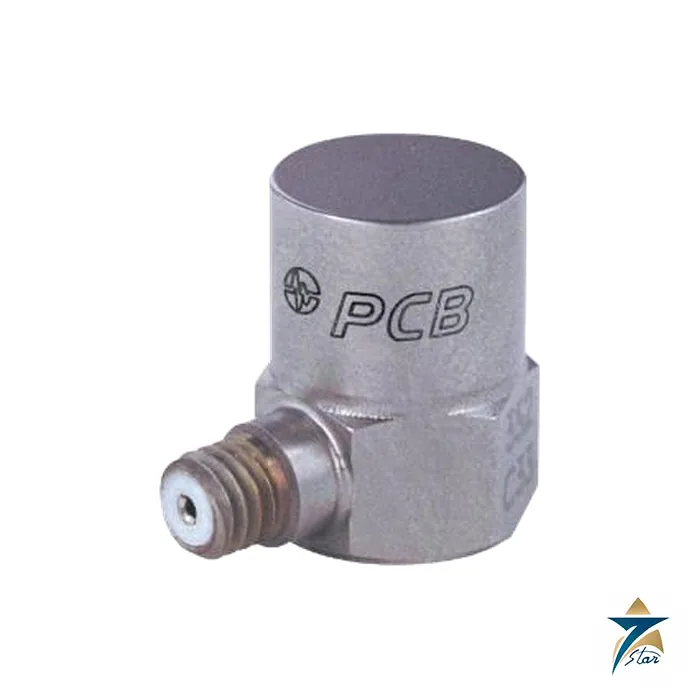
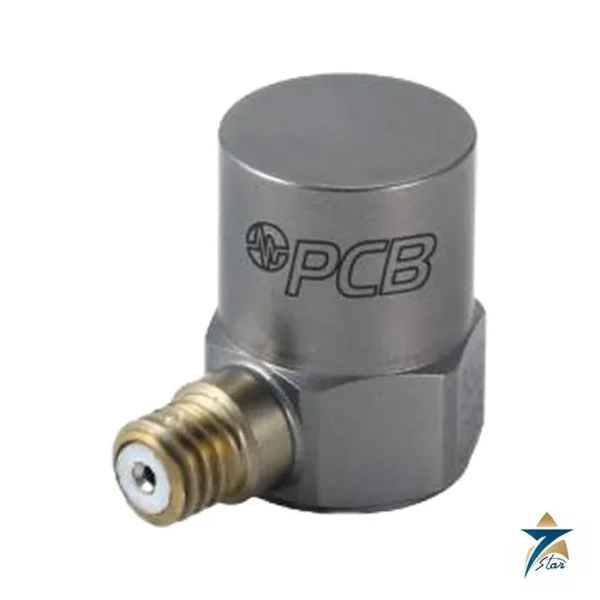
The PCB Piezotronics 352C33 is a miniature, general-purpose ICP® accelerometer from the PCB Piezotronics vibration division, and it is one of the best-known test and measurement accelerometers in use today. Weighing only 5.8 g, with 100 mV/g sensitivity, a ±50 g pk range and a frequency response of 0.5 to 10,000 Hz within ±5%, it is the sensor many engineers reach for when they need accurate vibration data from small structures, rotating machines and test rigs without mass-loading the object under test.

Seven Star LLC supplies the PCB Piezotronics 352C33 to engineering consultancies, university laboratories, OEM test departments and plant reliability teams in Oman and the GCC. From Muscat we provide engineering support, including the mounting accessories, coaxial cables and IEPE signal conditioners that a complete measurement chain requires.

Measurement Principle

The PCB Piezotronics 352C33 uses a ceramic sensing element in shear configuration. Under vibration, an internal seismic mass loads the ceramic in shear and generates a charge proportional to acceleration; built-in ICP® microelectronics convert that charge into a low-impedance voltage. In general, shear designs give low base strain sensitivity and good thermal stability, and the datasheet confirms a base strain sensitivity of 0.003 g/µε for this model, so the signal reflects real motion rather than bending of the mounting surface.

Being an IEPE device, the sensor needs a constant current supply of 2 to 20 mA from an 18 to 30 VDC source, which is provided by most data acquisition systems, dynamic signal analyzers and portable vibration meters. The output bias voltage is 7 to 12 VDC and the output impedance is at most 200 ohm, so the signal can be carried over ordinary coaxial cable with very good noise immunity.

Engineering Design of the PCB Piezotronics 352C33

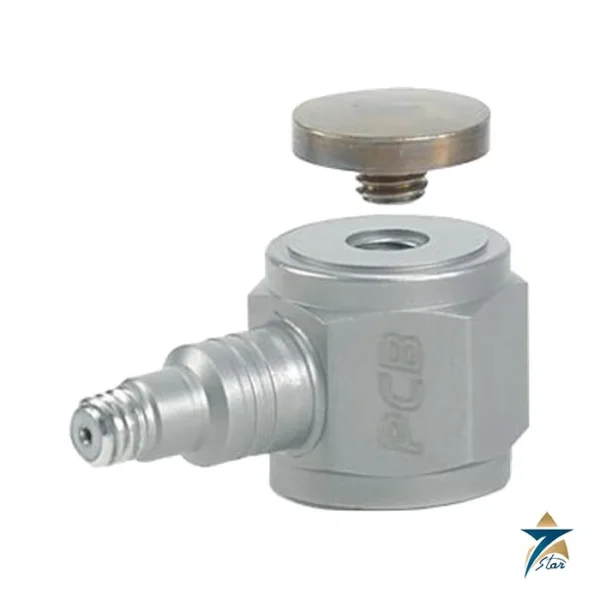
The housing is titanium with a hermetic seal, measuring 0.44 in hex by 0.62 in high (11.2 mm x 15.7 mm). A side-exit 10-32 coaxial jack keeps the profile low and the 10-32 female mounting thread accepts the supplied studs; recommended mounting torque is 10 to 20 in-lb (113 to 226 N-cm). The low mass and stiff construction place the resonant frequency at or above 50 kHz, which keeps the upper part of the usable band flat.

The datasheet lists a range of factory options. The HT option extends the operating temperature to +163 °C with some changes to bias and frequency data, the J option adds ground isolation, the W option provides a sealed integral water-resistant cable, and the T, TLA, TLB, TLC and TLD options add TEDS digital memory to IEEE P1451.4 or IEEE 1451.4 for automatic sensor identification in compatible data acquisition systems.

The mounting method affects the result. As a general rule, stud mounting on a smooth, flat surface gives the widest usable bandwidth, adhesive bases come close for most work, and wax is convenient for quick surveys at moderate temperatures and lower frequencies. Because the PCB Piezotronics 352C33 is supplied with an adhesive base, petro wax and two studs, an engineer can choose the right method on site. The side connector also lets the cable be taped down close to the surface, which reduces cable whip, a frequent source of noise at low frequencies.

Selecting the PCB Piezotronics 352C33 rather than a heavier industrial sensor makes sense whenever the test object is light, such as instrument tubing, small brackets or thin panels, since a heavy sensor can shift the natural frequencies being measured.

Key Features

The PCB Piezotronics 352C33 is valued for the following characteristics:

  • Sensitivity of 100 mV/g (±10%) with a ±50 g pk measurement range.
  • Frequency range of 0.5 to 10,000 Hz within ±5% and 0.3 to 15,000 Hz within ±10%.
  • Resonant frequency of at least 50 kHz.
  • Broadband resolution of 0.00015 g rms from 1 to 10,000 Hz.
  • Light 5.8 g titanium housing that minimizes mass loading on small structures.
  • Shock overload protection up to ±5,000 g pk.
  • Operating temperature range of -54 to +93 °C, extendable with the HT option.
  • Supplied with an adhesive mounting base, petro wax, 10-32 and M6 mounting studs and an NIST-traceable frequency response calibration.

Industrial Applications

Typical uses of the PCB Piezotronics 352C33 include modal and structural testing of skids and pipe supports, troubleshooting of resonance on pump baseplates, acceptance testing of motors and fans, and laboratory vibration measurement in product development. In the oil, gas and power sectors in Oman, reliability engineers often use it during root-cause investigations, where a few lightweight sensors are attached temporarily with wax or adhesive to map operating deflection shapes on a problem machine before a permanent monitoring solution is designed.

Seven Star LLC supplies the PCB Piezotronics 352C33 with cables, mounting bases and signal conditioning, and can recommend permanent industrial sensors when a temporary investigation turns into a monitoring program. On this site you can find the rugged PCB Piezotronics 356A01 tri-axial accelerometer for three-axis measurements, the PCB Piezotronics 378B02HT acoustic sensor for sound measurements, and the CEMB N600 portable vibration analyzer and dynamic balancer, which can work with IEPE accelerometers in field balancing tasks.

Technical Specifications

Data for the PCB Piezotronics 352C33 is taken from the PCB Piezotronics datasheet, revision H:

Parameter Specification
Model 352C33
Type General-purpose ICP® accelerometer
Sensitivity (±10%) 100 mV/g (10.2 mV/(m/s²))
Measurement range ±50 g pk
Frequency range (±5%) 0.5 to 10,000 Hz
Frequency range (±10%) 0.3 to 15,000 Hz
Resonant frequency ≥50 kHz
Broadband resolution (1 to 10,000 Hz) 0.00015 g rms
Non-linearity ≤1%
Transverse sensitivity ≤5%
Overload limit (shock) ±5,000 g pk
Temperature range (operating) -54 to +93 °C
Base strain sensitivity 0.003 g/µε
Excitation voltage / current 18 to 30 VDC / 2 to 20 mA
Output impedance ≤200 ohm
Output bias voltage 7 to 12 VDC
Discharge time constant 1.0 to 2.5 s
Sensing element / geometry Ceramic / shear
Housing / sealing Titanium / hermetic
Size (hex x height) 11.2 mm x 15.7 mm
Weight 5.8 g
Electrical connector 10-32 coaxial jack, side exit
Mounting thread / torque 10-32 female / 113 to 226 N-cm
Options HT high temperature, J ground isolated, T/TLA/TLB/TLC/TLD TEDS, W water-resistant cable

How to Order

To obtain the PCB Piezotronics 352C33 or one of its option versions, contact Seven Star LLC with the quantity, option codes and the data acquisition hardware you use. The PCB Piezotronics 352C33 datasheet can be downloaded from this page. Our Muscat instrumentation team will confirm availability and lead time, prepare a formal offer and assist with measurement setup for customers across Oman and the GCC.

PCB 352C33 Accelerometer: Key Specifications

The PCB Piezotronics 352C33 is a general-purpose ICP (IEPE) accelerometer used for machine vibration testing and laboratory measurement. Its nominal sensitivity of 100 mV/g suits general machinery monitoring.

  • Power – requires an ICP/IEPE constant-current signal conditioner or data acquisition input.
  • Mounting – stud, adhesive or magnetic mounting. The method affects the usable frequency range.
  • Cabling – coaxial cable with a 10-32 connector.

Send the quantity and your DAQ or analyzer type, and we quote the 352C33 with mounting accessories and cables.


Datasheets & Documents
  • PDF Datasheet PCB Piezotronics 352C33 Datasheet (Rev. H) Download
Reviews (0)

Reviews

There are no reviews yet.

How would you rate this product?

It takes about 10 seconds — just tap a star. Your email is never published.

About brand

PCB Piezotronics is the American maker of sensors for dynamic measurement: accelerometers, pressure, force and strain sensors, microphones and industrial vibration monitoring. The brothers Robert (Bob) and James Lally founded the company in August 1967 near Buffalo, New York; they are credited with ICP technology, which puts the amplifier inside the piezoelectric sensor. PCB is headquartered in Depew, New York, was acquired by MTS Systems in 2016, and has been part of Amphenol since Amphenol bought MTS in 2021.

Seven Star LLC sources and supplies PCB Piezotronics accelerometers and acoustic sensors for customers in Oman, including the models described below.

PCB Piezotronics company profile

Founded August 1967, near Buffalo, New York, USA
Founders Robert W. Lally (earlier a co-founder of Kistler Instrument Co. in 1955) and James Lally
Known for ICP integrated circuit piezoelectric sensors
Headquarters Depew, New York, USA
Ownership MTS Systems from July 2016; Amphenol (NYSE: APH) since 2021
Product families ICP and charge accelerometers, dynamic pressure and force sensors, measurement microphones, 4–20 mA vibration transmitters, reciprocating machinery protectors, Endevco sensors

Milestones

  • 1967: Bob and Jim Lally found PCB Piezotronics in August.
  • 2016: MTS Systems acquires PCB in July.
  • 2019: Endevco becomes a PCB Piezotronics company.
  • 2021: Amphenol acquires MTS, and PCB becomes part of Amphenol.

PCB sensors listed here

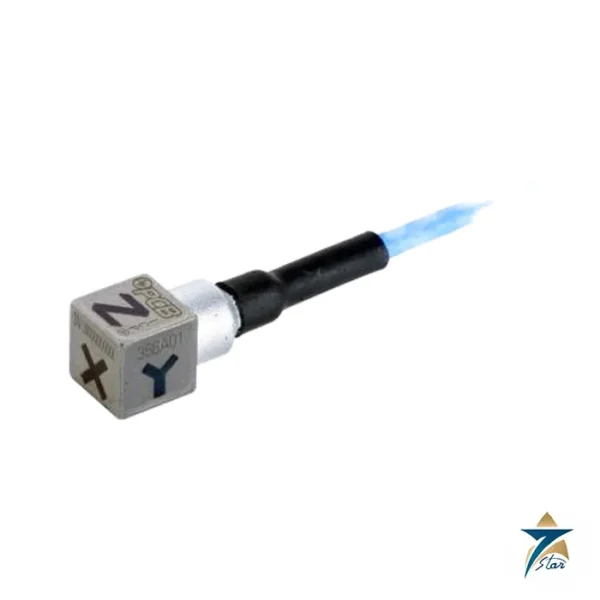
Model 356A01 is a miniature triaxial ICP accelerometer with a ceramic shear element and titanium housing. PCB gives it a nominal sensitivity of 5 mV/g, a range of 1000 g peak and a weight of about one gram; it is adhesive mounted and has an integral four-conductor cable. Model 378B02 is a 1/2-inch prepolarized free-field microphone supplied with a mated ICP preamplifier and TEDS, at 50 mV/Pa.

PCB Piezotronics products we list

Family Examples
Vibration Monitoring 208C02 ICP Force Sensor 100 lb, 352C03 General Purpose ICP Accelerometer, 352C33 General Purpose ICP Accelerometer, 356A01 Tri-Axial Accelerometer, 378B02HT Acoustic Sensor, 603C01 Industrial ICP Accelerometer, 607A11 Swiveler Industrial ICP Accelerometer, 608A11 Industrial ICP Accelerometer 100 mV/g and 6 more
Pressure Instrumentation 113B28 High Frequency ICP Pressure Sensor

Ordering PCB sensors: what we need

Send the exact model number, including any prefix letters. PCB puts option codes in front of the base model, so a high-temperature or metric version carries a different prefix. Add the cable length and connector, and the signal conditioner or analyzer input you are using. For GCC test laboratories we can request the manufacturer's calibration certificate with the sensor.
Facts checked against PCB Piezotronics' published company history, October 2026.

FAQ

Questions about the PCB Piezotronics 352C33 General Purpose ICP

Answers from our engineering team on installation, compatibility and integration.

01What is the PCB Piezotronics 352C33 typically used for?
The 352C33 is a lightweight general-purpose ICP accelerometer used for modal and structural testing, machinery troubleshooting, product development and laboratory vibration measurement, where low mass and a wide frequency range are important.
02How much does the 352C33 weigh and how is it mounted?
It weighs 5.8 g and has a 10-32 female mounting thread. It is supplied with an adhesive mounting base, petro wax, a 10-32 stud and an M6 adapter stud, so it can be stud, adhesive or wax mounted.
03What signal conditioning does the 352C33 need?
As an IEPE sensor it needs 2 to 20 mA constant current from an 18 to 30 VDC supply. Most dynamic signal analyzers, data acquisition cards and portable vibration meters provide this directly.
04Are there high-temperature or TEDS versions of the 352C33?
Yes. The datasheet lists an HT option to +163 C, a J ground-isolated option, a W option with water-resistant integral cable and several TEDS options compliant with IEEE 1451.4.
05Does Seven Star LLC supply the 352C33 to customers in Oman?
Seven Star LLC supplies the 352C33 and its accessories to customers in Oman and the GCC, with engineering support from our office in Muscat.