R9R51225: Resi9 2P 25 A 30 mA type AC RCCB
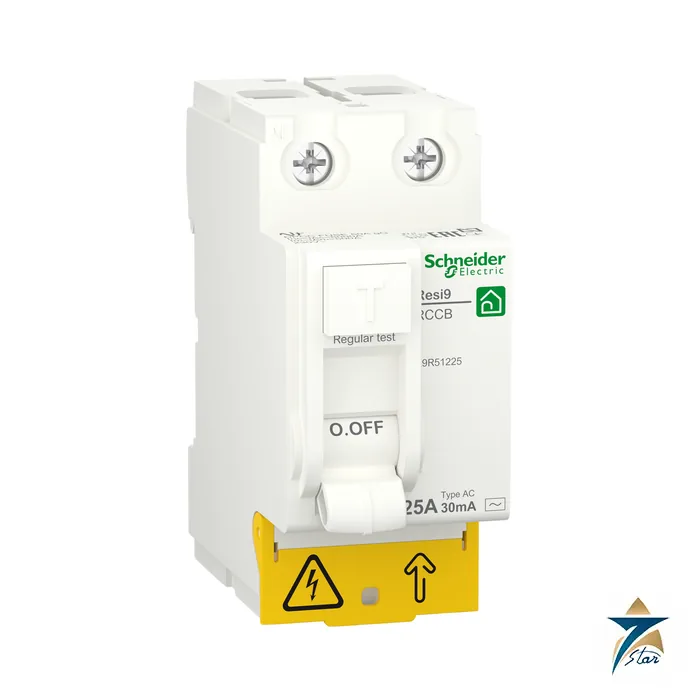
The R9R51225 is a Schneider Electric Resi9 residual current circuit breaker (RCCB): two-pole, opens phase and neutral together, for a single-phase circuit. Its rated current is 25 A, its earth-leakage sensitivity is 30 mA with instantaneous tripping, and the protection class is type AC. It clips onto a DIN rail, occupies 4 modules of 9 mm (36 mm) and is rated 230 V AC at 50/60 Hz. Seven Star LLC supplies the R9R51225 in Oman and the GCC as an independent supplier based in Muscat.
The reference reads as R9R5, then 1 for 30 mA, then 2 for the pole count and 25 for the rated current in amperes. That is our reading of the pattern across the Resi9 RCCB references we looked at, not a published ordering table, so confirm the complete reference before you order.
Technical specifications of the R9R51225
| Parameter |
Specification |
| Manufacturer / part number |
Schneider Electric / R9R51225 |
| Range |
Resi9 |
| Product type |
Residual current circuit breaker (RCCB) |
| Poles |
2P |
| Rated current [In] |
25 A |
| Earth-leakage sensitivity |
30 mA |
| Protection time delay |
Instantaneous |
| Protection class |
Type AC |
| Network / frequency |
AC / 50/60 Hz |
| Rated operational voltage [Ue] |
230 V AC 50/60 Hz |
| Rated insulation voltage [Ui] |
440 V |
| Rated impulse withstand [Uimp] |
4 kV |
| Surge current |
250 A |
| Rated breaking and making capacity |
Im 500 A (EN/IEC 61008) |
| Rated conditional short-circuit current |
Inc 6 kA |
| Residual current tripping |
Voltage independent |
| Control / signalling |
Toggle; ON/OFF indication |
| Mounting |
Clip-on, DIN rail |
| Width |
36 mm (4 × 9 mm pitches) |
| Height / depth / embedding depth |
81 mm / 73 mm / 44 mm |
| Net weight |
180 g |
| Colour |
White |
| Terminals |
Tunnel type, top or bottom: 1–35 mm² rigid; 1–25 mm² flexible; 1–25 mm² flexible with ferrule |
| Wire stripping / torque |
15 mm / 3.5 N.m, top or bottom |
| Mechanical / electrical durability |
20000 / 10000 cycles |
| Standards |
EN/IEC 61008-1; EN/IEC 61008-2-1 |
| Quality labels |
EAC; UA TR |
| Degree of protection |
IP20 |
| Pollution degree |
2 |
| Overvoltage category |
III |
| Tropicalisation |
2 (IEC 60068-1) |
| Relative humidity |
95 % at 55 °C |
| Operating temperature |
-5 to 40 °C |
| Storage temperature |
-40 to 80 °C |
| Packing |
1 piece, 206 g; 54 pieces in the second package level |
| Warranty |
18 months |
Why 30 mA on the R9R51225
The R9R51225 has a 30 mA threshold, the figure normally associated with supplementary protection of people on socket and final circuits. All leakage downstream adds up, including the small leakage that filters and electronic supplies send to earth, so a board with many such loads on one RCCB can drift toward the trip level. Splitting circuits across several RCCBs, or moving to a less sensitive stage where the protection goal allows it, is the usual remedy.
Instantaneous tripping, as listed here, means there is no built-in delay. When several residual current devices are cascaded, a downstream fault can trip the upstream device at the same time unless it is a selective type, so plan the board structure with that in mind.
Size, terminals and mounting of the R9R51225
The body is 36 mm wide, 81 mm high and 73 mm deep, which is 4 modules of 9 mm on the rail. The datasheet lists an embedding depth of 44 mm and ON/OFF indication on the front, and the body weighs 180 g net. The neutral position is listed on the left, and the diagram on the housing should be followed.
The terminals are tunnel type, top or bottom, taking 1 to 35 mm² rigid and 1 to 25 mm² flexible conductors, including flexible with ferrule. Tighten to 3.5 N.m after stripping 15 mm of insulation. A contact position indicator or ON/OFF indication shows whether the poles are open, so a glance at the front of the R9R51225 confirms its state.
Installing and testing the R9R51225
Isolate and prove dead, clip the R9R51225 onto the DIN rail, connect the conductors observing the neutral position and tighten to 3.5 N.m. After energising, operate the test button on the front. The device must trip immediately, and the toggle is then reset by hand. A device that does not trip on test should be replaced instead of reset.
Operate the test button at regular intervals in service and record the rating and sensitivity on the board schedule. When an RCCB trips for real, look for the leakage before closing it again, because a repeated trip normally points to wet equipment, a damaged cable or an earth fault.
How the R9R51225 detects earth leakage
Inside an RCCB the live conductors pass through a sensing core. When current out and current back are equal the core sees nothing, and when part of it leaves by another path, such as through a person or a damaged cable to earth, the imbalance appears. At 30 mA the this RCCB opens all 2 poles. The datasheet lists voltage-independent tripping, so the mechanism does not rely on the line voltage to act.
The device is type AC, which responds to sinusoidal alternating residual current. Loads that can put a smooth or pulsating DC component into a fault, such as some drives, chargers and rectifier supplies, need a type A or better device, and the protection class on this reference should be compared with those loads before it is chosen.
An RCCB gives no overload or short-circuit protection. The datasheet figure for conditional short-circuit current assumes the proper protective device ahead of the this RCCB, which should not be rated above 25 A.
Durability and environment for the R9R51225
The datasheet lists 20000 mechanical and 10000 electrical cycles, IP20 protection, pollution degree 2, overvoltage category III and tropicalisation 2, with 95 % relative humidity at 55 °C. Operation is listed from -5 to 40 °C and storage from -40 to 80 °C.
The upper operating limit is 40 °C, lower than some other RCCBs, so in a hot Gulf plant room check the temperature inside the enclosure and not only the room air. Heat from neighbouring breakers and cabling can bring R9R51225 closer to its limit than expected.
Selection checklist for the R9R51225
- Supply: 230 V AC, 2 poles, matching a single-phase circuit.
- Current: load through the device up to 25 A, with upstream protection no higher.
- Sensitivity: 30 mA against the goal of protecting people, equipment or the installation from fire.
- Waveform: type AC against the loads on the circuit.
- Backup: a miniature circuit breaker or fuse upstream, since the RCCB does not trip on overcurrent.
- Space: 4 modules, 36 mm of DIN rail.
Information to send with an RFQ for the R9R51225
- Exact reference R9R51225 and the quantity needed.
- Supply voltage, system type and earthing arrangement.
- Description of the loads, including drives or electronic equipment.
- Upstream protective device and its rating.
- Other poles, ratings or sensitivities needed in the same order.
- Delivery location and timeline.
Before ordering, check that the board enclosure, busbar arrangement and neighbouring devices leave enough room for heat to escape, since crowded boards in hot rooms run closer to their limits than the rated ambient suggests.
Keep a record of the installed ratings on the board schedule and note the supply voltage at commissioning, because later extensions and fault investigations depend on knowing exactly what protects each circuit.
Spare devices of the same rating, pole count and sensitivity are worth planning for sites that run continuously, since a like-for-like replacement keeps the original protection design intact after a trip or a fault.
If the board will be extended later, leave spare rail length and think about how added circuits change the leakage current seen by this device, which affects how close it runs to its trip threshold.
Documents and quotation
The Schneider Electric datasheet for the R9R51225 is attached on this page and holds the full specification summarised above. It is dated 8 Nov 2026 as printed on the manufacturer’s document.
Send us the reference R9R51225, quantity and delivery location and Seven Star LLC will reply to your request. We supply as an independent supplier based in Muscat and do not act for the manufacturer.


























Reviews
There are no reviews yet.