A9C30212: two-pole impulse relay for 24 V DC or 48 V AC control
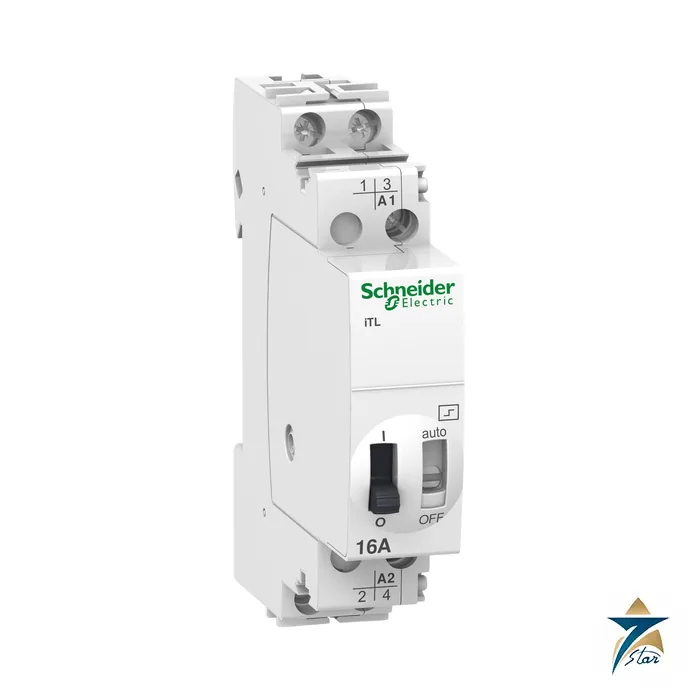
The A9C30212 is a Schneider Electric Acti9 product listed in the datasheet as: impulse relay iTL – 2P – 2 NO – 16A – coil 24 VDC – 48 VAC 50/60Hz. The A9C30212 is a two-pole impulse relay in an 18 mm body. Both contacts are normally open and operate together on each control pulse, which lets one push-button switch phase and neutral of a lighting or heating circuit and leave it open with no coil current. Seven Star LLC supplies the A9C30212 in Oman and the GCC as an independent supplier based in Muscat.
From the datasheet title: iTL, 2P with 2 NO, 16 A, and a coil rated for 24 V DC or 48 V AC at 50/60 Hz. The datasheet lists the same 250 V AC operational voltage and the same 50 ms to 1 s pulse window as the other iTL references; the coil voltage is the main difference.
Technical specifications of the A9C30212
| Parameter |
Specification |
| Manufacturer / part number |
Schneider Electric / A9C30212 |
| Description |
impulse relay iTL – 2P – 2 NO – 16A – coil 24 VDC – 48 VAC 50/60Hz |
| Range of product |
Acti9 |
| Product name |
Acti9 iTL |
| Product or component type |
Impulse relay |
| Device short name |
iTL |
| Device application |
Standard |
| Poles |
2P |
| Pole contact composition |
2 NO |
| [In] rated current |
16 A |
| Network type |
AC |
| [Uc] control circuit voltage |
48 V AC 50/60 Hz; 24 V DC |
| Network frequency |
50/60 Hz |
| [Ue] rated operational voltage |
250 V AC 50/60 Hz |
| Control type |
Remote and manual control; Coil deconnection |
| Control signal type |
Impulse |
| Switching frequency |
100 switching operations/day; 5 switching operations/minute |
| Impulse duration |
50 ms–1 s |
| Remote control type |
Illuminated push-button 3 mA |
| Local signalling |
ON/OFF indication |
| Mounting mode |
Fixed |
| Mounting support |
DIN rail |
| 9 mm pitches |
2 |
| Height |
84 mm |
| Width |
18 mm |
| Depth |
60 mm |
| Electrical durability |
AC-21: 200000 cycles; AC-22: 100000 cycles |
| Tightening torque |
1 N.m |
| Standards |
EN 669-1; EN 669-2-2 |
| Product certifications |
GOST |
| Quality labels |
IMQ; VDE; NF; KEMA; CEBEC |
| Noise level |
60 dB |
| IP degree of protection |
IP20 conforming to IEC 60529 (on opening); IP40 conforming to IEC 60529 (in enclosure) |
| Relative humidity |
95 % at 55 °C |
| Ambient air temperature, operation |
-20 to 50 °C |
| Ambient air temperature, storage |
-40 to 70 °C |
How the A9C30212 works
The coil of an impulse relay is designed for pulses, not for continuous energisation. The datasheet limits the pulse to between 50 ms and 1 s and the operating rate to 5 operations per minute; the listed daily figure is 100 operations. Within those limits the coil stays cool. Outside them, for example with a stuck button or a PLC output left on, the coil is held energised and may overheat, so the control scheme should prevent that.
The relay uses the pulse-and-latch principle: pulse one closes both poles, pulse two opens them. A 24 V DC supply is common in control cabinets and building automation outputs, while 48 V AC is found in telecommunication-style and some industrial control transformers. The datasheet lists a switching frequency of 5 operations per minute and a limit of 100 operations per day.
Control and contact data of the A9C30212
Coil voltage: 48 V AC 50/60 Hz; 24 V DC. Rated operational voltage: 250 V AC 50/60 Hz. Rated current: 16 A. Control type: Remote and manual control; Coil deconnection. Impulse duration: 50 ms–1 s. Switching frequency: 100 switching operations/day; 5 switching operations/minute. Remote control type: Illuminated push-button 3 mA. Electrical durability: AC-21: 200000 cycles; AC-22: 100000 cycles.
AC-21 and AC-22 are the load categories of IEC 60947: AC-21 refers to resistive loads including moderate overloads and AC-22 to mixed resistive and inductive loads. The higher cycle count for AC-21 shows that purely resistive circuits give the longer contact life.
Range and accessories around the A9C30212
The A9C30115 differs in contacts 1 NO + 1 NC against 2 NO here; coil 24 V AC 50/60 Hz against 48 V AC 50/60 Hz here. The A9C30811 differs in poles 1P against 2P here; contacts 1 NO against 2 NO here; coil 230 to 240 V AC 50/60 Hz against 48 V AC 50/60 Hz here.
The datasheet lists compatible accessories and range members for this reference: Acti9 iATEt; Acti9 iATLc; Acti9 iATLc+s; Acti9 iATLm; Acti9 iATLs; Acti9 iETL iTL 16; Acti9 iATLc+c. The comparison table lists the impulse relays of this group.
| Reference |
Poles / contacts |
Coil |
Width |
| A9C30111 |
1P / 1 NO |
24 V AC 50/60 Hz, 12 V DC |
18 mm |
| A9C30115 |
2P / 1 NO + 1 NC |
24 V AC 50/60 Hz, 12 V DC |
18 mm |
| A9C30212 (this page) |
2P / 2 NO |
48 V AC 50/60 Hz, 24 V DC |
18 mm |
| A9C30811 |
1P / 1 NO |
230 to 240 V AC 50/60 Hz, 110 V DC |
18 mm |
| A9C30812 |
2P / 2 NO |
230 to 240 V AC 50/60 Hz, 110 V DC |
18 mm |
| A9C30814 |
4P / 4 NO |
230 to 240 V AC 50/60 Hz, 110 V DC |
36 mm |
| A9C30815 |
2P / 1 NO + 1 NC |
230 to 240 V AC 50/60 Hz, 110 V DC |
18 mm |
| A9C32816 |
2P / 1 C/O + 1 NO |
230 to 240 V AC 50/60 Hz, 110 V DC |
18 mm |
| A9C33811 |
1P / 1 NO |
230 to 240 V AC 50/60 Hz |
18 mm |
Selection checklist for the A9C30212
- Choose the coil family carefully: 24 V DC or 48 V AC, which is different from the 12 V DC / 24 V AC and mains versions.
- Use a pulse output from a PLC; keep it within 50 ms to 1 s.
- Check the pulse source: a push-button or a controller output that delivers a pulse of 50 ms to 1 s.
- Check the width of 18 mm (2 pitches) against free space on the rail.
- Check load type against AC-21 and AC-22 data, including inrush of LED or electronic loads.
Installation and maintenance of the A9C30212
In service, the main maintenance task is to confirm the manual lever and the ON/OFF indicator still match the load state. The noise level listed is 60 dB, so a relay that clacks audibly is normal; this is a mechanical latch. Keep the board closed: the datasheet gives IP20 conforming to IEC 60529 (on opening) and pollution degree 3, so dust and condensation should be kept out by the enclosure.
Environmental data from the datasheet: -20 to 50 °C in operation, -40 to 70 °C in storage, relative humidity 95 % at 55 °C.
Where the A9C30212 is used in Oman and the GCC
A two-pole impulse relay is used where the neutral must be broken as well as the phase, for example in a hospitality room lighting circuit or in a kitchen extractor control. The 24 V DC coil lets the relay be driven straight from a PLC or relay output module, as long as the output delivers a clean pulse inside the permitted window.
Where a PLC drives the coil, check that the output is a real pulse and not a maintained signal. A maintained level on an impulse coil holds the coil energised, which is not the intended mode; use a timed output or a pulse function block set between 50 ms and 1 s.
Information to send with an RFQ for the A9C30212
- Full reference (A9C30212) and quantity required
- Supply and control voltage at site, with the frequency
- Existing panel, rail and neighbouring devices it must fit beside
- Delivery location and timing
- Whether it is a spare, a like-for-like replacement or a new installation
- Number of push-button stations and whether they are illuminated
Documents and quotation
A datasheet for the A9C30212 is attached on this page. It lists the electrical, mechanical and environmental data summarised above, and it should be read together with the manufacturer’s installation instructions for the final design.
Send us the part number, quantity and application and we will confirm availability and a quotation. Seven Star LLC is an independent supplier in Muscat and is not affiliated with the manufacturer.
Other Models in the Se Acti9 Itl Range
Seven Star LLC supplies models from the Se Acti9 Itl range in Oman and the GCC. Compare the related models below and request a quote for the one that matches your application.




















Reviews
There are no reviews yet.