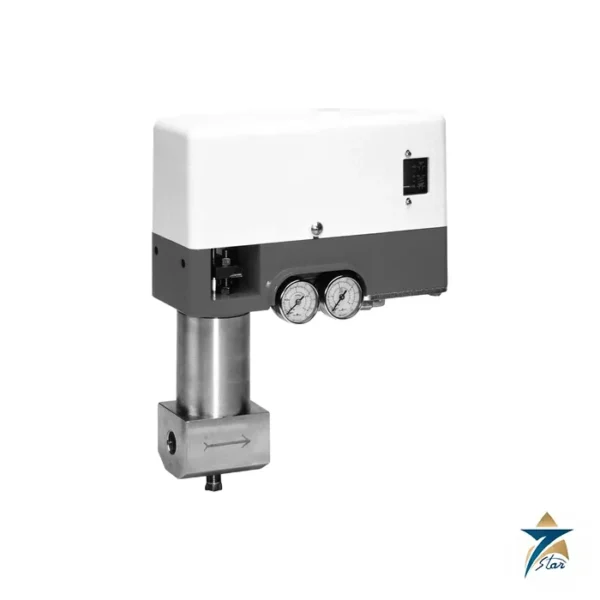
SAMSON Type 3531 globe valve for heat transfer oil systems
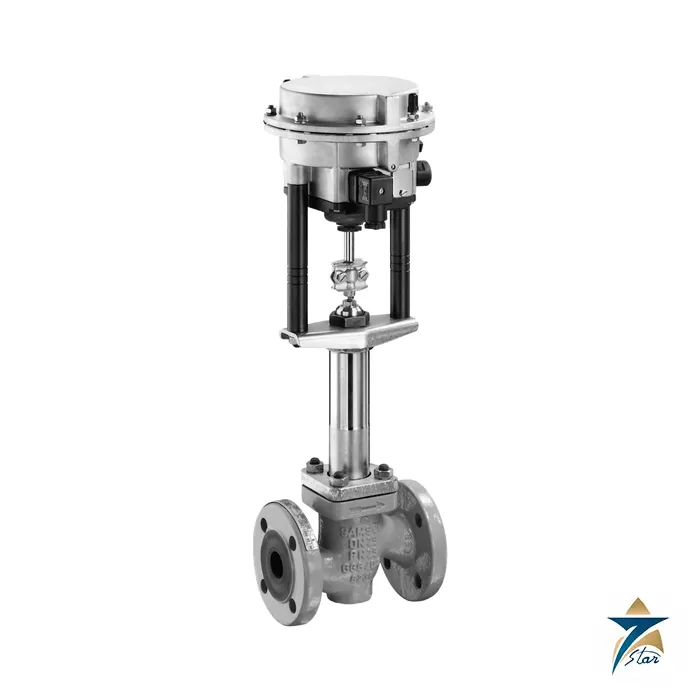
The SAMSON Type 3531 is a globe control valve made for thermal oil circuits. It is designed for organic heat transfer media as covered by DIN 4754, in sizes DN 15 to 80, with a PN 25 rating and a temperature range of –10 to +350 °C. Seven Star LLC supplies the Type 3531 in Oman and the GCC as an independent supplier based in Muscat.
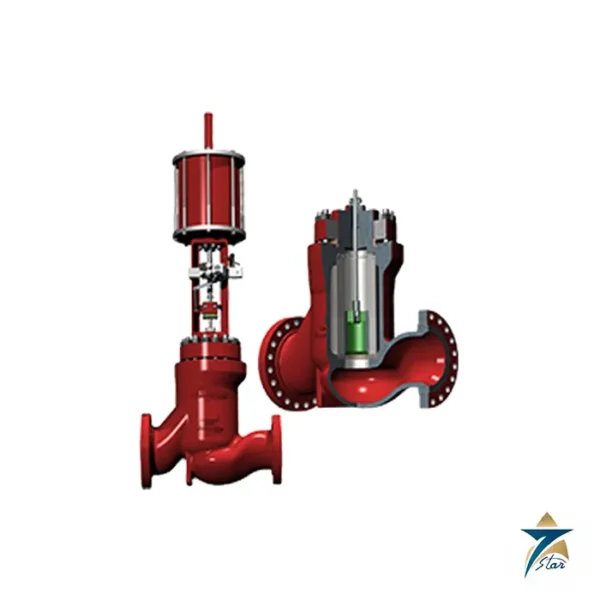
Hot-oil systems are unforgiving about leakage: a weeping stem packing becomes a fire risk and a fouling problem. For this reason the Type 3531 seals the plug stem with a metal bellows and an additional packing behind it. The valve belongs to the Series V2001 and shares its body styles and actuator range with the Type 3321, but it has an equal-percentage characteristic and a metal seat only.
The datasheet notes that an extended temperature range down to –70 °C and an ANSI version are separate offers, so state clearly if either is wanted.
Type 3531 versions and what the suffix means
- 3531-IP: Type 3372 pneumatic actuator of 120 cm² with a Type 3725 positioner, 4 to 20 mA set point, up to 6 bar supply, fail-safe with the stem extending or retracting, optional Type 4744-2 limit switch.
- 3531-PP: Type 3371 pneumatic actuator with bench range 2.1 to 3.3 bar for fail-close or 0.4 to 1.4 bar for fail-open, optional limit switch.
- 3531-E1: DN 15 to 50 with the Type 5827-N3 electric actuator for 230 V/50 Hz or 24 V/50 Hz, optional limit contacts, resistance transmitters or positioner.
- 3531-E3: Type 3374 electric actuator for 230 or 24 V at 50 or 60 Hz, optional type-tested fail-safe action, limit contacts, resistance transmitters and positioner.
Type 3531 technical specifications
| Parameter |
Specification |
| Manufacturer / part number |
SAMSON AG, Type 3531 globe valve for heat transfer oil (DIN version) |
| Nominal size |
DN 15, 20, 25, 32, 40, 50, 65 and 80 |
| Pressure rating |
PN 25 |
| Body materials |
Spheroidal graphite iron EN-GJS-400-18-LT, cast steel 1.0619, stainless steel 1.4408 |
| Connection |
Flanges per DIN EN 1092-1 form B1 (Ra 3.2 to 12.5 µm) or groove form D |
| Seat-plug seal |
Metal seal |
| Characteristic |
Equal percentage |
| Rangeability |
50:1 |
| Leakage class |
Class IV to DIN EN 60534-4 (Type 3531-E1: class I, 0.05 % of KVS) |
| Temperature range |
–10 to +350 °C; down to –70 °C on request |
| Stem seal |
Bellows 1.4571 plus PTFE packing |
| Body gasket |
Graphite on metal core |
| Seat and plug |
Seat 1.4401/1.4404 up to DN 50, 1.4006 from DN 65; plug 1.4305 up to DN 50, 1.4104 from DN 65 |
| Rated travel |
15 mm |
Type 3531 flow coefficients by nominal size
| DN |
KVS options |
| 15 |
1.6 or 4 |
| 20 |
2.5 or 6.3 |
| 25 |
4 or 10 |
| 32 |
16 |
| 40 |
25 |
| 50 |
35 |
| 65 |
50 |
| 80 |
80 |
Smaller sizes offer two coefficients so that the valve is not oversized for low-flow oil lines. For sizing, compare normal and maximum flow with the equal-percentage characteristic and check that normal flow lies in the middle of the travel.
How the Type 3531 keeps the stem tight
The process fluid flows through the valve in the direction of the arrow on the body, opening as the plug lifts. The plug stem is sealed by a metal bellows made of 1.4571 stainless steel, which isolates the oil from the atmosphere, with an additional PTFE packing as a back-up barrier.
Fail-safe action follows the same logic as in other V2001 valves. With the actuator stem extending the valve closes on loss of air or signal; with the stem retracting it opens. In a thermal oil circuit, the fail-open choice protects a heater from overheating, and fail-closed protects a process from overheating, so the answer depends on which side of the heat exchange is more vulnerable.
Pressure limits with the chosen actuator
The pressure the valve can close against depends on KVS and the actuator thrust. For a pneumatic version with metal seat and fail-safe action, the datasheet lists 16 bar for KVS 1.6 to 10, 10 bar for KVS 16 and 25 to 35, and 3.5 or 5 bar for KVS 50 to 80, depending on bench range and supply pressure.
For electric versions with metal seat: the Type 5827-N3 (0.7 kN) gives 10 bar for KVS 1.6 to 10 and 3.5 bar for KVS 16 and 25 to 35. The Type 3374-11 (2.5 kN) gives 16, 12 and 4 bar for the same three groups. The 5827-N3 takes 90 s for rated travel, while the Type 3374 takes 120 s. Check these figures against your maximum pressure drop, including upset conditions such as pump start-up on cold oil.
Selecting a Type 3531 for a thermal oil loop
- Heat transfer fluid and maximum operating temperature, and whether the system follows DIN 4754.
- Nominal size and KVS, using the equal-percentage characteristic at normal and minimum flow.
- Body material: spheroidal graphite iron, cast steel or stainless steel at PN 25.
- Actuator: IP, PP, E1 or E3, and the supply air pressure or voltage and frequency.
- Fail-safe direction and any limit contacts needed for the safety logic.
- Whether a low-temperature extension to –70 °C is needed.
- Insulation plan: the actuator should be kept out of the hot zone, and insulation of the body should leave the bonnet and actuator free.
Installation and maintenance of the Type 3531
Bolt the flanged valve into the oil line with the flow arrow matching the direction. Hot oil piping needs expansion loops, because the valve body is rigid and pipe movement transmits to the flanges.
After the first thermal cycle, check the flange bolts for relaxation, since hot-oil gaskets can creep. Inspect the packing for any sign of oil, which points to bellows damage and calls for a controlled shut-down. Keep spare gaskets and packing for each installed size, and verify the actuator travel and positioner calibration at scheduled turnarounds.
Typical Type 3531 applications in Oman and the GCC
Thermal oil systems appear in refineries, petrochemical plants, bitumen and asphalt facilities, food and edible oil processing, textile finishing and in process heating for resin and plastics production. The Type 3531 regulates oil flow to reactors, jacketed vessels, reboilers and process heat exchangers, or splits flow between users in a header.
In the GCC, ambient heat adds to the load on actuators and positioners that sit near hot piping. The datasheet limits for the pneumatic and electric actuators should be compared with the real temperature at the mounting point, and shielding the actuator from radiated heat is good practice. Seven Star LLC can help prepare an RFQ that includes these checks.
Type 3531 compared with related V2001 valves
| Type |
Medium |
Pressure |
Temperature |
Seat |
| 3321 globe valve |
Liquids, gases, steam |
PN 16 to 40 |
–10 to +300 °C |
Metal or soft |
| 3323 three-way valve |
Mixing and diverting |
PN 16 and 40 |
–10 to +300 °C |
Metal |
| 3531 heat transfer oil |
Organic media, DIN 4754 |
PN 25 |
–10 to +350 °C |
Metal, bellows seal |
Information to send with an RFQ for the Type 3531
- Oil type, operating and maximum temperature, and the pressures upstream and downstream.
- Flow rate for sizing, or the KVS and DN required.
- Body material and flange standard.
- Actuator version, supply, and fail-safe direction.
- Accessories and quantity, and whether a low-temperature version is needed.
Documents and quotation
A SAMSON datasheet (T 8131) for the DIN version is attached on this page with materials, coefficients, differential-pressure tables and dimensions.
Send the thermal oil duty and preferred actuator to Seven Star LLC and we will confirm the correct build and quote.
Other Models in the Samson V2001 Valves Range
Seven Star LLC supplies models from the Samson V2001 Valves range in Oman and the GCC. Compare the related models below and request a quote for the one that matches your application.


























Reviews
There are no reviews yet.