A touchscreen pulse velocity tester for concrete, rock and ceramics
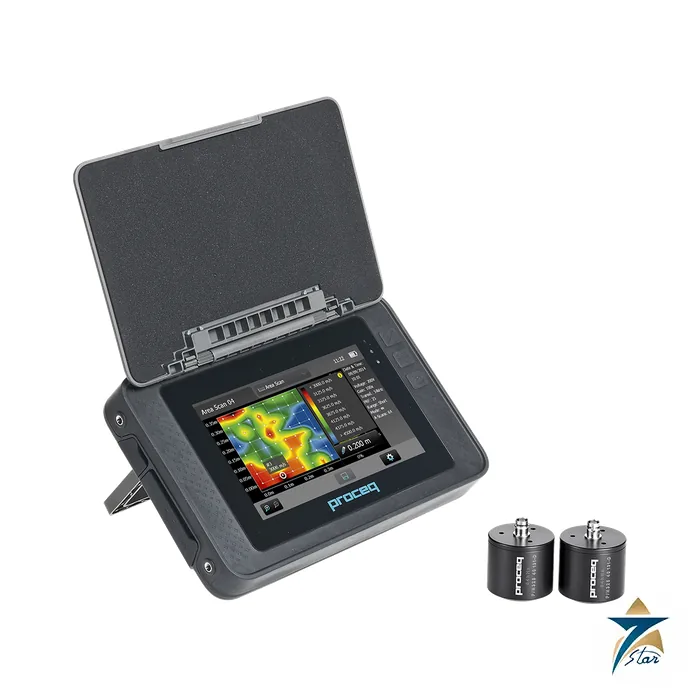
The Pundit 200 is Proceq’s ultrasonic pulse velocity (UPV) instrument for judging the quality and uniformity of concrete. It sends a high-voltage pulse into one transducer, measures the transit time to a second transducer and displays the pulse velocity, from which the user can draw conclusions about density, cracking, voids and strength. The unit sits in a 7 inch colour touchscreen housing of 250 x 162 x 62 mm and about 1.5 kg including battery.
Transit time is displayed from 0.1 to 7930 microseconds with a resolution of 0.1 microsecond below 793 microseconds. The receiver gain runs from 1x to 10000x (0 to 80 dB) in eleven steps, and the pulse voltage can be set between 100 and 450 Vpp. The manual describes the same touchscreen platform being used for Pundit 200 Pulse Echo and the Pundit 250 Array, so one display unit can serve several test methods.
Feature summary
- Pulse velocity, surface velocity, data logging and crack depth modes
- Line scan and area scan for uniformity mapping
- Dynamic E-modulus and Poisson’s ratio from P-wave and S-wave measurements
- Compressive strength correlation for concrete and rock
- Zoomable A-scan with automatic or manual triggering
- Standard BNC connection for transducers up to 500 kHz
- Corrections for temperature and moisture entered in the settings
Technical specifications
| Parameter |
Specification |
| Principle |
Ultrasonic pulse velocity, transmission |
| Range |
0.1 to 7930 us |
| Resolution |
0.1 us below 793 us, 1 us above 793 us |
| Display |
7 inch colour, 800 x 480 pixels |
| Pulse voltage (UPV) |
100 Vpp to 450 Vpp |
| Receiver gain |
1x to 10000x (0 to 80 dB), 11 steps |
| Receiver sensitivity / impedance |
10 uV / 7 kOhm |
| Bandwidth |
20 to 500 kHz |
| Pulse repetition |
5 to 40 Hz selectable |
| Battery |
6 x AA NiMH, 2300 mAh, user replaceable |
| Operating time / charging |
More than 7 h / about 150 min per the manual |
| Operating temperature |
-10 to 50°C |
| Protection class |
IP54 |
| Dimensions / weight |
250 x 162 x 62 mm / about 1.5 kg incl. battery |
Ordering codes and accessories
Part numbers below are copied from the ordering section of the 2017 operating instructions. Transducers are selected by frequency according to grain size and object dimensions.
| Code position |
Options |
| 327 10 002 |
Pundit Touchscreen without transducers, with BNC adapter cable, power supply, USB cable, software, strap and case |
| 327 10 001 |
Pundit 200 with two 54 kHz transducers, two 1.5 m BNC cables, couplant, calibration rod and case |
| Transducers |
24 kHz 325 40 026; 54 kHz 325 40 131; 150 kHz 325 40 141; 250 kHz 325 40 177; 500 kHz 325 40 175; 54 kHz exponential 325 40 170; 40 kHz shear wave 325 40 210 |
| Consumables and tools |
Ultrasound couplant 250 ml 710 10 031; calibration rods 25 us 710 10 028 and 100 us 710 10 029; battery 327 01 033; quick charger 327 01 053 |
Installation and operating notes
Select the connected transducer frequency in the settings so that the factory zero is loaded. The manual notes that this assumes 1.5 m cables; with other cable lengths, or when more accuracy is wanted, zero the instrument on the calibration rod.
Choose the transducer by wavelength. A 54 kHz transducer has a wavelength of 68.5 mm in the manual’s table, so the test object should be at least that wide and aggregate should not exceed about 34 mm. Smaller samples call for 150 kHz or higher.
Apply couplant for smooth surfaces, or use the exponential transducers on rough and curved surfaces. Crack depth follows the BS 1881 Part 203 method, and temperature correction factors from that standard can be entered.
Where pulse velocity testing is used
UPV is used to check the homogeneity of columns, beams and slabs, to find honeycombing and internal cracks, to monitor the development of strength in young concrete and to assess fire-damaged or deteriorated members. The Pulse Echo variant extends the method to one-sided access.
Pulse velocity depends on moisture, reinforcement and aggregate, so the figures are indicators and are normally correlated with cores. General guidance only.
The touchscreen unit connects to a PC through USB and the PL-Link software, which the product page lists for analysis and export of data to third-party applications. Eight gigabytes of internal flash memory hold the stored waveforms and measurement series, and Ethernet is available alongside USB host and device ports.
Information to send with an RFQ for the Proceq Pundit 200
Please give us the following so the offer matches the test plan.
- Standard unit with transducers, or touchscreen only
- Transducer frequencies and cable lengths needed
- Shear wave or exponential transducers if required
- Couplant, spare battery and calibration rod
- Calibration certificate requirement and quantity
Related items and documents
A complementary instrument for the same assessment is the Profometer PM8000 for rebar cover. The portable test and measurement category lists alternative instruments. The datasheet is available here. When the model, accessories and quantity of Pundit 200 are known, Seven Star LLC can answer the request.
Calibration and field notes
Ultrasonic pulse velocity testing is used in the region to check the uniformity and quality of concrete in new structures, to locate voids and cracks, and to assess older buildings, bridges and marine structures. Good coupling between the transducers and the concrete is essential, so use the couplant and prepare the surface as described in the manual. Avoid measuring along reinforcement bars, which can increase the measured velocity.
Check the instrument with the calibration rod before each series of measurements and record the results. In summer, keep the instrument and transducers out of direct sun.
Choose the transducer frequency to suit the path length and the material, and record the transducer arrangement used, whether direct, semi-direct or indirect, so results can be compared between surveys. Store the instrument and transducers in their case.
Frequently asked questions
What does the Pundit 200 measure?
The transit time of an ultrasonic pulse through concrete or rock and the pulse velocity calculated from the path length.
What time range does it cover?
0.1 to 7930 microseconds, with 0.1 microsecond resolution below 793 microseconds.
Which transducer frequencies are available?
Proceq lists 24, 54, 150, 250 and 500 kHz, a 54 kHz exponential and a 40 kHz shear wave type.
Does it have a standard connector?
Yes, a BNC connection, so third-party transducers up to 500 kHz can be used.
Which standards does the product page list?
ASTM C 597-02, EN 12504-4, ISO 1920-7:2004, IS 13311, CECS 21 and GOST 17624.











Reviews
There are no reviews yet.