Brand:

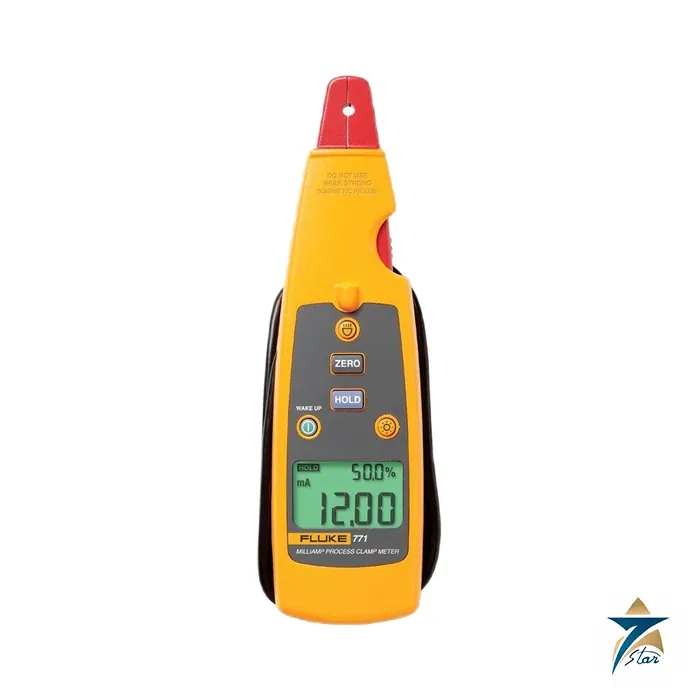
Fluke 771 Milliamp Process Clamp Meter

Description

771 milliamp process clamp meter for non-intrusive 4 to 20 mA checks

The Fluke 771 is a handheld milliamp clamp meter that reads 4 to 20 mA loop signals through the wire insulation, so the loop stays closed and the control system keeps running. It also reads 10 to 50 mA signals of older control systems on a 99.9 mA range. A detachable clamp on an extension cable lets the technician put the sensor on the wire and then carry the display to a better viewing position. Seven Star LLC supplies the 771 in Oman and the GCC as an independent supplier in Muscat, not affiliated with the manufacturer.

The model number is a plain product number. It is the base model of a three-model group.

Model Functions Typical use
771 Clamp measurement only Non-intrusive mA reading with percent-of-span display
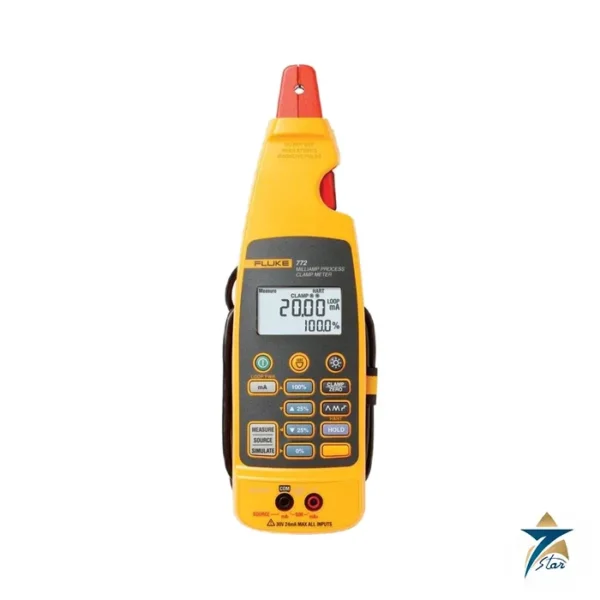
772 Adds in-circuit mA, mA source and simulate, 24 V loop power Loop checks and I/O tests
773 Adds dc voltage source and measure, scaled output and mA in/out Valve, isolator and voltage-input tests

771 technical specifications

Parameter Specification
Manufacturer / part number Fluke / 771
mA measurement by clamp, 0 to 20.99 mA 0.2 % + 2 counts
mA measurement by clamp, 21.0 to 100.0 mA 1 % + 5 counts
Maximum conductor diameter 4.5 mm (0.177 in)
Display Dual backlit, showing mA and percent of a 4 to 20 mA span
Other features Hold function, built-in LED spotlight, detachable clamp on extension cable
Batteries Two AA alkaline, about 40 hours typical
Operating / storage temperature -10 °C to 50 °C / -25 °C to 60 °C
Operating altitude 0 to 2000 m
IP rating IP40
Size / weight 59 x 38 x 212 mm / 260 g
Shock 1 m drop test, except the jaw
Vibration Random 2 g, 5 to 500 Hz
EMC note Add 1 mA to the specification for fields of 1 V/m up to 3 V/m
Warranty Three years on electronics, one year on cable and clamp assembly
Supplied with Soft carrying case, quick reference guide, user manual

How the 771 reads a loop without breaking it

A current in a wire produces a magnetic field around it. The clamp senses that field through the insulation and converts the strength to a milliamp value. Because the signal in a 4 to 20 mA loop is small, the clamp has to be well shielded and the reading depends on the position of the wire. Keep the wire centred in the jaw and use the same method each time. The percent-of-span display converts the reading into a position within the loop range: 4 mA reads 0 % and 20 mA reads 100 %, so a valve or transmitter value can be understood at a glance.

The conductor limit of 4.5 mm means the clamp suits single instrument wires, not multi-core cables where signals from several loops would cancel or add. Separate the conductor of the loop you want to read.

Where the 771 fits compared with the 772 and 773

The 771 is a pure measurement tool. When you also need to inject a signal, power a transmitter or measure in series with the highest accuracy, the 772 adds source and simulate modes and 24 V loop power. The 773 goes further with voltage output and input functions, and a scaled mA output that lets a data logger record the loop without breaking it. A technician who only needs to confirm that a transmitter output is following the process will find the 771 sufficient.

Selecting the 771

  • Confirm that you need only measurement of 4 to 20 mA signals and not injection or simulation.
  • Check that the wire diameter is 4.5 mm or less.
  • Note the accuracy: 0.2 % + 2 counts up to 20.99 mA, 1 % + 5 counts up to 100 mA.
  • Consider the 772 if you need to power a transmitter or source a signal.
  • Remember it has an IP40 rating and is not designed for wet environments.

Use and maintenance of the 771

Insert two AA batteries and switch on away from strong magnets and large steel structures, which can influence the reading. Zero the display with the clamp closed and no wire in it, if the manual calls for it. Keep the clamp faces clean because debris in the jaw degrades accuracy. The jaw is excluded from the 1 m drop test, so handle the clamp assembly carefully, and store the meter in the soft case. The cable and clamp assembly have a one-year warranty, which reflects the wear they receive in service.

Typical applications of the 771 in Oman and the GCC

Instrument technicians use the 771 on live control loops in oil and gas, power, desalination and petrochemical plants to confirm transmitter outputs, check valve positioner signals and track down loop faults without shutting down. The detachable clamp and LED spotlight help in dark junction boxes and marshalling cabinets. Since many Gulf plants run continuously, being able to measure without interrupting the loop avoids unplanned trips.

Information to send with an RFQ for the 771

  • Part number 771
  • Quantity
  • Loop wire sizes and signal types
  • Delivery location and time frame
  • Calibration certificate requirement

Storage, handling and spares for the Fluke 771

Keep the Fluke 771 in its carrying case when it is not in use, and store it in a clean, dry place. Remove or charge the batteries as recommended in the user manual before long storage. Field teams in Oman and the GCC should avoid leaving the instrument in a vehicle in the sun, as high cabin temperatures can exceed the storage range and shorten battery life.

  • Check the instrument, cables, hoses or lenses for damage before each job.
  • Clean the unit with a soft, slightly damp cloth only; do not use solvents unless the manual allows them.
  • Plan a calibration interval that matches your quality system, and keep the calibration certificate with the asset record.
  • Order wear parts and accessories, such as batteries, test leads, hoses or adapters, together with the instrument.

For calibration and test work, it helps to state in your RFQ whether you need an accredited calibration certificate with the Fluke 771, so the right documents can be confirmed with the quotation.

Documents and quotation

The official Fluke technical data sheet for the Fluke 771 milliamp process clamp meter (English) is attached on this page as a PDF. It lists the 4-20 mA and 10-50 mA measurement ranges, the 0.2% accuracy and 0.01 mA resolution, the detachable clamp with extension cable, the backlit display, the battery life, the safety ratings and the dimensions. Check the signal range and the accessories your loop checks need, then send us the quantity and the delivery location for a quotation.

Send us the quantity and delivery location as well and we will confirm availability and a quotation.

Other Models in the Fluke Ma Clamp Range

Seven Star LLC supplies models from the Fluke Ma Clamp range in Oman and the GCC. Compare the related models below and request a quote for the one that matches your application.

ModelCategory
Fluke 772 Milliamp Process Clamp MeterElectrical Testers & MultimetersView details
Fluke 771 Milliamp Process Clamp MeterElectrical Testers & MultimetersYou are viewing this model
Datasheets & Documents
  • PDF Datasheet Fluke 771 Milliamp Process Clamp Meter Technical Data (PDF) Download
Reviews (0)

Reviews

There are no reviews yet.

How would you rate this product?

It takes about 10 seconds — just tap a star. Your email is never published.

About brand

Fluke is the American maker of handheld electronic test tools: digital multimeters, clamp meters, insulation testers, process calibrators, thermometers, vibration meters and power quality analysers. John Fluke founded the John Fluke Engineering Company in Springdale, Connecticut, in June 1948 and moved it to Seattle in 1952. Fluke is headquartered in Everett, Washington, was acquired by Danaher in 1998 and has been part of Fortive since Fortive's spin-off from Danaher in 2016.

Seven Star LLC lists Fluke process calibrators, electrical test tools and bench calibrators, and sources them for maintenance teams and calibration laboratories in Oman.

Fluke company profile

Founded June 1948, Springdale, Connecticut, USA, as the John Fluke Engineering Company
Founder John M. Fluke Sr.
Headquarters Everett, Washington, USA (moved to the Seattle area in 1952)
Ownership Danaher from 1998; part of Fortive (NYSE: FTV) since July 2016
Product families Digital multimeters and clamp meters, insulation resistance testers, process and loop calibrators, infrared thermometers and thermal imagers, vibration meters, power quality analysers, Fluke Calibration laboratory standards

Milestones

  • 1948: John Fluke starts the company in Springdale, Connecticut.
  • 1952: The company moves to Seattle
  • 1987: A joint venture with Philips leads to the ScopeMeter handheld oscilloscope.
  • 1998: Danaher acquires Fluke.
  • 2016: Fluke becomes part of Fortive, spun off from Danaher in July.

Fluke calibrators and test tools listed

The main Fluke products on this page fall into three groups, besides other test tools such as further multimeters, a thermometer, an anemometer, a vibration tester and a portable appliance tester:

  • Process tools: the 754 documenting process calibrator with HART, 789 ProcessMeter, 721 dual sensor pressure calibrator and 729 automatic pressure calibrator
  • Electrical test: the 376 FC true-RMS clamp meter with iFlex probe and the 1587 FC insulation multimeter
  • Fluke Calibration bench standards: 5522A, 5502A, 5500A and 5080A multi-product calibrators, the 5720A multifunction calibrator, 8508A reference multimeter, 6100A electrical power standard and 9640A RF reference source

Several of the bench models belong to earlier generations. When a model is no longer produced, we check the manufacturer's documentation and propose the successor it names.

Where Fluke instruments are used

Fluke process calibrators are used for loop checks, transmitter calibration and valve tests in oil and gas, power and water plants. Clamp meters and insulation testers serve electrical maintenance on motors, switchgear and cables. The bench calibrators and reference multimeters are the working standards of electrical calibration laboratories in the GCC, where they calibrate multimeters, clamp meters, process tools and power analyzers.

Fluke products we list

Family Examples
Portable Test & Measurement 117 Electrician’s True-rms Multimeter with, 1507 Insulation Resistance Tester, 1550C 5 kV Insulation Resistance Tester, 1587 FC Insulation Multimeter, 376 FC True-RMS AC/DC Clamp Meter with iFlex, 5080A Multi-Product Calibrator, 5500A Multi-Product Calibrator, 5502A Multi-Product Calibrator and 17 more
Lubrication & Bearing Maintenance 805 FC Vibration Meter

Ordering Fluke instruments: what we need

Send the exact model with its suffix, since versions differ. A Fluke 721, for example, is defined by its two pressure ranges, and a 729 by its maximum pressure. For bench calibrators, list the options you need, such as oscilloscope calibration or power quality options, the line voltage, and the type of calibration certificate you require from the manufacturer. For Fluke multimeters and clamp meters, add the kit contents wanted, such as probes, leads or cases.

Frequently requested Fluke models: Fluke 5522A Multi-Product Calibrator.

Facts checked against published histories of Fluke Corporation and Fortive, October 2026.

FAQ

Questions about the Fluke 771 Milliamp Process Clamp Meter

Answers from our engineering team on installation, compatibility and integration.

01What does the Fluke 771 measure?
The 771 measures 4 to 20 mA loop signals through the wire insulation without breaking the loop. It also reads up to 100 mA, including 10 to 50 mA signals of older systems.
02How accurate is the Fluke 771?
From 0 to 20.99 mA the clamp reading is accurate to 0.2 % + 2 counts. From 21.0 mA to 100.0 mA the accuracy is 1 % + 5 counts.
03What is the largest wire the Fluke 771 can clamp?
The maximum conductor diameter is 4.5 mm (0.177 in). It is meant for single instrument wires rather than multi-core cables.
04What display does the Fluke 771 have?
It has a dual backlit display showing the mA value and the percent of a 4 to 20 mA span, plus a hold function and a built-in LED spotlight for dark enclosures.
05What is the difference between the Fluke 771 and 772?
The 772 adds series mA measurement, mA source and simulate, and 24 V loop power. The 771 is limited to non-intrusive clamp measurement.