- Automation & ControlView all 3,210 products
- Automation Accessories
- AC Drives
- PLC & I/O Cards
- Industrial Communications
- Vibration Monitoring
- Controllers & Data Acquisition
- Isolator & Barrier
- Safety Switches & Guard Locking
- Encoders
- Motor Soft Starters
- CCTV & Security
- Pneumatic Cylinders
- HMI Displays
- Servo Drives
- Industrial Computers
- Machine Vision
- Automation Software
- Robotics
Brand: Boll & Kirch
Boll & Kirch 6.46 Automatic Lube Oil Filter with Centrifuge
Description
Overview
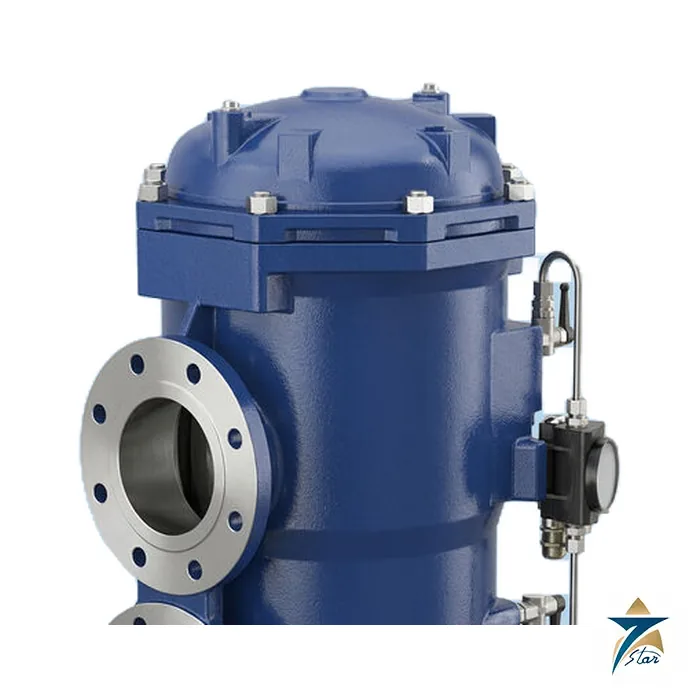
Boll & Kirch 6.46 is the BOLLFILTER Automatic Type 6.46, an automatic backflushing filter for engine lubricating oil that the manufacturer pairs with an oil centrifuge in a single treatment concept. The published brochure focuses on diesel locomotives, where a filter in the main oil flow protects the engine and a centrifuge in the bypass cleans the oil itself. It is a good example of a filter chosen as part of a system rather than as a stand-alone strainer.
The idea is simple. Contaminants in used lube oil range from metal wear particles to very fine soot, and no single device removes all of them at a sensible flow rate. A mesh filter handles the high flow and stops particles down to a defined size, while a centrifuge removes what the mesh cannot, and both work without consumable cartridges.
Main flow filtration with the 6.46
Oil from the pump enters the inlet flange and is directed from above and below into candles that are open at both ends. It flows from the inside of the candle to the outside, and the mesh keeps dirt particles of 25 microns and larger on the inside surface. Cleaned oil reaches the filter outlet and goes to the engine.
A turbine mounted in the inlet flange drives the backflushing mechanism, moving a flushing arm continuously from candle to candle while filtration carries on. During cleaning, a strong cross-flow runs across the inside of the candle, and the reduced pressure inside lets cleaned oil flow back from outside to inside. The brochure notes that backflushing over a long period is possible with a small volume of flushing oil, so the operating pressure does not drop. If operation is disturbed, a differential pressure indicator signals a fault, the overflow valves open and the oil is filtered through an integrated protective mesh.
The centrifuge in the bypass
The centrifuge takes up to 10 percent of the pumped oil and returns it cleaned straight to the lube oil tank. Oil pressure drives the rotor through a hollow spindle and two opposed tangential nozzles, so the rotor spins fast and generates centrifugal force in excess of 2,000 G. Dirt is pressed against the rotor wall and builds a dense cake, so there is no limit on the particle size that can be separated. The datasheet shows a pump supplying 4 to 8 bar and a sludge oil line at less than 1.0 bar.
Boll & Kirch 6.46 system data
| Parameter | Value |
|---|---|
| Product line | BOLLFILTER Automatic Type 6.46 with centrifuge |
| Medium | Engine lubricating oil |
| Candle type | Cylindrical, open at both ends |
| Particle retention | 25 microns on the inside of the candle (as described for this system) |
| Cleaning drive | Turbine mounted in the inlet flange |
| Cleaning action | Flushing arm moves continuously from candle to candle |
| Safety | Differential pressure indicator, overflow valves, integrated protective mesh |
| Bypass centrifuge flow | Up to 10 percent of the pumped oil |
| Centrifugal force | Above 2,000 G |
| Mounting | Vertical or horizontal flange-mounted, or slide-in |
| Centrifuge position | Fitted to the filter or at another preferred location |
Differences between 6.46, 6.48 and 6.72
The Type 6.48 is the general lube oil model, listed for 16 to 780 m3/h, DN 40 to DN 300 and 10 to 48 micrometres, and it does not rely on a centrifuge. The Type 6.72 works with compressed air and is limited to DN 40, DN 65 and DN 80, a very different arrangement. The 6.46 brochure is the one to read when an engine owner wants to reduce oil changes by adding a bypass centrifuge, because the document explains the full main-flow plus bypass logic with measured particle distributions and a stated payback range of between 6 months and 2 years depending on engine and locomotive type.
Why add a centrifuge
The brochure states that the vast majority of contaminants in diesel engine oil are smaller than 2 microns, including hard and abrasive soot. A mesh filter cannot remove these, and paper cartridges struggle with particles smaller than 10 microns. Centrifugal separation can remove particles below one micrometre. The benefits listed include higher oil purity, longer engine life, longer oil service life, longer service intervals, lower fuel consumption, less maintenance and fewer spare parts, plus higher availability of the locomotive.
Applications in Oman and the GCC
The brochure is about locomotive engines, but the same combination can be considered for any diesel with a long oil drain interval: haul trucks and diesel generator sets at remote mining and oil field camps, rail maintenance fleets and marine auxiliaries. In hot regional climates oil oxidises faster, and soot-laden oil thickens, so keeping the oil clean has an immediate effect on bearing and ring wear.
Fitting and commissioning
The filter can be fitted as a vertical or horizontal flange-mounted unit or as a slide-in filter, and the centrifuge can be attached directly to it or installed elsewhere around the engine, depending on space. Confirm the pump pressure, check that the sludge oil return is free-flowing and open, and watch the indicator while the engine reaches running temperature.
Care and spares
The mesh candles need no consumable elements, and the centrifuge rotor is cleaned by removing the dirt cake at service intervals. Keep an eye on the protective mesh and the overflow valve seats during overhauls. Because the cleaning needs no external energy, there is no air line or motor to fail, and a locomotive or generator that spends long periods away from a workshop keeps its protection until the next planned inspection.
Ordering Boll & Kirch 6.46
Send us the engine type, the oil flow, the mounting style and whether a bypass centrifuge is required. Seven Star LLC is an independent supplier serving Oman and the GCC and can check your nameplate data before quoting.
Related items you may also need: Donaldson P-SLF 0288-3072 Sterile Air Unit | Kaeser DC 2.0-DC 11.3 Heatless Desiccant Air Dryers | Mobile Filtration System Water Treatment | All Boll & Kirch products.
Documents and quotation
The brochure on automatic filtration and maintenance of engine lubricating oil with a centrifuge is attached as the datasheet. Send the RFQ with part number 6.46, quantity and engine application.
Datasheets & Documents
- Datasheet Boll & Kirch 6.46 Automatic Lube Oil Filter with Centrifuge Datasheet Download
Reviews (0)
How would you rate this product? Cancel reply
About brand
Boll & Kirch is a German filter maker best known for automatic backflushing filters sold under the BOLLFILTER name. The company began in 1950 as Boll & Kirch Maschinenfabrik in Cologne-Ehrenfeld, founded by Walter Boll and Josef Kirch, and started out as a small workshop making filter technology for marine engines. Over the following decades it widened its range to cover oil and gas, chemical processing and power generation, and it now concentrates on filters for liquids and gases from its base in Kerpen near Cologne. In 2025 Boll & Kirch celebrated 75 years of filtration engineering.
Boll & Kirch company profile
| Founded | 1950, Cologne-Ehrenfeld, Germany, by Walter Boll and Josef Kirch |
|---|---|
| Headquarters | Kerpen, Germany (Boll & Kirch Filterbau GmbH) |
| Ownership | The Dr. Heinz Lux Foundation became a shareholder in 2023 |
| Core technology | Automatic backflushing filters with filter candles, plus duplex and simplex strainers, gas filters, filter elements and fine filter units |
| Typical applications | Cooling and process water, ship and power plant fuel oil and lube oil, compressors and turbines, desalination, irrigation, machining and cleaning systems |
| Standards | Quality, environmental and occupational safety management certified to ISO 9001, ISO 14001 and ISO 45001; ASME U and R stamp certificates published; marine class approvals on selected types |
Milestones
- 1950: Walter Boll and Josef Kirch found the company in Cologne-Ehrenfeld.
- 1968: Production starts of a new, patented automatic filter with backflushing supported by compressed air.
- 1980: First serial production of automatic filters, following the 1978 start of mass production of coiled filter candles.
- 1993: Patent application for the first turbine-driven automatic filter with continuous backflushing for engines.
- 2017: First international production site opens in Pinghu, China, and the aquaBoll automatic water filter is launched.
- 2025: The company marks 75 years of filtration engineering.
How a Boll & Kirch automatic backflushing filter works
A backflushing filter removes solids on a mesh or wedge-wire candle and then cleans that candle without taking the filter out of service. Liquid passes through the candle, and particles collect on its surface. When the pressure difference across the filter reaches a set value, or a timer runs out, a flushing arm or valve reverses the flow through one candle at a time and carries the dirt out through a discharge valve, while the remaining candles keep filtering. Depending on the model, flushing is driven by a motor, by compressed air, or by a turbine powered by the oil flow itself. The result is steady pressure drop and no manual strainer cleaning. When selecting a size, check flow, the finest particle to be stopped and a route for the discharged sludge.
Where Boll & Kirch products are used in Oman and the GCC
Automatic and manual strainers protect cooling water and injection water in power, desalination and oil and gas plants, fuel and lube oil lines on diesel generator stations and vessels, and pump suction lines in utilities and industry. Fine sand and shell debris in seawater and dusty ambient conditions make self-cleaning filters attractive on unattended sites.
Boll & Kirch models we list
| Family | Examples |
|---|---|
| Automatic backflushing filters for water | 6.18, 6.04 |
| Automatic filters for fuel oil | 6.72 |
| Automatic filters for lube oil | 6.48, 6.46 |
| Duplex strainers | 2.04.5 |
| Simplex strainers | 1.12.2 |
Ordering Boll & Kirch products: what we need
Send the type number from the nameplate, the nominal size, the fluid and its temperature, operating pressure, the required filtration grade and the quantity. For spare parts such as candles, seals or control components, add the serial number or drawing number of the filter. Seven Star LLC is an independent supplier serving Oman and the GCC and replies to each request with availability and lead time.
Facts checked against the Boll & Kirch company history, product pages and published BOLLFILTER brochures, November 2026.
Browse Boll & Kirch products by category: Filter Housings, Filtration Systems.
FAQ
Questions about the Boll & Kirch 6.46 Automatic Lube Oil Filter with
Answers from our engineering team on installation, compatibility and integration.
01What is the Boll & Kirch 6.46 designed to filter?
It filters engine lubricating oil in the main flow, with candles open at both ends that retain dirt down to 25 microns on the inside surface.
02What drives the backflushing of the 6.46?
A turbine mounted in the inlet flange moves the flushing arm continuously from candle to candle, so no separate motor or air supply is needed.
03How much oil goes through the centrifuge in the 6.46 system?
The centrifuge receives up to 10 percent of the pumped oil in the bypass and returns the cleaned oil directly to the lubricating oil tank.
04What happens if the 6.46 filter is overloaded?
The differential pressure indicator signals a fault, the overflow valves open and the oil is filtered through an integrated protective mesh.
05How can the 6.46 be mounted?
The brochure says it can be fitted vertically or horizontally as a flange-mounted filter or as a slide-in filter on the engine.


Reviews
There are no reviews yet.