- Automation & ControlView all 3,185 products
- Automation Accessories
- AC Drives
- PLC & I/O Cards
- Industrial Communications
- Vibration Monitoring
- Controllers & Data Acquisition
- Isolator & Barrier
- Safety Switches & Guard Locking
- Encoders
- Motor Soft Starters
- CCTV & Security
- Pneumatic Cylinders
- HMI Displays
- Servo Drives
- Industrial Computers
- Machine Vision
- Automation Software
- Robotics
Brand: Boll & Kirch
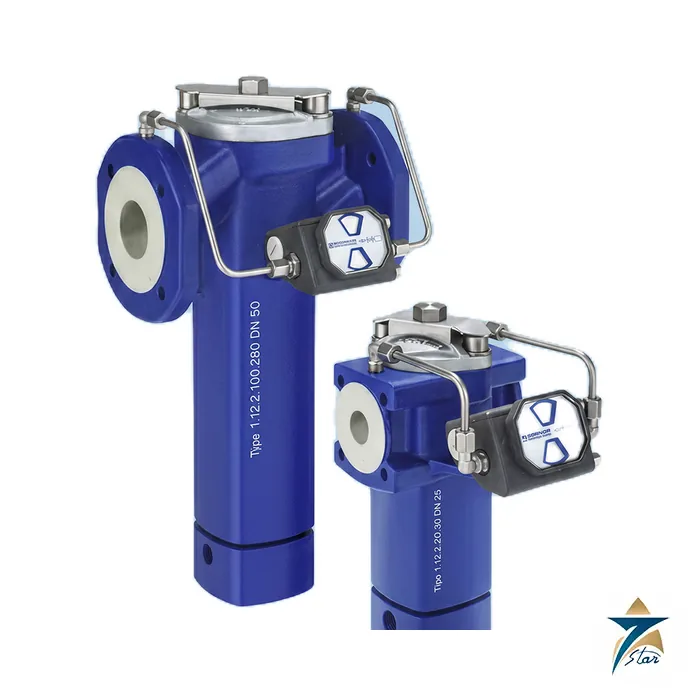
Boll & Kirch 1.12.2 Simplex Strainer Ductile Iron DN 25-80
Description
Overview
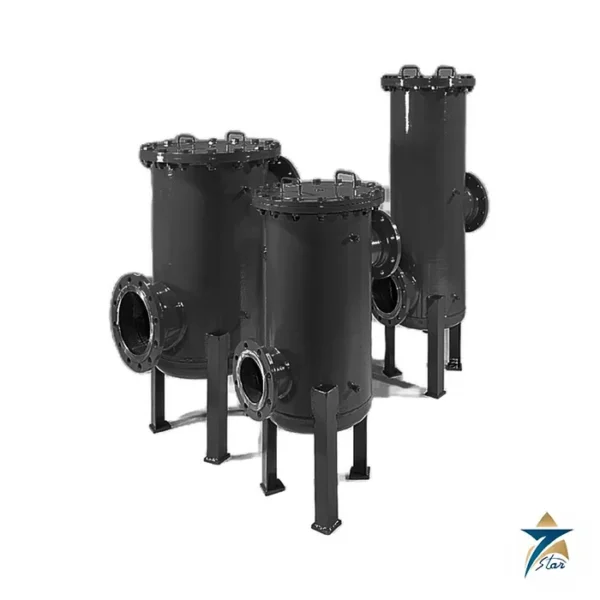
Boll & Kirch 1.12.2 is a compact simplex line strainer with flanged connections from DN 25 to DN 80, offered in ductile iron or cast stainless steel and optionally with integrated steam heating. In the BOLLFILTER catalogue it is called Simplex Type 1.12.2. It is installed in suction or pressure pipework to shield pumps, bearings, heat exchangers, valves and the pipe itself from contamination and accumulated mud, and it works with any liquid, not only water.
A simplex strainer has one chamber, so it is the simplest and most economical way to protect equipment where a short isolation for cleaning is acceptable. The manufacturer lists minimal pressure losses, a very compact construction, a minimal number of components and a cover held by only two screws as the main advantages.
Sizes, materials and pressure stages
Six nominal sizes are listed: DN 25, DN 32, DN 40, DN 50, DN 65 and DN 80. The ductile iron housing carries PN 40 in every size. Cast stainless steel is available in DN 25, DN 50, DN 65 and DN 80 and is rated PN 32. Flange drilling can follow DIN, ANSI or JIS, and the pressure-bearing parts are certified to AD 2000, to the European pressure equipment directive 2014/68/EU and to ASME Section VIII Division 1, which matters when documentation has to be shown to an inspector.
Flow capacity by nominal size
The sheet states the volume flow at a clean pressure drop of 0.1 bar with oil of 40 cSt and a filtration grade of 50 micrometres.
| Nominal size | Flow at 0.1 bar clean pressure drop |
|---|---|
| DN 25 | 5 m3/h, 83 l/min |
| DN 32 | 9 m3/h, 150 l/min |
| DN 40 | 14 m3/h, 233 l/min |
| DN 50 | 21 m3/h, 350 l/min |
| DN 65 | 35 m3/h, 583 l/min |
| DN 80 | 53 m3/h, 883 l/min |
Boll & Kirch 1.12.2 at a glance
| Parameter | Value |
|---|---|
| Product line | BOLLFILTER Simplex Type 1.12.2 |
| Housing | Cast ductile iron DN 25 to DN 80, or cast stainless steel in DN 25, DN 50, DN 65 and DN 80 |
| Pressure stages | PN 40 ductile iron, PN 32 stainless steel |
| Operating temperature | -10 to 160 degrees Celsius |
| Flange standards | DIN, ANSI, JIS |
| Certification | AD 2000, 2014/68/EU, ASME Section VIII Division 1 |
| Elements | Star-pleated element or basket element, optionally disposable |
| Filtration grade | 10 microns to 5 mm |
| Accessories | Optical or optoelectrical differential pressure indicator, cover safety device, magnetic bar, steam heating, bottom fastening |
| Drawing reference | Z107393 |
How 1.12.2 differs from other Simplex and Duplex types
The 1.12.2 covers the same DN 25 to DN 80 range as the duplex Type 2.04.5, but it has only one chamber. Cleaning the 1.12.2 element needs the system shut down or the filter isolated, while the 2.04.5 switches chambers and keeps the line running. The simplex sits at a higher nominal pressure stage of PN 40 in ductile iron, against the 25 bar of the duplex. Larger simplex strainers in the catalogue, such as the 1.03.2, 1.53.1 and 1.88.2 types, are separate products with their own data sheets, and so are the gas filters in the BFB series.
Cleaning routine
Depressurise the chamber with the venting screw, lift the housing cover and remove the element. Rinse it with a cleaning fluid such as BOLL-CLEAN 2000 and dry it with compressed air; the operating instructions give the full filter element cleaning procedure. Other than inspecting the seals and cleaning the element, the filter is described as maintenance-free. The pressure drop shown on the indicator tells you when to clean.
Typical duties in Oman and the GCC
This type suits pump protection on cooling water and chilled water, lube oil and fuel lines at generator stations, heat exchanger inlets, skid-mounted packages and general utility piping. The stainless steel option helps where seawater, brackish water or aggressive process liquids attack ductile iron, and the steam heating option is useful for viscous fuel oils and other products that must stay warm. Dust and sand are carried into open tanks in the region, so many sites choose a fine star-pleated element on the suction side of transfer pumps.
Temperature, certification and documentation
The listed operating temperature runs from minus 10 up to 160 degrees Celsius, which covers cold water lines and hot oil lines with the same body. Certification to AD 2000, the European pressure equipment directive and ASME Section VIII Division 1 means the strainer can usually be accepted by inspectors on projects that follow German, European or American pressure vessel codes. Ask us for the drawing reference Z107393 if you need to match the unit against a data pack. A cover safety device can be fitted to stop the cover being opened while the chamber is still pressurised, a useful feature on sites with strict lock-out procedures, and the two-screw cover makes it quick to reopen once the line is isolated and vented.
Selecting element and accessories
Choose between the star-pleated element for a large area in a small body and the basket element for coarser straining. Disposable star elements save cleaning time on dirty duties. A magnetic bar inside the element catches ferrous swarf, and a cover safety device is available for sites with a strict isolation procedure. Name the fineness, the viscosity and the allowable pressure loss when you enquire.
Installation
Mount the strainer with the cover pointing up, leave space to lift the element out and connect the venting screw to a safe point. Check flange facing and drilling against DIN, ANSI or JIS before ordering, and fit the differential pressure indicator where operators can read it from the walkway. Record the clean-element pressure drop at commissioning so later readings have a baseline. Where steam heating is chosen, plan the steam and condensate connections.
Ordering Boll & Kirch 1.12.2
Please tell us the nominal size, housing material, flange standard, fluid, temperature, fineness and accessories. Seven Star LLC is an independent supplier serving Oman and the GCC and checks each enquiry against the manufacturer data sheet.
Related items you may also need: Hydac BDE Breather Dryer with Two-Stage Desiccant | Donaldson SG-C 1650-11000 Flanged Cyclone Separator | Hydac RFN Tank-Top Return Line Filter to DIN 24550, up to 10 bar | All Boll & Kirch products.
Documents and quotation
The two-page data sheet for Type 1.12.2 is attached as the datasheet. Send your RFQ with the part number 1.12.2, quantity, size and element fineness.
Datasheets & Documents
- Datasheet Boll & Kirch 1.12.2 Simplex Strainer Ductile Iron DN 25-80 Datasheet Download
Reviews (0)
How would you rate this product? Cancel reply
About brand
Boll & Kirch is a German filter maker best known for automatic backflushing filters sold under the BOLLFILTER name. The company began in 1950 as Boll & Kirch Maschinenfabrik in Cologne-Ehrenfeld, founded by Walter Boll and Josef Kirch, and started out as a small workshop making filter technology for marine engines. Over the following decades it widened its range to cover oil and gas, chemical processing and power generation, and it now concentrates on filters for liquids and gases from its base in Kerpen near Cologne. In 2025 Boll & Kirch celebrated 75 years of filtration engineering.
Boll & Kirch company profile
| Founded | 1950, Cologne-Ehrenfeld, Germany, by Walter Boll and Josef Kirch |
|---|---|
| Headquarters | Kerpen, Germany (Boll & Kirch Filterbau GmbH) |
| Ownership | The Dr. Heinz Lux Foundation became a shareholder in 2023 |
| Core technology | Automatic backflushing filters with filter candles, plus duplex and simplex strainers, gas filters, filter elements and fine filter units |
| Typical applications | Cooling and process water, ship and power plant fuel oil and lube oil, compressors and turbines, desalination, irrigation, machining and cleaning systems |
| Standards | Quality, environmental and occupational safety management certified to ISO 9001, ISO 14001 and ISO 45001; ASME U and R stamp certificates published; marine class approvals on selected types |
Milestones
- 1950: Walter Boll and Josef Kirch found the company in Cologne-Ehrenfeld.
- 1968: Production starts of a new, patented automatic filter with backflushing supported by compressed air.
- 1980: First serial production of automatic filters, following the 1978 start of mass production of coiled filter candles.
- 1993: Patent application for the first turbine-driven automatic filter with continuous backflushing for engines.
- 2017: First international production site opens in Pinghu, China, and the aquaBoll automatic water filter is launched.
- 2025: The company marks 75 years of filtration engineering.
How a Boll & Kirch automatic backflushing filter works
A backflushing filter removes solids on a mesh or wedge-wire candle and then cleans that candle without taking the filter out of service. Liquid passes through the candle, and particles collect on its surface. When the pressure difference across the filter reaches a set value, or a timer runs out, a flushing arm or valve reverses the flow through one candle at a time and carries the dirt out through a discharge valve, while the remaining candles keep filtering. Depending on the model, flushing is driven by a motor, by compressed air, or by a turbine powered by the oil flow itself. The result is steady pressure drop and no manual strainer cleaning. When selecting a size, check flow, the finest particle to be stopped and a route for the discharged sludge.
Where Boll & Kirch products are used in Oman and the GCC
Automatic and manual strainers protect cooling water and injection water in power, desalination and oil and gas plants, fuel and lube oil lines on diesel generator stations and vessels, and pump suction lines in utilities and industry. Fine sand and shell debris in seawater and dusty ambient conditions make self-cleaning filters attractive on unattended sites.
Boll & Kirch models we list
| Family | Examples |
|---|---|
| Automatic backflushing filters for water | 6.18, 6.04 |
| Automatic filters for fuel oil | 6.72 |
| Automatic filters for lube oil | 6.48, 6.46 |
| Duplex strainers | 2.04.5 |
| Simplex strainers | 1.12.2 |
Ordering Boll & Kirch products: what we need
Send the type number from the nameplate, the nominal size, the fluid and its temperature, operating pressure, the required filtration grade and the quantity. For spare parts such as candles, seals or control components, add the serial number or drawing number of the filter. Seven Star LLC is an independent supplier serving Oman and the GCC and replies to each request with availability and lead time.
Facts checked against the Boll & Kirch company history, product pages and published BOLLFILTER brochures, November 2026.
Browse Boll & Kirch products by category: Filter Housings, Filtration Systems.
FAQ
Questions about the Boll & Kirch 1.12.2 Simplex Strainer Ductile Iron
Answers from our engineering team on installation, compatibility and integration.
01What sizes does the Boll & Kirch 1.12.2 simplex strainer come in?
It is offered with flanged connections of DN 25, DN 32, DN 40, DN 50, DN 65 and DN 80, in cast ductile iron, and stainless steel in four of these sizes.
02What is the pressure rating of the 1.12.2?
Ductile iron housings are rated PN 40 in all sizes, while cast stainless steel housings are rated PN 32 in DN 25, DN 50, DN 65 and DN 80.
03How much flow does the 1.12.2 pass at DN 50?
At a clean pressure drop of 0.1 bar with 40 cSt oil and 50 micrometre filtration, DN 50 passes 21 m3/h, or 350 litres per minute.
04What approvals does the 1.12.2 carry?
The housing is certified to AD 2000, the pressure equipment directive 2014/68/EU and ASME Section VIII Division 1, as stated in the data sheet.
05Can the 1.12.2 be heated?
Yes, integrated steam heating is an optional accessory, along with a differential pressure indicator, magnetic bar, cover safety device and bottom fastening.


Reviews
There are no reviews yet.