AEMC Instruments 6417 Clamp-On Ground Resistance Tester

Description

Overview

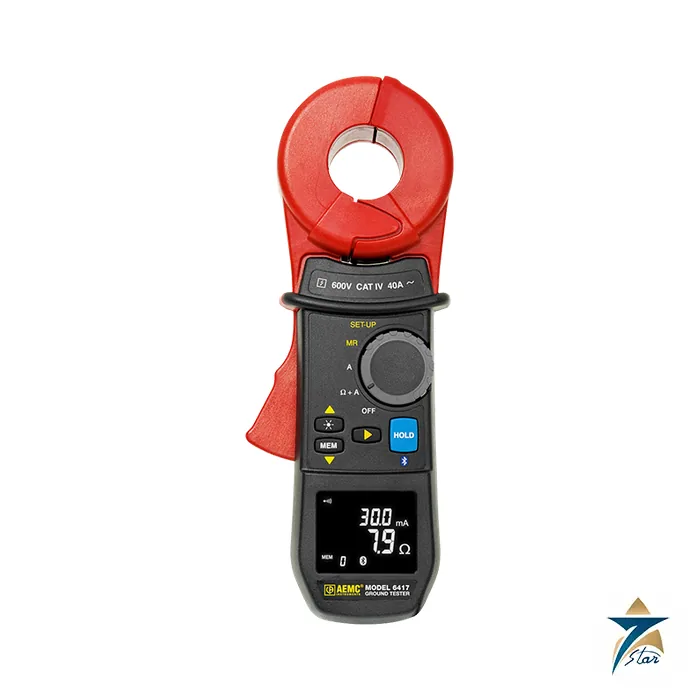
The AEMC Instruments 6417 is a clamp-on ground resistance tester: you close the jaws around a grounding conductor, and the instrument works out the resistance of the earth loop without a single auxiliary spike or a disconnected electrode. That one trait makes it the tool of choice when the electrode is part of a bonded system, for example a pole ground on a live feeder, a lightning down conductor on a tank, or a single rod in a plant grid that cannot be taken out of service. It is catalogued as Cat. #2141.02 and is the Bluetooth model of the three-member 6416, 6417 and 6418 family, with onboard memory for 2000 readings.

Seven Star LLC is an independent supplier serving Oman and the GCC, and we supply this tester to inspection teams, utilities and plant maintenance departments.

How the clamp measures earth resistance

The jaws contain two coils. One induces a known test voltage into the loop formed by the grounding conductor, the soil and every parallel return path; the other measures the current that comes back. Voltage divided by current gives loop resistance, which, when the electrode under test is much higher in resistance than the paralleled network, is dominated by that electrode. The basic reading is made at 2083 Hz, and the Model 6417 can also calculate ground impedance at 50, 60 or 128 Hz in its advanced mode, which is closer to the frequencies a real fault would see.

A LOOP alarm warns when the clamp is placed so that a metallic loop could distort the result, and the instrument shows a hazardous-voltage warning together with touch voltage, calculated as the product of loop impedance and leakage current. In practice that gives an electrician three results from one closing of the jaws: resistance, leakage current and an estimate of the voltage a person could touch.

AEMC Instruments 6417 specifications

Item Value
Catalogue number 2141.02
Measured quantities Ground impedance in ohm, current, inductive component in mH, touch voltage
Test frequency selections 50, 60, 128 and 2083 Hz
Resistance range 0.01 to 1500 ohm; over-range indication above 1500 ohm
Resistance accuracy 1.5 percent
Current range 200 microamp to 40 A; typical accuracy 2 percent
Jaw opening 1.38 in (35 mm)
Alarms Audible alarms on resistance, voltage and current
Memory and communication 2000 measurements; Bluetooth with DataView reporting
Display Multi-parameter OLED, dual readout
Battery life More than 1400 measurements on AA alkaline cells
Safety and ingress CAT IV 600 V; IP40

How 6417 differs from other 6416 and 6418 variants

The 6416 shares the same 1.38 in jaw, the same 0.01 to 1500 ohm range and the same CAT IV 600 V rating, yet it has no Bluetooth link, no DataView reporting and holds 300 readings, against 2000 for the 6417. The 6418 is a different animal: its oblong jaw takes a 1.26 in round conductor or sections of 1.18 by 1.57 in (30 by 40 mm) and 0.79 by 2.17 in (20 by 55 mm) bus bar, but it measures only at 2083 Hz, covers 0.01 to 1200 ohm, reads current from 500 microamp to 20 A, carries a CAT IV 100 V rating and also stores 300 readings. Choose the 6417 if you need data logging to a PC or phone-class workflow and the wider jaw range; choose the 6418 only when the conductor is a flat bar.

Where the 6417 earns its place in Oman and the GCC

  • Periodic checks of individual earth pits around oil and gas wellheads and tank farms, where isolating each electrode would mean a work permit and a shutdown.
  • Medium-voltage substations and ring main units, testing the earth connection of each transformer without opening the earth link.
  • Telecom towers and rooftop lightning protection on high-rise buildings in Muscat, where the down conductor is accessible but the soil is not.
  • Water and wastewater plants with many small pump stations that must be surveyed quickly and documented.

Because every measurement is instantaneous and continuous, a technician can walk from pit to pit and take back-to-back readings, adding the notes to the memory index for later retrieval. Parallel electrodes can be verified individually by clamping each leg of the grid in turn.

Limits to understand before you buy

A clamp-on tester needs a closed loop. If the electrode under test is the only path to earth, with no parallel return, the instrument will show an over-range result or a very high value, and a fall-of-potential tester such as the AEMC 6472 or 6471 is the right choice instead. The clamp is also not suitable where the conductor diameter exceeds the jaw opening, and the IP40 rating means it should be kept dry and out of blowing sand while measuring. Use the supplied calibration loop to confirm that the unit reads correctly before a survey.

Setup and daily use

Fit the AA batteries, clamp the calibration loop and confirm the stated value, then open the jaws around the conductor, check that the jaw-closing indicator is clear, and read resistance in the upper display and current in the lower. The Hold function freezes a reading when the clamp sits in an awkward position. Pairing over Bluetooth with a PC running DataView lets you configure the instrument, download the stored readings, watch measurements in real time and produce a dated report. The kit comes in a hard carrying case with a calibration loop, quick start guide and a USB drive with the software and manual.

Maintenance

Keep the jaw faces clean and free of rust or conductive dust, because a gap that does not close fully gives the incorrect-closing indicator and a poor reading. Replace the batteries when the battery symbol appears and remove them for long storage. Send the unit for periodic traceable calibration; the manufacturer directs customers to consult the factory for NIST calibration pricing.

Ordering AEMC Instruments 6417 and accessories

The accessory table in the datasheet includes carrying bags, pouches and replacement items shared across the ground tester range. When requesting a price for the AEMC Instruments 6417, mention whether you also need the sister 6416 or 6418 for comparison, so that we can match jaw geometry to the conductors on your site.

Related items you may also need: Fluke 179 True-RMS Digital Multimeter with Temperature | Hioki FT6380-50 Clamp-On Earth Resistance Tester | Chauvin Arnoux CA 6240 10 A Micro-Ohmmeter | All AEMC Instruments products.

Documents and quotation

The manufacturer’s datasheet for the AEMC Instruments 6417 is attached to this page with the family comparison table for the 6416, 6417 and 6418. Send your RFQ to Seven Star LLC with part number 6417 (Cat. #2141.02) and the quantity, and we will confirm lead time for Oman and the wider GCC.

Datasheets & Documents
  • PDF Datasheet AEMC Instruments 6417 Clamp-On Ground Resistance Tester Datasheet Download
Reviews (0)

Reviews

There are no reviews yet.

How would you rate this product?

It takes about 10 seconds — just tap a star. Your email is never published.

About brand

AEMC Instruments is the American test and measurement brand best known for ground resistance testers, insulation (megohm) testers, micro-ohmmeters, clamp-on meters and power quality loggers. The company trades under the legal name Chauvin Arnoux, Inc. d.b.a. AEMC Instruments and belongs to the Chauvin Arnoux Group, which traces its roots to Paris in 1893, when Raphaël Chauvin and René Arnoux founded the business. AEMC Instruments itself dates from 1976, and its offices, manufacturing facility and NIST calibration laboratory are in Dover, New Hampshire.

AEMC Instruments company profile

Founded 1976 (AEMC Instruments); parent heritage Chauvin Arnoux founded in Paris in 1893
Headquarters 15 Faraday Drive, Dover, New Hampshire, USA
Ownership Part of the Chauvin Arnoux Group; operates as Chauvin Arnoux, Inc. d.b.a. AEMC Instruments
Core technology Electrical test and measurement: ground resistance and soil resistivity, insulation resistance, low-resistance (micro-ohm), current probes and clamp meters, power and energy analysis
Typical applications Substation and plant earthing checks, motor and cable insulation testing, switchgear contact resistance, load and power quality studies
Software and service Free DataView software for configuring instruments and building reports; NIST calibration, training seminars and webinars

Milestones

  • 1893: Chauvin Arnoux is founded in Paris by Raphaël Chauvin and René Arnoux; its inventions include the universal tester, a forerunner of the multimeter, and the current clamp.
  • 1976: AEMC Instruments is founded; the company is part of the Chauvin Arnoux Group.
  • 1977: The Chauvin Arnoux Group opens a subsidiary in the United States.
  • 1993: The group celebrates its centennial.
  • Today: AEMC designs, builds and calibrates instruments in Dover and offers custom OEM products and accredited training in ground testing and power quality.

How an AEMC fall-of-potential ground tester works

A ground resistance tester injects a known alternating current into the earth electrode under test and returns it through a remote auxiliary spike, then reads the voltage on a second probe placed between them. Resistance is the voltage divided by the current. Testers such as the 6472 run this at selectable frequencies and voltages so that stray earth currents do not corrupt the result, and the 4-pole method removes the lead resistance from the answer. When an electrode cannot be disconnected, clamp-on testers such as the 6417 induce a test current in the loop through the conductor and measure the current that returns, which gives loop resistance in seconds without any spikes. The choice between the two depends on whether a closed, parallel earth network exists. A practical selection tip: use fall-of-potential for new electrodes and acceptance tests, and clamp-on for quick periodic surveys on bonded systems.

Where AEMC Instruments products are used in Oman and the GCC

Earthing and insulation testing are routine across oil and gas facilities, power utilities, desalination and water plants, telecom towers and large commercial buildings. These instruments serve commissioning crews checking electrodes before energisation, motor shops trending insulation resistance, switchgear teams verifying joint resistance, and energy auditors logging loads on feeders in hot-climate buildings.

AEMC Instruments models we list

Family Examples
Ground resistance testers 6472, 6417
Micro-ohmmeters 6255
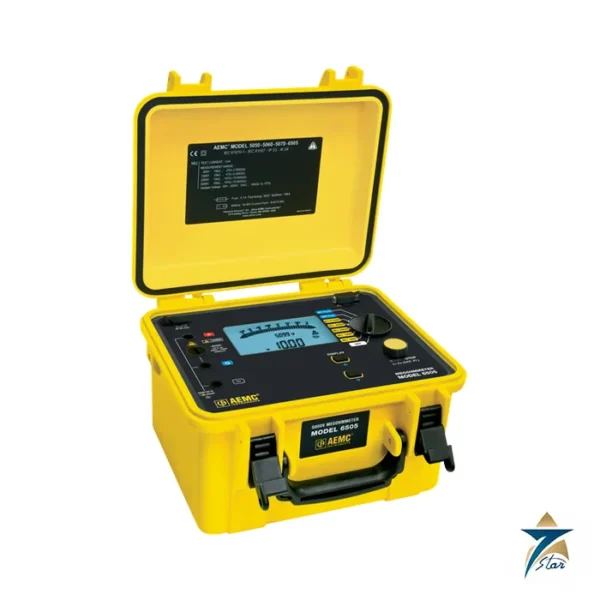
Megohmmeters (insulation testers) 5060, 6505
Power loggers and clamp meters PEL 113, 607

Ordering AEMC Instruments products: what we need

Send the model and, where the manufacturer uses them, the catalogue number, for example 2135.51 for the bare 6472 or 2135.53 for the kit with 300 ft leads. State the quantity and any leads, probes, sensors or carrying cases you need, since many accessories are listed separately. For replacement items, tell us which instrument they belong to so that we can match them to the manufacturer's accessory tables.

Facts checked against the AEMC Instruments website and corporate profile, the Chauvin Arnoux Group history page and current AEMC datasheets, November 2026.

FAQ

Questions about the AEMC Instruments 6417 Clamp-On Ground Resistance

Answers from our engineering team on installation, compatibility and integration.

01What resistance range does the AEMC Instruments 6417 cover?
The 6417 measures ground loop resistance from 0.01 to 1500 ohm with 1.5 percent accuracy, and current from 200 microamp to 40 A with 2 percent typical accuracy.
02How is the 6417 different from the 6416 and 6418?
The 6417 adds Bluetooth, DataView reporting and 2000 stored readings; the 6416 stores 300 readings without Bluetooth, and the 6418 has oblong jaws, 2083 Hz only and a 0.01 to 1200 ohm range.
03What jaw opening does the 6417 have?
The jaw opening is 1.38 in (35 mm), which suits most grounding conductors; flat bus bar needs the oblong jaw of the 6418.
04Which test frequencies and special measurements are available?
The 6417 offers 2083 Hz plus 50, 60 and 128 Hz in advanced mode, and it displays inductive component, ground impedance at the lower frequencies and calculated touch voltage.
05Can the 6417 test an electrode that is the only path to earth?
No. A clamp-on tester needs a closed loop with parallel return paths; for a single isolated electrode a fall-of-potential tester such as the AEMC 6472 is the correct tool.