Brand:

Meinberg LANTIME M900 Modular 3U NTP Time Server Platform

Description

Overview

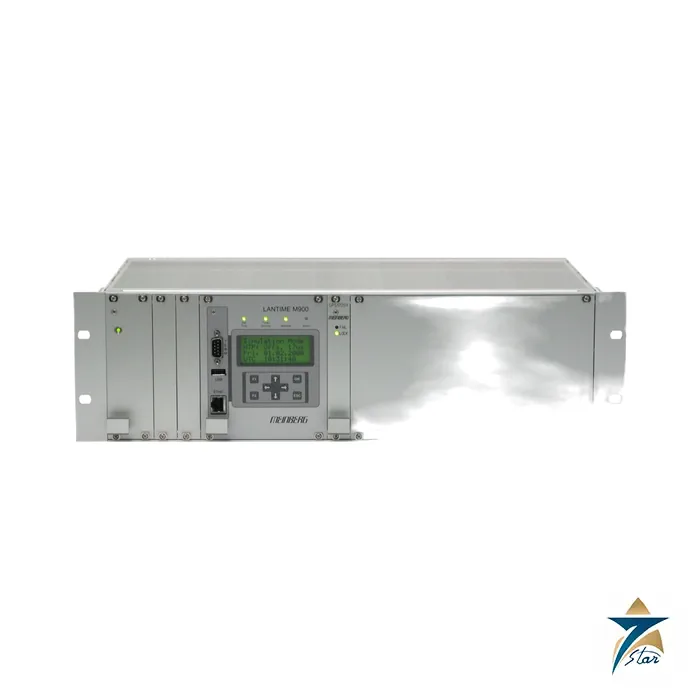
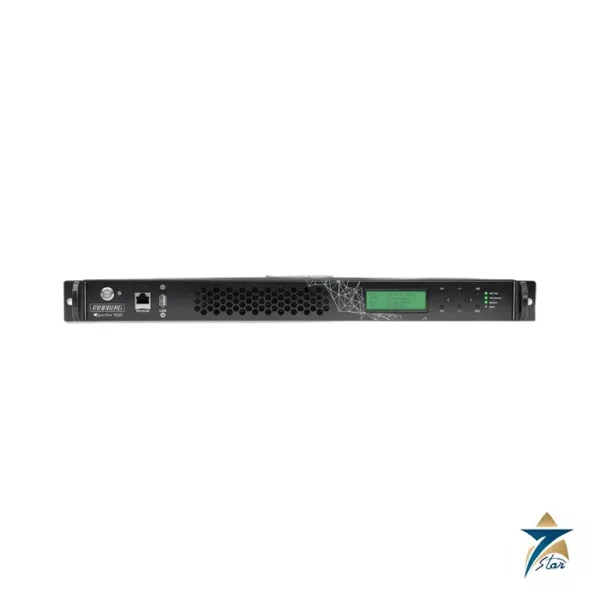
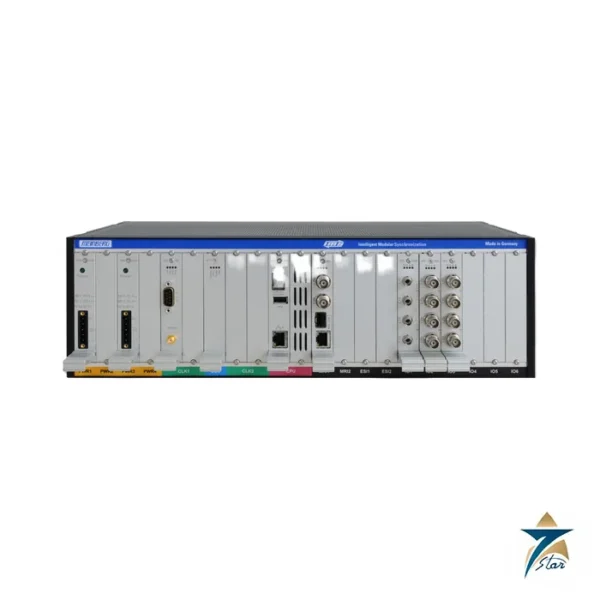
The Meinberg LANTIME M900 is a three-unit rackmount platform for building a time and frequency synchronization system around a single NTP server core. Instead of a fixed box, the M900 chassis offers slots for reference receivers, output modules and power supplies, so one engineer can specify a server that reads GPS and DCF77, generates IRIG and 10 MHz, and still provides several Ethernet ports. The manufacturer describes it as its system platform for customized solutions, aimed at large computer centres, industrial networks and telecom sites.

It is listed by the maker as no longer available, with support continuing for installed units, and the datasheet link names the LANTIME M3000 family as the follow-on. A project that has to extend an installed M900 will therefore ask for modules, spares or a like-for-like unit. Seven Star LLC is an independent supplier serving Oman and the GCC.

Platform capabilities of the Meinberg LANTIME M900
  • Reference sources: GPS, a combined GPS, GLONASS, Galileo and BeiDou receiver, PZF (DCF77 correlation), MSF long wave, TCR time code for IRIG A/B, AFNOR or IEEE 1344, and MRS multi reference source with priorities.
  • Oscillator choices from TCXO up to a rubidium oscillator for very stable holdover over days, weeks or months.
  • Up to 9 network interfaces: one 10/100 Mbit RJ45 port plus up to eight additional LAN interfaces.
  • Redundant power supplies and other DC input ranges available on request.
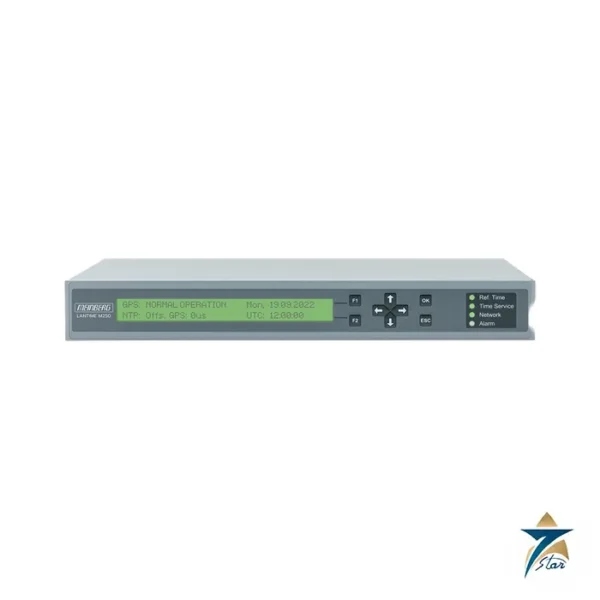
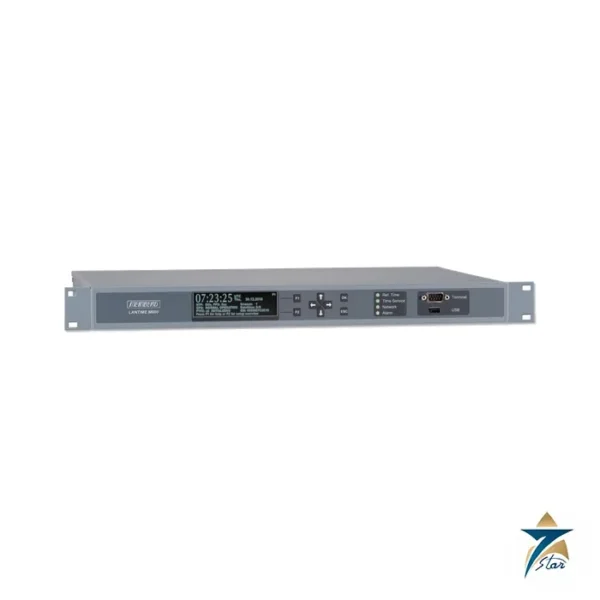
  • Four bicolor LEDs and a 4 x 16 character LC display on the front panel.
  • USB front port for firmware, backup and restore, key copying and front-panel locking.

Specification table for Meinberg LANTIME M900

Form factor Rackmount 3U chassis for 19 inch racks
Display LC display, 4 x 16 characters
Controls Eight push buttons
Indicators Four bicolor LEDs: reference time, time service, network link, alarm
Network 1 x 10/100 Mbit RJ45; up to 8 additional LAN interfaces possible
Serial Two independent RS-232 interfaces, menu configurable
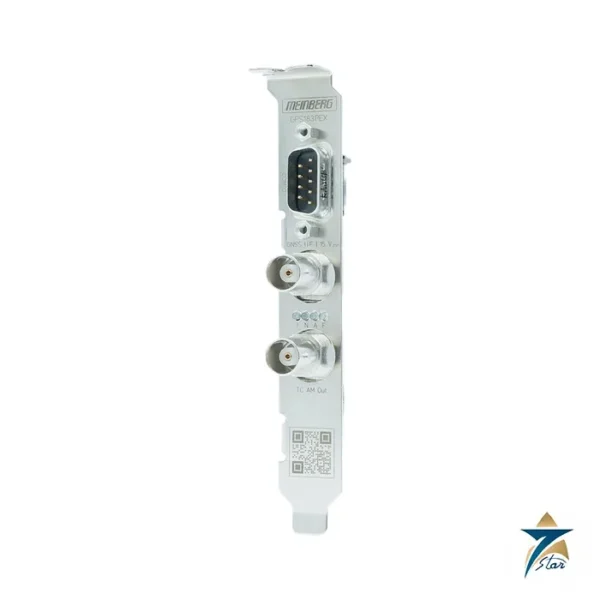
Frequency output 10 MHz, BNC, TTL into 50 ohm; accuracy depends on oscillator, standard TCXO
Pulse output PPS, BNC, TTL level, 200 ms pulse width
Alarm output Relay changeover contact
Power consumption 25 W
Operating voltage 100 to 240 V AC at 50-60 Hz or 100 to 240 V DC
Operating temperature 0 to 50 degrees Celsius
Storage temperature minus 20 to plus 70 degrees Celsius
Humidity Maximum 85 percent, non-condensing, at 40 degrees Celsius
CPU and OS AMD Geode; Linux with nano kernel including PPSkit
Warranty Three years

Protocols, security and redundancy

The unit speaks NTP versions 2 to 4 and SNTP 3 and 4 with MD5 or SHA-1 authentication and Autokey key management. As of firmware LTOS version 7.08 the datasheet states full support for Network Time Security in unicast client and server mode, and notes that an MRS-capable reference clock must be used in client mode. For substations and industrial rings the datasheet lists Parallel Redundancy Protocol per IEC 62439-3 and synchronization of IEC 61850 devices through SNTP. Management access is by HTTP, HTTPS, SSH with SFTP and SCP, Telnet, FTP, syslog and SNMP v1, v2c and v3 over IPv4 and IPv6, with DHCP and DHCPv6 autoconfiguration.

Serial strings and output options

The first serial port can send time telegrams such as the Meinberg standard string, SAT, NMEA RMC, GGA and ZDA, Uni Erlangen, Computime, Sysplex, SPA, Racal, ION, 6021 and IRIG-J, at baud rates from 300 to 19200. The datasheet stresses that pulse, frequency and serial output figures describe a sample configuration and can be adjusted. Additional modules can provide PPS, 10 MHz, programmable pulses, modulated and unmodulated IRIG, T1 and E1 telecom signals and frequency synthesizers.

Where it fits in Oman and the GCC

Large industrial campuses, refineries, power stations and telecom exchanges use a platform of this kind when a single time source must feed many consumers through different interfaces: NTP to servers, IRIG to protection recorders, 10 MHz to test gear, and PRP-capable networks for substation automation. The rubidium oscillator option suits sites where the satellite signal may be jammed or lost for long periods.

How the M900 differs from the M600 and the compact LANTIME models

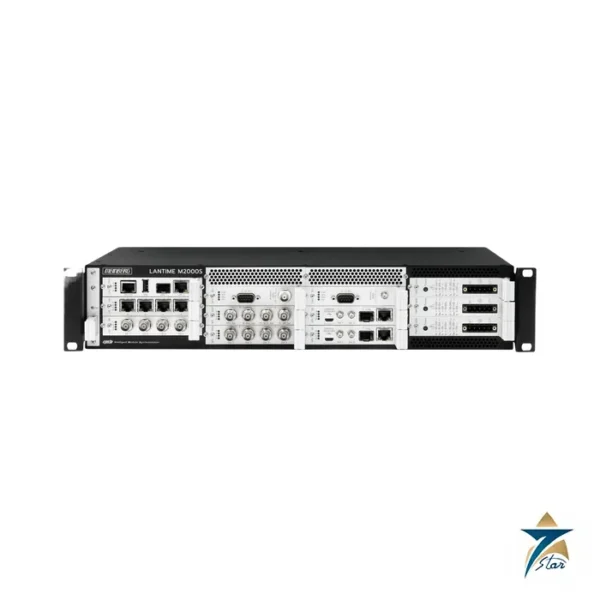
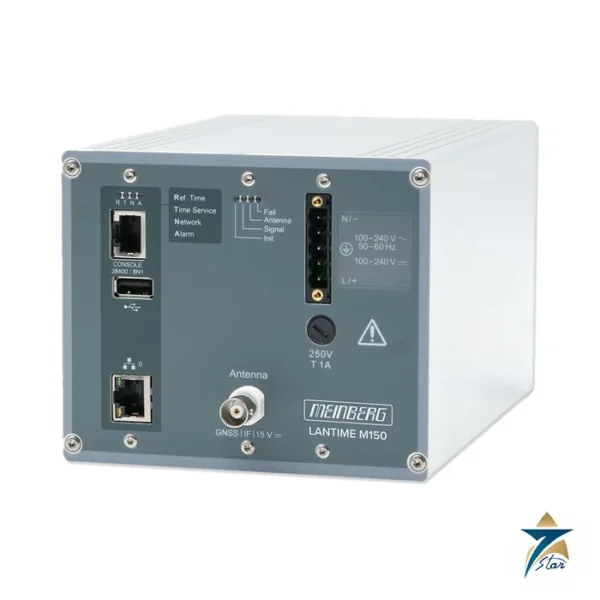
The M600 is a one-unit box with a vacuum fluorescent display and four network ports; the M900 takes 3U, uses a 4 x 16 character LC display and 25 W instead of 30 W, offers up to nine network interfaces and supports redundant power supplies. The compact M150, M250 and M450 are fixed-function models for smaller networks.

Holdover and oscillator selection

Holdover is the period during which the server keeps accurate time after it loses its reference, for example when a satellite antenna is damaged or jammed. The datasheet states that accuracy of the frequency output depends on the oscillator and that the standard fitting is a TCXO. A site with strict requirements can choose an OCXO grade, and the platform can take a rubidium-based oscillator with extremely stable holdover that is meant to keep a network tightly synchronized for days, weeks or even months without an external reference. Decide the oscillator by asking how long your plant could tolerate drift: a utility with a protection recorder may accept minutes, a telecom node usually needs much longer.

Planning the antenna and cabling

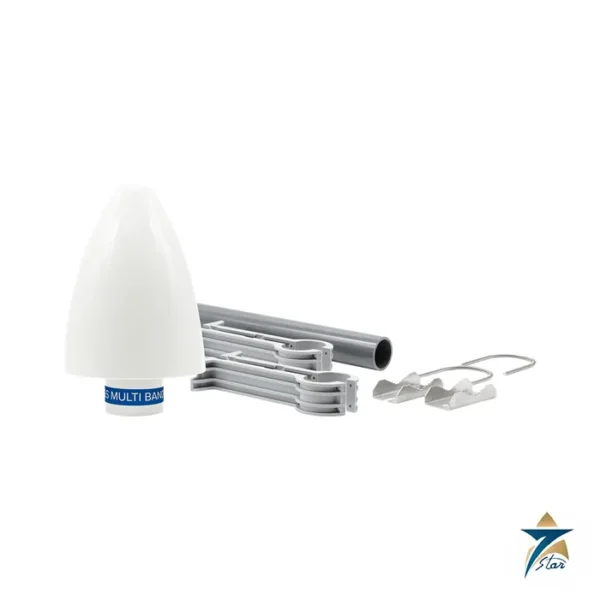
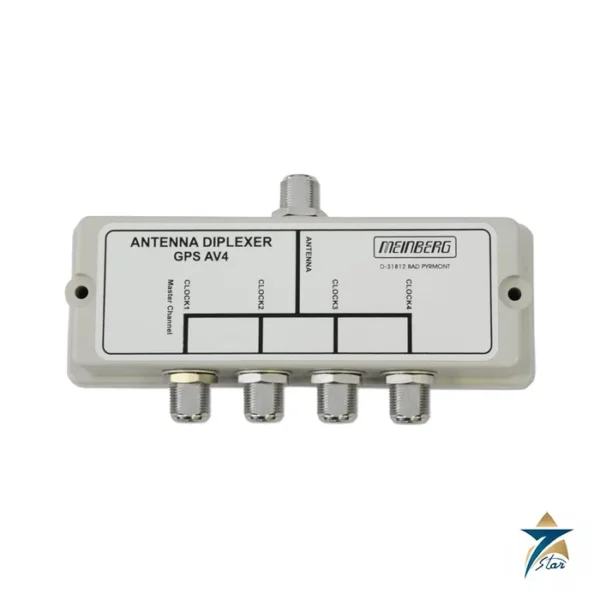
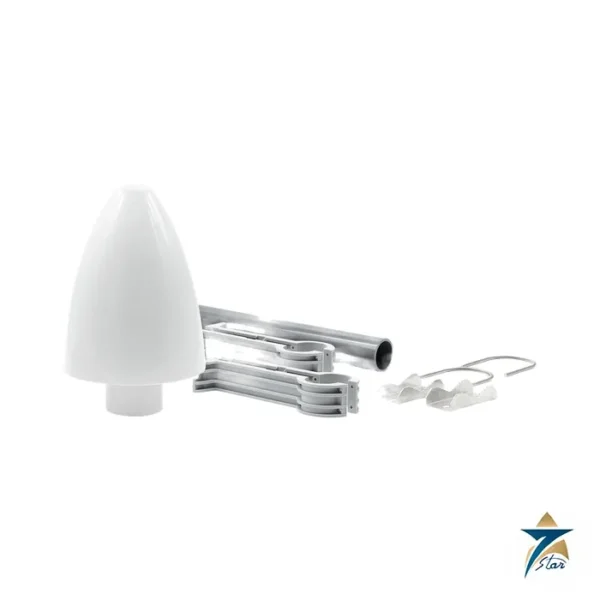
The included GPSANTv2 antenna uses downconverter technology that allows a long transmission route of up to 1100 m with the Ultraflex H2010 cable, which means the antenna can be placed on a clear roof area far from the equipment room. Shipment includes a Meinberg outdoor antenna with mounting kit and a pre-assembled antenna cable, except on time code receiver models. Provide lightning protection at the cable entry and keep the antenna away from metal obstructions that block the sky view.

Installation and maintenance

Mount the chassis in the rack, connect the antenna cable, supply and network, and set up the network from the front buttons before using the web interface. Back up the configuration to USB, review the alarm relay wiring, and plan firmware updates, which are free for the lifetime of the unit.

Ordering notes

Because every M900 is configured individually, please list the reference receivers, oscillator, outputs, number of network ports and power supply type needed.

Related items you may also need: Meinberg LANTIME M250 Compact NTP Time Server | Meinberg LANTIME M450 DIN Rail NTP Time Server | Meinberg LANTIME M150 DIN-Rail NTP Time Server | All Meinberg products.

Checklist before ordering the Meinberg LANTIME M900

  • Before ordering the Meinberg LANTIME M900, compare the nameplate of the unit being replaced with the code shown on this page, character by character.
  • Our team confirms the Meinberg LANTIME M900 code, condition and lead time in writing before any order is placed.
  • The datasheet attached to this page is the reference for the Meinberg LANTIME M900 dimensions, ratings and wiring.
  • The Meinberg LANTIME M900 is listed in our industrial communications range and ships to sites across Oman and the GCC.
  • Spare quantities of the Meinberg LANTIME M900 are worth planning for critical duty so that a failure does not stop production.

Documents and quotation

The manufacturer datasheet attached to this page lists the platform characteristics. Send an RFQ with the part number Meinberg LANTIME M900 and your configuration to receive a quotation.

Datasheets & Documents
  • PDF Datasheet Meinberg LANTIME M900 Modular 3U NTP Time Server Platform Datasheet Download
Reviews (0)

Reviews

There are no reviews yet.

How would you rate this product?

It takes about 10 seconds — just tap a star. Your email is never published.

About brand

Meinberg is a German maker of time and frequency synchronisation products, founded in 1979 by the brothers Werner and Günter Meinberg in Bad Pyrmont. It began with DCF77 longwave radio clock receivers and now makes GPS and GNSS-referenced NTP and PTP time servers. Meinberg is family-owned and designs and manufactures its products in Bad Pyrmont.

Seven Star LLC sources and supplies Meinberg LANTIME time servers for utilities and networks in Oman, including the M1000 and M320 listed here.

Meinberg company profile

Founded 1979, Bad Pyrmont, Germany
Founders Werner and Günter Meinberg
Ownership Family-owned
Manufacturing Bad Pyrmont, Germany
Product families LANTIME M150, M250, M320, M500 and M1000 NTP/PTP time servers, IMS modular systems, GNSS and DCF77 receivers, PTP grandmaster clocks

Meinberg LANTIME models listed here

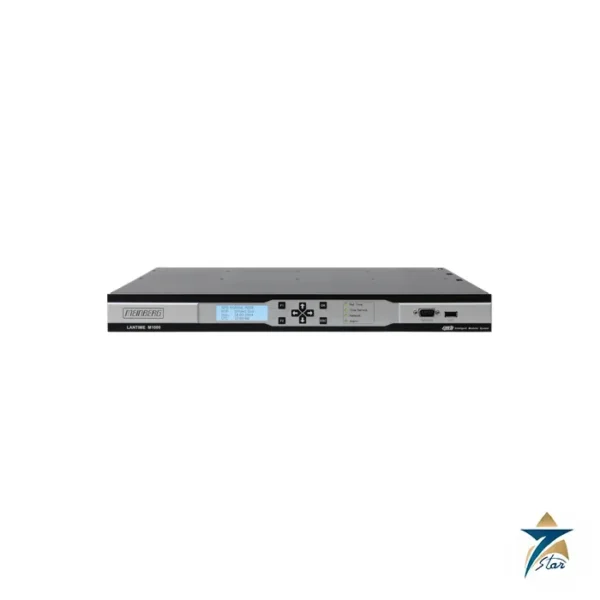
The LANTIME M320 is a 1U rackmount NTP time server. It works as a stratum 1 source with its own reference receiver, and Meinberg offers it with GPS, combined GNSS, DCF77 (PZF), MSF and IRIG time code references. The LANTIME M1000 is a 1U platform on the modular IMS system, with slots for up to two reference clocks, two power supplies and hot-pluggable I/O modules, plus PTP (IEEE 1588) and IEC 61850 time synchronization.

Meinberg products we list

Family Examples
Industrial Communications LANTIME M1000 Modular NTP/PTP Time Serve…, LANTIME M150 DIN-Rail NTP Time Server, LANTIME M250 Compact NTP Time Server, LANTIME M320/GPS/AD10 NTP Time Server, LANTIME M500 Modular DIN-Rail Time Server

Ordering a Meinberg time server: what we need

A Meinberg order code describes the build. In M320/GPS/AD10, GPS is the receiver and AD10 is the wide-range AC/DC power supply. Send the full code or serial number, the reference source, oscillator option, supply voltage, the outputs you need (PPS, 10 MHz, IRIG, extra LAN ports) and the antenna cable length. GCC utility projects often require redundant supplies.

Facts checked against Meinberg's own company history (meinbergglobal.com), October 2026.

FAQ

Questions about the Meinberg LANTIME M900 Modular 3U NTP Time Server

Answers from our engineering team on installation, compatibility and integration.

01Is the Meinberg LANTIME M900 still produced?
The datasheet marks it as no longer available while support continues; the link given by the maker points to the LANTIME M3000 family as its replacement.
02How many network ports can the LANTIME M900 have?
It has one 10/100 Mbit RJ45 port and up to eight additional LAN interfaces, giving up to nine network interfaces.
03Which oscillators can the LANTIME M900 use?
All Meinberg oscillator options are possible, from TCXO as standard up to a rubidium oscillator for very stable holdover.
04Does the LANTIME M900 support redundancy protocols?
The datasheet lists Parallel Redundancy Protocol per IEC 62439-3, and redundant power supplies are available on request.
05What form factor is the LANTIME M900?
A rackmount 3U chassis for standard 19 inch racks, consuming 25 W and accepting 100 to 240 V AC or DC.