- Automation & ControlView all 3,115 products
- Automation Accessories
- AC Drives
- PLC & I/O Cards
- Industrial Communications
- Vibration Monitoring
- Isolator & Barrier
- Controllers & Data Acquisition
- Safety Switches & Guard Locking
- Encoders
- Motor Soft Starters
- CCTV & Security
- Pneumatic Cylinders
- HMI Displays
- Servo Drives
- Industrial Computers
- Machine Vision
- Automation Software
- Robotics
Brand: Autonics
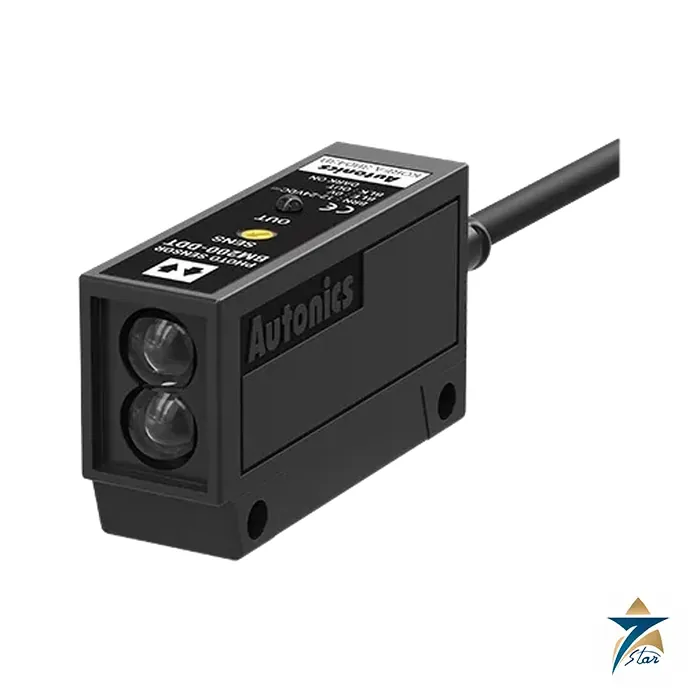
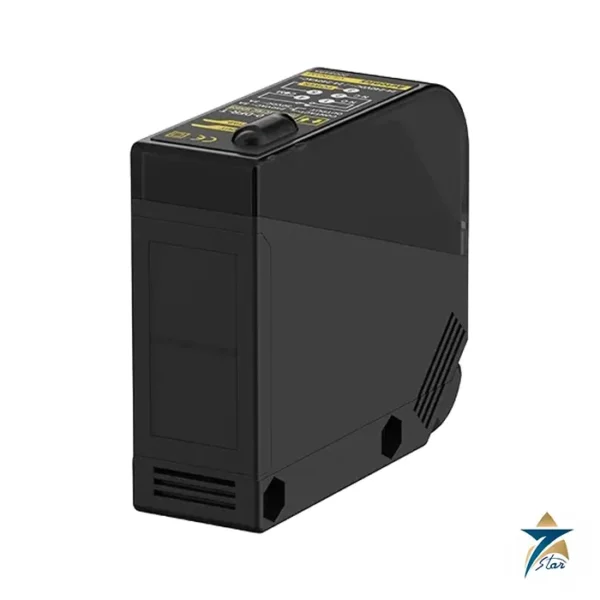
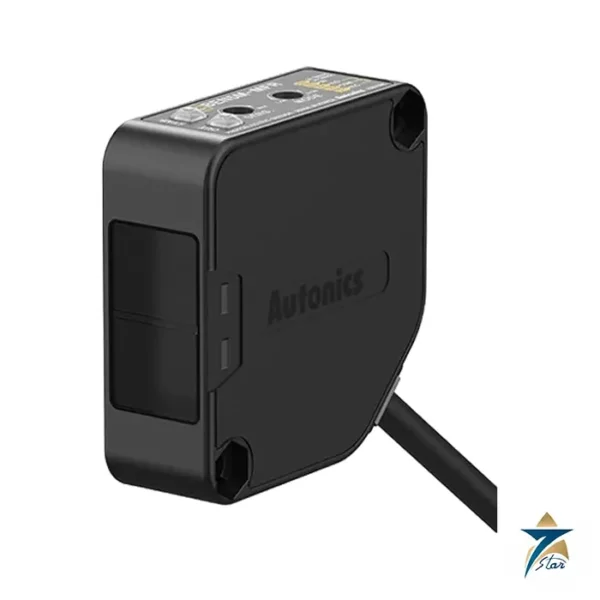
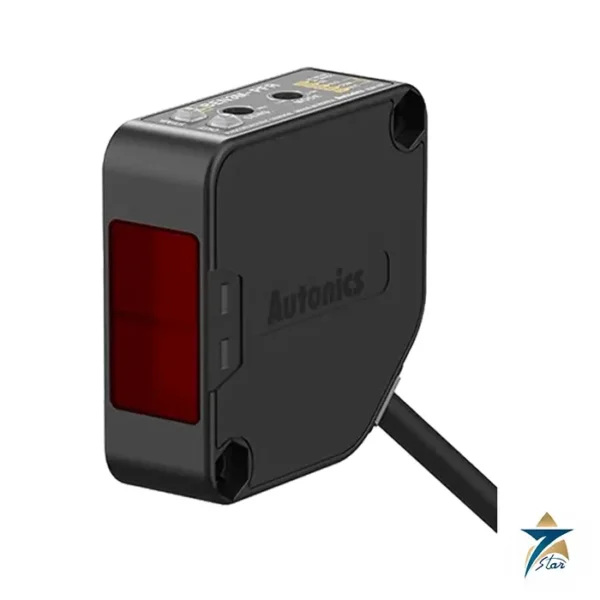
Autonics BM200-DDT 200 mm Diffuse Photoelectric Sensor NPN
Description
Overview
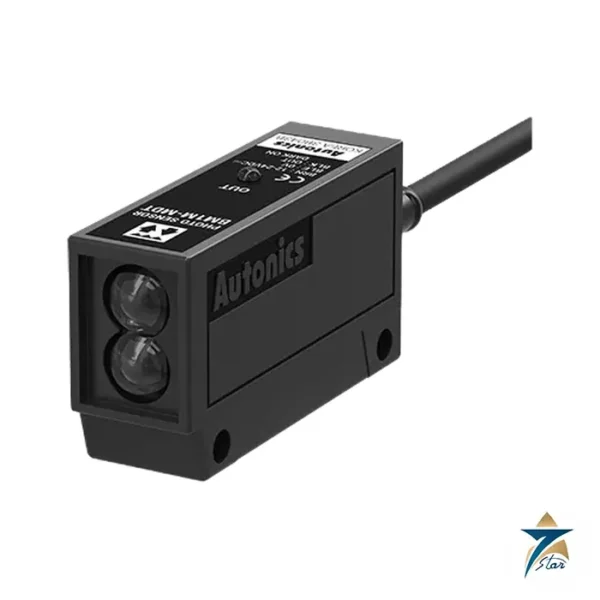
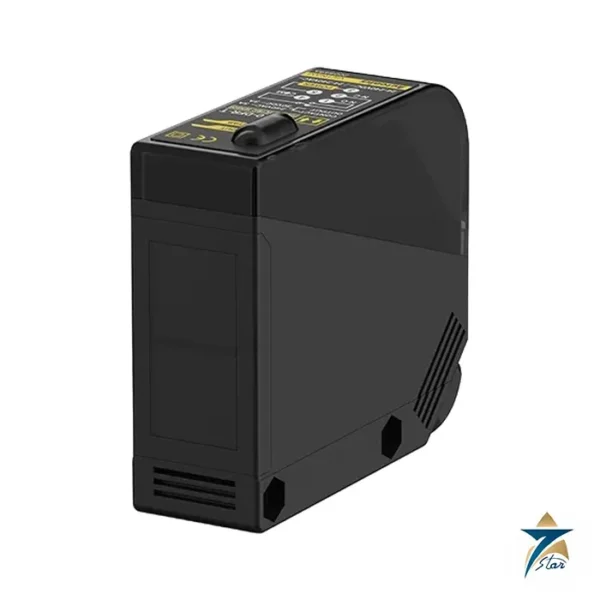
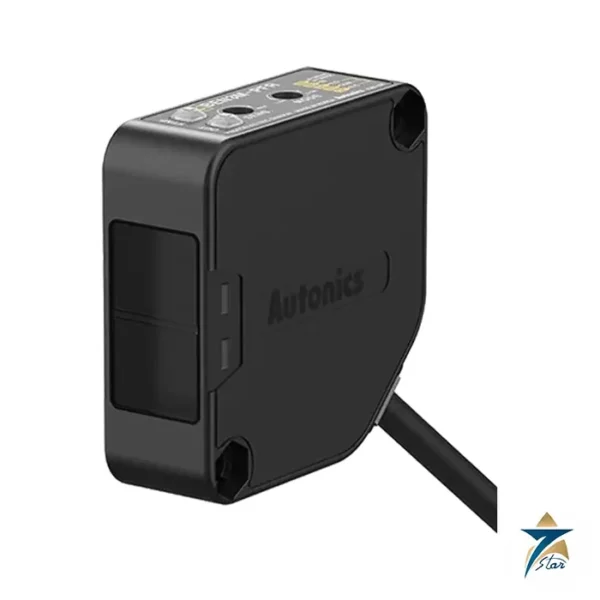
The Autonics BM200-DDT is an economical diffuse reflective photoelectric sensor in a small rectangular ABS housing. It detects opaque and translucent objects up to 200 mm in front of its lens, works from 12 to 24 V DC and gives an NPN open collector output of up to 100 mA. Seven Star LLC is an independent supplier serving Oman and the GCC. The facts on this page come from the BM series instruction manual and apply to this code.
Diffuse reflective sensors need only one housing: the light leaves the lens, is reflected by the object and returns to the receiver in the same unit. That makes them the simplest photoelectric solution when there is access to only one side of the path, for example above a conveyor belt or beside a feeder chute.
Autonics BM200-DDT technical data
| Item | Data |
|---|---|
| Sensing type | Diffuse reflective |
| Sensing distance | 200 mm on non-glossy white paper 200 x 200 mm |
| Targets | Opaque and translucent materials |
| Hysteresis | 10 percent of sensing distance or less |
| Response time | 3 ms or less |
| Light source | Infrared, peak wavelength 940 nm |
| Supply | 12 to 24 V DC plus or minus 10 percent, ripple 10 percent or less |
| Current consumption | 40 mA or less |
| Output | NPN open collector, up to 100 mA, load voltage up to 30 V DC |
| Residual voltage | 1.5 V or less |
| Protection circuits | Reverse polarity and output short-circuit overcurrent |
| Sensitivity | Adjuster |
| Operation mode | Light ON; Dark ON optional |
| Indicator | Operation indicator, red |
| Ambient light | Sunlight 11,000 lx; incandescent 3,000 lx |
| Ambient temperature | -10 to 60 C |
| Cable | 4 mm, 3-wire, 2 m |
| Housing | ABS case, acrylic sensing part |
What the letters mean
In the BM family BM is the economical general-purpose series. The 200 is the sensing distance in millimetres, so BM3M would be 3 metres and BM1M 1 metre. The first D after the dash is the diffuse reflective principle (T would be through-beam and M retroreflective). The second D is the 12 to 24 V DC supply, and the final T is the transistor output.
How BM200-DDT differs from BM3M-TDT and BM1M-MDT
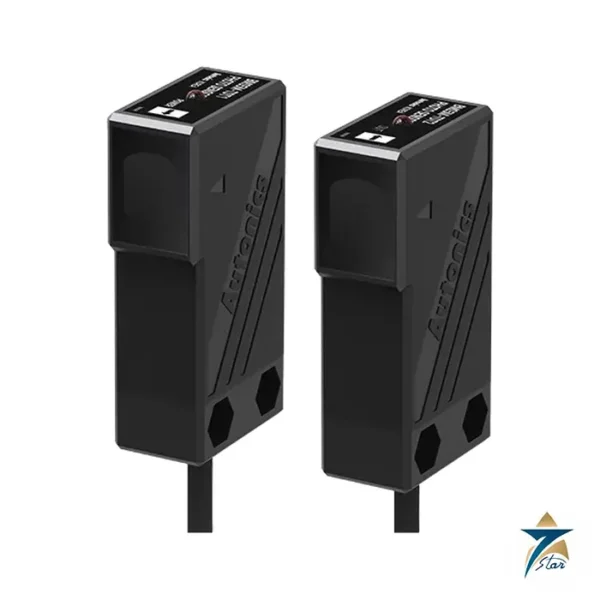
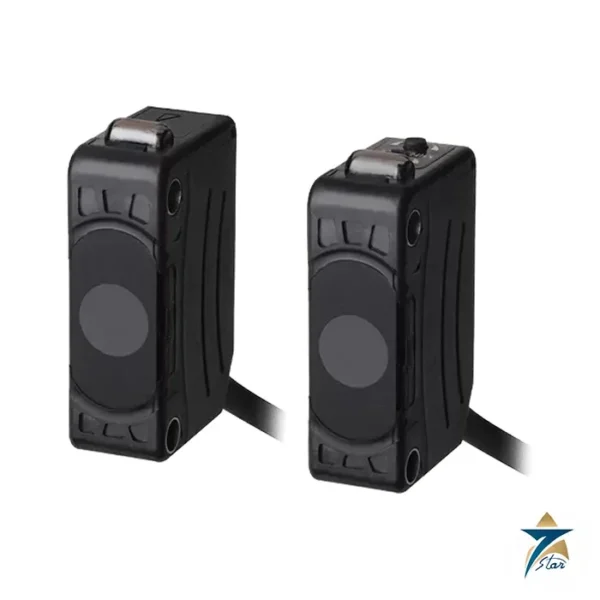
The BM3M-TDT is a through-beam pair with a 3 m range for opaque objects of 8 mm diameter or larger. The BM1M-MDT is a retroreflective sensor with a 1 m range using the MS-2 reflector, for targets of 60 mm or larger. This Autonics BM200-DDT is the only one of the three with a sensitivity adjuster, and it responds to translucent targets as well. All three share a response time of 3 ms or less and the same 12 to 24 V DC supply.
Setting up the sensitivity
With the Autonics BM200-DDT the adjuster is used in three steps. With the target present, turn the adjuster from minimum to maximum and note the point A where the operation indicator turns on. Remove the target, continue to maximum and note point B where the indicator turns on due to the background; if it does not turn on, maximum is B. Set the adjuster in the middle between A and B. Use only the supplied adjustment screwdriver, and do not force the adjuster.
The distance of 200 mm applies to white non-glossy paper. Darker or glossier targets reflect less light and are sensed at shorter range, so test with the real product and background. A bright background close behind the target can cause false detection; use a matt, dark or distant background.
Installing the Autonics BM200-DDT
Mount the sensor with the bracket and screws at a tightening torque of 0.8 N m, and fix the bracket properly to avoid twisting the optical axis. Use the sensor only after a test confirming that the indicator follows the object. If several sensors are installed close together, mutual interference can cause malfunction, so separate them. Do not use the sensor in places with flammable or corrosive gas, high humidity, direct sunlight, vibration or impact, as the safety notes warn.
Diffuse sensing in practice
The sensing distance of the Autonics BM200-DDT is not a fixed number but a function of the object. The manual states 200 mm for non-glossy white paper of 200 x 200 mm, and it references characteristic curves for other conditions. A black rubber part, a dark carton or a shiny metal part will each return a different amount of light, and the practical range may be a fraction of the nominal value. The safest approach is to set up the sensor on the real product at the real distance and then adjust sensitivity to the middle of the stable zone.
Hysteresis of 10 percent or less means that the point where the output switches on differs a little from the point where it switches off. It prevents flicker for objects at the edge of range, but also means that objects must move by a small amount before the output changes back. With a fast moving conveyor, this is not a concern, but with a slowly moving object it can add a short delay.
The infrared light at 940 nm is invisible, so alignment cannot be checked by eye. Use the red operation indicator instead: bring the object into the range and note whether the indicator lights up at the required distance. Also check that the indicator turns off when the object leaves, which confirms that the background is not triggering the sensor.
Ambient light matters as well. The receiver tolerates sunlight up to 11,000 lx and incandescent light up to 3,000 lx, which covers most indoor factory lighting, but not direct sunshine on the lens. Shade the sensor from windows and skylights, and avoid aiming it at bright reflective surfaces.
Wiring and power
The three wires are brown for supply plus, blue for 0 V and black for the NPN output. Add a diode or varistor across an inductive load such as a DC relay or solenoid valve. Wait 0.5 seconds after power-up before using the output, and if sensor and load have separate supplies, energise the sensor first. The supply should be insulated and limited in voltage and current, or a Class 2 SELV supply.
Applications in Oman and the GCC
Typical uses are carton and container presence on conveyors, parts detection in feeders, paper and label detection in packaging and printing machines, and detection of bottles on filling lines. The sensor has no stated ingress protection rating in the manual, so for washdown areas pick a sealed type; indoors, a clean and dry location suits it.
Related items you may also need: Autonics PR18-8DN M18 Inductive Proximity Sensor 8 mm | Autonics E40S6-2500-6-L-5 Rotary Encoder Incremental | Banner Q20-2PLP-2M Polarized Retroreflective Sensor | All Autonics products.
Checklist before ordering the Autonics BM200-DDT
- Before ordering the Autonics BM200-DDT, compare the nameplate of the unit being replaced with the code shown on this page, character by character.
- Our team confirms the Autonics BM200-DDT code, condition and lead time in writing before any order is placed.
- The datasheet attached to this page is the reference for the Autonics BM200-DDT dimensions, ratings and wiring.
- The Autonics BM200-DDT is listed in our photoelectric sensors range and ships to sites across Oman and the GCC.
- Spare quantities of the Autonics BM200-DDT are worth planning for critical duty so that a failure does not stop production.
Documents and quotation
The BM series instruction manual is attached as a datasheet. Send an RFQ for Autonics BM200-DDT to Seven Star LLC with quantity and delivery location and we will confirm availability and lead time for Oman and the GCC.
Other Models in the BM Range
Seven Star LLC supplies models from the BM range in Oman and the GCC. Compare the related models below and request a quote for the one that matches your application.
| Model | Category | |
|---|---|---|
| Autonics BM1M-MDT 1 m Retroreflective Photoelectric Sensor | Photoelectric Sensors | View details |
| Autonics BM200-DDT 200 mm Diffuse Photoelectric Sensor NPN | Photoelectric Sensors | You are viewing this model |
Datasheets & Documents
- Datasheet Autonics BM200-DDT 200 mm Diffuse Photoelectric Sensor NPN Datasheet Download
Reviews (0)
How would you rate this product? Cancel reply
About brand
Autonics is a South Korean maker of sensors and controllers, founded in 1977 as a small engineering business making controllers for looms. It took the Autonics name in 1988 and opened a new corporate headquarters in Busan in 2014. Autonics makes proximity and photoelectric sensors, rotary encoders, temperature controllers, counters, timers and stepper motor systems, with factories in Busan and Yangsan.
Seven Star LLC lists the Autonics E40S6-2500-6-L-5 incremental rotary encoder and supplies Autonics sensors and control devices in Oman and the GCC.
Autonics company profile
| Founded | 1977, South Korea |
|---|---|
| Current name | Autonics, since 1988 |
| Headquarters | Busan, South Korea |
| Factories | Busan and Yangsan |
| Product families | E40 and E50 rotary encoders, PR proximity sensors, BJ photoelectric sensors, TK temperature controllers |
Milestones
- 1977: The company is founded.
- 1988: Renamed Autonics Corporation.
- 2014: Opens its Busan headquarters.
Reading the Autonics E40S encoder code
E40S is the 40 mm diameter shaft-type incremental encoder, and the 6 that follows is the 6 mm shaft. 2500 is the resolution in pulses per revolution. The next 6 means six output signals: A, B and Z with their inverted signals. L is a line driver output and the final 5 is a 5 V DC supply. The same 40 mm body is made in hollow shaft form as the E40H and E40HB series.
Where Autonics encoders are used
Servo and spindle feedback, conveyor length measurement, packaging and printing machines.
Ordering Autonics encoders: what we need
Send the complete model string from the label. If it is worn off, give the body and shaft diameter, pulses per revolution, output type, supply voltage and cable or connector style.
Facts checked against Autonics corporate profiles, October 2026.
Browse Autonics products by category: Encoders.
FAQ
Questions about the Autonics BM200-DDT 200 mm Diffuse Photoelectric
Answers from our engineering team on installation, compatibility and integration.
01What is the range of Autonics BM200-DDT?
200 mm on non-glossy white paper of 200 x 200 mm; darker or glossy targets give shorter distances.
02What output does the BM200-DDT have?
NPN open collector up to 100 mA at up to 30 V DC with a residual voltage of 1.5 V or less.
03Does BM200-DDT detect translucent objects?
Yes, the diffuse reflective type detects opaque and translucent materials, unlike through-beam and retroreflective versions.
04How fast is the BM200-DDT?
The response time is 3 ms or less, and the hysteresis is 10 percent of the sensing distance or less.
05How is BM200-DDT adjusted?
With a sensitivity adjuster set mid-way between the target-on and background-on points, using the supplied screwdriver.


Reviews
There are no reviews yet.