- Automation & ControlView all 3,015 products
- Automation Accessories
- AC Drives
- PLC & I/O Cards
- Industrial Communications
- Vibration Monitoring
- Isolator & Barrier
- Controllers & Data Acquisition
- Safety Switches & Guard Locking
- Motor Soft Starters
- CCTV & Security
- Encoders
- Pneumatic Cylinders
- HMI Displays
- Servo Drives
- Industrial Computers
- Machine Vision
- Automation Software
- Robotics
Brand: Meinberg
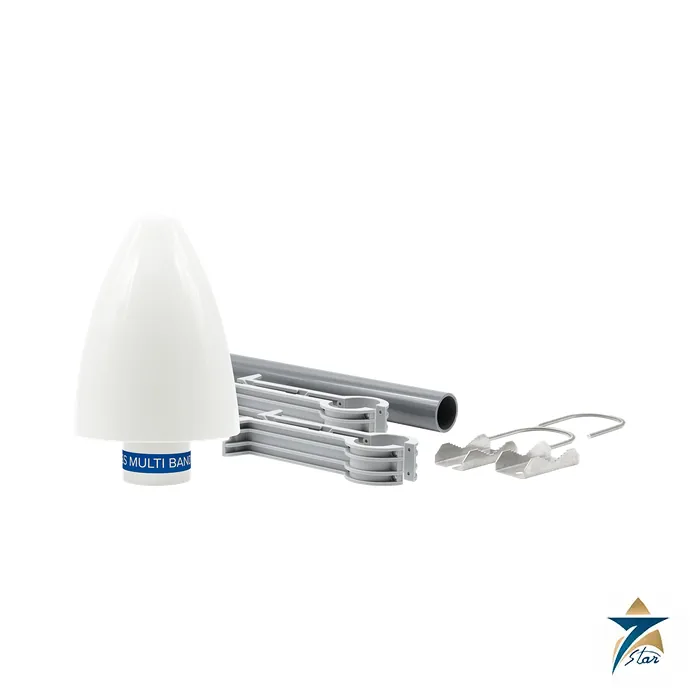
Meinberg GNMANTv2 Dual-Band Multi-GNSS Antenna, IP65
Description
Overview
A time server is only as good as the satellite signal it hears, and the Meinberg GNMANTv2 is the antenna Meinberg designs to make sure that signal arrives clean. It is a dual-band, multi-frequency GNSS antenna in the maker’s characteristic IP65 dome case, covering GPS, GLONASS, Galileo and BeiDou plus augmentation services such as SBAS, QZSS and L-band correction services including Fugro AtomiChron. Seven Star LLC is an independent supplier serving Oman and the GCC. It is intended for LANTIME, IMS and microSync systems and for standalone multi-GNSS receivers.
What the Meinberg GNMANTv2 receives
The antenna works in two bands. The lower band spans 1160 to 1255 MHz and the upper band spans 1539 to 1606 MHz. Within them it supports GPS and QZSS on L1 at 1575.42 MHz, L2 at 1227.6 MHz and L5 at 1176.45 MHz, GLONASS on G1, G2 and G3, Galileo on E1, E5a and E5b, BeiDou on B1, B2a and B2b, and L-band correction services between 1539 and 1559 MHz. The gain figures are 35 dB plus or minus 2 dB in the lower band and 37 dB plus or minus 2 dB in the upper band.
Specification of Meinberg GNMANTv2
| Parameter | Datasheet value |
|---|---|
| Compatible receivers | All Meinberg GNS, GNM or GXL type reference clocks |
| Frequency range | 1160 to 1255 MHz and 1539 to 1606 MHz |
| Overall LNA gain | Typically 37 dB |
| Connector | Type-N |
| Supply | 3.6 V to 5.5 V DC via the antenna cable |
| Housing | Injection-moulded ABS dome, IP65 |
| Grounding | M8 threaded bolt and hex nut for a ring lug |
| Out-of-band rejection | 60 dB in band skirts; more than 60 dB above 1427 MHz; more than 70 dB from 1710 to 4700 MHz |
| Noise figure | Typically under 2.0 dB |
| Axial ratio | Typically under 2.0 dB |
| ESD protection | 15 kV circuit protection |
| Weight | 1.4 kg including mounting kit |
| Operating temperature | minus 70 to plus 85 degrees C; storage minus 70 to plus 95 degrees C |
| Humidity | Maximum 95 percent non-condensing at 40 degrees C |
| Warranty | Three years |
How the Meinberg GNMANTv2 differs from the GPSANTv2
The GPSANTv2 receives only the GPS L1 and Galileo E1 band at 1575.42 MHz and converts it to an intermediate frequency of 35 MHz for transmission over up to 300 m of RG58 or 700 m of RG213 cable. It is fed with 15 V from the receiver. The GNMANTv2, in contrast, passes the received radio frequency signal straight through, is supplied with only 3.6 to 5.5 V, covers two bands and several constellations, and is meant for GNS, GNM and GXL receivers. Choose the GNMANTv2 when the clock is multi-band, and the GPSANTv2 when a long cable run or an older GPS-UC clock is involved.
Where the antenna is used in Oman and the GCC
Time servers in utilities, telecom exchanges and process plants typically sit inside buildings, so the antenna has to live on a roof, mast or gantry in strong sun, dust, humidity and sometimes sea air. The wide operating range of minus 70 to plus 85 degrees C and the IP65 dome case suit these conditions. The narrowband filter helps in places crowded with cellular transmitters, where LTE and 5G signals can overload an ordinary GNSS antenna.
Selection and compatibility notes
The antenna is compatible with Meinberg GNS, GNM and GXL clocks, and these types are used in LANTIME, IMS and microSync systems. Check the receiver type on the clock before ordering. Keep the cable run within the loss budget of the receiver, use the Type-N connector with weatherproofing, and consider an additional surge protector at the building entry even though the antenna has integrated surge protection.
Installation and commissioning
Mount the antenna with a clear view of the sky, away from metal obstacles and other antennas. Bond the M8 grounding bolt to the equipotential system with a ring lug. Connect the coaxial cable, protect the connector from water and route the cable to the receiver. After power up, confirm that the receiver lists a healthy number of satellites in the status screen.
Maintenance
Check the dome for damage, the connector for corrosion and the grounding for tightness at each plant inspection. If receivers report low signal strength, inspect the cable and connectors before replacing the antenna.
Why dual-band reception helps timing receivers
Receivers that use two frequencies can remove most of the delay that the ionosphere adds to satellite signals, which improves the accuracy of the time solution compared with single-frequency operation. A dual-band antenna also gives the receiver more satellites to choose from and reduces dependence on a single constellation. For control rooms that need a dependable time base, this adds resilience against local jamming or regional service problems. The stable phase centre of the antenna matters too, because a drifting centre would appear as a time error.
Siting the antenna for best timing performance
Choose a position with a full view of the sky down to a low elevation angle in all directions, because the receiver needs several satellites spread across the sky to calculate a stable position and time. Keep the antenna at least a metre away from metal structures that could reflect signals, and do not mount it beside radar, satellite uplink or cellular antennas that could saturate the front end. On a roof, place it on a short mast rather than at the parapet edge, where reflections are strongest. In a plant with tall structures, a gantry top may offer the best view. The ground terminal should reach the lightning protection system with the shortest practical conductor, and the cable should be dressed with a drip loop below the connector so water cannot run into it.
Fix the mast firmly, since a swaying antenna changes the phase centre.
Ordering notes for Meinberg GNMANTv2
The antenna is supplied with its mounting kit. Cable, connectors and lightning or surge protectors are separate items, so list the cable length with your enquiry.
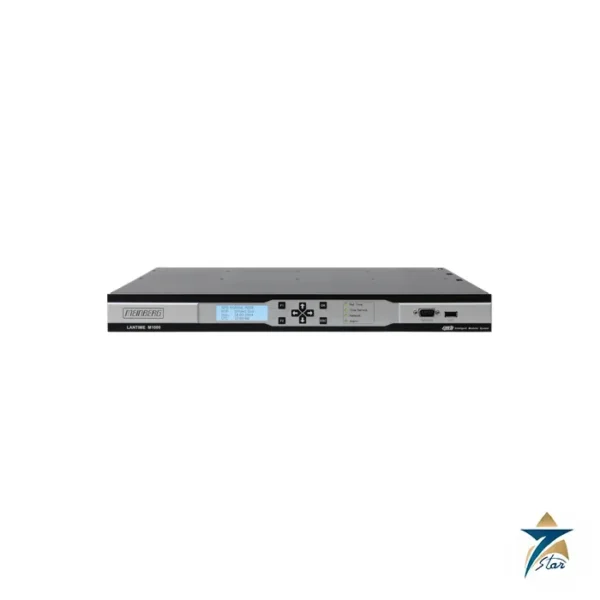
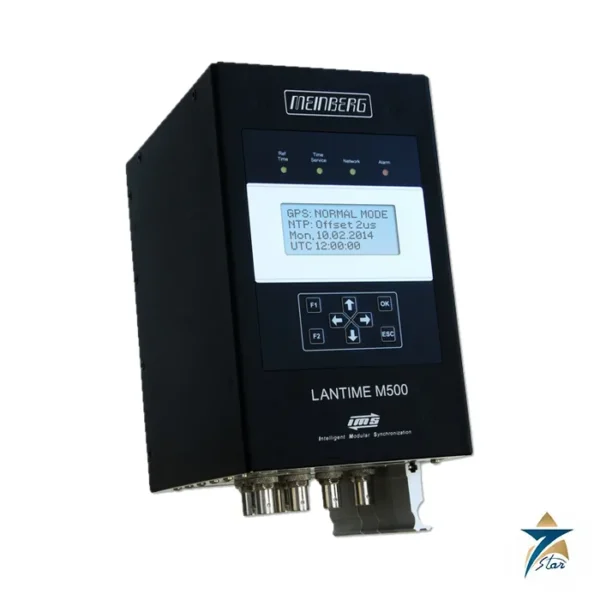
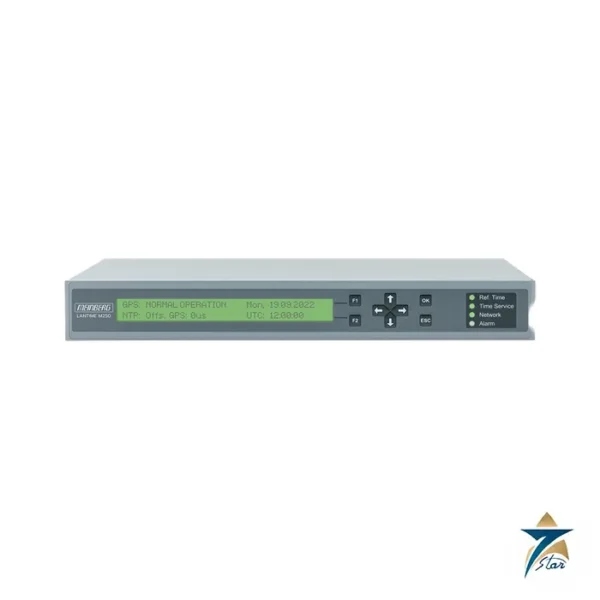
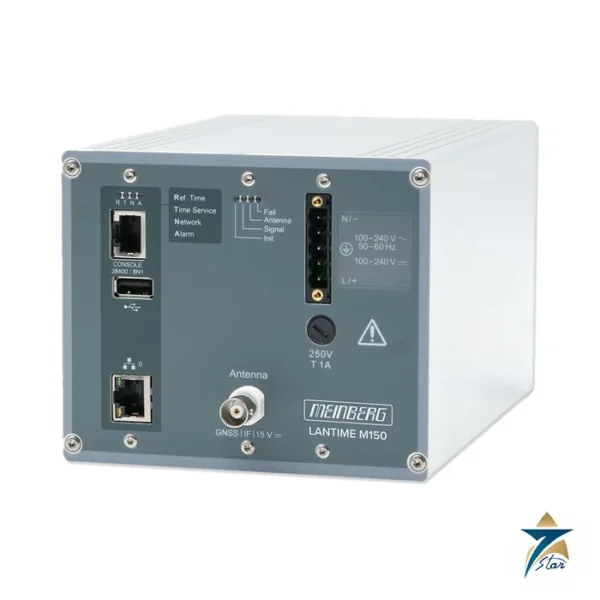
Related items you may also need: Meinberg LANTIME M1000 Modular NTP/PTP Time Server (IMS 1U) | Meinberg LANTIME M150 DIN-Rail NTP Time Server | Meinberg LANTIME M500 Modular DIN-Rail Time Server | All Meinberg products.
Documents and quotation
The manufacturer datasheet for the Meinberg GNMANTv2 is attached to this page, and the installation guide it references is available from the maker. Send your RFQ with the part number, quantity and delivery location in Oman or the GCC.
Datasheets & Documents
- Datasheet Meinberg GNMANTv2 Dual-Band Multi-GNSS Antenna, IP65 Datasheet Download
Reviews (0)
How would you rate this product? Cancel reply
About brand
Meinberg is a German maker of time and frequency synchronisation products, founded in 1979 by the brothers Werner and Günter Meinberg in Bad Pyrmont. It began with DCF77 longwave radio clock receivers and now makes GPS and GNSS-referenced NTP and PTP time servers. Meinberg is family-owned and designs and manufactures its products in Bad Pyrmont.
Seven Star LLC sources and supplies Meinberg LANTIME time servers for utilities and networks in Oman, including the M1000 and M320 listed here.
Meinberg company profile
| Founded | 1979, Bad Pyrmont, Germany |
|---|---|
| Founders | Werner and Günter Meinberg |
| Ownership | Family-owned |
| Manufacturing | Bad Pyrmont, Germany |
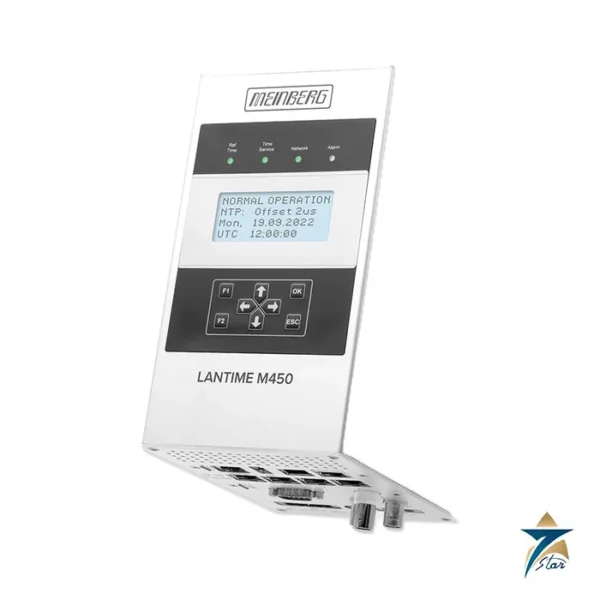
| Product families | LANTIME M150, M250, M320, M500 and M1000 NTP/PTP time servers, IMS modular systems, GNSS and DCF77 receivers, PTP grandmaster clocks |
Meinberg LANTIME models listed here
The LANTIME M320 is a 1U rackmount NTP time server. It works as a stratum 1 source with its own reference receiver, and Meinberg offers it with GPS, combined GNSS, DCF77 (PZF), MSF and IRIG time code references. The LANTIME M1000 is a 1U platform on the modular IMS system, with slots for up to two reference clocks, two power supplies and hot-pluggable I/O modules, plus PTP (IEEE 1588) and IEC 61850 time synchronization.
Meinberg products we list
Ordering a Meinberg time server: what we need
A Meinberg order code describes the build. In M320/GPS/AD10, GPS is the receiver and AD10 is the wide-range AC/DC power supply. Send the full code or serial number, the reference source, oscillator option, supply voltage, the outputs you need (PPS, 10 MHz, IRIG, extra LAN ports) and the antenna cable length. GCC utility projects often require redundant supplies.
Facts checked against Meinberg's own company history (meinbergglobal.com), October 2026.
Browse Meinberg products by category: Industrial Communications.
FAQ
Questions about the Meinberg GNMANTv2 Dual-Band Multi-GNSS Antenna, IP65
Answers from our engineering team on installation, compatibility and integration.
01Which satellite systems does the Meinberg GNMANTv2 receive?
It receives GPS, GLONASS, Galileo and BeiDou in two bands, plus SBAS, QZSS and L-band correction services such as Fugro AtomiChron.
02What supply voltage does the Meinberg GNMANTv2 need?
It runs on 3.6 V to 5.5 V DC supplied through the antenna cable, and it uses a Type-N connector.
03What is the IP rating of the Meinberg GNMANTv2?
The injection-moulded ABS dome has an IP65 rating and works from minus 70 to plus 85 degrees C.
04Which Meinberg receivers work with the Meinberg GNMANTv2?
It is compatible with all Meinberg reference clocks of the GNS, GNM or GXL type, including LANTIME, IMS and microSync systems.
05How does the Meinberg GNMANTv2 reject interference?
A narrowband front-end filter rejects out-of-band signals such as LTE and 5G, with more than 70 dB rejection from 1710 to 4700 MHz.


Reviews
There are no reviews yet.