Brand:

Autonics MD5-HD14 Micro Step 5-Phase Stepper Motor Driver

Description

Overview

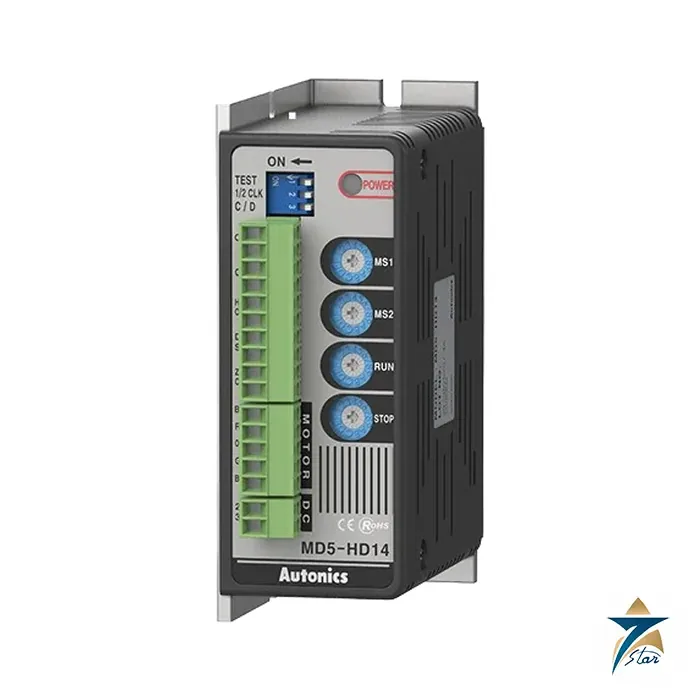
Positioning axes that must move smoothly at low speed, without the buzzing of full-step drives, are the natural home of the Autonics MD5-HD14. This is a micro-step driver for Autonics five-phase stepper motors, running from 20 to 35 V DC and delivering a bipolar constant-current pentagon drive with a RUN current adjustable from 0.4 to 1.4 A per phase. Sixteen resolution settings divide the basic 0.72 degree step angle down to 0.00288 degrees, so a single motor revolution can be cut into up to 125,000 steps. Seven Star LLC is an independent supplier serving Oman and the GCC.

Resolution and current settings of Autonics MD5-HD14

The manual lets the installer select everything with rotary and DIP switches on the front, which keeps commissioning simple and avoids software. A 16-position switch sets the RUN current in steps, starting at 0.4 A, passing 0.5, 0.57, 0.63, 0.71 and 0.77 A, and ending at 1.4 A. A second switch sets the stop current as a percentage of RUN current, from 27 percent up to 90 percent, and it is applied when the auto current down function is on. Two more rotary switches choose the micro-step resolutions MS1 and MS2 from the list 1, 2, 4, 5, 8, 10, 16, 20, 25, 40, 50, 80, 100, 125, 200 and 250 divisions, and an external division selection input can switch between them while running.

Electrical data for the Autonics MD5-HD14

Item Value in the instruction manual
Supply 20 to 35 V DC, permissible range 90 to 110 percent
Maximum current consumption 3 A at 25 degrees C and 55 percent RH
RUN current 0.4 to 1.4 A per phase
Stop current 27 to 90 percent of RUN current
Drive method Bipolar constant current pentagon drive
Basic step angle 0.72 degrees per step
Resolution 1 to 250 divisions (0.72 to 0.00288 degrees per step)
Input pulse 10 microseconds or more, duty 50 percent, rise and fall 130 ns or less
Maximum pulse frequency 500 kHz on CW and CCW
Signal levels High 4 to 8 V DC, low 0 to 0.5 V DC, 7.5 to 14 mA
Input resistance 270 ohm (CW, CCW); 390 ohm (hold off, division select); 10 ohm (zero out)
Insulation 100 megohm or more at 500 V DC; 1000 V AC for 1 minute
Vibration 1.5 mm double amplitude, 5 to 60 Hz, 2 hours
Ambient temperature 0 to 40 degrees C (storage minus 10 to plus 60)
Weight about 220 g, about 327.5 g packaged

How Autonics MD5-HD14 differs from other MD5 drivers

The MD5-ND14 from the same family handles 0.5 to 1.5 A, a stop current of 25 to 75 percent and only two fixed resolutions, 1 and 2 divisions, with a maximum pulse frequency of 50 kHz. The Autonics MD5-HD14 instead offers sixteen resolutions, a pulse rate of 500 kHz, a zero-point excitation output and a self-diagnosis test function. It also accepts a division selection signal, so a machine can run fast in a coarse setting and then switch to a fine setting for positioning. Choose the HD14 where smooth motion and high pulse rates are needed, and the ND14 for simple, economical stepping.

Inputs, outputs and the test function

The input terminals include CW and CCW pulse lines, a HOLD OFF line that releases motor excitation after 1 ms so the shaft can be turned by hand, and the division selection line. The ZERO OUT output switches on when the excitation sequence is at its starting point, which occurs every 7.2 degrees of shaft rotation, or fifty times per motor revolution. A DIP switch selects either one-pulse mode, where one input carries pulses and the other the direction, or two-pulse mode, with separate forward and reverse pulse inputs. Another switch starts a self-diagnosis rotation of 30 rpm in full-step, which is handy for checking motor wiring without any controller.

Typical uses in Oman and the GCC

Micro-stepping drivers of this kind are found in small positioners, dosing and filling machines, label applicators, camera and inspection stages, textile and packaging equipment and laboratory automation. Local panel builders and OEMs also use them to retrofit axes on older machines, because the motor wiring uses five leads and the driver is compact at 220 g. The environment must be indoor, with pollution degree 2 and an altitude of up to 2000 m, so place the driver in a clean cabinet.

Installation guidance

Mount the driver inside an enclosure or ground it, with room for ventilation, and consider forced cooling when ambient temperature approaches the 40 degree limit. Use cable of AWG18 or thicker for the supply, fit an over-current device in the supply line, and keep signal wires under 2 m in twisted pairs, at least 10 cm from power wiring. Set the RUN current within the rated current of the motor and never change the switches while the motor runs or after power has been applied. Wait one second after disconnecting before re-applying power. If the driver is used on a vertical axis, add a mechanical safety device since holding torque is lost when power is removed.

Maintenance and fault finding

The manual recommends regular checks of bolts and connections, listening for abnormal sound from the motor bearings, inspecting the lead cable for damage and checking that the shaft and load are concentric. If the motor does not excite, verify the pulse levels and the connection of the controller. If it rotates in the wrong direction, reverse the direction signal level or swap the CW and CCW inputs. If it runs unevenly, check pulse width and voltage against the specification. The driver has no motor protection of its own, so use proper current settings.

Ordering the Autonics MD5-HD14

State the exact code Autonics MD5-HD14 in the enquiry, along with the motor type that will be driven. Matching motors and cables can be quoted together; confirm the motor rated current before choosing the RUN current position.

Related items you may also need: Autonics E40S6-2500-6-L-5 Rotary Encoder Incremental | SICK WTB8-P2231 Miniature Background Suppression Sensor | SICK GTE6-P4231 G6 Background Suppression Sensor | All Autonics products.

Documents and quotation

The instruction manual for the Autonics MD5-HD14 is attached and includes dimensions, switch tables, timing charts and wiring. To request a quotation, send your RFQ with Autonics MD5-HD14, the quantity and your delivery location in Oman or the GCC.

Datasheets & Documents
  • PDF Datasheet Autonics MD5-HD14 Micro Step 5-Phase Stepper Motor Driver Datasheet Download
Reviews (0)

Reviews

There are no reviews yet.

How would you rate this product?

It takes about 10 seconds — just tap a star. Your email is never published.

About brand

Autonics is a South Korean maker of sensors and controllers, founded in 1977 as a small engineering business making controllers for looms. It took the Autonics name in 1988 and opened a new corporate headquarters in Busan in 2014. Autonics makes proximity and photoelectric sensors, rotary encoders, temperature controllers, counters, timers and stepper motor systems, with factories in Busan and Yangsan.

Seven Star LLC lists the Autonics E40S6-2500-6-L-5 incremental rotary encoder and supplies Autonics sensors and control devices in Oman and the GCC.

Autonics company profile

Founded 1977, South Korea
Current name Autonics, since 1988
Headquarters Busan, South Korea
Factories Busan and Yangsan
Product families E40 and E50 rotary encoders, PR proximity sensors, BJ photoelectric sensors, TK temperature controllers

Milestones

  • 1977: The company is founded.
  • 1988: Renamed Autonics Corporation.
  • 2014: Opens its Busan headquarters.

Reading the Autonics E40S encoder code

E40S is the 40 mm diameter shaft-type incremental encoder, and the 6 that follows is the 6 mm shaft. 2500 is the resolution in pulses per revolution. The next 6 means six output signals: A, B and Z with their inverted signals. L is a line driver output and the final 5 is a 5 V DC supply. The same 40 mm body is made in hollow shaft form as the E40H and E40HB series.

Where Autonics encoders are used

Servo and spindle feedback, conveyor length measurement, packaging and printing machines.

Ordering Autonics encoders: what we need

Send the complete model string from the label. If it is worn off, give the body and shaft diameter, pulses per revolution, output type, supply voltage and cable or connector style.

Facts checked against Autonics corporate profiles, October 2026.

FAQ

Questions about the Autonics MD5-HD14 Micro Step 5-Phase Stepper Motor

Answers from our engineering team on installation, compatibility and integration.

01What supply voltage does the Autonics MD5-HD14 need?
It operates from 20 to 35 V DC, with a maximum current consumption of 3 A, and the permissible range is 90 to 110 percent of the rated voltage.
02What is the RUN current range of the MD5-HD14?
The RUN current is adjustable from 0.4 to 1.4 A per phase with a rotary switch, and the stop current is 27 to 90 percent of that value.
03How many micro-step resolutions does the MD5-HD14 have?
It offers sixteen settings from 1 to 250 divisions, which corresponds to 0.72 down to 0.00288 degrees per step on a five-phase motor.
04What is the maximum pulse frequency of the MD5-HD14?
The CW and CCW inputs accept pulses up to 500 kHz with a minimum width of 10 microseconds and a duty rate of 50 percent.
05How does the MD5-HD14 differ from the MD5-ND14?
The ND14 has only 1 and 2 division resolutions, 0.5 to 1.5 A and a 50 kHz input, while the HD14 has sixteen resolutions and a 500 kHz input.