Brand:

Autonics TK4SP-14RN 11-Pin Plug-in PID Temperature Controller

Description

Overview

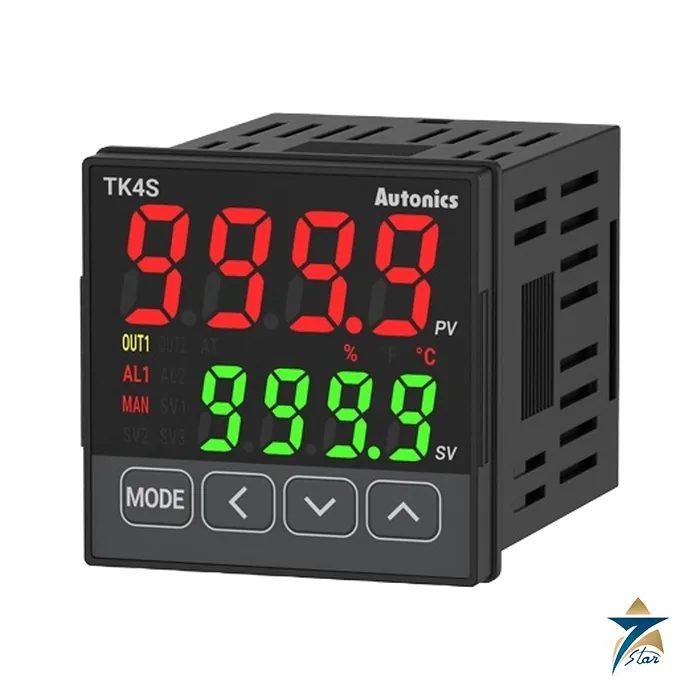
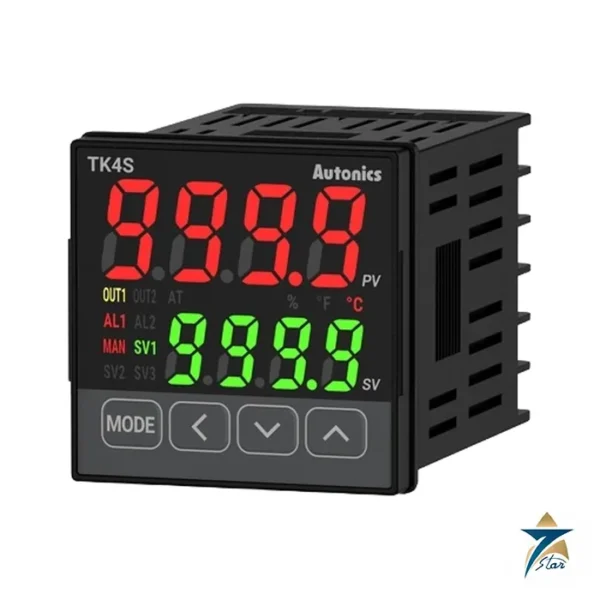
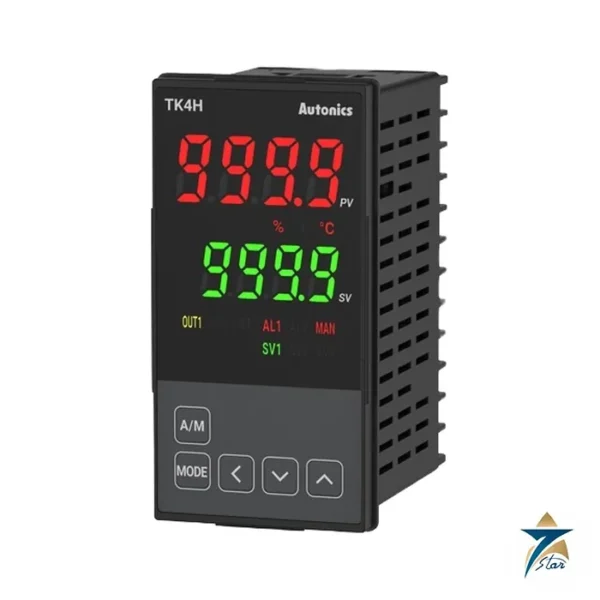
An 11-pin plug-in base, the type used on older octal and 11-pin temperature controllers, is what distinguishes the Autonics TK4SP-14RN. It is a 48 x 48 mm TK series PID controller that mounts into a socket and can be removed from the panel without touching the field wires, so a failed unit is exchanged in a few seconds. It supplies a relay output for heating or cooling, one alarm relay, and the same wide input table as the other TK models. Seven Star LLC is an independent supplier serving Oman and the GCC.

Understanding the code Autonics TK4SP-14RN

TK4 identifies the four-digit TK series. SP is the 48 x 48 mm DIN size in the 11-pin plug type. The digit 1 gives alarm 1 as the option output, and for the SP size that is the only option available. The 4 means the supply is 100 to 240 V AC at 50/60 Hz. R is a relay for output 1, and N is the normal type, with no second control output.

Autonics TK4SP-14RN technical data

Item Data
Front size 48 x 48 mm, cut-out 45 mm square
Connection 11-pin plug type, socket PG-11 or PS-11(N) sold separately
Supply 100 to 240 V AC 50/60 Hz, permissible 90 to 110 percent
OUT1 Relay 250 V AC 3 A, 30 V DC 3 A, 1a
Alarm Alarm 1 relay, 250 V AC 3 A, 1a
Thermocouple inputs K, J, E, T, B, R, S, N, C, G, L, U and Platinel II
RTD inputs Cu50, Cu100, JPt100, DPt50, DPt100, Nickel120
Analog inputs 0-10 V, 0-5 V, 1-5 V, 0-100 mV, 0-20 mA, 4-20 mA
Sampling period 50 ms
Control modes ON/OFF, P, PI, PD, PID; heating, cooling or heating and cooling
Display accuracy PV plus or minus 0.3 percent or plus or minus 1 degree C, whichever is greater, plus 1 digit, at 23 degrees C plus or minus 5
Accuracy note For the SP series, 1 degree C is added to the degree standard
Ambient minus 10 to plus 50 degrees C
Protection IP50 front panel
Weight about 85 g, about 130 g packaged

How the Autonics TK4SP-14RN differs from other TK4 variants

Compared with the screw-terminal TK4S-14RN of the same size, the plug type loses some protection and accuracy margin: the front panel is IP50 where the TK4S has IP65, and 1 degree C is added to the accuracy limits. In exchange the TK4SP can be pulled out of its socket, and it weighs about 85 g against about 105 g. Only alarm 1 is available on the SP size, with no transmission output, RS485 or digital input. The standard wiring terminals are therefore on the socket and not on the controller, which makes the socket PG-11 or PS-11(N) a required accessory to order together.

Why choose a plug-in controller

A plug-in design speeds replacement during shutdowns. The socket is wired once, and the controller is pushed in and held with a clip. The same pin layout is familiar to technicians who have worked with legacy plug-in controllers, so the TK4SP often serves in upgrades where field wiring is left alone. It is less suited to places with severe vibration or water spray, because the front is rated IP50, and in such cases a screw-terminal case with IP65 front is better.

Reading the accuracy statement of the Autonics TK4SP-14RN

The manual gives its accuracy figures for the TK family and then adds a note for the SP series: one degree Celsius must be added to the stated accuracy standard. In practice, at room temperature the family figure of 0.3 percent of reading or 1 degree C, whichever is larger, becomes a larger band for this plug-in model, so a process with a tight tolerance should take that extra degree into account when the alarm and setpoint are chosen. Analog signals keep their own specification of 0.3 percent of full scale plus one digit under normal room conditions.

The inputs are the same menu as other TK models. Choose from thermocouple K, J, E, T, B, R, S, N, C, G, L, U or Platinel II, from RTD Cu50, Cu100, JPt100, DPt50, DPt100 or Nickel120, or from voltage and current ranges such as 0 to 10 V, 1 to 5 V and 4 to 20 mA. Typical working spans are minus 200 to 1,350 degrees C for K and minus 200 to 650 degrees C for Pt100. Because a plug-in socket adds contacts in the sensor path, keep the socket screws tight, as a poor terminal on a thermocouple circuit appears as a drifting reading.

Typical applications

Retrofits of small ovens, lab furnaces, heat sealers, laminators and test chambers are typical. In the GCC, workshops and maintenance departments appreciate being able to change a controller without rewiring, particularly where there are many identical machines. The 48 mm size and compact depth allow installation in shallow enclosures.

Installation

Mount the socket on a DIN rail or panel, wire the supply, sensor, output and alarm to its terminals using AWG 20 or heavier cable for supply and relays and tightening to the specified torque, then push the controller into the socket. If it is panel mounted through a cut-out of 45 mm, fasten the bracket according to the manual. Check polarity on sensor terminals and use three equal-length wires for RTDs. Keep to the 5 ohm per line limit.

Setup and control

As with the rest of the TK range, select the input, choose ON/OFF or PID control, run auto tuning and set alarm 1. The proportional band can be set from 0.1 to 999.9, integral and derivative times from 0 to 9,999 seconds, and the relay control cycle between 0.1 and 120 seconds. Multi SV values can be recalled where used. Parameters remain in non-volatile memory for about ten years.

Maintenance

Switch off the supply before pulling the unit from its socket. Check that the socket clip is engaged and that no moisture or dust gets at the pins. When the display flashes OPEN, check the sensor and its wiring. Replace the unit if relay output contacts become unreliable after many operations.

Related items you may also need: Autonics E40S6-2500-6-L-5 Rotary Encoder Incremental | SICK WTB2S-2P1151 Proximity Sensor | SICK WL150-P430 Miniature Retro-Reflective Sensor, 2 m | All Autonics products.

Documents and quotation

The TK series product manual that covers the Autonics TK4SP-14RN is attached with ordering information, wiring and dimensions. Send an RFQ with the part number Autonics TK4SP-14RN, quantity and delivery location in Oman or the GCC, and mention if you also need the PG-11 or PS-11(N) socket.

Other Models in the TK Range

Seven Star LLC supplies models from the TK range in Oman and the GCC. Compare the related models below and request a quote for the one that matches your application.

ModelCategory
Autonics TK4S-14RN PID Temperature Controller 48×48 mmControllers & Data AcquisitionView details
Autonics TK4M-14RN 72×72 PID Temperature Controller RelayPhotoelectric SensorsView details
Autonics TK4S-14RR 48×48 Heating Cooling PID ControllerPhotoelectric SensorsView details
Autonics TK4H-24CN 48×96 PID Controller Current SSR OutputPhotoelectric SensorsView details
Autonics TK4SP-14RN 11-Pin Plug-in PID Temperature ControllerPhotoelectric SensorsYou are viewing this model
Datasheets & Documents
  • PDF Datasheet Autonics TK4SP-14RN 11-Pin Plug-in PID Temperature Controller Datasheet Download
Reviews (0)

Reviews

There are no reviews yet.

How would you rate this product?

It takes about 10 seconds — just tap a star. Your email is never published.

About brand

Autonics is a South Korean maker of sensors and controllers, founded in 1977 as a small engineering business making controllers for looms. It took the Autonics name in 1988 and opened a new corporate headquarters in Busan in 2014. Autonics makes proximity and photoelectric sensors, rotary encoders, temperature controllers, counters, timers and stepper motor systems, with factories in Busan and Yangsan.

Seven Star LLC lists the Autonics E40S6-2500-6-L-5 incremental rotary encoder and supplies Autonics sensors and control devices in Oman and the GCC.

Autonics company profile

Founded 1977, South Korea
Current name Autonics, since 1988
Headquarters Busan, South Korea
Factories Busan and Yangsan
Product families E40 and E50 rotary encoders, PR proximity sensors, BJ photoelectric sensors, TK temperature controllers

Milestones

  • 1977: The company is founded.
  • 1988: Renamed Autonics Corporation.
  • 2014: Opens its Busan headquarters.

Reading the Autonics E40S encoder code

E40S is the 40 mm diameter shaft-type incremental encoder, and the 6 that follows is the 6 mm shaft. 2500 is the resolution in pulses per revolution. The next 6 means six output signals: A, B and Z with their inverted signals. L is a line driver output and the final 5 is a 5 V DC supply. The same 40 mm body is made in hollow shaft form as the E40H and E40HB series.

Where Autonics encoders are used

Servo and spindle feedback, conveyor length measurement, packaging and printing machines.

Ordering Autonics encoders: what we need

Send the complete model string from the label. If it is worn off, give the body and shaft diameter, pulses per revolution, output type, supply voltage and cable or connector style.

Facts checked against Autonics corporate profiles, October 2026.

FAQ

Questions about the Autonics TK4SP-14RN 11-Pin Plug-in PID Temperature

Answers from our engineering team on installation, compatibility and integration.

01What kind of connection does the Autonics TK4SP-14RN use?
It is an 11-pin plug type controller that fits a separate socket, PG-11 or PS-11(N), which the manual lists as sold separately.
02How does the Autonics TK4SP-14RN differ from the TK4S?
The SP plug type has an IP50 front, adds 1 degree C to the accuracy standard and weighs about 85 g, while the TK4S has screw terminals and IP65.
03What output does the Autonics TK4SP-14RN provide?
One relay control output rated 250 V AC 3 A, 30 V DC 3 A, plus alarm 1 as a relay, from a 100 to 240 V AC supply.
04How big is the Autonics TK4SP-14RN?
The front is 48 x 48 mm, with a panel cut-out of 45 mm square when mounted in a panel.
05Can the Autonics TK4SP-14RN heat and cool at once?
No, the N in the code means a normal type with one control output; simultaneous heating and cooling needs an R or C output 2 code on another size.