- Automation & ControlView all 2,855 products
- Automation Accessories
- AC Drives
- PLC & I/O Cards
- Industrial Communications
- Vibration Monitoring
- Controllers & Data Acquisition
- Isolator & Barrier
- Safety Switches & Guard Locking
- Motor Soft Starters
- CCTV & Security
- Encoders
- Pneumatic Cylinders
- HMI Displays
- Servo Drives
- Industrial Computers
- Machine Vision
- Automation Software
- Robotics
Brand: Moore Industries
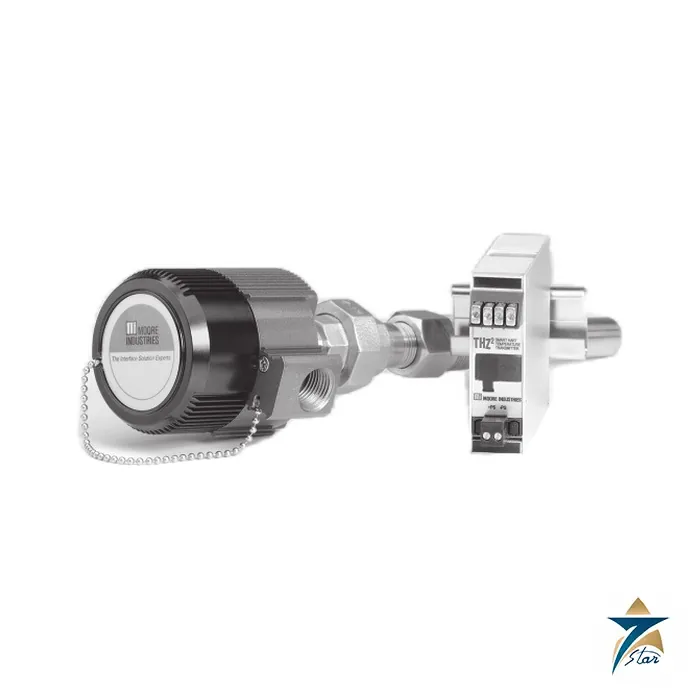
Moore Industries THZ2/HLPRG/4-20MA/12-42DC [DIN] Isolator
Description
Moore Industries THZ2/HLPRG/4-20MA/12-42DC [DIN]: a HART isolator for mA and voltage signals
Moore Industries THZ2/HLPRG/4-20MA/12-42DC [DIN] is not a temperature transmitter at all, even though it sits in the THZ2 family. The HLPRG input code turns the module into a programmable signal isolator and converter: it accepts a current up to 50 mA or a voltage up to 10 V and re-transmits it as an isolated 4-20 mA loop with HART communication.
That makes it useful as a front-end for signals that are not thermocouples or RTDs, such as a 0-10 V position feedback, a 0-20 mA recorder tap or a 4-20 mA loop that must be galvanically separated from a PLC input.
Because the input stage of this module is built for signals up to 50 mA, it also serves as a loop isolator for equipment that cannot tolerate the voltage drop of a standard 250 ohm sense resistor. The 20 ohm current input leaves most of the drive capability of the source available, which is helpful with older recorders and meters whose output stage is already close to its compliance limit.
Capabilities of THZ2/HLPRG/4-20MA/12-42DC [DIN]
- Two input modes selected in software: current to 50 mA with a 20 ohm input, or voltage to 10 V with a 1 Mohm input.
- Input accuracy of 1 mV or 2 microamps, expressed as 0.01% of span, with a 0.01% analog output stage.
- Galvanic isolation of 500 Vrms between input and output in the DIN housing.
- Programmable output limits and burnout directions, and fifteen HART addresses for multidrop use.
- Fast response: 256 ms typical for the output to reach 90% of a step.
The 20-bit input converter keeps resolution fine even when the span is a small fraction of 10 V.
THZ2/HLPRG/4-20MA/12-42DC [DIN] data sheet values
Figures below are the HLPRG model specifications.
| Parameter | Value for THZ2/HLPRG/4-20MA/12-42DC [DIN] |
|---|---|
| Model code | THZ2/HLPRG/4-20MA/12-42DC [DIN] |
| Input type | HLPRG: programmable mA and V input; voltage 0 to 10 V, current 0 to 50 mA |
| Input accuracy | Plus or minus 1 mV (0.01% of maximum span) or plus or minus 2 microamps (0.01% of 20 mA span) |
| Input impedance | Voltage 1 Mohm nominal; current 20 ohms nominal |
| Overrange limits | Voltage 18 V DC maximum; current 100 mA maximum |
| Output | 4-20 mA, scalable, with HART |
| Analog output accuracy | Plus or minus 0.01% of maximum span |
| Housing | DIN: DIN-style housing for G-type and Top Hat rails, 221 g |
| Isolation | 500 Vrms between input and output continuous |
| Step response | 500 ms maximum, 256 ms typical; rise time 100 ms |
| Supply | 12-42 V DC (12-30 V DC for I.S. version) |
| Noise rejection | Common mode 100 dB at 50/60 Hz; normal mode 70 dB at 1 Vp-p (voltage) or 50 mA p-p (current) |
| RFI/EMI | 10 V/m at 80-1000 MHz; 20 V/m with the -RF DIN option |
| Start-up | Less than 0.5 s |
| Burnout | Upscale 20 to 23.6 mA, downscale 3.6 to 4.0 mA |
| Ambient | -40 to +85 C, 0 to 95% RH non-condensing |
How THZ2/HLPRG/4-20MA/12-42DC [DIN] differs from TPRG THZ2 codes
Where THZ2/TPRG variants read sensors that produce millivolts or ohms, this code reads process signals that are already volts or milliamps. The input impedance of 1 Mohm for voltage is far lower than the 40 Mohm quoted for thermocouple inputs of the TPRG units, and the over-voltage limit is 18 V instead of 5 V.
The category is different too: it belongs with isolators and signal converters, not with temperature transmitters, although it shares the housing, the HART tools and the display-free DIN body.
Another point is the supply code. 12-42DC covers the standard version; the intrinsically safe version of the family is limited to 12-30 V DC, so confirm which of the two your hazardous-area documents expect before you place an order.
Where THZ2/HLPRG/4-20MA/12-42DC [DIN] is used
Use it to protect PLC analog cards from ground loops, to convert a 0-10 V valve position feedback to a 4-20 mA loop, or to bring a legacy 0-50 mA meter signal into a modern HART-capable DCS.
In water treatment plants it isolates pump motor current signals; in power stations it conditions vibration and speed transducers whose output is a voltage.
Selecting THZ2/HLPRG/4-20MA/12-42DC [DIN]
Decide the signal first. Current to 50 mA is acceptable for inputs with impedance requirements met by 20 ohms; voltage inputs up to 10 V should be driven from a source that can drive a 1 Mohm load. For hazardous areas use the I.S. power option or install in a safe area.
Note that the minimum span and re-ranging are done by HART, and that the output range is limited to 4-20 mA only.
A short checklist: confirm the source output type (current or voltage), confirm the maximum value including any overrange, decide the required 4-20 mA span, and check that the control system input card can supply loop power or accepts a loop-powered signal. The HART tools then let you set zero and span without any potentiometer adjustments inside the housing.
Installing THZ2/HLPRG/4-20MA/12-42DC [DIN]
Clip onto the rail, connect the input to the correct pair according to current or voltage mode, connect the loop, and set the ranges with HART. For noisy plants consider the -RF version of the DIN, which lifts immunity to 20 V/m.
Verify wiring polarity, then run a loop test and view the live value in the HART tool.
Servicing THZ2/HLPRG/4-20MA/12-42DC [DIN]
Periodically verify the output against a calibrator injecting current or voltage at the input. The stability table in the datasheet gives long-term drift figures that guide the calibration interval.
Replace with a unit configured from the stored file.
Enquiries for THZ2/HLPRG/4-20MA/12-42DC [DIN]
Include the code THZ2/HLPRG/4-20MA/12-42DC [DIN] in every enquiry and state the input signal range required.
Seven Star LLC is an independent supplier serving Oman and the wider GCC and is not affiliated with the manufacturer; all names and part numbers are used only to identify the product being requested.
Documents and quotation
We can provide the datasheet for Moore Industries THZ2/HLPRG/4-20MA/12-42DC [DIN] with our quotation. Please send an RFQ stating part number, quantity and delivery place.
Other Models in the THZ2 TDZ2 Range
Seven Star LLC supplies models from the THZ2 TDZ2 range in Oman and the GCC. Compare the related models below and request a quote for the one that matches your application.
| Model | Category | |
|---|---|---|
| Moore Industries TDZ2/TPRG/4-20MA/12-42DC [BH2NGP] Transmitter | Temperature Transmitters | View details |
| Moore Industries THZ2/TPRG/4-20MA/12-42DC [LH2NSP] Transmitter | Temperature Transmitters | View details |
| Moore Industries THZ2/HLPRG/4-20MA/12-42DC [DIN] Isolator | Isolator & Barrier | You are viewing this model |
Datasheets & Documents
- Datasheet Moore Industries THZ2/HLPRG/4-20MA/12-42DC [DIN] Isolator Datasheet Download
Reviews (0)
How would you rate this product? Cancel reply
About brand
Moore Industries is an American manufacturer of signal interface instruments, founded in 1968 by engineer Leonard W. Moore in North Hills, California. Its first product was the SCT signal converter, built in a friend's workshop. The company has been at its North Hills headquarters since 1974 and still designs and builds its products there, known for rugged aluminium housings.
Seven Star LLC, an independent supplier in Oman, lists Moore Industries temperature transmitters, limit alarm trips, isolators and a PID backup controller, and sources units and replacements by full model number.
Moore Industries company profile
| Founded | 1968, North Hills, California, USA, by Leonard W. Moore |
|---|---|
| Headquarters | North Hills, California, since 1974 |
| Ownership | Privately owned (Moore Industries-International, Inc.) |
| First product | SCT signal converter |
| Product families | Signal isolators and converters (ECT, SCT), temperature transmitters (TRY, THZ), alarm trip units (SPA), miniMOORE multichannel signal conditioners, HART interfaces, SIL-rated safety logic solvers (STA) |
Milestones
- 1968: Leonard W. Moore founds the company and builds the first SCT signal converter.
- 1974: The company moves into its North Hills headquarters.
- 2009: miniMOORE wins a Control Engineering Engineers' Choice Award.
Moore Industries product families on this page
The manufacturer's catalog is arranged by function, and many of the items listed here map onto it directly:
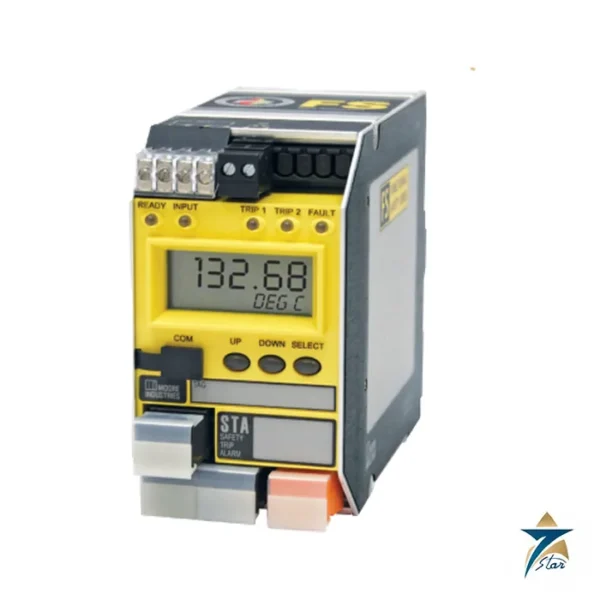
- Temperature transmitters: the TRX, and the STZ functional safety dual input smart HART transmitter
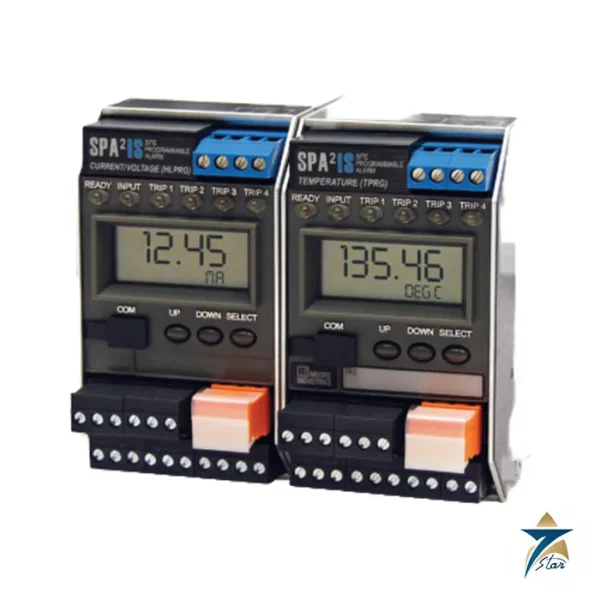
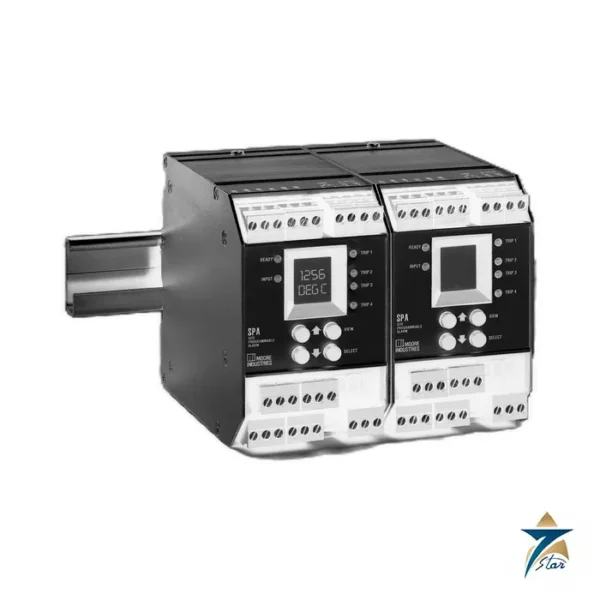
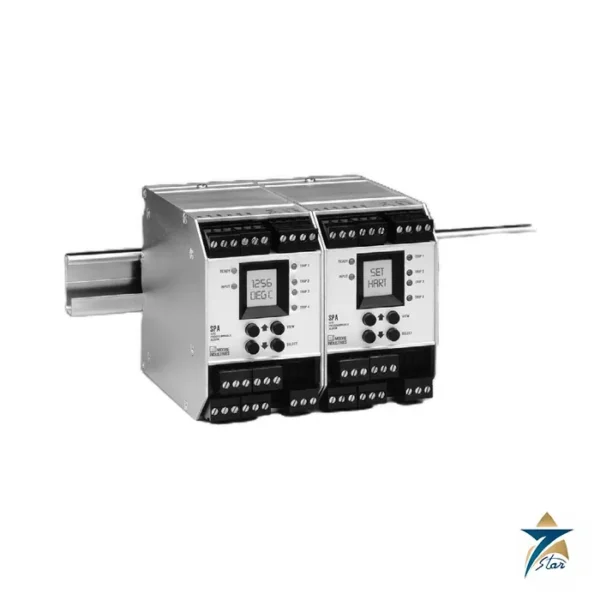
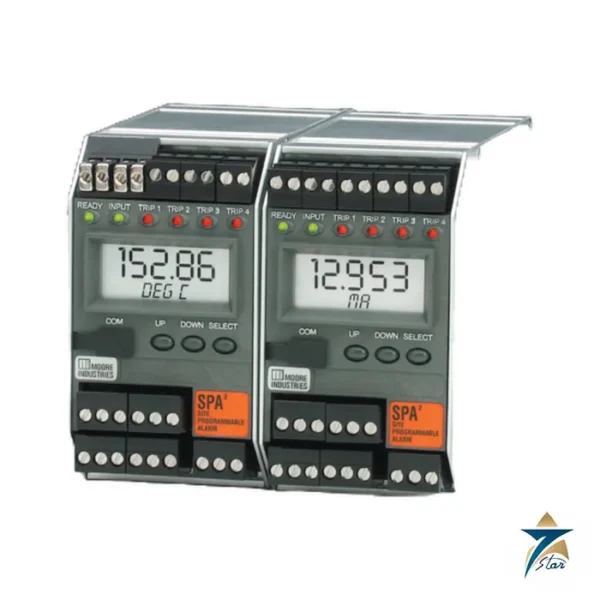
- Alarm trips: the SPA2 programmable limit alarm trip, including an SPA2 with HLPRG input and four relay outputs
- Signal isolators, repeaters and converters: the SIX
- PID controllers and backup stations: the 535 in 1/4 DIN format
Other catalog groups include temperature assemblies and sensors, I/P and P/I converters, remote I/O, HART gateways and interfaces, indicators, and fieldbus device couplers.
Where Moore Industries instruments are used
These are control room and marshalling cabinet devices, plus field-mounted transmitters. Typical jobs are isolating a 4-20 mA loop between two systems, converting a thermocouple or RTD signal for a DCS input, adding an independent high or low trip next to the control system, and keeping a control loop running on a backup station when the main controller is out of service. Process plants in oil and gas, chemicals and power across the GCC use them for exactly these tasks.
Moore Industries products we list
Ordering Moore Industries instruments: what we need
Moore Industries model numbers are built from fields separated by slashes: unit, input, output, power and options, followed by the housing code in brackets. Every field matters. Send the complete string from the label, the serial number, and for programmable units the input type and range you want set. State any hazardous area or functional safety requirement, because approved versions are ordered with their own option codes.
Facts checked against trade press obituaries of Leonard W. Moore (Control Engineering, Control Global), October 2026.
Browse Moore Industries products by category: Temperature Instrumentation, Controllers & Data Acquisition, Isolator & Barrier.
FAQ
Questions about the Moore Industries THZ2/HLPRG/4-20MA/12-42DC [DIN]
Answers from our engineering team on installation, compatibility and integration.
01Is this a temperature transmitter?
No. The HLPRG input code makes it a programmable mA and voltage isolator within the THZ2 family.
02What input ranges does it accept?
Current from 0 to 50 mA and voltage from 0 to 10 V, selected in software.
03What input impedance does it have?
Nominally 20 ohms for current and 1 Mohm for voltage inputs.
04What happens when the input is out of range?
The output limits and burnout values are programmable: upscale 20 to 23.6 mA and downscale 3.6 to 4.0 mA.
05What isolation level applies?
500 Vrms between input and output continuous in the DIN housing.


![Moore Industries THZ2/HLPRG/4-20MA/12-42DC [DIN] Isolator Moore Industries THZ2/HLPRG/4-20MA/12-42DC [DIN] Isolator](https://omansevenstar.com/wp-content/uploads/2026/11/moore-industries-thz2-hlprg-4-20ma-12-42dc-din-smart-hart-ma-voltage-input-din-rail.webp)
Reviews
There are no reviews yet.