Moore Industries SPA/HLPRG/4PRG/U/-AO [DIN] overview
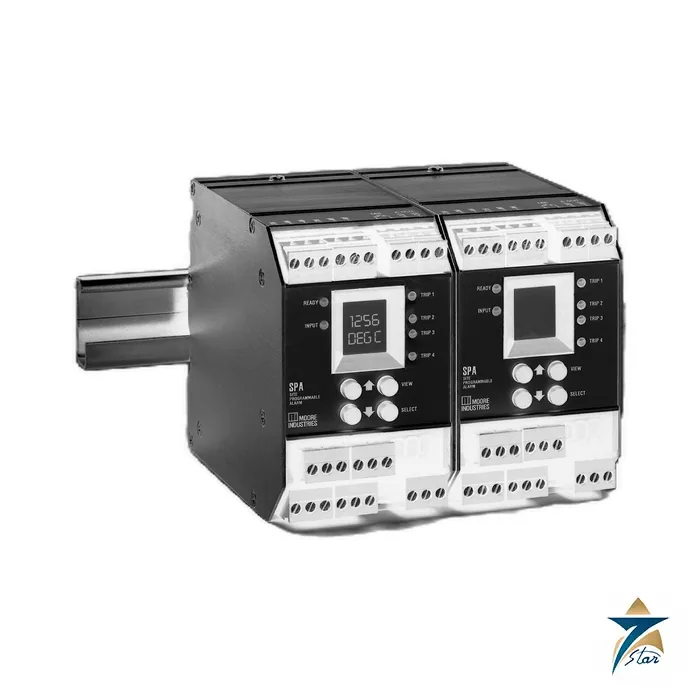
The Moore Industries SPA/HLPRG/4PRG/U/-AO [DIN] is a site-programmable limit alarm trip from the Moore Industries SPA family. This configuration accepts a current or voltage process signal, drives four alarm relays and adds an isolated analog output, all in a metal, RFI-resistant DIN-rail housing.
In this model string HLPRG means the unit is programmed on site for a current input in any range between 0 and 50 mA, or a voltage input in any range between 0 and 10 V. 4PRG gives four relays, U selects the universal power supply, -AO adds the scalable analog output and [DIN] is the rail-mount housing. Because input type, range and trip points are entered from the front panel, the SPA/HLPRG/4PRG/U/-AO [DIN] can serve as a plant-standard alarm for many loops.
The SPA provides on/off control, warns of trouble or can provide emergency shutdown. The datasheet describes it as a simple, independent warning or shutdown layer that connects to a warning light, annunciator, bell or shutdown system. The SPA/HLPRG/4PRG/U/-AO [DIN] is a practical choice where several alarm points are needed from a single 4-20 mA signal.
The part number written as SPA/HLPRG/4PRG/U/-AO [DIN] is the model string given in the manufacturer datasheet as a worked ordering example for the SPA family, so it describes one complete, orderable configuration rather than a loose product family. Every field of the string (unit, input, output, supply or power, option and housing) can be changed when a different configuration is needed, and the datasheet table lists the allowed choices. If your plant standard differs from this example, send the configuration you need with your RFQ and we will check it against the table.
Key features of the Moore Industries SPA/HLPRG/4PRG/U/-AO [DIN]
- Four alarm relays, each individually configured for high or low trip, normally open or normally closed, failsafe or non-failsafe, latching or non-latching operation.
- Site programming from the front panel with a plain-English LCD menu; no potentiometers are needed for zero and span.
- Quick Ranging Calibration, using push buttons and the display to set zero and span in seconds.
- Real-time process readout in selectable engineering units (V, mA, %, degrees C, degrees F, psig, mV, ohms) or custom units.
- Analog output option (-AO) so the same unit acts as alarm trip and transmitter at one location.
- Universal power input accepting 22-300 Vdc or 90-260 Vac.
- Transmitter power supply of 24 Vdc for a connected two-wire transmitter.
- Security password protection and programmable alarm delay of 0 to 60 seconds.
Technical specifications for SPA/HLPRG/4PRG/U/-AO [DIN]
| Parameter |
Value |
| Model string |
SPA/HLPRG/4PRG/U/-AO [DIN] |
| Input |
Current, any range between 0 and 50 mA; voltage, any range between 0 and 10 V |
| Recommended minimum span |
4 mA for current inputs, 1 V for voltage inputs |
| Alarm outputs |
4 relays, SPDT (1 form C), rated 5 A at 250 Vac, 50/60 Hz |
| Power |
U universal: 22-300 Vdc or 90-260 Vac |
| Analog output option |
-AO: scalable 0-20 mA (4 mA span minimum) into 1200 ohms, or 0-5 V (1 V span minimum) into 10 kohms |
| Input accuracy |
Current input plus or minus 5 microamps; voltage input plus or minus 1 mV |
| Repeatability |
Trip point repeats within plus or minus 0.05% of input span |
| Stability |
Plus or minus 0.1% of calibrated span over 6 months, maximum |
| Alarm response time |
600 ms |
| Alarm trip delay |
Programmable 0 to 60 seconds |
| Input impedance |
20 ohms nominal (current input); 1 Mohm (voltage input) |
| Transmitter power |
24 Vdc, plus or minus 10% at 24 mA, regulated |
| Analog output accuracy |
Plus or minus 0.03% of output span |
| Display |
LCD, 2 x 4 character, backlit, alphanumeric |
| Relative humidity |
0-95% non-condensing |
| Housing |
DIN-style metal housing for 32 mm G-type (EN50035) and 35 mm Top Hat (EN50022) rail |
| Certifications |
CSA general location; FM non-incendive Class I, Division 2, Groups A, B, C, D (-HS option required) |
The values above come from the manufacturer datasheet for the SPA family. Specifications can depend on the option and housing chosen, so always read the matching page of the datasheet before you finalise a purchase specification, and keep the full model string on your purchase documents.
Typical applications in Oman and the GCC
Limit alarm trips are used wherever a process variable must start an independent warning or shutdown action without relying on the control system. In the region this typically means:
- Oil and gas facilities, where a high or low trip on a separator, pump or compressor loop can switch a beacon, horn or shutdown relay.
- Power and utility plants that need an extra annunciator contact on boiler, feedwater or auxiliary-system signals.
- Water and wastewater works, for tank level, pump discharge and chemical dosing alarms taken from a 4-20 mA loop.
- Manufacturing and process plants in industrial zones across the GCC, for interlocks and warnings on temperature, flow or pressure signals.
Because the trip points, deadband and delay are set on site rather than at the factory, one unit type can be stocked as a spare for many different loops, which is particularly helpful for remote sites with long delivery times.
Selection and compatibility notes
The first decision is whether a current or voltage input is correct. The SPA/HLPRG/4PRG/U/-AO [DIN] is the HLPRG variant, so it fits 4-20 mA, 0-20 mA, 10-50 mA, 1-5 V and similar signals. For AC voltage or AC current signals the same datasheet describes different input types, and for temperature sensors it describes the TPRG types, so make sure the model string matches the signal source.
The second decision is the relay count and contact rating. The 4PRG output gives four SPDT relays. The datasheet also lists options such as -DPDT for double-pole relays on single-relay or dual-relay variants, and -FMEDA for units supplied with failure modes and diagnostic analysis data for use in safety-related applications. If an assessment of safety integrity is part of your project, state it in your RFQ.
Questions to settle before ordering SPA/HLPRG/4PRG/U/-AO [DIN]:
- What is the signal type and range, and is the span at least the recommended minimum?
- How many independent alarm points and which contact logic (failsafe or non-failsafe, latching or not) are needed?
- Is the analog output needed, and at what range and load?
- What supply voltage is available at the panel?
- Does the hazardous-area classification match the certifications listed in the datasheet?
Installation and commissioning
The housing snaps onto standard rails and is intended for control-room or panel mounting. Allow clearance around the front panel so the push buttons and display can be read, and keep alarm relay wiring physically separate from low-level signal wiring where possible.
Commissioning starts with the input type and range, then zero and span with the Quick Ranging Calibration method, then each trip point with its high or low action, deadband, delay and relay logic. Test every relay with a simulated input before the unit is placed in service, and record the settings in your loop documentation.
Maintenance and service life
The unit has no field-adjustment potentiometers to drift, and its parameters are held in memory and protected by an internal jumper and menu password. Periodic maintenance is therefore mainly a functional test of the alarm path: simulate an out-of-range input, confirm that the relay changes state and that the downstream annunciator or shutdown logic responds.
Keep a record of the configured ranges and trip settings so that a replacement can be programmed identically without delay.
Related products and ordering notes
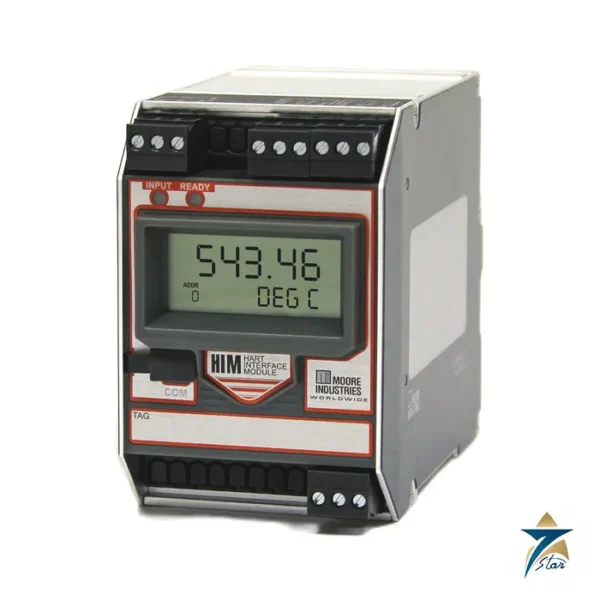
Other Moore Industries alarm and signal-conditioning products on this site include the SPA2 programmable limit alarm trip and the SIX signal isolator, which may suit loops that need a different input or housing. For HART monitoring, see the SPA HART variant.
Always give the complete model string when you order, because the unit, input, output, power, options and housing fields together define the part.
Seven Star LLC is an independent supplier serving Oman and the GCC and is not affiliated with the manufacturer. Product names and model designations belong to their owners and are used here only to identify the equipment you are asking about.
Frequently asked questions in brief
- What does the SPA/HLPRG/4PRG/U/-AO [DIN] do? It monitors a current or voltage signal and operates four relays when the signal passes user-set high or low limits, with an analog output as well.
- How is the SPA/HLPRG/4PRG/U/-AO [DIN] configured? Input type, range, trip points, delay and relay logic are set from the front-panel keys and LCD menu, with no external programmer.
- What power does the SPA/HLPRG/4PRG/U/-AO [DIN] accept? The U option accepts any supply between 22 and 300 Vdc or between 90 and 260 Vac.
- Is the SPA/HLPRG/4PRG/U/-AO [DIN] for hazardous areas? The datasheet lists FM non-incendive Class I, Division 2 with the -HS option; check the datasheet for the details before use.
- How do I get a quotation for the SPA/HLPRG/4PRG/U/-AO [DIN]? Send an RFQ with the part number, quantity and delivery location in Oman or the GCC.
Documents and quotation
The manufacturer datasheet for the SPA family is available for download from this page, and it contains the full ordering table, dimensional drawings and wiring diagrams referred to above. To request a quotation, send an RFQ that includes the part number SPA/HLPRG/4PRG/U/-AO [DIN], the quantity you need, the delivery location in Oman or the GCC and any special requirements such as certification or documentation. We will confirm availability and lead time and reply with a written offer. Please check the datasheet and your own hazardous-area and safety requirements before you place an order.






















Reviews
There are no reviews yet.