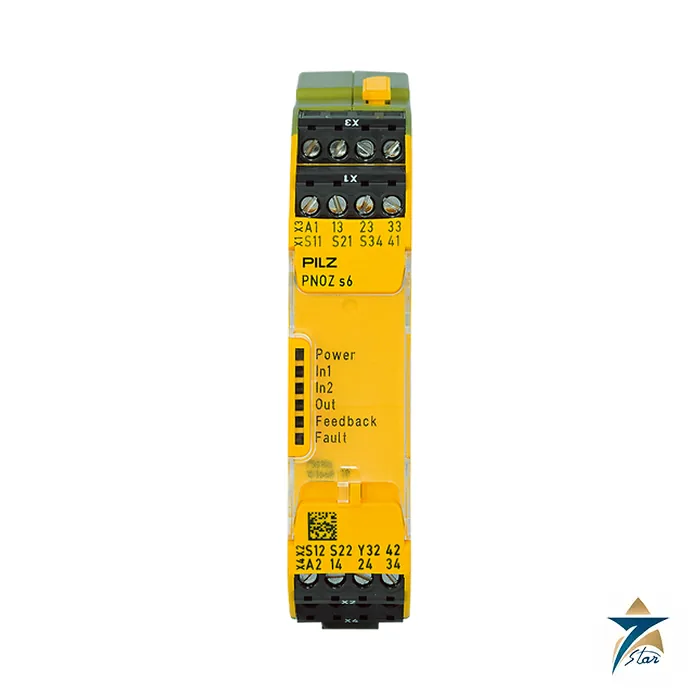
Pilz PNOZ s6 750106 two-hand control relay, 24 V DC, screw terminals
The Pilz PNOZ s6 750106 is a two-hand control relay from the PNOZsigma family. It forces an operator to keep both hands outside the danger zone while a hazardous movement is running, which is why it is typically used on press controls, woodworking machinery and machine tools. The 750106 is the 24 V DC version with plug-in screw terminals. It gives you three instantaneous N/O safety contacts, one N/C auxiliary contact and one semiconductor output, all in a housing only 22.5 mm wide.
The unit meets the requirements of EN ISO 13851 type IIIC and EN 60204-1. Both pushbuttons must be pressed within 0.5 s of each other, and the outputs drop out as soon as either button is released.
PNOZ s6 750106 part number and unit types
The product ID 750106 identifies the 24 V DC unit with screw terminals. The same manual covers three sister units, so the supply voltage and terminal style should always be confirmed before ordering.
| Product type |
Supply voltage |
Connection type |
Product ID |
| PNOZ s6 |
24 V DC |
Screw terminals |
750106 |
| PNOZ s6 C |
24 V DC |
Spring-loaded terminals |
751106 |
| PNOZ s6 |
48 – 240 V AC/DC |
Screw terminals |
750136 |
| PNOZ s6 C |
48 – 240 V AC/DC |
Spring-loaded terminals |
751136 |
Technical specifications of the PNOZ s6 750106
| Parameter |
Specification |
| Manufacturer / part number |
Pilz PNOZ s6, product ID 750106 |
| Function |
Two-hand control relay, EN ISO 13851 type IIIC |
| Supply voltage |
24 V DC, tolerance −15 % / +10 %, residual ripple 20 % |
| Power consumption |
3.5 W (DC) |
| Safety contacts |
3 N/O, instantaneous, positive-guided |
| Auxiliary contact |
1 N/C |
| Semiconductor output |
1 output, 24 V, 20 mA |
| Inputs |
2 (two-hand pushbuttons), 24 V DC, simultaneity max. 0.5 s |
| Contact rating, AC1 |
240 V, 0.003 – 6 A, max. 1,500 VA |
| Contact rating, DC1 |
24 V, 0.003 – 6 A, max. 150 W |
| Contact rating, AC15 / DC13 |
230 V, 5 A / 24 V, 5 A (6 cycles/min) |
| External contact fuse |
10 A quick, 6 A slow, 10 A gG, or circuit breaker 6 A B/C |
| Contact material |
AgCuNi + 0.2 µm Au |
| Response time |
30 ms (N/O), 40 ms (N/C); recovery time 250 ms |
| Max. cable resistance per input circuit |
30 Ω |
| Safety data |
PL e, Category 4, SIL 3, PFH 2.62E-09 1/h, PFD 3.32E-05, TM 20 years |
| Ambient temperature |
−10 to 55 °C operating, −40 to 85 °C storage |
| Humidity |
93 % r.h. at 40 °C, no condensation in operation |
| Protection |
Housing IP40, terminals IP20, mounting area IP54 |
| Terminals |
Plug-in screw terminals, 0.25 – 2.5 mm² (24 – 12 AWG), torque 0.5 Nm |
| Dimensions and weight |
98 × 22.5 × 120 mm (H × W × D), 185 g |
| Listed approvals |
CCC, CE, EAC, KOSHA, TÜV, UKCA, cULus Listed |
How the PNOZ s6 750106 works
The relay is activated by pressing two buttons at practically the same time, within 0.5 s. If one or both buttons are released, the unit interrupts the control command for the hazardous movement. After that, the output relays will not pull in again until both operator elements have been released and then operated together once more. This prevents an operator from tying one button down and running the machine with one hand.
The circuit is redundant with built-in self-monitoring, and the safety function stays effective after a component failure. According to the manual the circuit prevents a further stroke after relay failure, contact welding, a coil defect, an open circuit or a short circuit. The input circuit can be wired dual-channel with detection of shorts across contacts, and a feedback loop through terminal S34 can monitor external contactors. Without feedback monitoring the link between S12 and S34 is used instead.
Connecting and expanding the PNOZ s6 750106
Outputs 13-14, 23-24 and 33-34 are the safety contacts. Output 41-42 is an auxiliary contact intended for signalling, and it should not be used in safety circuits, just like the semiconductor output Y32. A PNOZsigma contact expansion module can be attached through the side connector, which is useful when the machine needs more safety contacts than the three on the base unit. On a stand-alone unit the plug terminator must stay inserted at the side, otherwise the unit shows a fault.
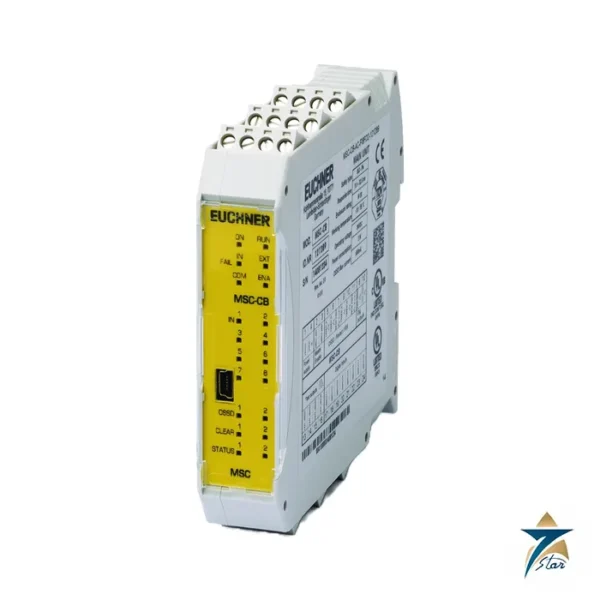
In practice the 750106 sits beside other PNOZsigma modules in the same cabinet row. Related Pilz relays for other safety functions, such as the PNOZ s3, PNOZ s4 and PNOZ s5, cover emergency stop, gate and delayed-stop duties, while the PNOZ s6 is the specialist for two-hand operation.
Selection checklist for the 750106
- Confirm that the machine needs a type IIIC two-hand control and that the risk assessment calls for it.
- Check the supply: 750106 is 24 V DC only. For 48 – 240 V AC/DC choose 750136; for spring terminals choose 751106 or 751136.
- Count the safety contacts you need. Three N/O are built in; more require an expansion module.
- Verify the load category (AC15 or DC13) and size the external contact fuse as listed.
- Use pushbuttons with gold-plated contacts, since the monitoring currents are low (20 mA at N/O, 10 mA at N/C).
- Keep the combined cable resistance of each input circuit below 30 Ω.
Installation and commissioning of the PNOZ s6 750106
Mount the relay in a control cabinet rated at least IP54 on a 35 mm DIN rail. Any mounting position is allowed, but a vertically mounted unit should be held with an end angle or retaining bracket. Use copper wire rated for 75 °C. The 24 V DC supply must meet SELV or PELV rules. Run the pushbutton cables separately from power cables to avoid inductive and capacitive coupling, and apply suitable spark suppression on inductive or capacitive loads.
The unit is ready when the Power LED lights continuously. The IN1 and IN2 LEDs follow the pushbuttons, the OUT LED shows closed safety contacts, and FEEDBACK shows 24 V at S34. A flashing Fault LED combined with other LEDs points to the cause, for example a missing plug terminator, a simultaneity error on channel 1 or 2, or a short between S12 and S22.
Maintenance and proof testing of the PNOZ s6 750106
The relay contacts cannot be tested automatically while the outputs are on, so the manual asks for a periodic test. Open the safety contacts and restart the device so that internal diagnostics can check the contacts open correctly. For SIL 3 / PL e this should happen at least once a month, and for SIL 2 / PL d at least once a year. The safety functions must also be checked after initial commissioning and after every change to the machine. Service-life graphs for the relay outputs are published in the manual and the PFH value is valid when the stated cycle counts are respected. The mission time TM is 20 years.
Typical applications of the PNOZ s6 in Oman and the GCC
Two-hand control is common on presses, shears, bending machines, packaging machines and workshop machine tools. In Oman and the GCC this includes fabrication yards, metalworking shops, industrial-zone factories and maintenance workshops that serve oil and gas, power and water projects. The relay is built for control cabinets with a protection level of at least IP54 and a humidity rating of 93 % r.h. at 40 °C without condensation, so cabinets that are shaded and ventilated or air-conditioned are the right fit in hot, dusty or coastal locations. Ambient temperature inside the cabinet must stay between −10 and 55 °C.
Information to send with your RFQ for the PNOZ s6 750106
- Full part number: PNOZ s6 750106 (or the sister product ID you need).
- Quantity and whether you need an expansion module or spare plug-in terminals.
- Supply voltage available in the cabinet and type of pushbuttons used.
- Delivery location and required lead time.
Documents and quotation
The Pilz operating manual for the PNOZ s6 (750106, 750136, 751106 and 751136) is attached on this page, including the technical details and safety characteristic data quoted above. Always verify the final values against the latest manual before commissioning.
Send us the part number PNOZ s6 750106 with your quantity and delivery location, and we will prepare a quotation. Seven Star LLC supplies Pilz safety relays in Oman and the GCC.


















Reviews
There are no reviews yet.