TM3XREC1: TM3 remote receiver module for the expansion bus
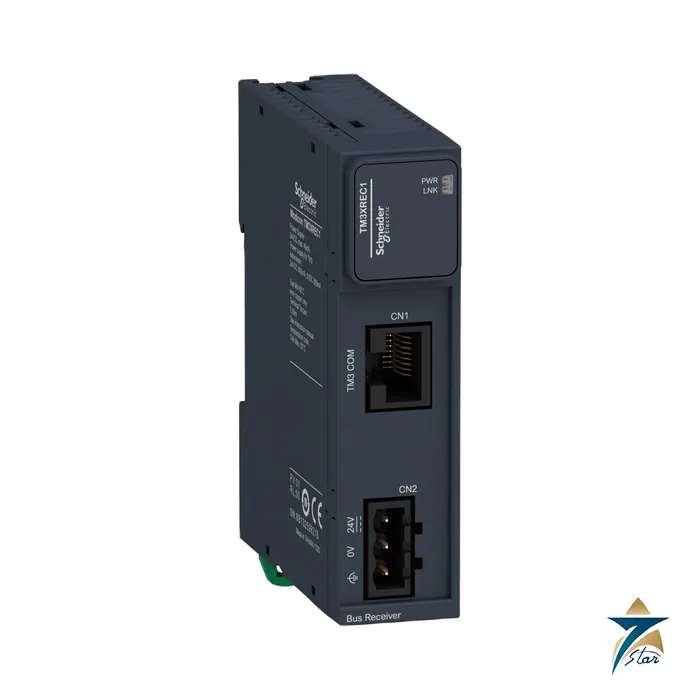
The TM3XREC1 is a Modicon TM3 bus receiver. Paired with a transmitter module on the controller, it extends the TM3 expansion bus over an RJ45 cable to a second rail or cabinet, where up to seven TM3 I/O modules can be fitted and powered from their own 24 V DC supply.
Think of TM3XREC1 as the remote end of the link: the controller rack holds TM3XTRA1, a cable carries the bus, and the receiver sits at the head of the remote stack. It is the way to place I/O close to the process without installing a full controller there. Seven Star LLC supplies the this unit in Oman and the GCC as an independent supplier based in Muscat.
Technical specifications of the TM3XREC1
| Parameter |
Specification |
| Manufacturer / part number |
Schneider Electric / TM3XREC1 |
| Range of product |
Modicon TM3 |
| Product type |
Remote receiver module |
| Maximum expansion modules |
7 |
| Rated supply voltage |
24 V DC external supply (−15 to +20 %) |
| Expansion bus supply |
560 mA at 5 V; 560 mA at 24 V |
| Current consumption |
40 mA at 24 V DC via bus connector |
| Power dissipation |
1 W maximum |
| Connections |
RJ45 connector for the bus transmitter; 3-terminal removable screw block for the 24 V DC supply |
| Link to transmitter |
Extension cable with RJ45 connectors between receiver and transmitter |
| LEDs |
1 green for power; 1 green for link |
| Dimensions (W x H x D) |
23.65 x 90 x 73.3 mm |
| Net weight |
0.075 kg |
| Compatible controllers |
Modicon M221, M241, M251, M262 |
| Mounting |
35 mm DIN rail or panel with fixing kit |
| Operating temperature |
−10 to 55 °C horizontal; −10 to 50 °C vertical |
| Storage temperature |
−40 to 70 °C |
| Humidity |
5–95 % without condensation |
| Protection |
IP20 |
| Certifications listed |
Merchant Navy, GOST, C-Tick, CSA HazLoc, CE, UKCA, RCM, EAC, cULus |
| Standards |
IEC 61131-2; UL 508; CSA C22.2 No 142; CSA C22.2 No 213 Class I Division 2 Groups A–D; UL 1604 Class 1 Division 2 |
| Shock / vibration |
15 gn for 11 ms; 3.5 mm at 5–8.4 Hz and 3 gn at 8.4–150 Hz |
Power capability of the TM3XREC1
The receiver supplies the remote bus with 560 mA at 5 V and 560 mA at 24 V, and itself draws 40 mA at 24 V DC through the bus connector, with a maximum power dissipation of 1 W. The external supply is 24 V DC with a tolerance of −15 % to +20 %, wired to a three-terminal removable screw block.
Add up the 5 V and 24 V currents of every module in the remote stack from their datasheets and compare the result with the 560 mA limits. A mix of relay and analogue modules can approach those limits sooner than expected.
Approvals and environment of the TM3XREC1
Certifications listed are Merchant Navy, GOST, C-Tick, CSA HazLoc, CE, UKCA, RCM, EAC and cULus. Standards include IEC 61131-2, UL 508, CSA C22.2 No 142, CSA C22.2 No 213 Class I Division 2 Groups A to D and UL 1604 Class 1 Division 2. Operating temperature is −10 to 55 °C horizontal and −10 to 50 °C vertical, storage is −40 to 70 °C, and humidity is 5 to 95 % without condensation.
The hazardous-area listings are for installation in a suitable enclosure and under the conditions in the full certificates; read the detail before using the module in a classified area.
The TM3XREC1 with its transmitter counterpart
| Reference |
Role |
Power |
Width |
Net weight |
| TM3XREC1 |
Remote receiver |
24 V DC external; feeds 560 mA at 5 V and 24 V |
23.65 mm |
0.075 kg |
| TM3XTRA1 |
Remote transmitter |
Powered via bus connector; 100 mA at 5 V |
23.6 mm class |
0.065 kg |
Where the TM3XREC1 saves money in Oman and the GCC
Remote I/O stacks reduce field cabling: instead of running dozens of conductors from a distant skid back to the main panel, a single bus cable connects a nearby I/O rack. Typical examples are a second row of pump drives, a chemical dosing area, tank farm instruments in a separate building or a long conveyor line.
With the controller in an air-conditioned room and the remote rack in a hotter area, check the 55 °C limit at the remote location, not only at the main panel.
How the TM3XREC1 works with the transmitter
The transmitter takes the bus signals from the controller, and the receiver reproduces the bus on the remote side. The datasheet lists an RJ45 connection between them with an extension cable, and the receiver has a link LED to show when communication is established. The receiver is supplied by an external 24 V DC source, so the remote rack is powered independently from the controller rack.
The datasheet states that the maximum number of expansion modules behind the receiver is seven. Together with the local modules on the controller, the overall system stays within the 14-module remote architecture of the M221 and M241.
Mounting and wiring of the TM3XREC1
The module is 23.65 mm wide, 90 mm high and 73.3 mm deep and weighs 0.075 kg. It is fixed on a 35 mm DIN rail or on a panel with the kit. The RJ45 patch between transmitter and receiver should be routed away from power cables, and the 24 V DC supply should be protected by its own breaker or fuse.
The datasheet gives the cable-length field in a form that looks inconsistent, so check the permitted extension cable length against the accessory documentation before ordering cable.
Selection checklist and RFQ details for the TM3XREC1
Check before ordering:
- a TM3XTRA1 transmitter is also ordered for the controller side
- an RJ45 extension cable of suitable length is available
- a 24 V DC supply is provided at the remote rack
- the controller supports the remote architecture and the module count is within seven
Send quantity, controller model and delivery site with the RFQ.
Documents and quotation
The Schneider Electric datasheet for the this unit is attached on this page, so you can compare the listed values with your design before ordering.
To request a quotation for the TM3XREC1, send the quantity, delivery destination and any project reference through the RFQ form. Seven Star LLC supplies Schneider Electric automation products in Oman and the GCC as an independent supplier based in Muscat, and we confirm stock status and lead time against your request.


















Reviews
There are no reviews yet.