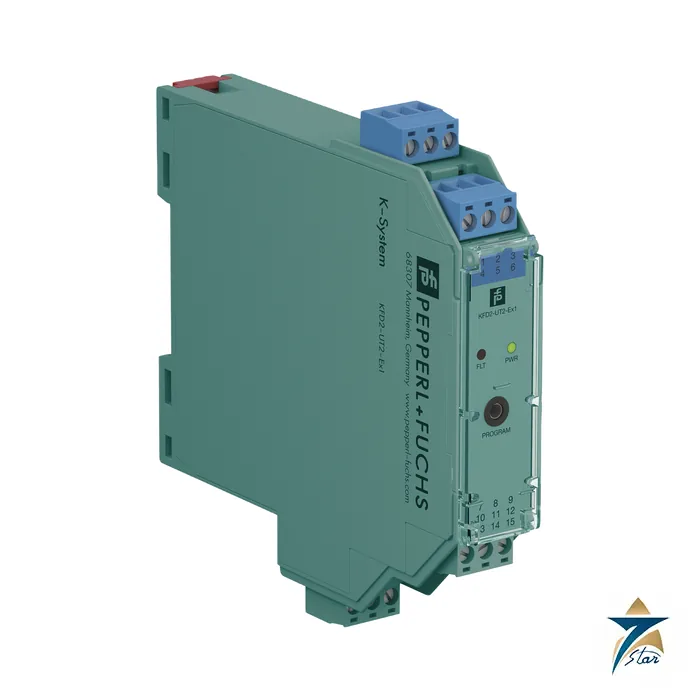
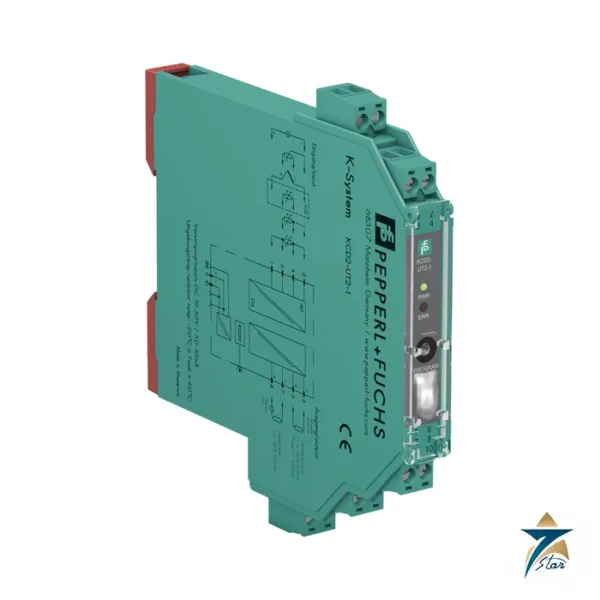
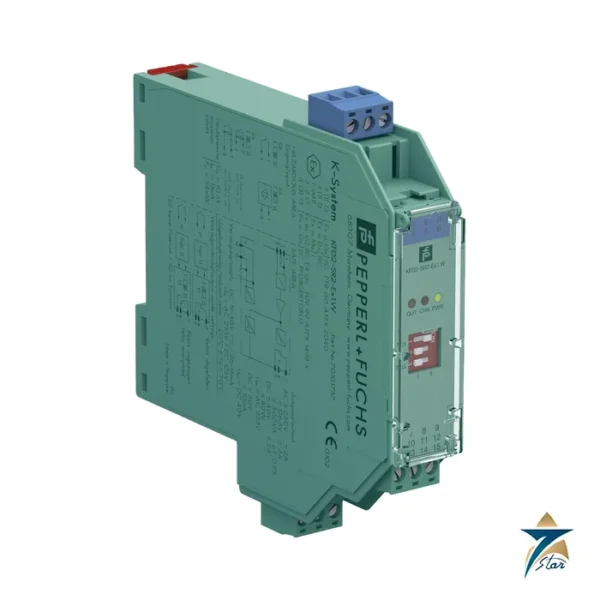
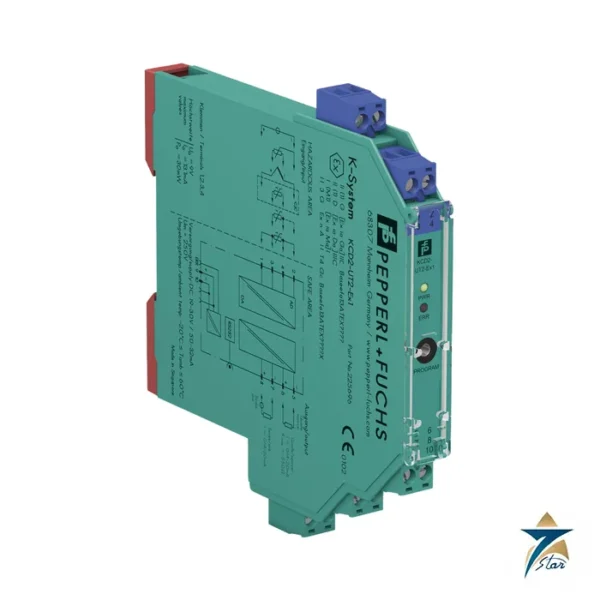
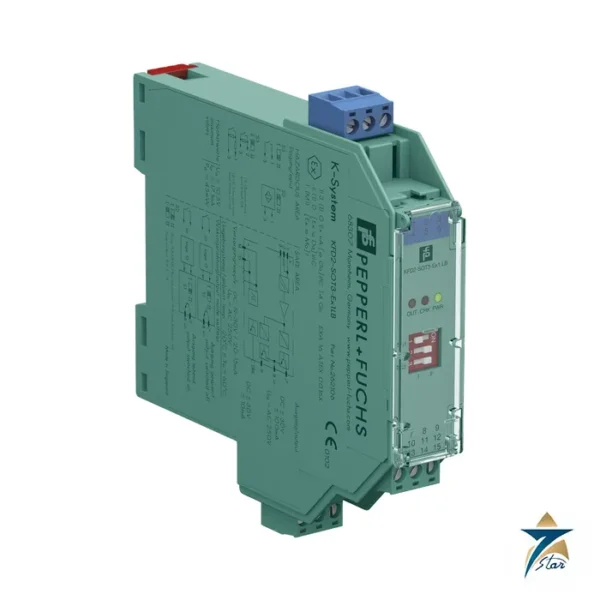
KFD2-UT2-Ex1 universal temperature converter, one channel, 20 mm housing
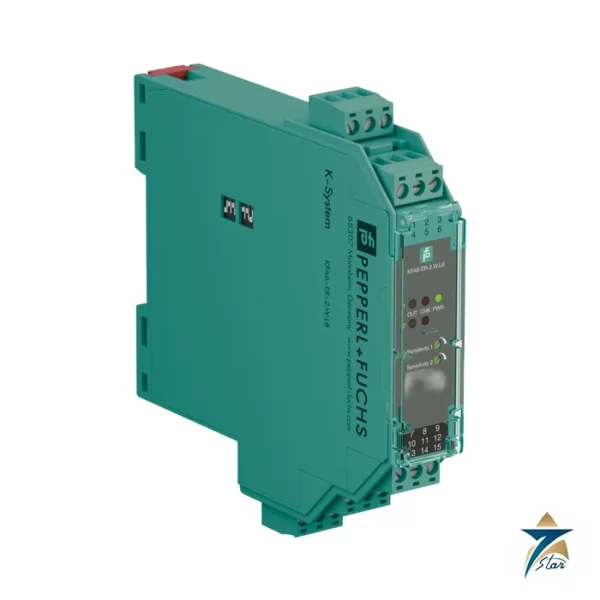
The KFD2-UT2-Ex1 is a single-channel isolated barrier from the Pepperl+Fuchs K-System that reads a resistance thermometer, thermocouple, potentiometer or millivolt source located in a hazardous area and converts it into a 0 or 4 to 20 mA signal for the safe area. It is configured by PACTware software through a front programming socket, so there is no keypad or display to learn.
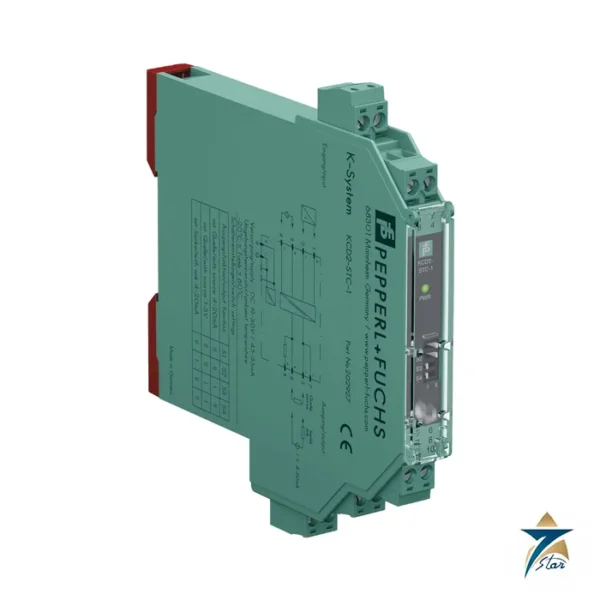
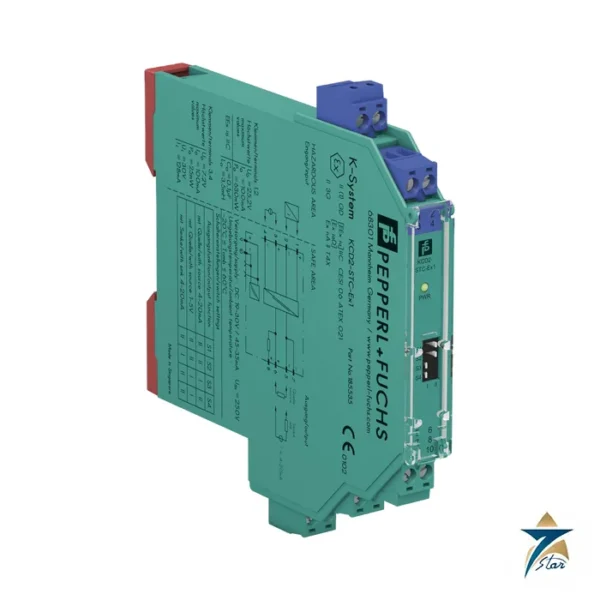
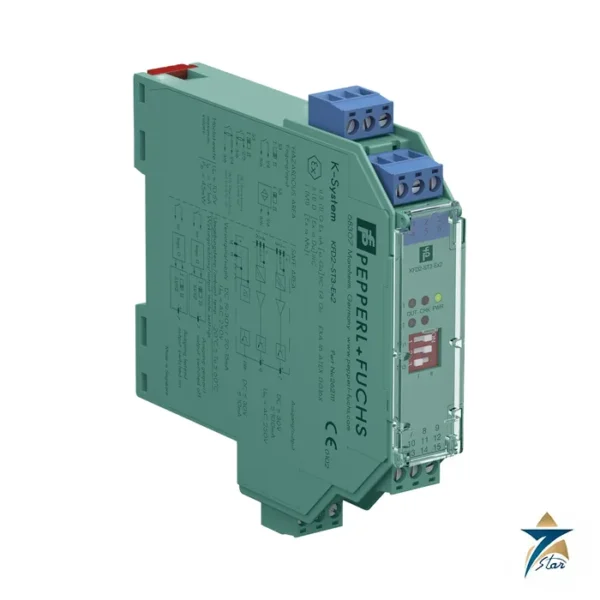
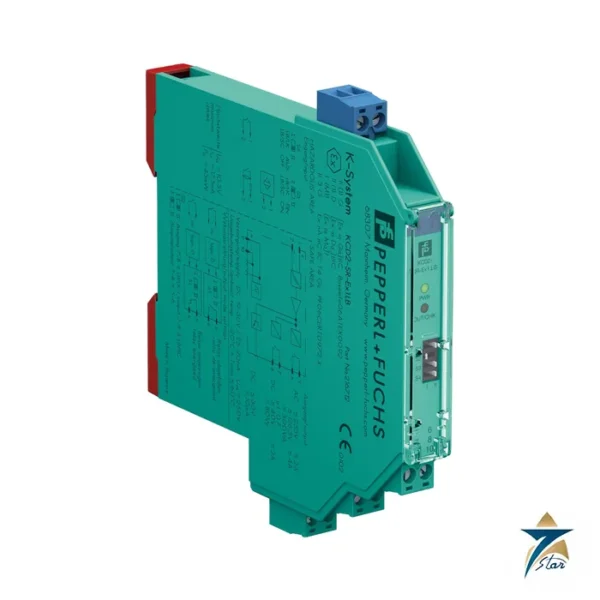
Reading the part number: KFD2 is the 24 V DC isolated barrier range in a 20 mm housing, UT2 is the second generation universal temperature converter, and Ex1 means one channel with an Ex ia field circuit. The two-channel sibling is KFD2-UT2-Ex2, and the 12.5 mm KCD2-UT2-Ex1 covers the same single-channel job in a narrower case.
Seven Star LLC supplies this module in Oman and the GCC as an independent supplier in Muscat.
Technical specifications of the KFD2-UT2-Ex1
| Parameter |
Specification |
| Manufacturer / part number |
Pepperl+Fuchs KFD2-UT2-Ex1 |
| RTD inputs |
Pt10, Pt50, Pt100, Pt500, Pt1000 (EN 60751), the GOST versions of the same Pt types, Cu10, Cu50, Cu100 and Ni100 (DIN 43760); 2-, 3- or 4-wire; lead resistance max. 50 Ω per line; measuring current approx. 200 µA |
| Thermocouples |
B, E, J, K, N, R, S, T (IEC 584-1), L (DIN 43710), TXK, TXKH, TXA; external or internal cold junction compensation |
| Potentiometer / voltage |
0 to 20 kΩ (2-wire) or 0.8 to 20 kΩ (3-wire); voltage selectable within -100 to 100 mV, input resistance ≥ 1 MΩ |
| Output |
0 to 20 mA or 4 to 20 mA; source mode load 0 to 550 Ω with open-circuit voltage ≤ 18 V; sink mode with 5 to 30 V across the terminals |
| Fault signal |
Downscale 0 or 2 mA, upscale 21.5 mA (NAMUR NE 43) |
| Accuracy after calibration |
Pt100 4-wire: ± (0.06 % of value in K + 0.1 % of span + 0.1 K); thermocouple: ± (0.05 % of value in °C + 0.1 % of span + 1 K), 1.2 K for types R and S, including ± 0.8 K cold junction error; mV: ± (50 µV + 0.1 % of span) |
| Reaction time |
mV 1 s; thermocouple 1.1 s; 3- or 4-wire RTD 920 ms; 2-wire RTD 800 ms; potentiometer 2.05 s |
| Supply |
20 to 30 V DC, terminals 14+/15- or Power Rail; power dissipation ≤ 0.98 W |
| Functional safety |
SIL 2 acc. to IEC/EN 61508 / IEC/EN 61511 |
| Hazardous area data |
CESI 04 ATEX 143, [Ex ia Ga] IIC, [Ex ia Da] IIIC, [Ex ia Ma] I; inputs Uo 9 V, Io 22 mA, Po 50 mW; IECEx TUN 07.0003 |
| Ambient temperature |
-20 to 60 °C |
| Housing |
Type B2, 20 x 119 x 115 mm, IP20, approx. 130 g, screw terminals, 35 mm DIN rail |
How the KFD2-UT2-Ex1 measures and reports faults
The module excites the sensor, measures it, linearises the characteristic for the selected type and drives a proportional output current. Line fault detection is built in: for RTDs it covers both sensor breakage and sensor short-circuit, for thermocouples it covers breakage. When a fault is found the output goes to the configured downscale or upscale value and an LED lights, while a collective error message is passed to the Power Rail.
For thermocouples the removable K-CJC-** terminal block is an accessory that gives internal cold junction compensation; without it, a fixed or externally measured reference temperature has to be configured. The programming input is not isolated from the supply, which is why the PACTware cable itself provides the galvanic isolation and avoids ground loops.
System fit and related parts
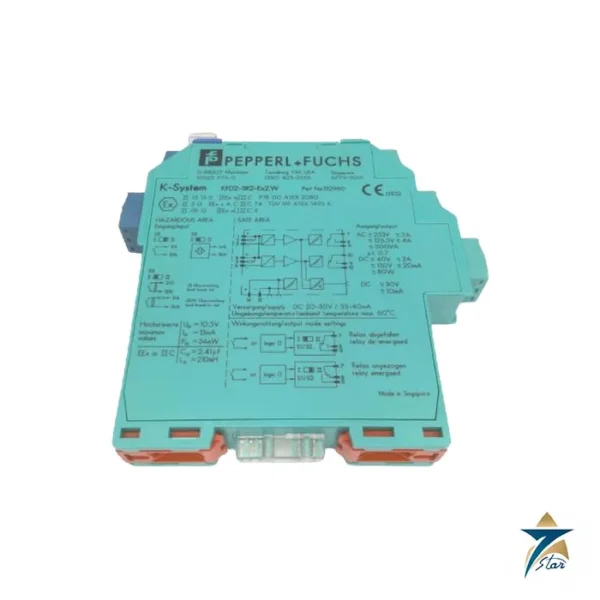
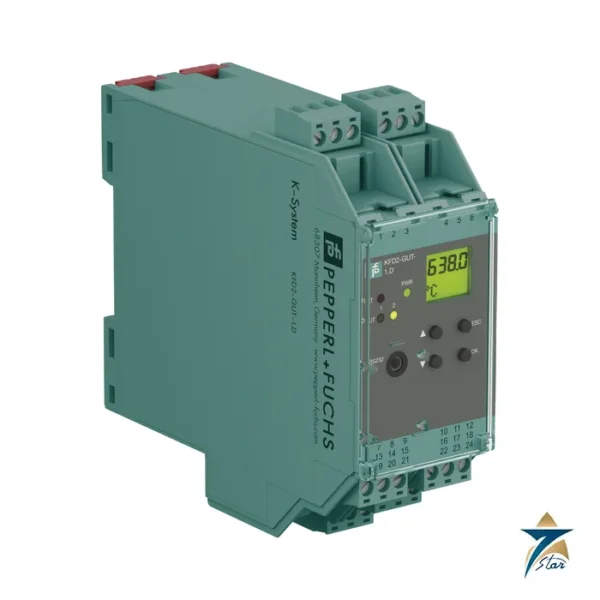
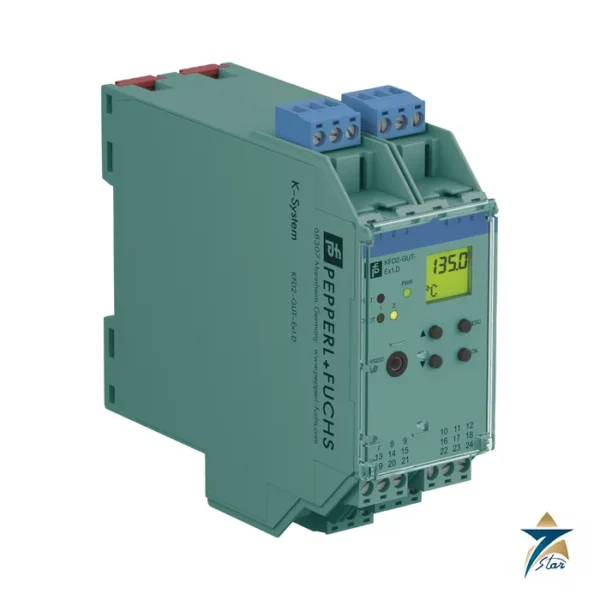
Use the KFD2-UT2-Ex1 for one temperature point per module and a 4 to 20 mA analog input at the control system. If two sensors are to share one 20 mm housing, take the KFD2-UT2-Ex2. If the rack space is tight, the KCD2-UT2-Ex1 saves 7.5 mm per loop. If local trip contacts and a display are needed, the KFD2-GUT-Ex1.D is the better fit, and KFD2-GUT-1.D is the version without hazardous-area input rating.
Selection and ordering checklist
- Sensor type, number of wires and measuring range.
- Output range (0 to 20 or 4 to 20 mA) and source or sink mode.
- Fault level: downscale 0 or 2 mA, or upscale 21.5 mA.
- Cold junction method for thermocouples and whether a K-CJC terminal block is needed.
- Ex ia entity values of the sensor and cable against Uo 9 V, Io 22 mA, Po 50 mW.
- PACTware and a programming cable for commissioning.
Installation, commissioning and maintenance of the KFD2-UT2-Ex1
Snap the module on a DIN rail, wire the sensor to terminals 1 to 4 and the loop to terminals 7 to 9, then program it. A decade box for RTDs or a millivolt calibrator for thermocouples lets you verify the characteristic at zero, mid and full scale. Keep the PACTware parameter file with the loop sheet so a replacement module can be loaded identically.
In service the module needs no routine adjustment. Inspect terminals for corrosion in coastal plants, keep ambient temperature inside the stated range and record the fault LED behaviour during loop checks.
Accuracy and wiring practice with the KFD2-UT2-Ex1
The deviation figures in the datasheet are made of three terms: a share of the measured value, a share of the span and a fixed offset. Because the span term scales with the configured range, setting an unnecessarily narrow range increases the relative error. For long RTD cables use three or four wires, since two-wire connections add the cable resistance to the reading. For thermocouples, route the compensating cable to the cold junction block without intermediate joints.
Ambient temperature influences are given per kelvin of change from 23 °C, and supply voltage influence is below 0.01 % of span, so the main error sources in practice are the sensor, the cable and the reference junction.
Typical applications in Oman and the GCC
The KFD2-UT2-Ex1 is used in refineries, gas plants, power stations and desalination units where skin, bearing, process and stack temperatures in Zone 0, 1 or 2 are brought to a DCS or PLC. Warm marshalling rooms are common in the region, so check cabinet temperature against the 60 °C limit and leave spacing between modules.
Family comparison
| Part |
Key difference |
| KFD2-UT2-Ex1 (this part) |
1 channel, 20 mm, PACTware |
| KFD2-UT2-Ex2 |
2 channels in a 20 mm housing |
| KCD2-UT2-Ex1 |
1 channel, 12.5 mm housing |
| KFD2-GUT-Ex1.D |
1 channel with 2 relays and display |
Information to send with an RFQ
- Part number KFD2-UT2-Ex1 and quantity
- Sensor type and range
- Output mode and fault level
- Zone and gas group
- Supply method (Power Rail or terminals)
- Delivery location
Documents and quotation
The manufacturer datasheet for KFD2-UT2-Ex1 is attached on this page, so you can check wiring, approvals and dimensions before ordering. Send the exact part number, quantity and delivery location in Oman or the GCC and Seven Star LLC will reply with a quotation.
Seven Star LLC is an independent supplier in Muscat and is not the manufacturer; confirm availability, lead time and any project approval requirements in your RFQ.



















Reviews
There are no reviews yet.