MACX MCR-UI-UI-NC configurable 3-way isolating amplifier, 12.5 mm
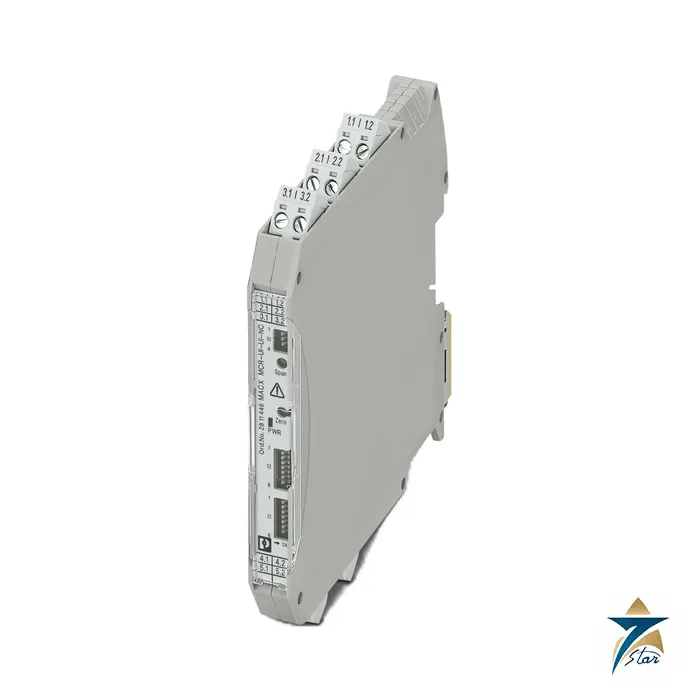
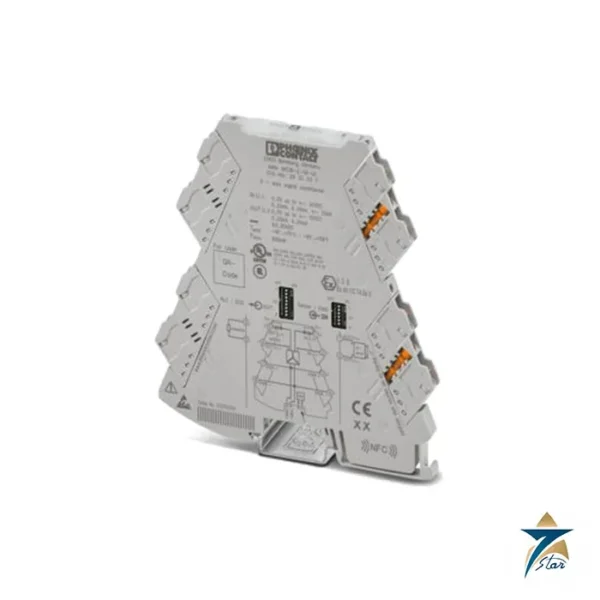
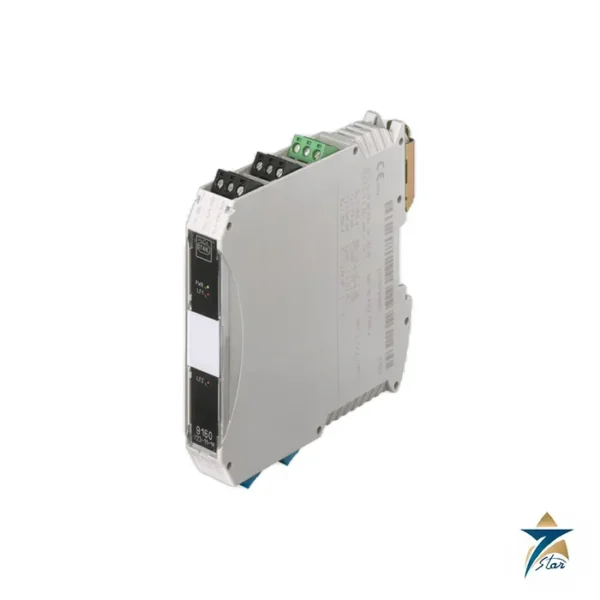
The MACX MCR-UI-UI-NC (item number 2811446) is a configurable 3-way isolating amplifier for standard analogue signals. It takes a voltage or current signal at the input, isolates it electrically from the output and from the supply, and converts it to another standard voltage or current signal, all in a housing only 12.5 mm wide. The manufacturer states that over 1,600 signal conversions can be set with front DIP switches. The NC in the type code marks the standard-configuration version, delivered set to 0 to 10 V input and 0 to 20 mA output. Seven Star LLC supplies the MACX MCR-UI-UI-NC in Oman and the GCC as an independent supplier in Muscat for instrumentation and automation cabinets in Oman and the GCC.
Type code of the MACX MCR-UI-UI-NC and its siblings
| Type |
Item no. |
Description |
| MACX MCR-UI-UI |
2811284 |
Order configuration, screw connection, SIL |
| MACX MCR-UI-UI-SP |
2811572 |
Order configuration, spring-cage (push-in) connection, SIL |
| MACX MCR-UI-UI-NC |
2811446 |
Standard configuration IN 0 … 10 V / OUT 0 … 20 mA, screw connection, SIL |
| MACX MCR-UI-UI-SP-NC |
2811556 |
Standard configuration, spring-cage connection, SIL |
MACX MCR-UI-UI-NC technical specifications
| Parameter |
Specification |
| Manufacturer / part number |
Phoenix Contact MACX MCR-UI-UI-NC, item no. 2811446 |
| Function |
Configurable 3-way isolating amplifier with safe electrical isolation and power bridging |
| Input |
1 voltage/current input; voltage ranges from 0 … 50 mV up to the volt range; input resistance about 1 MΩ current ranges to ±100 mA with about 10 Ω input resistance |
| Output |
Voltage 0 … 10 V, 0 … 5 V, 2 … 10 V, 1 … 5 V, ±10 V, ±5 V and other ranges; current 0 … 5 mA, 0 … 10 mA, 0 … 20 mA, 4 … 20 mA, ±5, ±10 and ±20 mA |
| Output load |
Voltage output ≥ 1 kΩ (10 V); current output ≤ 600 Ω (20 mA, active) |
| Accuracy |
Max. transmission error ≤ 0.1 % of final value; temperature coefficient 0.0075 %/K; zero and span adjustment ±4 % |
| Step response |
35 µs (10 kHz) or 11 ms (30 Hz) cut-off, 10 … 90 % |
| Supply |
12 V DC … 24 V DC (-20 % … +25 %), range 9.6 … 30 V DC; power consumption ≤ 700 mW |
| Isolation |
3-way electrical isolation; test voltage 2.5 kV AC (50 Hz, 60 s); rated insulation voltage 300 Vrms (IEC/EN 61010-1) |
| Functional safety |
Up to SIL 2 per IEC/EN 61508 |
| Hazardous area |
ATEX II 3 G Ex ec IIC T4 Gc (BVS 10 ATEX E 059 X); IECEx Ex ec IIC T4 Gc; UKEX equivalent |
| Ambient temperature |
-20 °C … +70 °C; derating at altitude above 2,000 m |
| Dimensions |
12.5 x 112.5 x 113.7 mm (W x H x D); IP20 |
What the DIP switches configure
The MACX MCR-UI-UI-NC does not need a laptop. DIP switch S1 sets the input range and DIP switch S2 sets the output range and the cut-off frequency, with tables printed in the data sheet and a QR code on the housing that links to the Signal Conditioner app. The delivered standard configuration converts 0 to 10 V into 0 to 20 mA at a cut-off of 10 kHz. Typical re-configurations include 0 to 10 V to 4 to 20 mA for a PLC analogue input, 4 to 20 mA to 0 to 10 V for a drive reference, or a reversed range such as 10 to 0 V for inverted control. The same module serves as galvanic isolator in ground-loop situations, as signal converter between systems, and as a signal doubler or amplifier.
Speed and filtering
The data sheet quotes a step response of 35 µs at the 10 kHz setting and 11 ms at the 30 Hz setting. The wide setting suits fast control signals, while the 30 Hz setting adds filtering that quiets noisy transmitters. With a transmission error of at most 0.1 % and a temperature coefficient of 0.0075 %/K, the conversion adds little uncertainty in typical process loops.
Power bridging and system fit
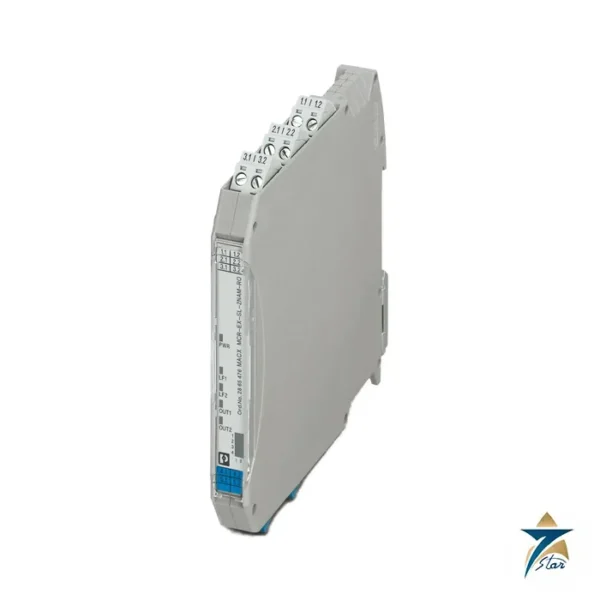
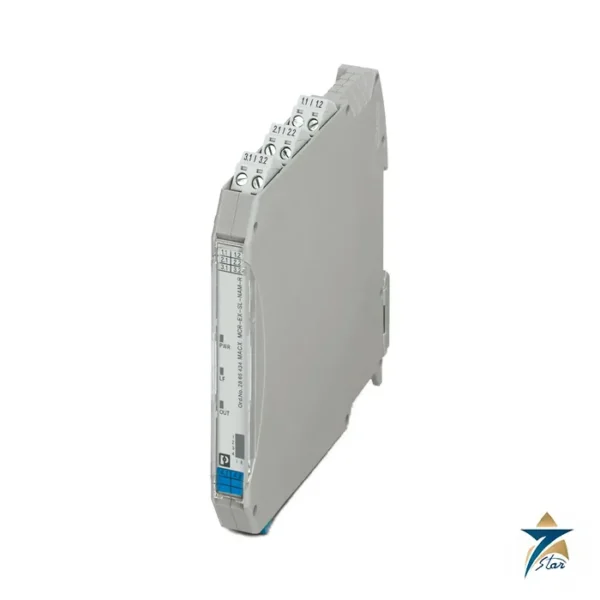
The module is supplied with 12 to 24 V DC and can pass supply voltage through the DIN rail connector, so a row of MACX MCR-UI-UI-NC modules needs only one feed. Accessories named for the family include the MACX MCR-PTB power and fault signaling module (2865625) and its push-in version (2924184). The module can sit in Ex zone 2 as an Ex ec device, but it is not an intrinsically safe barrier: signals from Zone 0 or Zone 1 should use the MACX MCR-EX-SL types rather than this module. For higher-density wiring, the manufacturer also lists the MINI MCR-2-UI-UI line.
Selection checklist
- Input signal type and range (mV, V or mA) and whether it is bipolar.
- Output signal type and range, with the PLC input impedance against the 1 kΩ and 600 Ω load limits.
- Whether the standard NC configuration is acceptable or an order configuration is needed.
- Screw (MACX MCR-UI-UI-NC) or push-in connection (MACX MCR-UI-UI-SP-NC).
- Whether the field side is in Zone 2 or a safe area, and any SIL requirement.
- Ambient temperature, which can reach 70 °C for this module.
Installation, commissioning and maintenance
Snap the MACX MCR-UI-UI-NC on the DIN rail, set both DIP switches before applying power, and verify the output with a signal calibrator at the start, middle and end of the range. The data sheet gives a zero and span alignment range of ±4 % for fine adjustment. Record the switch settings with the loop sheet. In operation the module needs no routine maintenance; if a loop shows drift, check the field transmitter and wiring before replacing the isolator.
Typical applications in Oman and the GCC
Typical uses include isolating analogue signals between DCS and package PLCs, converting 0 to 10 V controller outputs to 4 to 20 mA for valve positioners and variable speed drives, breaking ground loops in long cable runs between buildings, and splitting signals for monitoring systems at power, water and gas facilities. The 12.5 mm width helps in crowded marshalling cabinets.
Information to send with an RFQ
- Full type designation or item number, and quantity
- Input signal type and range, output signal required, and any special scaling
- Hazardous-area classification if the module is installed in zone 2
- Supply voltage available and whether DIN rail power bridging is planned
- Required SIL or other approvals
- Delivery location and documents needed
Documents and quotation
The manufacturer data sheet for the MACX MCR-UI-UI-NC is attached on this page.
Send item number 2811446, quantity and delivery location to Seven Star LLC and request a quotation.























Reviews
There are no reviews yet.