A tank-mounted temperature switch with its own probe and display
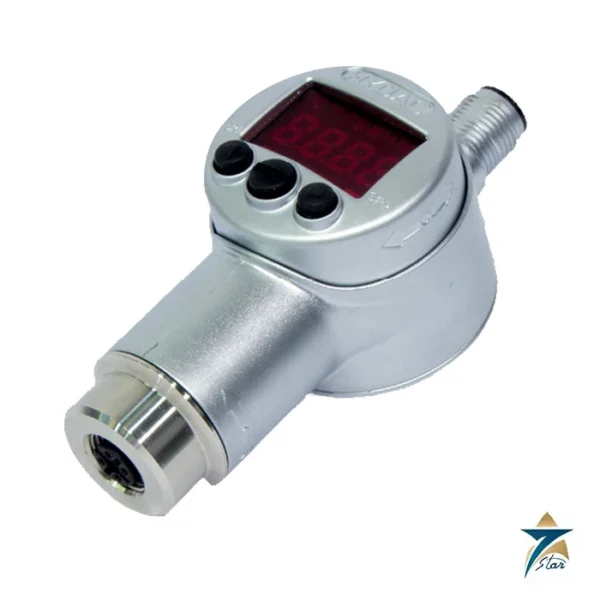
The Hydac ETS 3226-2-100-000 (HYDAC part number 909618) is a compact electronic temperature switch for direct installation in oil tanks and pipes. A temperature probe 100 mm long and 8 mm in diameter is built into the housing, so no separate sensor wiring is needed. A four-digit red LED display shows the temperature in degrees Celsius or Fahrenheit, and the display housing can be turned in two axes to face the operator.
It has two PNP transistor switching outputs of up to 1.2 A each. Typical jobs are oil over-temperature alarm, cooler fan switching and heater control on hydraulic and lubrication systems.
Technical specifications
| Parameter |
Specification |
| HYDAC part number |
909618 |
| Model code |
ETS 3226-2-100-000 |
| Measuring range |
-25 to +100 °C (-13 to +212 °F) |
| Probe |
100 mm long, 8 mm diameter, integrated |
| Mechanical connection |
G1/2 A DIN 3852, male; 45 N·m |
| Pressure resistance |
725 psi (about 50 bar) |
| Wetted parts |
Stainless steel, FKM seal |
| Switching outputs |
2 PNP transistor outputs, 1.2 A max. each; more than 100 million cycles |
| Switch point range |
-23 to +100 °C; increment 0.5 °C |
| Hysteresis range |
1.0 to 123.5 °C |
| Window function |
Lower -23 to +97.5 °C; upper -22 to +98.5 °C |
| Accuracy at room temperature |
Within 1.0 °C (display and analogue output) |
| Rise time (DIN EN 60751) |
t50 = 8 s; t90 = 15 s |
| Display |
4-digit red LED, 7 mm digits, °C or °F |
| Supply voltage |
9 to 35 V DC without analogue output |
| Current consumption |
35 mA max. with inactive outputs; 2.455 A total |
| Electrical connection |
Male M12x1, 4-pole |
| Ambient temperature |
-13 to +176 °F (-13 to +140 °F to UL specification) |
| Fluid temperature |
-13 to +212 °F with FKM seal; -40 °F on request |
| Protection class |
IP 67 |
| Vibration / shock |
10 g / 50 g |
| Weight |
Approx. 150 g (100 mm probe) |
| Approvals as printed |
CE (EN 61000-6-1/2/3/4); cUL, certificate no. E318391 |
Settings and functions
Switch points and hysteresis are entered on the keypad in two menus, with a programming lock. The outputs run as a switching-point or window function, with N/C or N/O direction and switch-on or switch-off delay of 0.00 to 99.99 seconds. The display can show the actual temperature, the peak temperature, either switching point, or be turned off. Because the response time of the probe is 8 seconds to t50, set a short delay rather than relying on the probe to ignore brief spikes.
Order code
ETS 3 2 X X – X – XXX – 000: the 2 after the series selects the G1/2 A DIN 3852 male connection, 6 the four-pole M12x1 plug, the next 2 two switching outputs, and 100 the probe length in mm (250 and 350 mm are also listed). Output code 3 gives one switching and one analogue output and 5 two switching outputs with analogue output on a five-pole plug. The datasheet is the HYDAC USA tank-mounting edition (E 18.319.3), printed in degrees Fahrenheit.
Install the probe so that its full length is immersed in flowing oil rather than in a stagnant dead leg, and check the available depth in the tank against the 100 mm probe length. Where a hot start-up regularly exceeds 100 °C, choose a different range after discussing the application with the supplier.
Applications on hydraulic and lubrication systems
The ETS 3226-2-100-000 is designed to sit directly in the oil tank or pipe of a hydraulic power unit or lubrication system and to act on the oil temperature locally. With two switching outputs, one unit can perform two tasks, for example an over-temperature alarm on one output and control of cooling or heating on the other. Typical machines include presses, injection moulding machines, mobile and stationary hydraulic units, gearbox lubrication systems and test benches.
Keeping oil temperature within a defined band protects the oil from early ageing, keeps viscosity in the range the system was designed for, and helps pumps and valves work as intended.
Selection and integration
Check that the measuring range covers the normal operating temperature and the highest temperature expected during start-up and peak load. Confirm the installation depth available in the tank or pipe against the probe length, and make sure the threaded port matches the mechanical connection in the table. On the electrical side, confirm that the controller or relay inputs accept PNP signals and that the load on each output stays within the stated current. Decide whether each output should use the switching-point or window function and whether it should be normally open or normally closed, so that a broken wire leads to the safer state for the machine.
Installation and setup practice
Install the switch where oil is flowing past the probe and where the reading represents the bulk oil temperature, away from return line jets or heaters that could give a misleading local value. Tighten the connection to the torque given in the table. Route the M12 cable away from motor power wiring, and support it so that vibration does not load the plug. During setup, enter switch points and hysteresis to suit the machine, use the switch-on or switch-off delay to avoid nuisance switching, and enable the programming lock once the settings are confirmed.
After commissioning, compare the reading of the switch with an independent check of the oil temperature and confirm that each output switches at the intended point when the oil warms up. Document the switch points, hysteresis, delay and output functions so that a replacement unit can be set up quickly in the same way. The peak value stored by the switch is a useful indicator of how hot the system has run between inspections, and reviewing it regularly can reveal cooling problems before they lead to an alarm.
Site conditions in Oman and the GCC
Hydraulic units in Gulf plants often operate in hot environments, and oil temperature rises quickly when cooling capacity is limited in summer. Check the ambient temperature at the switch housing against the table, especially on outdoor units in direct sun. The IP 67 rating suits dusty and humid locations, but keep the plug connection clean and dry, and include the switch settings and readings in routine maintenance checks so that a drift in oil temperature is noticed early.
Documents and quotation
The datasheet is attached. Send the code, installation depth and fluid. Related: our temperature instrumentation range.











Reviews
There are no reviews yet.