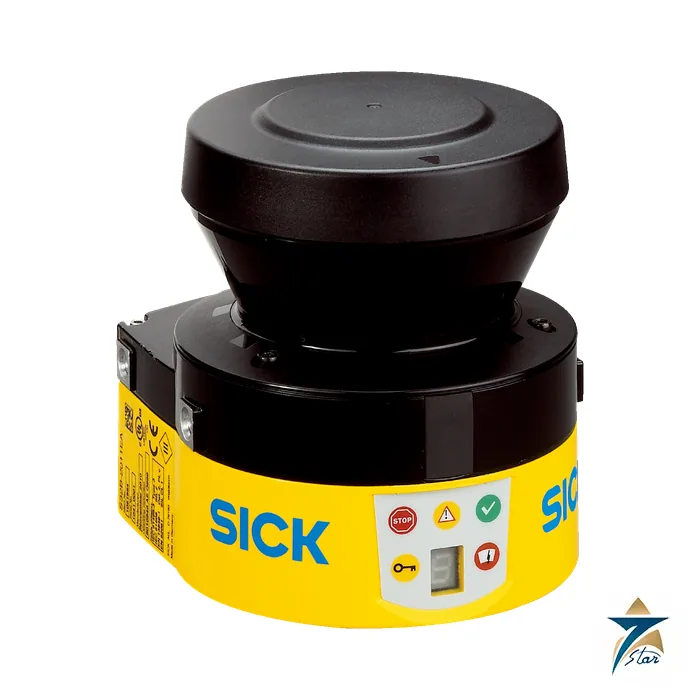
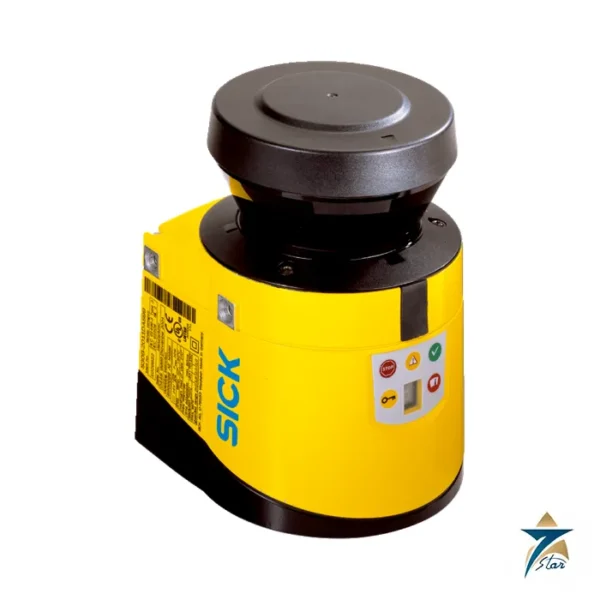
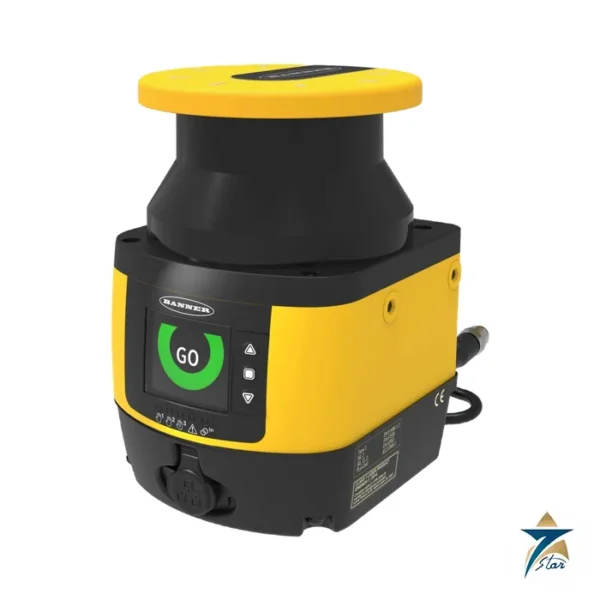
S32B-3011EA is a SICK S300 Mini safety laser scanner (part no. 1056431), version S300 Mini Remote. It guards an area by scanning a pulsed laser through 270°, with a protective field range of 3 m and 48 fields in 16 field sets. Safety data as printed: SIL 2 (IEC 61508), PL d (EN ISO 13849). SICK currently lists this type as “to be phased out”; the catalogue names no successor, so confirm availability and any replacement with us before you plan a repair around it.
What the S32B-3011EA protects and how it is configured
This is the Remote version: according to the data sheet it can only be used in an EFI system network, for example with a Flexi Soft safety controller and a further S300 or S3000 scanner, and it is not a stand-alone unit. Order it only where the network partner is already present or being supplied.
Warning field range 8 m (at 15 % reflectivity), distance measuring range 30 m, response time 80 ms, configurable resolution 30 mm, 40 mm, 50 mm, 70 mm, 150 mm, and 32 monitoring cases can be switched. Configuration is by PC with SICK’s CDS software; the data sheet lists the interface and the transmission rates. Measured data output: none.
Technical specifications
| Parameter |
Specification |
| Type code |
S32B-3011EA |
| Part number |
1056431 |
| EAN |
4047084235801 |
| Product family |
S300 Mini |
| Usage |
Can only be used in the EFI system network, e.g., with a Flexi Soft safety controller and an additional S300 or S3000 safety laser scanner |
| Product version |
S300 Mini Remote |
| Application |
Indoor |
| Protective field range |
3 m |
| Warning field range |
8 m (at 15 % reflectivity) |
| Distance measuring range |
30 m |
| Type of field set |
Triple field sets |
| Scanning angle |
270° |
| Resolution (can be configured) |
30 mm, 40 mm, 50 mm, 70 mm, 150 mm |
| Angular resolution |
0.5° |
| Response time |
80 ms |
| Protective field supplement |
100 mm |
| Delay of automatic reset |
2 s … 60 s, configurable |
| Type |
Type 3 (IEC 61496) |
| Safety integrity level |
SIL 2 (IEC 61508) |
| Category |
Category 3 (EN ISO 13849) |
| Performance level |
PL d (EN ISO 13849) |
| PFHD (mean probability of a dangerous failure per hour) |
8.0 x 10⁻⁸ |
| Multiple sampling |
Yes |
| Monitoring case switching |
Yes |
| Static protective field switching |
Yes |
| Dynamic protective field switching |
Yes |
| Contour as a reference |
Yes |
| Measured data output |
None |
| Safe SICK device communication via EFI |
Yes |
| Connection type |
Cable, 250 mm, with male connector M12, 7-pin |
| Inputs: Static control inputs with EFI |
5 |
| Inputs: Standby |
1 |
| Configuration method |
PC with CDS (Configuration and Diagnostic Software) |
| Configuration and diagnostics interface |
RS-232 |
| Transmission rate |
38.4 kBaud |
| Safe SICK device communication via EFI: Transmission rate |
≤ 500 kBaud |
| Safe SICK device communication via EFI: Length of cable |
≤ 20 m |
| Supply voltage Vs |
24 V DC (16.8 V DC … 30 V DC) |
| Power consumption |
0.22 A ; 0.24 A |
| Dimensions (W x H x D) |
102 mm x 116 mm x 105 mm |
| Weight |
0.8 kg, without connecting cables |
| Housing material |
Aluminum die cast |
| Housing color |
RAL 1021 (yellow), RAL 9005 (black) |
| Optics cover material |
Polycarbonate |
| Declarations and certificates in the data sheet |
EU declaration of conformity; UK declaration of conformity; ACMA declaration of conformity; China RoHS; cULus certificate; EC-Type-Examination approval; Information according to Art. 3 of Data Act (Regulation EU 2023/2854) |
Type code S32B-3011EA and part number 1056431
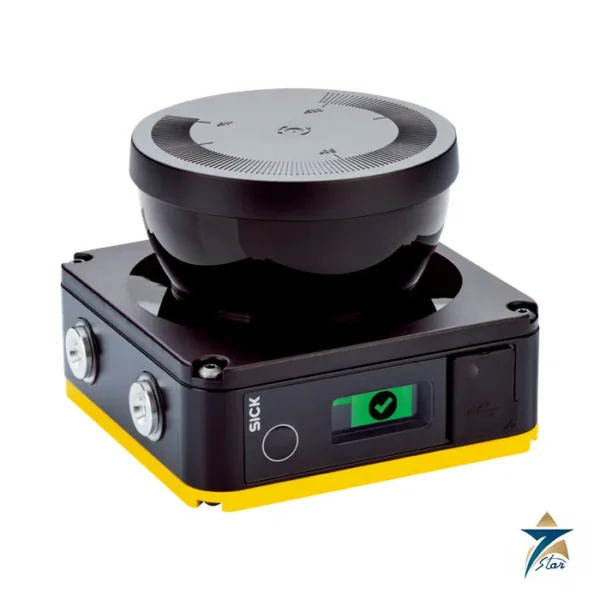
S32B-3011EA sits in the S300 family: the part number 1056431 names this exact version, with its range, field sets and interfaces as printed in the table. Neighbouring scanner versions in SICK’s list are close in appearance, yet they differ in protective field range and in whether they can work alone, so always match the number and check it against your configuration file.
Commissioning notes for the scanner
Supply 24 V DC (16.8 V DC … 30 V DC), enclosure rating IP65 (EN 60529), ambient –10 °C … +50 °C; the unit weighs 0.8 kg, without connecting cables and measures 102 mm x 116 mm x 105 mm; laser class 1 (21 CFR 1040.10 and 1040.11, IEC 60825-1). After installation, define protective fields in the CDS software, verify them with a test object of the specified resolution, and document the result. Check the stopping distance and mounting height for your machine, because the protective field must cover the stopping distance plus the supplement listed in the table.
Documents and quotation
Download the SICK data sheet for S32B-3011EA from this page. It is the manufacturer’s PDF for part no. 1056431, unchanged, and it carries the drawings and the full parameter list. Quote the part number in the RFQ form together with the quantity and delivery location, and our team will respond with pricing. Related items are listed under Safety Switches & Guard Locking. Compare the connection, the output and the ratings with your existing installation first; the PDF governs if it differs from this text.



Reviews
There are no reviews yet.