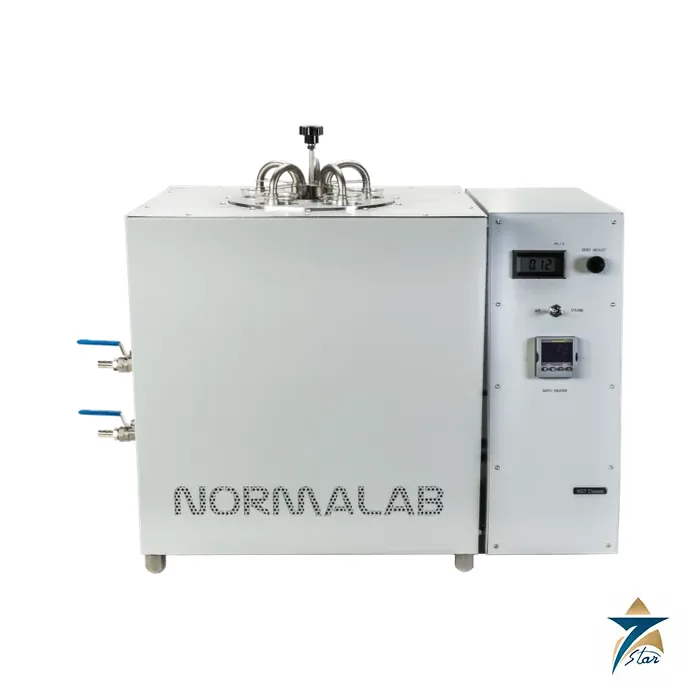
Five-position gum tester with digital control of air, steam and temperature
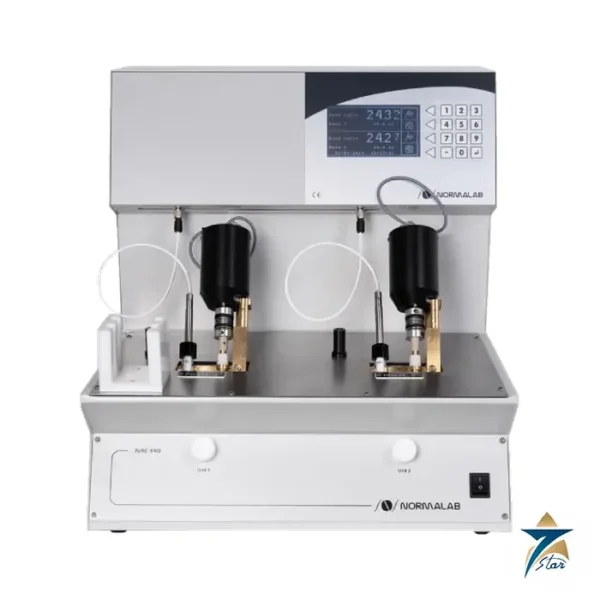
The Normalab NGT Classic is the Normalab gum tester for determining existent gum in fuels by jet evaporation. Five test beakers sit in a heated block, and either air or steam is blown over each sample through an injector. Normalab fits triple digital controllers for the air temperature and for both air and steam flows, a switch for air or steam, an integrated superheater for the steam method and an overheating cut-off.
Technical specifications
| Parameter |
Specification |
| Manufacturer / model |
Normalab NGT Classic |
| Order number |
941320 |
| Positions |
5 |
| Temperature range |
Ambient to 260 °C, electronic digital control |
| Air temperature |
155 ± 0.5 °C |
| Steam temperature |
232 ± 2 °C |
| Air and steam flow |
1000 mL/s ± 15% |
| Flow measurement |
Digital flowmeter |
| Safety |
Power cut in case of overheating |
| Power |
AC 230 V, 50/60 Hz, 16 A |
| Required air pressure |
2.15 bar maximum |
| Dimensions |
580 x 350 x 440 mm; 580 x 350 x 630 mm with grip |
| Weight |
40 kg |
Standards and test purpose
The brochure lists ASTM D381, IP 131, IP 540, ISO 6246 and DIN 51784. The method covers the existent gum content of aviation fuels and of motor gasolines and other volatile distillates in their finished form at the time of test. Existent gum is the residue left after controlled evaporation of the fuel, and a high value points to fuel that has oxidised or been contaminated and may foul inlet systems, so it is a routine check at fuel terminals and refineries.
The small footprint, easy installation of the five injectors and the calibration kits for air and for steam (vapour) make the unit practical for a busy laboratory. After evaporation, the beakers are weighed on an analytical balance, so a balance of suitable resolution belongs in the plan.
Scope of delivery and options
Delivered with an ASTM 3C thermometer (P/N 11491, certificate on request), five beakers (19035), five conical outlets (941306), handling forceps (10686) and a pair of gloves (9417444). Accessories are ordered separately according to application: a two-stage air compressor (REF 9413080, 300 L, 400 V three-phase), a steam generator (REF 941309, 400 V three-phase, 0.55 kW) and an analytical balance (REF 24248, 120 g, 0.1 mg). The product page also lists filter funnels, a Class A beaker, a dryer and a porcelain plate for the desiccator.
Running the test properly depends on preparation: the beakers are conditioned, cooled in a desiccator and weighed before use, a measured portion of fuel is evaporated under the controlled jet, and the beakers are cooled and weighed again to find the residue. Because the steam method needs a steam generator and the air method a clean, dry compressed air source, many laboratories specify the utilities together with the tester. The calibration kits for air and vapour flow let the laboratory verify the jet conditions before reporting gum values that decide whether a fuel batch is released.
Choosing a gum tester for the laboratory
The first question is which fuels the laboratory tests and therefore which method it must run. The test method assigns air or steam evaporation according to the type of fuel, so check the current edition of the standard for each product the laboratory handles. A laboratory that needs both modes requires a tester able to run both, together with the utilities to support them, and it should plan bench space for the compressor, steam generator and balance from the start rather than adding them later. The NGT Classic covers both through its air or steam switch and integrated superheater, and its five positions allow several samples, or a sample and duplicates, to be evaluated in one run. Throughput, available bench space, and the electrical supplies for the tester and its utilities should be checked before the purchase order is placed, along with the standards named in the laboratory’s accreditation scope.
Installation and commissioning practice
Place the tester in a well-ventilated area suited to work with fuel vapours, following the laboratory’s own safety rules, on a stable bench that can carry its weight, and with a dedicated electrical supply matching the stated rating. Connect the compressed air supply so that the air reaching the instrument is clean, dry and within the stated pressure limit. For steam work, position the steam generator close enough to keep the steam line short. Once installed, verify block and jet temperatures and the air and steam flows with the calibration kits and the supplied thermometer, and record the results as the baseline for the laboratory’s quality system.
Routine operation and care
Reliable gum results depend as much on technique as on the instrument. Handle beakers only with forceps and gloves, keep them clean and conditioned, and follow the standard’s sequence of cooling and weighing exactly. Check temperature and flow before each series of tests, and repeat the verification with the calibration kits at the interval set by the laboratory’s procedures. Keep the injectors and outlets clean so the jet reaches each beaker as intended, and log maintenance and verification alongside test records so any result can be traced back to the instrument condition on that day.
Laboratory conditions in the Gulf
Fuel terminal and refinery laboratories in Oman are typically air-conditioned, but humidity and fine dust can still affect gravimetric work. Weighing small residues is sensitive to moisture pick-up and to dust settling on beakers, so keep the desiccator in good order, minimise the time beakers spend exposed, and site the balance away from air-conditioning draughts. Compressed air in humid coastal locations needs particular attention to drying, since moisture in the jet can disturb the evaporation.
What to include in an RFQ
Specify the order number, the quantity, which method or methods will be used, and which of the separately ordered accessories should be included in the offer, such as the compressor, steam generator and analytical balance. Note the available electrical supplies on site and any documentation the laboratory needs for its quality records.
Documents and quotation
The Normalab brochure is linked here. Seven Star LLC, an independent supplier in Muscat, quotes the tester within its liquid analytical systems range. Confirm whether the air or steam method is needed, the compressor and steam generator power supplies (three-phase), and the balance before ordering.








Reviews
There are no reviews yet.