Thermostatic bath for copper strip corrosion testing
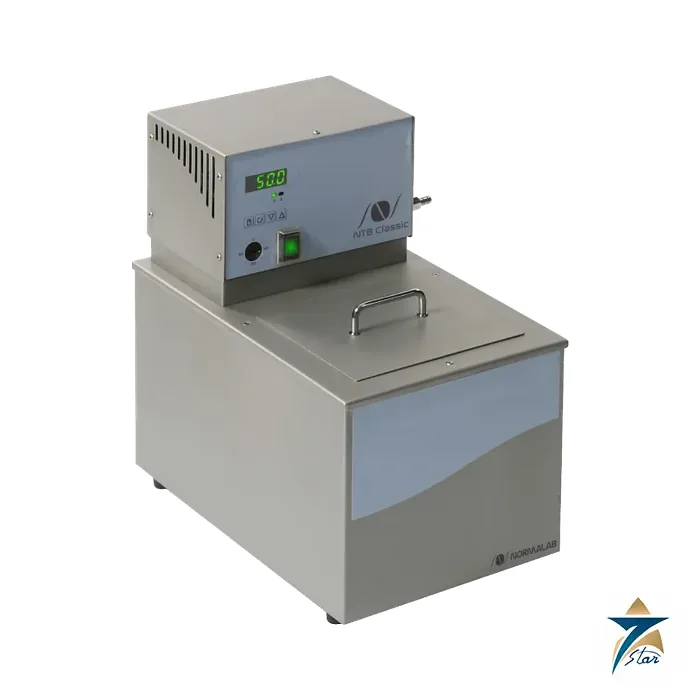
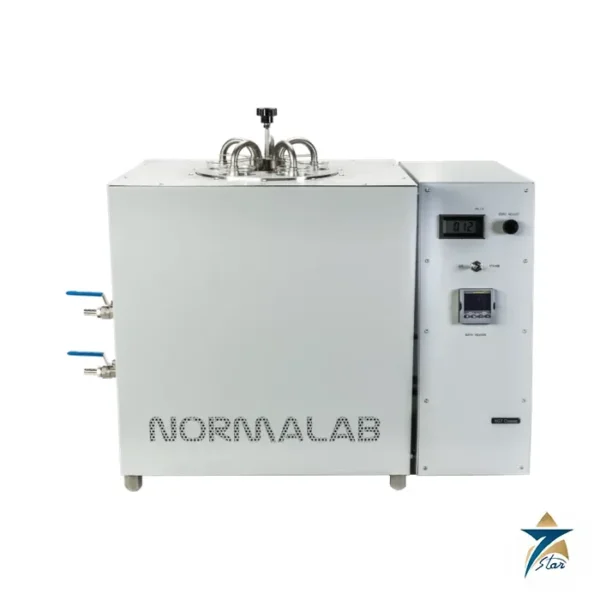
The Normalab NTB Classic is a stainless steel thermostatic bath designed for the copper strip corrosion test on petroleum products. It holds 16 litres of bath fluid, positions six test cylinders (nine as an option), and keeps temperature within plus or minus 0.02 °C over a wide range from ambient to 250 °C. An integrated cooling coil allows operation at ambient temperature with tap water or an external chiller, and a bath drain is fitted as standard.
Technical specifications
| Parameter |
Specification |
| Manufacturer / model |
Normalab NTB Classic |
| Order number |
23007 |
| Bath material and volume |
Stainless steel, 16 L |
| Temperature range |
Ambient to +250 °C |
| Temperature stability |
± 0.02 °C (product page also lists 0.2 °C) |
| Capacity |
6 test cylinders; 9 positions as an option |
| Cooling |
Integrated cooling coil; tap water or external chiller |
| Power |
AC 230 V, 50/60 Hz, 7 A |
| Dimensions (W x D x H) |
455 x 295 x 440 mm |
| Weight |
40 kg |
| Wash solvent |
Isooctane, supplied locally |
Standards and sample range
The brochure cites ASTM D130, D4048, D7095, EN/ISO 2160, IP 154 and IP 112; the product page also lists ASTM D7671. The method determines the corrosiveness to copper of aviation gasoline, aviation turbine fuel, automotive gasoline, cleaners (Stoddard) solvent, kerosine, diesel fuel, distillate fuel oil, lubricating oil, natural gasoline and other hydrocarbons whose vapour pressure is no greater than 124 kPa at 37.8 °C. A polished copper strip is immersed in the sample at a set temperature and time, and its tarnish is compared with the ASTM copper strip corrosion colour standard.
The right silicone oil depends on the test temperature: 10 cSt oil for ambient to 100 °C and 47V20 oil for 100 to 150 °C.
Accessories and consumables
The bath is delivered with six lids and mounting hooks (P/N 23005). Necessary accessories: pack of 10 copper strips (REF 15115), ASTM copper strip corrosion colour standard (15114), ASTM 12C thermometer (11499, without certificate), flat glass test tube (19008) and test tubes 25 x 150 mm (12780; six maximum). Sample preparation items include a single-strip polishing vise (24541), silicon carbide paper and powder (12068, 225051000), absorbent cotton (29321), forceps (14663), nitrile gloves (20973) and a chronometer (21375). For aviation gasoline and higher vapour pressure samples a copper corrosion test cylinder (941492) is required, and for the test tube procedure a holder (23008) is needed.
Copper strip corrosion is a quick pass or fail screen for sulphur compounds in a fuel, so it is run frequently on gasoline, jet fuel and diesel at terminals and refineries. The result is a classification from 1 to 4 (with sub-classes) obtained by comparing the strip with the colour standard under good light. A bath of this kind should be filled with the correct oil, brought to temperature and checked with a calibrated thermometer before samples go in; for tests near ambient the integrated coil takes over the cooling, which avoids the need for a separate chiller in many cases.
Matching the bath to the laboratory workload
Before selecting the NTB Classic, review which products the laboratory tests and how often. A terminal handling mainly diesel and jet fuel has different needs from a refinery laboratory that also runs lubricating oils or aviation gasoline. The number of samples per shift decides whether the standard six positions are enough or whether the optional nine-position configuration should be requested. The test temperatures in use determine which silicone oil grade the bath must be filled with, and samples with higher vapour pressure require the test cylinder rather than the open test tube procedure.
- List the products and the standard methods the laboratory follows.
- Note the test temperatures used so the correct bath oil can be chosen.
- Estimate daily sample numbers to decide on six or nine positions.
- Identify which samples need the copper corrosion test cylinder and which use test tubes.
Setting up and commissioning the bath
Place the bath on a stable, level bench that can carry its weight when filled, with access to a suitable power supply and, if ambient-temperature tests are planned, to tap water or an external chiller for the cooling coil. Fill with the silicone oil grade suited to the test temperature, switch on and allow the bath to stabilise fully before use. Verify the temperature with a calibrated thermometer at the test position rather than relying only on the controller reading, and record the check in the laboratory log. Run a trial with a prepared copper strip so the operators can confirm the whole procedure, from polishing to comparison with the colour standard, before routine samples are tested.
Day-to-day operation
Good copper strip results depend as much on strip preparation as on the bath. Polish strips consistently, handle them only with forceps and gloves, and compare the finished strip with the colour standard under the same lighting each time. Keep the test time and temperature exactly as the method requires and document any deviation.
Laboratory conditions in the Gulf
Laboratories at terminals, refineries and depots in Oman and the GCC often work in hot climates where the room temperature can rise above comfortable levels. This matters most for tests run near ambient temperature, where the integrated cooling coil and a water or chiller supply keep the bath at its set point. Dust can contaminate copper strips and bath oil, so keep the bath lids in place when not loading samples and store strips and polishing materials in closed containers. Check the bath oil level and condition regularly, replace oil that has darkened or become contaminated, and use the bath drain when changing it.
For your enquiry
- Number of positions required, six or the nine-position option.
- Silicone oil grades needed for your test temperatures.
- The accessories and consumables from the list above that you want included.
Documents and quotation
The brochure is linked on this page. Seven Star LLC, an independent supplier in Muscat, quotes the bath under liquid analytical systems. Confirm the sample types, the number of positions, the silicone oil and the consumables before ordering.








Reviews
There are no reviews yet.